Web3 isn’t just a buzzword anymore. Web3 trends are quietly reshaping how we own things online, how we get paid, how we play games, and even how communities make decisions. Instead of everything running through a few big tech platforms, Web3 is pushing us toward a more open, user-owned internet built on blockchains, smart contracts, and decentralized apps.
The shift is often described as the move from the “Rent Economy” of Web2—where you rent your music, your storage, and even your audience on social media—to the “Ownership Economy” of Web3. In this new landscape, digital assets are property, employment is fluid, and identity is self-sovereign. This article dives deep into the specific ways decentralized technologies are rewriting the rules of how we earn a living, manage our assets, and enjoy our leisure time.
In this guide, we’ll break down the most important Web3 trends and show how they’re changing everyday life across living, working, and playing.
What Is Web3? A Quick Refresher
Before we dive into specific trends, let’s set the stage. Web3 is the next evolution of the internet, built on:
- Blockchain technology is a shared ledger that anyone can verify
- Smart contracts code that runs automatically on-chain
- Decentralized applications (dApps) that run on blockchains instead of centralized servers
- Tokens and NFTs are digital assets you can truly own
Compared to classic Web2 platforms, Web3 focuses on decentralization, user ownership, and transparency.
Here’s a simple comparison:
| Aspect | Web2 | Web3 |
|---|---|---|
| Control | Centralized platforms | Decentralized networks and protocols |
| Data ownership | Company servers | User-controlled wallets and decentralized storage |
| Identity | Email/password logins | Wallets and self-sovereign identity |
| Monetization | Ads, subscriptions | Tokens, NFTs, on-chain rewards |
| Governance | Company board or executives | Token holders, DAOs, on-chain voting |
With that in mind, let’s walk through the key Web3 trends changing how we live, work, and play.
Web3 Trends That Are Changing How We Lead Our Lives
As we analyze the most impactful Web3 trends shaping our world today, it becomes clear that this technology is no longer just about volatile cryptocurrency prices or speculative trading. Instead, it has transitioned into a phase of genuine utility, fundamentally altering the “invisible plumbing” of our daily lives.
LIVE: Financial Autonomy & Digital Identity
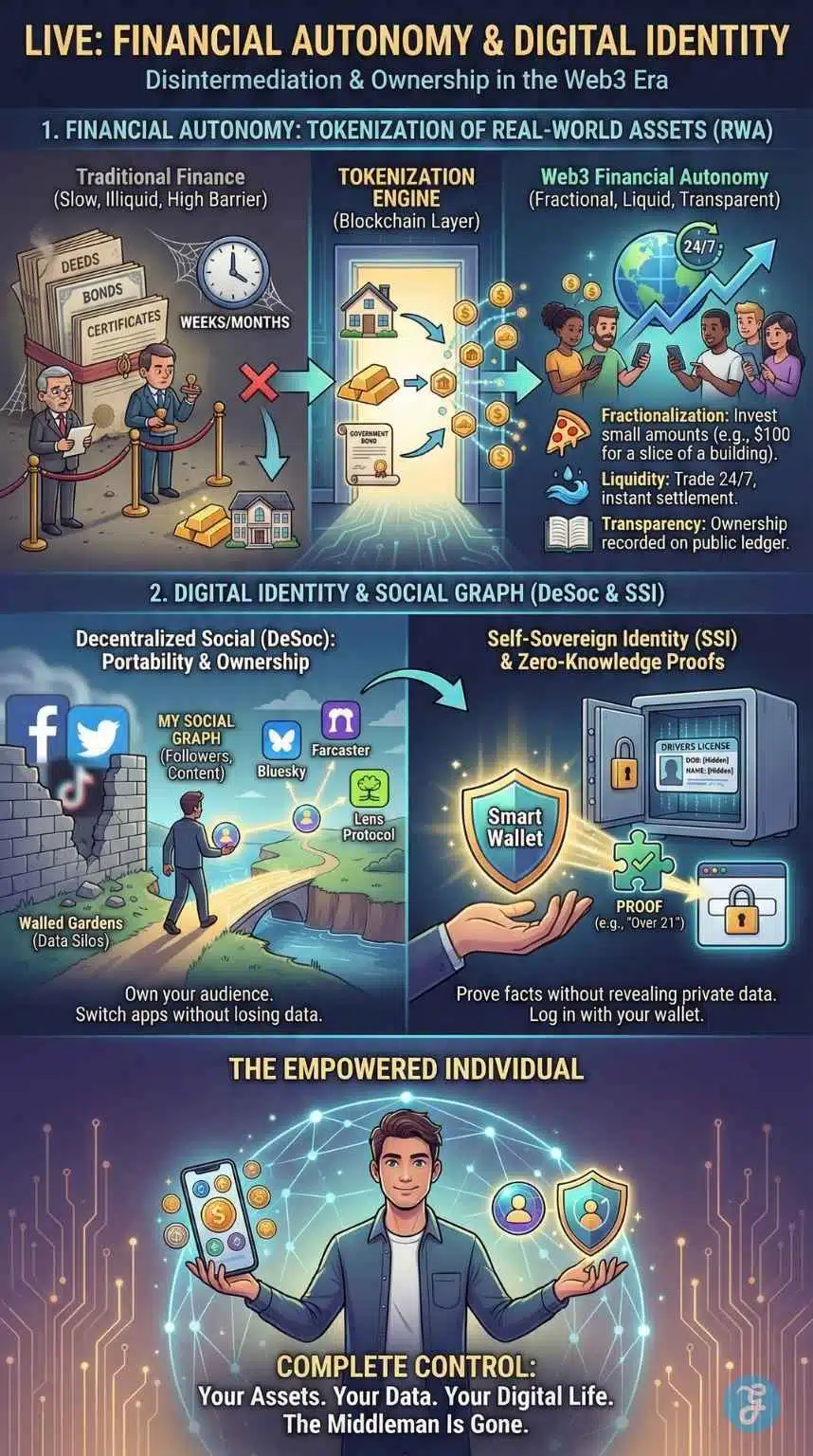
The “Live” aspect of Web3 is perhaps the most personal. It touches on how we save money, how we prove who we are, and how we interact with our friends. The prevailing theme here is disintermediation—removing the middleman to give power back to the individual.
1. Self-Sovereign Identity and Wallet-Based Login
One of the most important Web3 trends is the shift from platform-controlled accounts to self-sovereign identity.
Instead of logging in with an email and handing over your data, you connect with a wallet such as MetaMask, Phantom, or a mobile wallet. On top of that, decentralized identity standards and verifiable credentials let you prove things about yourself, such as age, membership, or qualifications, without exposing every detail.
Why it matters for everyday life:
- You control which apps get access to what
- Your identity becomes portable across apps, not locked into one platform
- It becomes easier to use services across borders because your credentials travel with you
This is especially powerful in metaverse-style virtual worlds where digital identity and reputation matter as much as physical identity.
2. Tokenization of Real-World Assets (RWA)
If there is one trend that is currently capturing the attention of major financial institutions, it is the tokenization of Real-World Assets (RWA). This process involves creating a digital twin of a physical asset—such as a house, a gold bar, or a US Treasury Bond—and placing it on a blockchain.
Why does this matter?
-
Fractionalization: Historically, investing in high-end commercial real estate required millions of dollars. With tokenization, a $100 million building can be split into 100 million tokens worth $1 each. This democratizes access to wealth creation strategies that were previously reserved for the ultra-wealthy.
-
Liquidity: Selling a house usually takes months of paperwork and fees. Selling a token that represents a fraction of a house can be done in seconds on a digital exchange, 24/7.
-
Transparency: The ownership history and yield payments are recorded on a public ledger, reducing the risk of fraud or clerical errors.
Leading Examples in RWA:
-
Ondo Finance: Allows users to invest in tokenized versions of institutional-grade products, like US Government treasuries, providing a safe yield on stablecoins.
-
RealT: A platform that tokenizes residential real estate in the United States. Investors can buy tokens representing a specific property and receive daily rental income sent directly to their digital wallets.
-
Pax Gold (PAXG): A digital asset where each token is backed by one fine troy ounce of a 400 oz London Good Delivery gold bar, stored in professional vaults.
3. Decentralized Social Media (DeSoc)
For over a decade, our social lives have been trapped in “walled gardens.” If you build a following on one major platform and decide to leave, you lose everything—your audience, your content, and your data.
Web3 introduces DeSoc, or Decentralized Social Media. The core innovation here is the separation of the “application” layer from the “data” layer.
-
The Social Graph: In DeSoc, your “social graph” (who you follow and who follows you) belongs to you, stored on an open protocol.
-
Portability: You can use a single identity to log into multiple different social apps. If you dislike the algorithm or moderation policy of one app, you can switch to another interface without losing your friends or history.
Platforms like Bluesky and protocols like Farcaster and Lens are currently gaining significant traction. They offer a user experience that feels familiar (similar to X or Instagram) but operates on a completely different foundation. Users can mint their posts as NFTs, creating a direct monetization channel where fans can “collect” content to support creators, bypassing the ad-based model entirely.
WORK: The Rise of the “Sovereign Professional”
The traditional 9-to-5 corporate structure is rigid, geographically limited, and hierarchical. Web3 is dismantling this model in favor of “permissionless work” and fluid contribution. The most profound shift in the workplace is the rise of the Decentralized Autonomous Organization (DAO), which operates less like a company and more like an internet-native co-op.
1. From “Employee” to “Contributor”
In the current landscape, we are seeing a surge in professionals who identify as “poly-workers.” Instead of holding a single job title at one company, these individuals contribute to three or four different DAOs simultaneously. They might manage a community for a DeFi protocol, write code for an NFT marketplace, and vote on governance proposals for an investment DAO—all in the same week.
This shift is enabled by smart contracts. When a contributor completes a “bounty” (a specific task), payment is often instant and programmatic. There is no waiting for a bi-weekly paycheck or navigating complex international wire transfers.
Key Roles in High Demand:
-
Community Managers: The “HR” of Web3, responsible for maintaining the culture within Discord and Telegram channels.
-
Smart Contract Auditors: The digital safety inspectors who ensure code is secure before it holds millions in value.
-
Technical Writers: Translators who turn complex code documentation into human-readable guides.
-
Governance Facilitators: Experts who manage the voting processes and proposal structures within DAOs.
2. The Geographic Arbitrage
One of the most powerful aspects of this new work culture is the removal of geographic barriers. Talent in emerging markets—such as Southeast Asia, Latin America, and Africa—can now earn global wages paid in stablecoins (cryptocurrencies pegged to the US Dollar).
This has created a phenomenon known as “geographic arbitrage.” A developer in Lagos or Buenos Aires can earn a salary comparable to a peer in New York or London, while living in a region with a much lower cost of living. This isn’t just outsourcing; it’s direct, peer-to-peer employment without the friction of traditional banking rails.
3. Active DAOs Hiring and Contributing
To understand this better, we can look at the organizations currently leading this charge:
| Organization | Primary Focus | Type of Work Available |
| Developer DAO | Education & Open Source | Coding, mentorship, and creating public goods. |
| MolochDAO | Grants & Funding | Grant writing, project evaluation, and coordination. |
| Global Coin Research (GCR) | Investment & Research | Market analysis, writing investment memos, sourcing deals. |
| BanklessDAO | Media & Education | Content creation, video editing, marketing, and design. |
| Service DAOs | B2B Services | Legal, accounting, and software development on contract. |
4. Tools of the Trade
The “Sovereign Professional” relies on a completely different tech stack than the traditional corporate worker.
-
Snapshot: Used for voting on company decisions. Instead of a boardroom meeting, decisions are made via token-weighted votes.
-
Opolis: A digital employment cooperative that helps independent workers get benefits like health insurance and tax compliance, bridging the gap between Web2 stability and Web3 freedom.
-
Discord/Telegram: The virtual office buildings where all coordination happens.
PLAY: From “Pay-to-Play” to “Play-and-Own”
Gaming is often considered the “Trojan Horse” for mass Web3 adoption because gamers are already accustomed to digital currencies and virtual items. However, the model is undergoing a painful but necessary evolution.
1. The Death of “Play-to-Earn” (P2E)
In the previous market cycle, the “Play-to-Earn” model promised that gamers could quit their jobs and earn a living solely by playing video games. While this worked for a short time, the economic models were unsustainable; they relied on a constant influx of new players to pay the old ones. When growth slowed, the economies collapsed.
2. The Rise of “Play-to-Own”
The industry has now pivoted to a sustainable model known as “Play-to-Own.” The focus has shifted back to gameplay first. The blockchain elements are often hidden in the background, serving only to facilitate ownership.
In this model:
-
You Own Your Loot: If you earn a rare sword or skin, it is minted as an NFT. You can legally sell it on a secondary market, gift it to a friend, or keep it as a collectible.
-
Interoperability: This is the “holy grail” of Web3 gaming. Imagine earning a weapon in a shooter game and being able to use that same asset (or a modified version of it) in a racing game within the same ecosystem. This connects disparate digital worlds into a cohesive “Metaverse.”
Current Leaders in Web3 Gaming:
-
Illuvium: An open-world exploration and auto-battler game that features AAA-quality graphics, aiming to bridge the gap between hardcore gamers and crypto enthusiasts.
-
Off The Grid: A cyberpunk battle royale that integrates blockchain mechanics seamlessly. It focuses on high-octane gameplay where players can extract loot and trade it, treating in-game items as valuable commodities.
-
The Machines Arena: A top-down hero shooter that rewards skill with digital collectibles, emphasizing competitive play over grinding for tokens.
Web2 Gaming vs. Web3 Gaming
| Feature | Traditional Gaming (Web2) | Web3 Gaming (Play-to-Own) |
| Asset Ownership | Leased from the developer. Can be banned/deleted. | Owned by the player on-chain. Censorship-resistant. |
| Economy | Closed loop. Value stays in the game. | Open economy. Value can be extracted to real money. |
| Interoperability | Assets locked to one game. | Assets potentially usable across multiple games. |
| Governance | The developer makes all rules. | Players can often vote on game updates via DAOs. |
The Tech Layer: Invisible Improvements
None of these changes in how we live, work, and play would be possible without significant upgrades to the underlying technology. Early blockchain networks were slow and expensive, making them impractical for daily use, like social media or gaming.
Today, we are seeing the dominance of Layer 2 (L2) solutions. Networks like Base, Arbitrum, and Optimism sit on top of Ethereum, handling transactions quickly and for pennies, while still inheriting the security of the main chain.
Furthermore, Account Abstraction is removing the biggest barrier to entry: the “seed phrase.” In the past, losing your 12-word password meant losing your money forever. New smart wallets allow for social recovery (e.g., “if I lose my key, let my three trusted friends help me recover my account”) and biometric logins (FaceID), making the experience indistinguishable from a standard banking app.
Web3 Trends Across Live Work and Play
| Life Area | Key Web3 Trend | What Changes in Practice |
|---|---|---|
| Live | Self-sovereign identity | Wallet-based login, portable credentials, more privacy, and control |
| Live | User-owned social and content | Followers and posts are portable, and creators rely less on platform algorithms |
| Live | DAOs and community ownership | Communities co-own treasuries and make decisions together |
| Work | Borderless stablecoin payments | Faster, cheaper cross-border payouts for freelancers and businesses |
| Work | DAOs as workplaces | People work for protocols and communities, earning tokens and on-chain reputation |
| Work | DeFi and tokenization | New ways to fund, invest, and manage treasuries, plus tokenized real-world assets |
| Work | Creator economy 2.0 | NFTs and tokens unlock membership, patronage, and co-owned IP |
| Play | Web3 gaming and play-and-own | Players truly own items and can trade them |
| Play | Metaverse and virtual economies | User-owned land, wearables, and experiences with real economic value |
| Play | Token-gated fandom communities | Fans get access, perks, and meaningful participation |
Benefits of Web3 Trends: Why They Matter
These Web3 trends are not just technical upgrades. They bring real benefits.
More Control and Ownership for Users
- You control your digital assets and credentials through your wallet
- Data and identity no longer live solely on big tech servers
- You can move between apps without losing your history or relationships
Transparent and Programmable Systems
- Open ledgers make financial flows and governance decisions easier to audit
- Smart contracts automate rules without intermediaries
- Community treasuries and DAOs can be inspected in real time
New Opportunities and Inclusion
- People without traditional banking access can still use digital financial tools
- Creators can monetize directly through NFTs and tokens
- Developers, designers, marketers, and community builders can work for global Web3 projects from anywhere
Challenges and Risks in Current Web3 Trends
Of course, it’s not all upside.
Complex User Experience
- Seed phrases, private keys, and gas fees can be confusing
- One mistake can mean losing funds permanently
- Security hygiene is critical
Security and Scams
- Hacks and exploits can drain protocols
- Rug pulls and pump schemes happen in low-quality projects
- Users must learn how to verify sources and contracts
Scalability and Infrastructure
- Some networks struggle with congestion
- Layer 2 solutions help, but add complexity
- Better infrastructure is still evolving
Regulation and Fake Decentralization
- Regulatory clarity is still evolving
- Many projects still depend on centralized components despite decentralization claims
- Users often assume more decentralization than exists
The Future of Web3 Trends: Where Is This All Going?
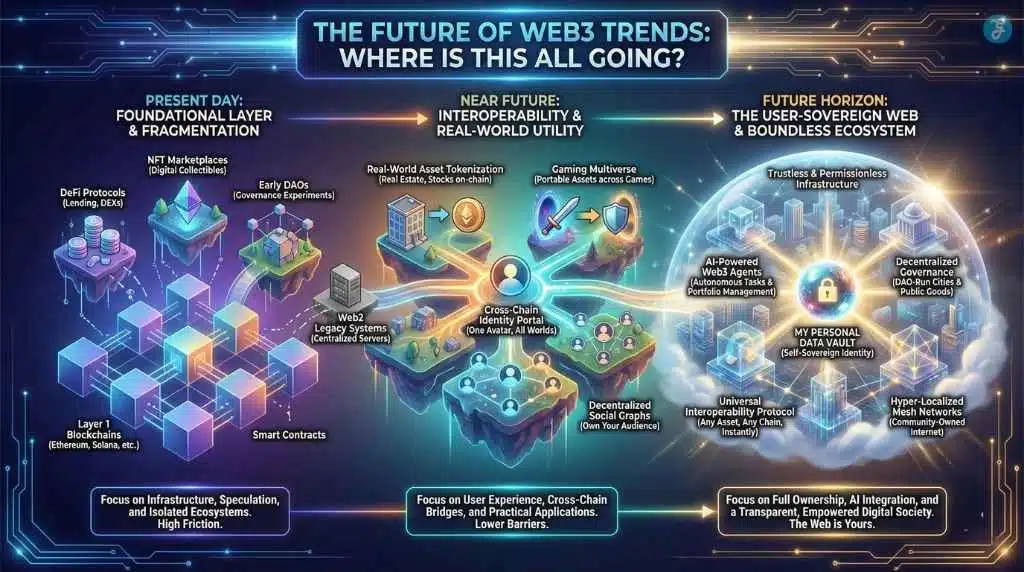
Even with challenges, several Web3 trends are clearly shaping the next phase of the internet.
1. Better UX and More Invisible Web3
We’re already seeing:
-
Wallets that hide complexity and let users sign in with familiar flows.
-
Account abstraction and smart contract wallets that reduce the pain of seed phrases.
-
Apps where the “Web3 part” (like on-chain storage) is behind the scenes, and the front-end feels like a normal app.
2. AI + Web3, DePIN, and Smarter Infrastructure
Emerging Web3 trends include:
-
AI-powered dApps that use on-chain data for smarter automation and recommendations.
-
DePIN (Decentralized Physical Infrastructure Networks), where people are rewarded in tokens for providing real-world resources like connectivity or storage.
-
More modular, scalable blockchains focused on speed and energy efficiency.
3. Hybrid Web2 + Web3 World
It’s unlikely Web3 will fully “replace” Web2. Instead, we’ll most likely see:
-
Traditional platforms integrating Web3 features (like on-chain rewards, NFTs, or wallet logins).
-
Web3-native projects using Web2 channels for reach and discovery.
-
Users are interacting with both, often without even realizing which side is which.
In other words, Web3 trends are pushing us toward a user-owned layer on top of the existing internet.
FAQs About Web3 Trends
1. What are Web3 trends in simple terms?
Web3 trends are major shifts toward decentralization and user ownership, including DeFi, NFTs, DAOs, metaverse platforms, digital identity, and tokenized assets.
2. How are Web3 trends changing the way we work?
They enable borderless payments, new workplaces such as DAOs, token-based compensation, and direct monetization for creators. People can contribute to global protocols and earn on-chain rewards.
3. How do Web3 trends affect everyday life?
You gain more control over your data and identity, your content can live on decentralized storage instead of one site, and you can join communities that share ownership of treasuries, platforms, or creative projects. It moves us toward a more participatory digital life.
4. Are Web3 trends just about cryptocurrencies?
No. Cryptocurrencies and tokens are the financial layer, but Web3 also covers identity, governance, content publishing, gaming, metaverse infrastructure, and more. Tokens are the glue, but the trends go far beyond speculation.
5. Is Web3 safe for beginners?
Web3 includes risks such as scams, hacks, and irreversible mistakes. Beginners should start slowly, use reputable platforms, and keep security in mind at all times.
6. How can someone start benefiting from Web3 trends?
Set up a reliable wallet, learn about security, try a beginner-friendly Web3 app, and explore communities or projects aligned with your interests. Over time, you’ll experience how Web3 trends are changing the way we live, work, and play.
Final Thought: Web3 Trends Transforming Our Lives
The Web3 trends dominating the current landscape tell a story of maturation. We have moved past the initial hype cycle and into an era of practical application. The technology is becoming quieter, receding into the background where it belongs, while the benefits—ownership, autonomy, and transparency—move to the forefront.
-
In Work: We are seeing a future where talent is liquid and global, free from the constraints of local economies.
-
In Life: We are regaining control over our financial destiny and our digital footprints, reducing our reliance on centralized gatekeepers.
-
In Play: We are turning “time spent” into “value earned,” transforming digital leisure into a productive asset class.
The transition is not instant, and challenges regarding regulation and user interface remain. However, the trajectory is clear. The internet is growing up, and for the first time, its users are invited to be not just participants, but owners.