

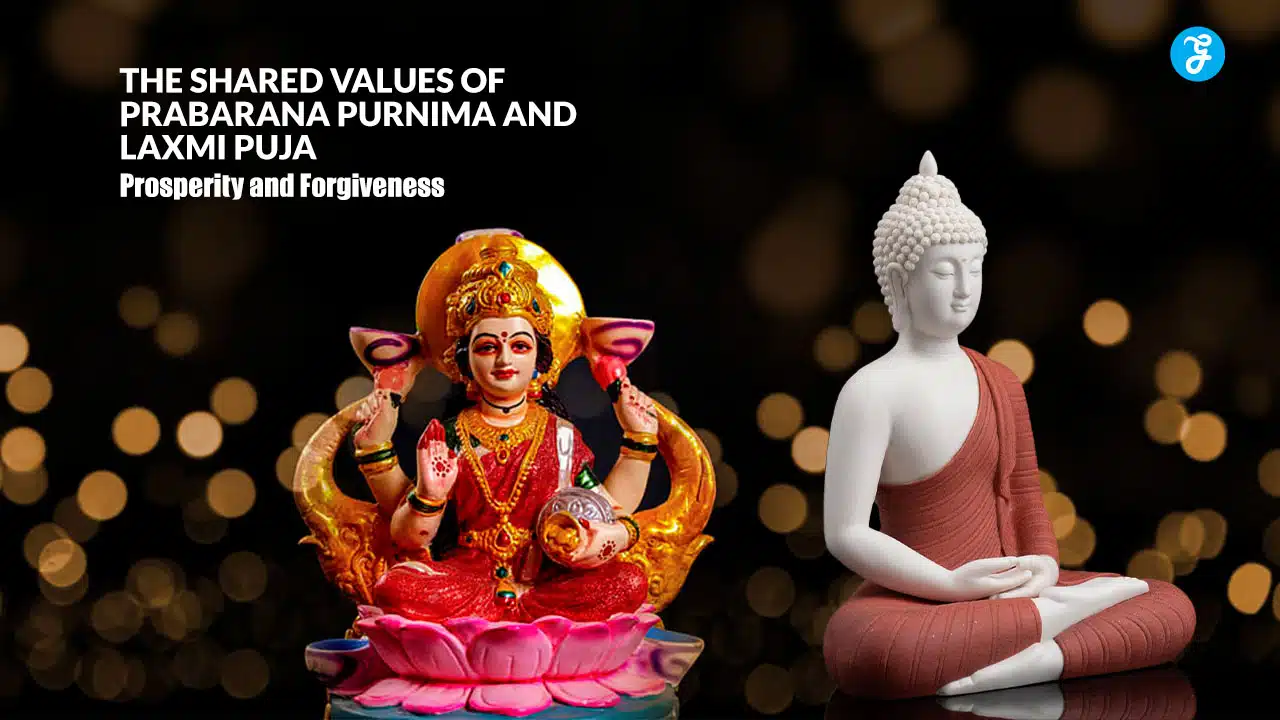
In the vibrant tapestry of Indian culture, few threads shine as brightly as the festivals that mark our calendar. Today, we witness a unique convergence of two such celebrations: Prabarana Purnima and Laxmi Puja. While these festivals emerge from different religious traditions—Buddhism and Hinduism, respectively—they share a remarkable commonality in their core values.
Both festivals, occurring on the same full moon day, emphasize the intertwined concepts of prosperity and forgiveness. This confluence offers us a unique opportunity to explore how diverse religious paths can lead to similar spiritual destinations.
As we delve into the rich traditions of Prabarana Purnima and Laxmi Puja, we’ll uncover how these seemingly distinct festivals actually mirror each other in their pursuit of both material and spiritual abundance, as well as in their emphasis on the transformative power of forgiveness.
Through this exploration, we’ll gain a deeper appreciation for the universal nature of these values and the cultural richness they bring to our society.
Background of Prabarana Purnima
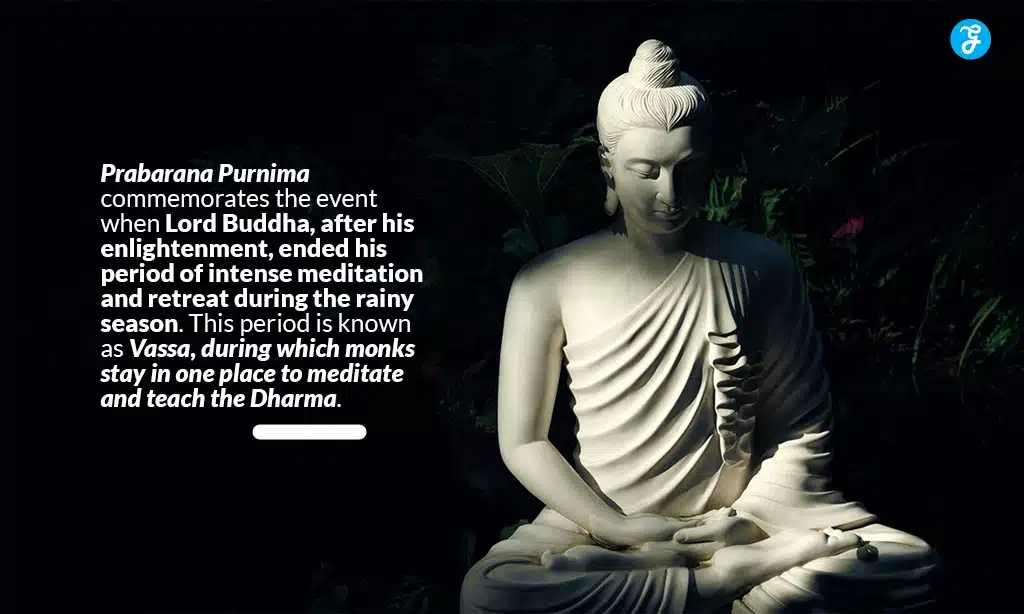
Prabarana Purnima, also known as Pavarana, is a significant Buddhist festival celebrated on the full moon day of the Ashvin month (usually falling in October). This day marks the end of the three-month rainy season retreat known as Vassa, during which Buddhist monks remain in their monasteries, dedicating themselves to intensive meditation and study.
The word “Pavarana” itself means “to invite” in Pali, referring to the practice where monks invite fellow monks to admonish them for any offenses they might have committed during the retreat. This ritual of inviting criticism embodies the Buddhist principles of self-reflection, humility, and continuous self-improvement.
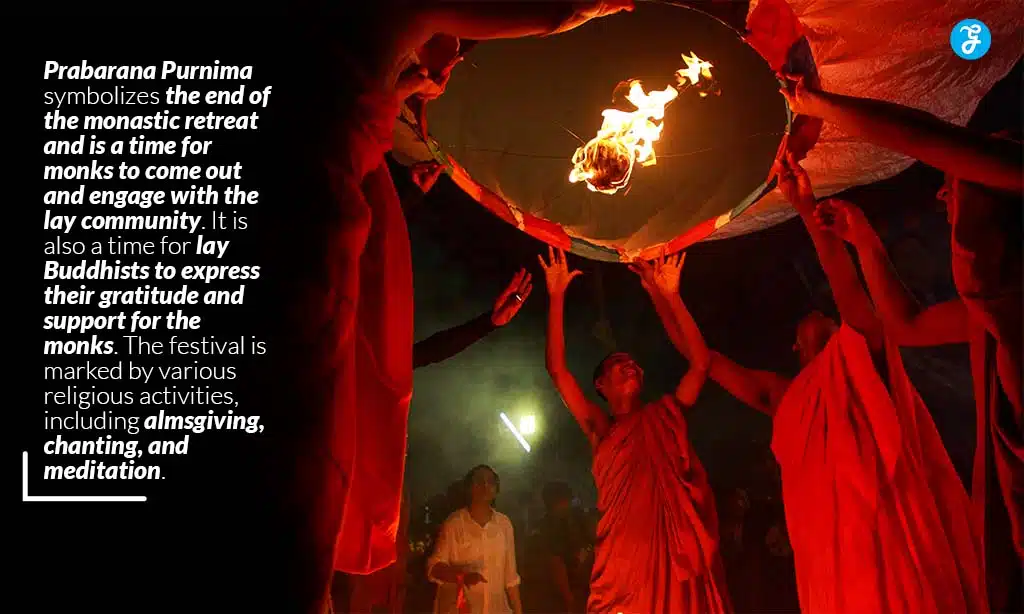
Key rituals of Prabarana Purnima include the lighting and releasing of sky lanterns, symbolizing the light of Buddha’s teachings and dispelling the darkness of ignorance. Devotees also participate in alms-giving, meditation sessions, and listening to dharma talks. In countries like Bangladesh and among Buddhist communities in India, this day is marked by vibrant celebrations, prayer meetings, and community gatherings.
Background of Laxmi Puja
Laxmi Puja, on the other hand, is a Hindu festival dedicated to Goddess Laxmi, the deity of wealth, fortune, and prosperity. Celebrated on the full moon night of the Ashvin month, it coincides with Prabarana Purnima in the lunar calendar. This festival is particularly significant in eastern and northeastern parts of India, where it marks the end of the Durga Puja celebrations.
According to Hindu mythology, Goddess Laxmi emerged from the churning of the cosmic ocean and chose Lord Vishnu as her eternal consort. She is often depicted seated on a lotus, symbolizing purity and spiritual awakening, while holding lotus blossoms in her hands, representing beauty, fertility, and growth.
The primary ritual of Laxmi Puja involves cleaning and decorating homes, creating intricate rangoli designs, and setting up a special altar for the Goddess. Devotees light oil lamps, offer flowers, fruits, and sweets, and chant mantras invoking the blessings of Laxmi. The illumination of homes with lamps is believed to guide the Goddess to bring prosperity and good fortune.
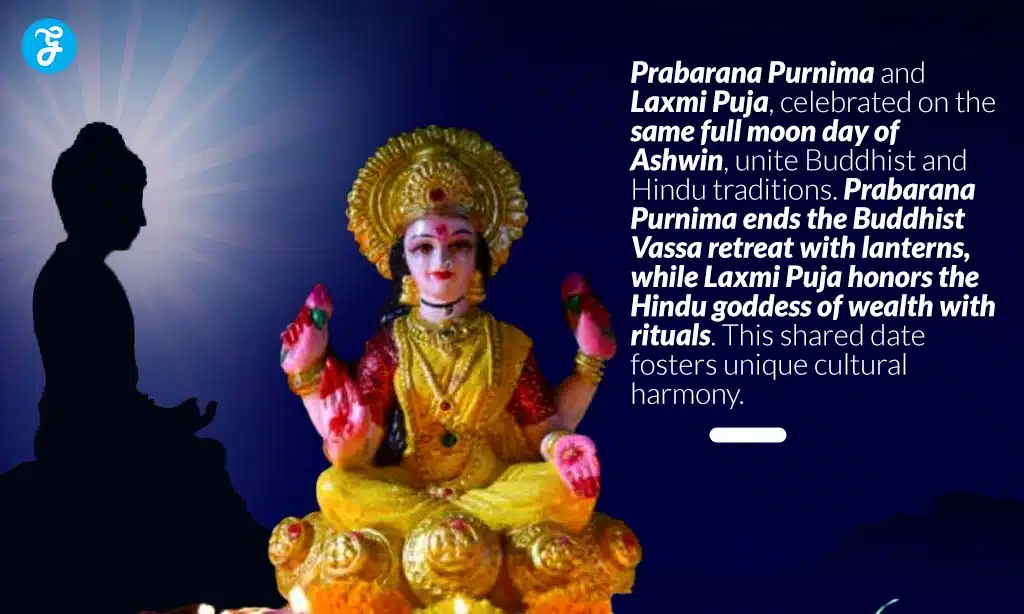
While both festivals celebrate prosperity, they approach the concept from slightly different angles, reflecting their respective philosophical foundations.
In Buddhism, as reflected in Prabarana Purnima, prosperity is viewed through a more spiritual lens. While material wealth is not dismissed, the emphasis is on spiritual richness—the accumulation of good karma, wisdom, and compassion. The figure of Shibuli or Sivali, an arhat venerated in Theravada Buddhism, is often associated with this festival.
Shibuli is considered a symbol of abundance, but this abundance extends beyond material wealth to include the richness of spiritual attainments and the ability to benefit others.
Hinduism, as celebrated in Laxmi Puja, takes a more holistic view of prosperity. Goddess Laxmi embodies not just wealth and material abundance but also qualities like good fortune, purity, and generosity. The festival acknowledges the importance of material prosperity in leading a fulfilling life, but it also emphasizes that true wealth comes from using one’s resources for the greater good.
The rituals of Laxmi Puja are designed to invite prosperity in all its forms—financial, spiritual, and emotional.
The Role of Forgiveness
Interestingly, both festivals place a significant emphasis on forgiveness, though they approach it from different perspectives.
In Prabarana Purnima, forgiveness is a central theme. The practice of Pavarana, where monks invite criticism from their peers, is fundamentally an act of seeking forgiveness for any transgressions, known or unknown. This ritual extends to lay devotees as well, who use this occasion to reflect on their actions, seek forgiveness, and forgive others.
In Buddhist philosophy, forgiveness is seen as a path to spiritual prosperity—by letting go of grudges and negativity, one cultivates a mind conducive to peace and enlightenment.
While forgiveness might not be as explicitly ritualized in Laxmi Puja, it is an integral part of Hindu philosophy and is implicitly present in the festival’s spirit. The concept of karma in Hinduism is closely tied to forgiveness.
By forgiving others and seeking forgiveness for one’s own mistakes, one can mitigate negative karma and pave the way for positive outcomes, including prosperity. Moreover, the act of worship itself is seen as a form of seeking forgiveness and blessings from the divine.
Despite their distinct origins, Prabarana Purnima and Laxmi Puja share several symbolic practices, most notably the use of light. In Prabarana Purnima, the release of sky lanterns symbolizes the spread of Buddha’s teachings and the dispelling of ignorance.
Similarly, in Laxmi Puja, the lighting of lamps (deepa) represents the triumph of light over darkness, knowledge over ignorance, and good over evil.
Both festivals also emphasize the practice of dana or giving. In Prabarana Purnima, this takes the form of offering alms to monks and making donations to temples. Laxmi Puja, while focusing on inviting prosperity, also encourages sharing one’s wealth through charitable acts.
Community gatherings and collective prayers are another common feature. Both festivals bring people together, fostering a sense of unity and shared purpose. These gatherings serve not just religious functions but also strengthen social bonds and cultural identity.
The Interplay of Prosperity and Forgiveness
The juxtaposition of prosperity and forgiveness in these festivals offers a profound insight into the nature of true wealth. Both traditions suggest that material prosperity alone is insufficient for a fulfilling life. The Buddhist emphasis on forgiveness as a path to spiritual wealth complements the Hindu view of using material wealth for dharmic purposes.
Forgiveness can lead to prosperity in multiple ways. Psychologically, it frees one from the burden of negativity, creating mental space for positive growth. Socially, it mends relationships, potentially opening up new opportunities. Spiritually, it aligns one with higher principles, attracting positive energy and outcomes.
Conversely, prosperity, when understood holistically, can foster forgiveness and generosity. When one feels abundant—materially, emotionally, or spiritually—it becomes easier to let go of grievances and extend compassion to others.
Modern Interpretations and Celebrations
In contemporary times, the celebration of these festivals has evolved, especially in urban settings. Many Buddhists and Hindus today interpret the concepts of prosperity and forgiveness in light of modern challenges. For instance, prosperity might be viewed in terms of career success or work-life balance, while forgiveness could be applied to professional relationships or social media interactions.
The rituals, too, have adapted. Sky lanterns might be replaced with eco-friendly alternatives, and traditional oil lamps might give way to electric lights. However, the core values remain intact, with many people finding innovative ways to incorporate the spirit of these festivals into their busy lives.
Interestingly, the coincidence of these festivals has led to some beautiful instances of interfaith harmony. In some communities, Buddhists and Hindus come together to celebrate, sharing in each other’s traditions and finding common ground in their shared values.
Societal Impact
The celebration of Prabarana Purnima and Laxmi Puja has significant societal impacts. Economically, these festivals boost local businesses, from flower sellers to sweet shops. The emphasis on charity and community service during these times also contributes to social welfare.
Socially, these festivals play a crucial role in community bonding. They provide opportunities for people to come together, reinforcing social ties and cultural identity. In an increasingly individualistic world, such communal celebrations serve as important anchors of collective experience.
Moreover, the values promoted by these festivals—prosperity tempered with generosity and forgiveness as a path to personal and social harmony—contribute to the ethical fabric of society. They remind us of the importance of balancing material pursuits with spiritual and moral growth.
Takeaways
As we reflect on the shared values of Prabarana Purnima and Laxmi Puja, we are reminded of the universal nature of human aspirations. Across different religious traditions, we find common threads—the desire for prosperity, the need for forgiveness, the quest for meaning beyond material success.
These festivals, occurring simultaneously, offer a beautiful testament to India’s cultural richness and diversity. They demonstrate how different paths can lead to similar spiritual insights and how ancient wisdom remains relevant in our modern world.
In celebrating these festivals, we not only honor our respective traditions but also participate in a larger human narrative—one that recognizes the interconnectedness of all beings and the delicate balance between material and spiritual prosperity.
As we light our lamps and lanterns today, we illuminate not just our homes but our hearts, spreading the light of understanding, forgiveness, and shared humanity.






















