A freelancer can finish the work on time, send a clean invoice, and still lose money before the payment reaches the local bank account. That is the part many payment guides skip. For freelancers in Bangladesh, India, Pakistan, Sri Lanka, Nepal, and nearby markets, cross-border payments are not just about “which app is popular.” The real question is rougher: which account can receive money from a US, UK, Canadian, Australian, or European client without eating too much in fees, breaking platform rules, or creating compliance headaches later?
That is why choosing the best neobanks for freelancers needs more care than a simple feature list. A nice dashboard means very little if the service does not support your country, cannot receive from your client’s payment method, charges heavily on currency conversion, or leaves you without the paperwork your tax system expects.
One more note before the ranking: some services people casually call “neobanks” are not banks. Some are payment companies, e-money institutions, business account providers, or fintech platforms working with banking partners. That does not make them unsafe by default. It does mean freelancers should read the eligibility and fee pages before routing serious income through any account.
How to Choose the Best Neobanks for Freelancers
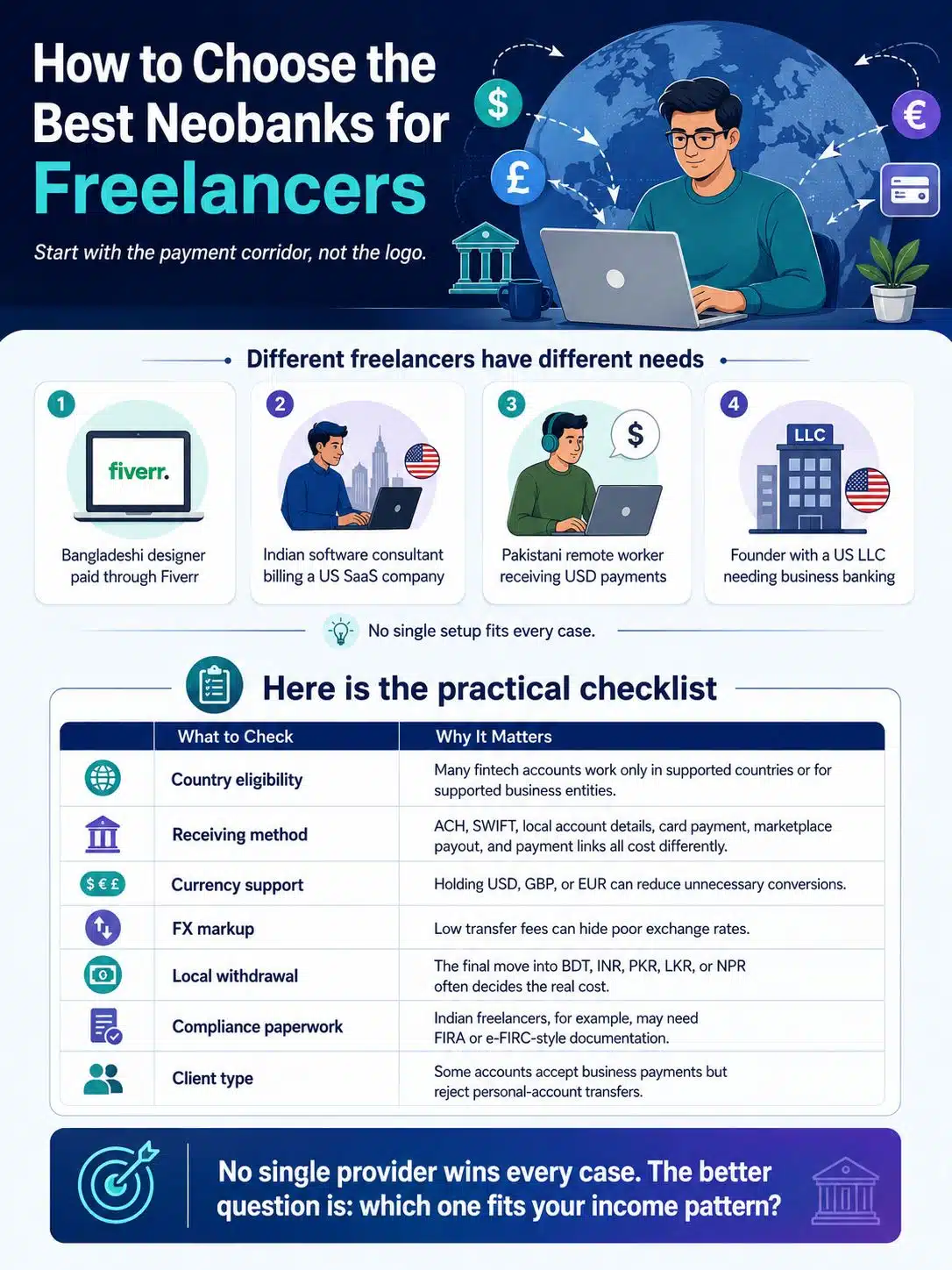
Start with the payment corridor, not the logo.
A Bangladeshi designer paid through Fiverr has a different problem from an Indian software consultant billing a US SaaS company. A Pakistani remote worker receiving salary-like payments in USD needs something different again. A founder with a US LLC needs a business banking setup, not a casual freelancer wallet.
Here is the practical checklist:
| What to Check | Why It Matters |
|---|---|
| Country eligibility | Many fintech accounts work only in supported countries or for supported business entities. |
| Receiving method | ACH, SWIFT, local account details, card payment, marketplace payout, and payment links all cost differently. |
| Currency support | Holding USD, GBP, or EUR can reduce unnecessary conversions. |
| FX markup | Low transfer fees can hide poor exchange rates. |
| Local withdrawal | The final move into BDT, INR, PKR, LKR, or NPR often decides the real cost. |
| Compliance paperwork | Indian freelancers, for example, may need FIRA/eFIRC-style documentation. |
| Client type | Some accounts accept business payments but reject personal-account transfers. |
No single provider wins every case. The better question is: which one fits your income pattern?
1. Payoneer — Best for Marketplace-Heavy Freelancers
Payoneer remains one of the most practical accounts for freelancers who earn through marketplaces. If most of your work comes from Upwork, Fiverr, Freelancer.com, Toptal-style platforms, affiliate networks, or global partner programs, Payoneer is hard to ignore.
Its biggest advantage is not that it is always the cheapest. It is accepted in many places where freelancers already earn money. You can receive into supported currency balances, withdraw to a local bank account, and in some cases use Payoneer receiving account details for business payments.
That convenience has a price. Payoneer fees depend heavily on how the payment arrives. A marketplace payout may cost differently from a client payment request. A card-funded client payment may cost more than a local bank transfer. Currency conversion and withdrawals can also change the final amount.
The part freelancers often miss: Payoneer receiving accounts are generally meant for business payments. Payments from personal bank accounts may be declined. So if a client says, “I’ll send from my personal checking account,” do not assume it will work just because you have USD receiving details.
Payoneer fits best when:
- You earn from global freelance marketplaces.
- You want a widely recognized payout account.
- You receive in USD, EUR, GBP, or other supported currencies.
- You prefer convenience over chasing the absolute lowest FX cost.
Skip it as your only option if most clients pay direct invoices and expect a simple bank transfer from a personal account. In that case, a Wise-style or business-account setup may work better, depending on your country.
2. Wise Business — Best for Transparent FX in Supported Markets
Wise Business is attractive because it makes the exchange-rate issue easier to understand. Wise is known for using mid-market-rate logic and showing fees before a transfer. For freelancers who hate surprise deductions, that matters.
But Wise is not equally available everywhere.
This is especially important for South Asian readers. Wise can be useful for Indian businesses receiving international payments through its India-specific flow. It can also provide documentation such as eFIRC for eligible Indian transfers. That makes it relevant for Indian freelancers, consultants, and small exporters who care about paperwork as much as the exchange rate.
For Bangladesh, Pakistan, and Sri Lanka, the picture is more limited. Wise’s USD account-detail availability is restricted for addresses in several countries, including Bangladesh, Pakistan, and Sri Lanka. That means a freelancer in Dhaka, Karachi, or Colombo should not read a UK or US Wise Business review and assume the same features are available locally.
Wise Business is a strong option when:
- Your country and business type are supported.
- You need transparent FX.
- You want to invoice clients with local account details in major currencies where available.
- You care about clean documentation.
It is weaker when Wise does not support the receiving feature you need in your country. In that case, it may still be useful for some transfers, but not as your main freelance receiving account.
3. WorldFirst — Best for Multi-Currency Platform Collections
WorldFirst is worth watching for freelancers and small agencies that receive from several platforms or clients in different currencies.
Its freelancer-focused pages describe support for collecting from platforms such as Upwork, Fiverr, Deel, Freelancer.com, Toptal, and others. It also promotes multi-currency receiving, holding, conversion, and withdrawals. For a freelancer who has outgrown one platform but does not yet need full corporate banking, this middle ground can be useful.
The practical value is control. Imagine a remote agency that receives USD from a US client, GBP from a UK client, and EUR from a European platform. Converting every payment immediately into local currency may not be ideal, especially if the agency pays for software, contractors, or ads in foreign currencies.
WorldFirst can make sense for:
- Freelancers earning from multiple international platforms.
- Small agencies receiving USD, EUR, GBP, or other major currencies.
- Operators who want to hold funds before converting.
- People who need a more business-like payment account but are not ready for Airwallex or Mercury.
The limitation is the same as with every cross-border provider: country support and available routes matter. A feature shown on a global page may not apply equally to every user. Confirm your country, account type, and withdrawal path before giving WorldFirst details to clients.
4. Elevate Pay — Best USD-Focused Option for Supported Freelancers
Elevate Pay is more focused than Wise, Payoneer, or WorldFirst. It is built around USD accounts for freelancers, remote workers, and founders.
That focus is useful. Many freelancers in Bangladesh and Pakistan do not need ten currencies on day one. They need a reliable way to receive USD from platforms, employers, or business clients and move the money home.
Elevate Pay’s fee structure is attractive for ACH-based receiving because inbound ACH is listed as free. But the wording matters. Inbound wire transfers are not free. Domestic and international inbound wires are listed with a fee, so freelancers should check how the client or platform will actually send the money.
Another important limit: Elevate’s business account information says payments can only be received from business accounts. Funds sent from individuals may be returned. That is a serious point for freelancers with small direct clients. A US startup paying from a business bank account may be fine. A client trying to send from a personal account may cause trouble.
Elevate Pay is most useful when:
- You mainly earn in USD.
- Your platform or client can pay through ACH or a supported business route.
- You want to hold USD before withdrawing locally.
- You are in a supported market and can pass KYC.
It is not ideal if you regularly receive GBP, EUR, AUD, or CAD, or if clients pay casually from personal accounts.
5. Airwallex — Best for Registered Agencies and Growing Service Businesses
Airwallex is not the right starting point for every freelancer. It is better suited to registered businesses, agencies, exporters, SaaS companies, and cross-border operators.
That distinction matters. A solo freelancer with two clients may find Airwallex too heavy. A remote agency with international clients, contractors, ad spend, subscriptions, and multiple currencies may find it much more useful.
Airwallex provides business accounts, local and international transfers, multi-currency capabilities, expense tools, and payment infrastructure. Its pricing and availability vary by region, but the product is clearly built for companies rather than casual personal payments.
The onboarding standard reflects that. A company generally needs to be officially registered, active, in an eligible country, and outside unsupported industries. Directors, owners, business activity, and documents may be reviewed.
Airwallex makes sense when:
- You run a registered agency or company.
- You pay contractors or suppliers internationally.
- You manage foreign-currency costs.
- You need business cards, approval flows, or payment controls.
- You want a more serious finance stack than a marketplace payout account.
Skip it if you are just trying to receive your first few freelance payments. It can be excellent later, but early freelancers often need simpler rails first.
6. Mercury — Best for US-Registered Remote Businesses
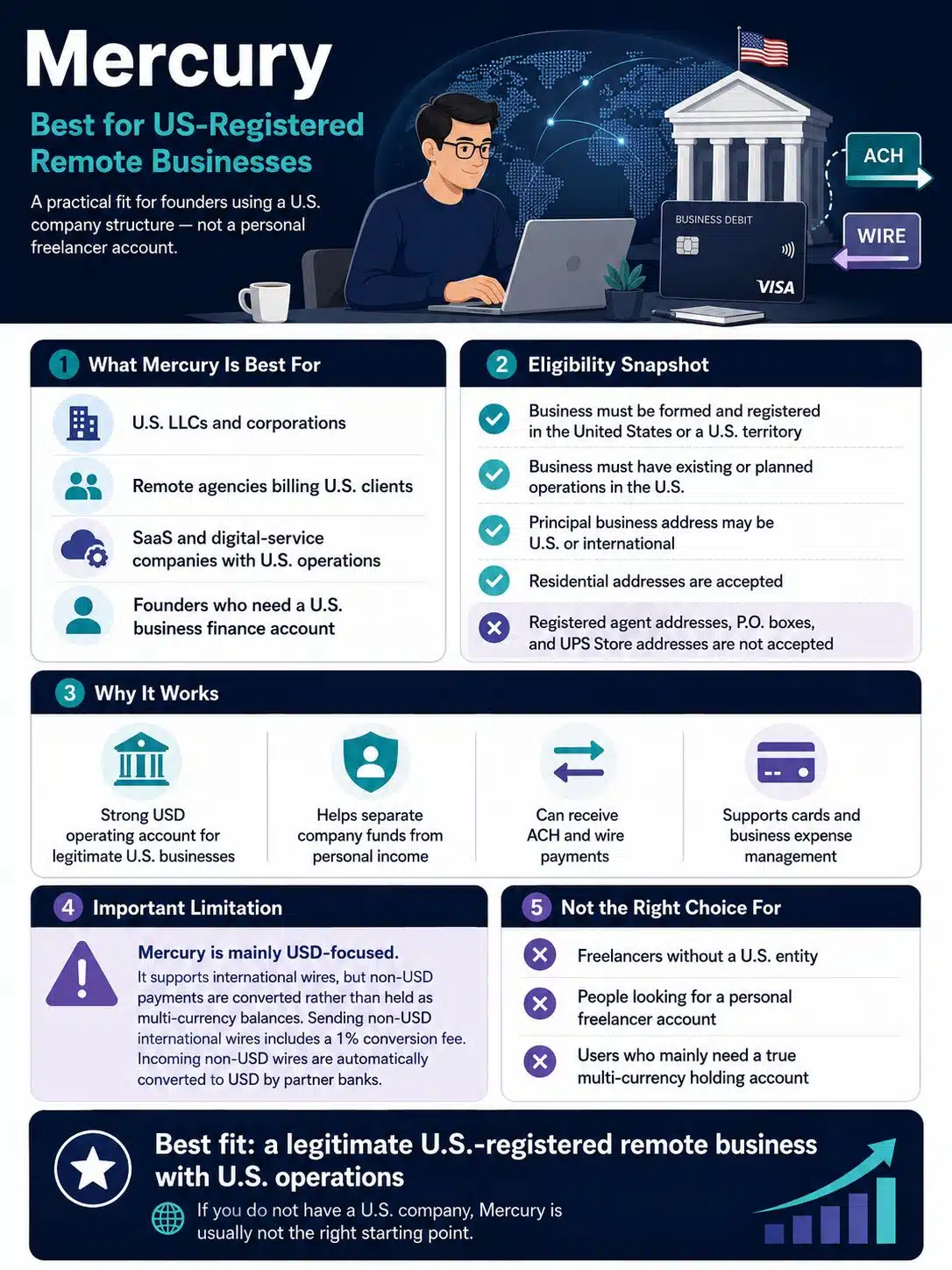
Mercury is often discussed by international founders because it supports US-registered companies with founders from around the world. That makes it relevant for remote agency owners, SaaS founders, and service businesses using a US LLC or corporation.
It is not a personal freelancer account.
Mercury’s eligibility rules require the business to be formed and registered in the United States or a US territory. The company must also have existing or planned US operations. The principal business address cannot simply be a registered agent address or a PO box.
For a South Asian founder with a legitimate US company and US clients, Mercury can be a strong USD operating account. It can help separate company funds from personal income, receive ACH or wire payments, issue cards, and manage business expenses.
The limitation appears when money moves outside USD. Mercury supports international wires, but non-USD handling can involve conversion rules and partner-bank behavior. Freelancers should not assume Mercury is a cheap multi-currency receiving account in the same way Wise or WorldFirst may be.
Mercury is best for:
- US LLCs and corporations.
- Remote agencies billing US clients.
- SaaS or digital-service companies with US operations.
- Founders who need a US business finance account.
It is not the right choice for a freelancer without a US entity.
7. Revolut Business — Best for UK and EEA-Based Freelancers
Revolut Business is useful, but only for the right geography and business setup.
For freelancers or small businesses based in the UK, EEA, Switzerland, or supported territories, Revolut Business can be a convenient multi-currency account with cards, local and international payments, and expense features. It is especially useful when the business spends across currencies and wants everything inside one app.
For freelancers sitting in South Asia, Revolut Business is usually not the direct answer unless they have a supported company and meet the applicant residence requirements. This is where many online comparisons become misleading. Revolut Business looks attractive in a UK article, but that does not make it available to a Bangladeshi or Pakistani freelancer working from home.
Pricing also deserves attention. Revolut Business plans and allowances vary by country and plan. The UK pricing page, for example, includes monthly plan fees and limits on no-fee transfers and FX allowances. That means freelancers should check the exact local pricing page before choosing it over Wise, Payoneer, or a local bank route.
Revolut Business is a good fit when:
- Your business is registered in a supported country.
- The applicant meets residence requirements.
- You work across UK, EU, and international clients.
- You need cards and expense controls as much as receiving payments.
It is weaker as a South Asia-first freelance payout solution.
Where Skydo Fits for Indian Freelancers
Skydo is not a classic neobank, but Indian freelancers should know about it.
India has specific documentation needs for export income. For many freelancers, the payment account is not only about receiving USD. It is also about getting proper FIRA or eFIRC-style documentation, reconciling invoices, and keeping records clean for tax and compliance.
Skydo positions itself as a cross-border payment platform for Indian businesses and freelancers, with RBI PA-CB authorisation, zero FX margin, flat-fee pricing, and FIRA support. That makes it especially relevant for Indian service exporters.
For an Indian freelancer billing foreign clients directly, Skydo may be more practical than a flashy global neobank that does not solve the paperwork problem.
For Bangladeshi, Pakistani, Sri Lankan, or Nepali freelancers, Skydo is not the same kind of answer. It is mainly worth mentioning because it shows how local regulation can change the “best” choice.
Quick Match: Which One Should You Try First?
Use this as a starting point, not a final decision.
| Your Situation | Better First Option |
|---|---|
| You mostly earn from Upwork, Fiverr, or marketplaces | Payoneer or WorldFirst |
| You are an Indian freelancer needing inward payment documentation | Wise India flow or Skydo |
| You are in Bangladesh or Pakistan and mainly receive USD | Elevate Pay or Payoneer |
| You run a registered agency with international contractors | Airwallex |
| You own a US LLC or corporation | Mercury |
| You are based in the UK or EEA | Revolut Business or Wise Business |
| You receive in several currencies and want to hold balances | Wise Business or WorldFirst, where available |
Mistakes Freelancers Should Avoid
Do not choose by headline fee alone. “No monthly fee” does not mean low cost. The money may disappear through FX markup, wire deductions, withdrawal fees, card fees, or platform-side charges.
Do not assume business-account details accept personal payments. Several providers restrict receiving-account payments to business senders. A client using a personal account can cause delays or failed transfers.
Do not ignore paperwork. Indian freelancers especially should think about FIRA/eFIRC documentation before choosing a low-cost route.
Do not depend on one account. Cross-border fintech accounts can pause transfers during reviews, request documents, or change country rules. Once freelance income becomes regular, keep a backup route.
Do not use a workaround that violates platform or provider terms. Opening an account with the wrong country, fake address, or VPN may feel clever until the account is frozen with money inside.
Final Thoughts
The best neobanks for freelancers are not the ones with the most polished apps. They are the ones that fit the payment corridor, client type, fee structure, documentation needs, and country rules.
For marketplace-heavy freelancers, Payoneer remains one of the most practical choices. For transparent FX in supported markets, Wise Business is hard to beat. WorldFirst is useful for multi-currency platform collections. Elevate Pay is strong for USD-focused freelancers in supported countries. Airwallex and Mercury are better for registered businesses than casual solo work. Revolut Business makes more sense for UK and EEA-based freelancers than for most South Asia-based workers.
Start with the payment source. Then check the fee path. Then check the paperwork. Only after that should you choose the app.
That small order of thinking can save freelancers more money than chasing whatever payment platform is trending this year.
FAQs about Best Neobanks for Freelancers
What is the best neobank for freelancers in Bangladesh?
There is no single best option. Payoneer remains widely useful for marketplace payouts, while Elevate Pay may work well for USD-focused freelancers who can receive from supported platforms or business accounts. Wise Business is more limited for Bangladeshi addresses, especially for USD account details.
What is the best option for Indian freelancers receiving international payments?
Indian freelancers should compare Wise’s India receive-money flow, Skydo, Payoneer, and direct bank routes. The right choice depends on fees, FX rate, client payment method, and whether FIRA/eFIRC-style documentation is required.
Are neobanks safer than PayPal?
Not automatically. Safety depends on regulation, account protection, transaction monitoring, dispute handling, and whether the provider supports your country and payment use case. PayPal is a payment platform, not a neobank, but it may still be useful for certain clients.
Should freelancers keep more than one payment account?
Yes, once income becomes regular. A primary account plus one backup route is sensible. Cross-border payments can be delayed by compliance checks, banking holidays, document reviews, or platform changes.