Sending money overseas often leaves recipients with less than expected due to steep costs. While upfront bank charges hurt, the true impact of international wire transfer fees hides within exchange rate markups, intermediary bank deductions, and incoming transfer processing costs.
On a large $50,000 cross-border transaction, even a seemingly minor 2% exchange rate markup quietly drains $1,000 before the funds ever land safely. Traditional banking relies heavily on the legacy SWIFT network, where multiple intermediary institutions systematically slice away at the principal amount while applying inflated retail currency conversion rates rather than the true mid-market rate.
Fortunately, bypassing these hidden banking leaks is entirely possible today. Utilizing modern digital-first fintech platforms, leveraging SEPA networks for European transfers, or adopting multi-currency business accounts drastically lowers global transaction friction. Shifting away from legacy financial corridors ensures international corporate payments remain completely transparent, highly predictable, and fully intact upon their actual final arrival.
Understanding International Wire Transfers
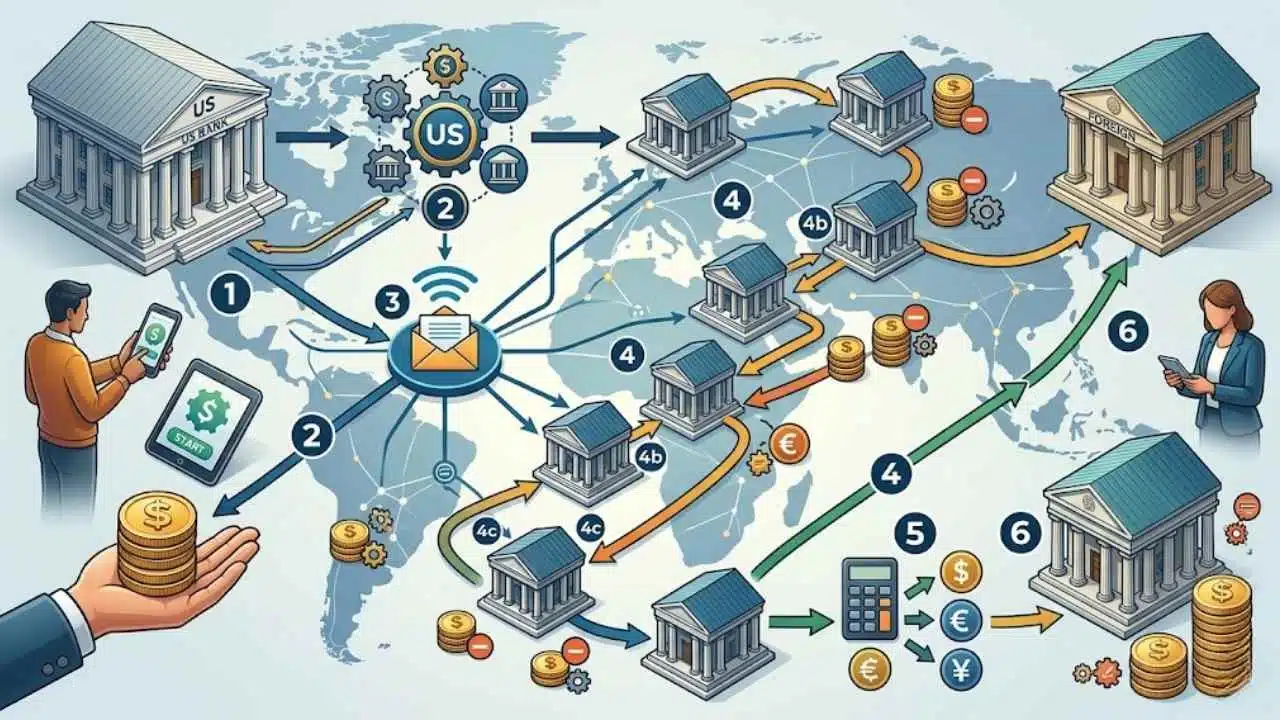
An international wire transfer moves money from one bank account to another across borders, usually through a chain of payment networks and correspondent banks. That chain is why wire transfer fees, exchange rate markups, and delivery times can look simple on the front end but get messy by the time the money arrives.
What is an international wire transfer?
A wire transfer between countries is a bank-to-bank electronic funds transfer. If the payment crosses currencies, the sending bank or a partner bank also handles currency conversion, and that is where hidden costs often start.
SWIFT is the messaging system most people hear about, but it does not move the money by itself. Swift says more than 11,500 institutions use its network, which helps explain why even a routine cross-border payment can pass through several banks before it reaches the beneficiary.
In the United States, high-value payments may start on Fedwire or CHIPS before the international leg is sent onward. CHIPS processed a little over $2 trillion in average daily value in 2025, so if you are sending a large business payment in U.S. dollars, there is a good chance a big-bank settlement rail is involved somewhere in the background.
- Sender bank: charges the outgoing wire transfer fee and starts the payment instruction.
- Messaging and settlement rails: SWIFT sends the message, while Fedwire or CHIPS may settle the U.S. dollar side.
- Correspondent banks: step in when the two end banks do not have a direct relationship.
- Receiving bank: may deduct an incoming wire transfer fee before crediting the account.
SWIFT sends the message, correspondent banks move the money, and each extra handoff can add cost.
If you want fewer surprises, ask your bank two plain questions before you send: Which exchange rate will you use? and Will any intermediary bank fees be deducted? Those two answers matter more than the headline fee in many transfers.
Domestic vs international wire transfers
Domestic and international wires look similar in online banking, but they behave very differently once money starts moving.
| Aspect | Domestic wire transfers | International wire transfers |
|---|---|---|
| Typical speed | Often same business day through Fedwire, and some local payment rails move even faster. | Often 1 to 5 business days, depending on the country, currency, cut-off time, and number of banks involved. |
| Costs to sender | Usually a single flat fee, or no fee on some accounts. | Usually a flat fee plus exchange rate markup, and sometimes third-party deductions. |
| Intermediary involvement | Usually direct between U.S. institutions. | Often routed through correspondent banks, especially for less common currencies and smaller foreign banks. |
| Receiving fees | Less common for retail accounts. | Still common, and the fee may be charged separately or deducted from the amount received. |
| Currency conversion | Usually none. | Common, and the exchange rate spread may cost more than the wire fee. |
| Transparency | Usually clearer. | Often weaker, because you may not see every bank in the chain or every deduction ahead of time. |
| Best lower-cost alternatives | ACH, RTP, and other local rails for non-urgent payments. | Specialized FX providers, local payout networks, SEPA for euro payments, and multi-currency accounts. |
| Rules and screening | Local compliance and fraud checks. | Extra sanctions screening, country-specific rules, and more documentation for certain destinations. |
One useful exception is euro payments inside SEPA. The European Central Bank notes that SEPA instant payments make funds available within 10 seconds, and EU rules say the charge cannot be higher than a comparable regular euro credit transfer. If you pay suppliers in euros often, that is a strong reason to ask whether a SEPA route is available instead of a full SWIFT wire.
The Standard Costs of International Wire Transfers
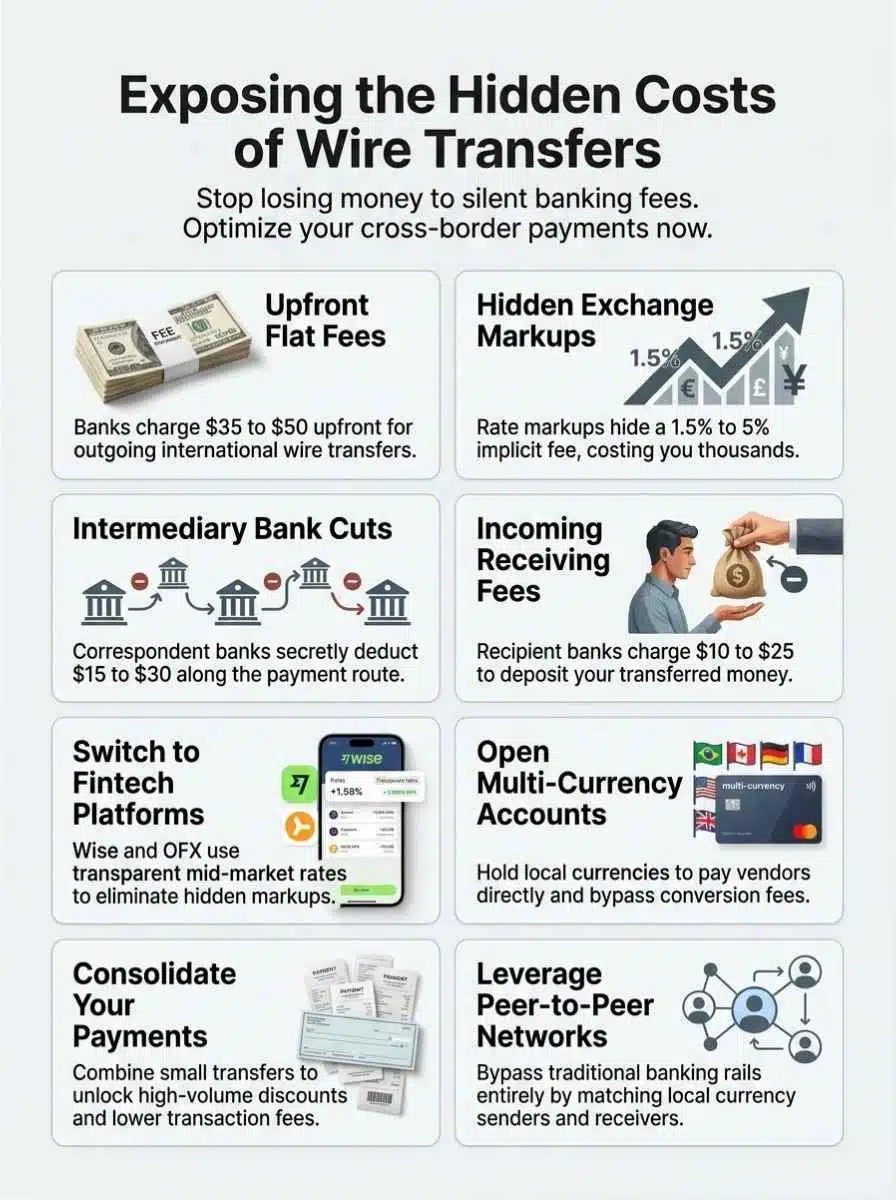
The standard price of an international payment usually has two layers: the bank’s flat wire fee and the spread hidden inside the exchange rate. For many readers, the second one is the bigger problem.
Flat fees charged by banks
Most major U.S. banks still charge a clear flat fee for an outgoing or incoming international wire transfer. As of May 2026, U.S. Bank lists $50 for an outgoing international wire and $25 for an incoming international wire on its consumer pricing sheet, while Wells Fargo lists $25 for a consumer digital international wire sent in U.S. dollars and $40 if you do it in branch.
| Bank | Example published fee | What that means for you |
|---|---|---|
| Wells Fargo | Consumer digital international wire in USD: $25. Branch: $40. Incoming domestic and international wires: $0 for consumer accounts. | Sending online is cheaper, but Wells Fargo also says its exchange rate includes a markup. |
| U.S. Bank | International outgoing: $50. International incoming: $25. | On smaller transfers, the flat fee alone can take a painful bite out of the payment. |
| Citibank | Regular Checking online international wire in USD: $35. Incoming wire: $15. Online foreign-currency international wire: waived. | A lower front-end fee can still be offset by the quoted FX rate. |
| Chase Bank | Consumer fee pages for eligible accounts show incoming wires at $15, online international wires in USD at $40, and banker-assisted international wires at $50. Online foreign-currency wires can be $5, or $0 at $5,000 and up. | The lower fee on foreign-currency wires is your signal to ask where the bank is making its margin. |
That fee table also explains why in-branch wires are rarely worth it unless you need help correcting bank details. For routine payment processing, online initiation is usually the cheaper path.
How exchange rate markups impact costs
The mid-market exchange rate is the midpoint between the buy and sell prices in the currency market. It is the clean benchmark to compare against because it strips out the retail spread a bank or provider adds for itself.
Banks rarely give everyday customers the mid-market rate. U.S. Bank says its retail exchange rate includes its profit, fees, costs, and charges, and Wells Fargo says its quoted exchange rate includes a markup. That is why a wire can look cheap on the fee page and still be expensive in practice.
| Transfer amount | 2% exchange rate markup | 3% exchange rate markup |
|---|---|---|
| $5,000 | $100 hidden cost | $150 hidden cost |
| $20,000 | $400 hidden cost | $600 hidden cost |
| $50,000 | $1,000 hidden cost | $1,500 hidden cost |
On larger transfers, the exchange rate spread usually matters more than the posted wire fee.
This is where businesses often get caught. A company may track the $40 outgoing fee in its expense management system and miss the much larger FX loss buried in the converted amount. If you use expense reporting solutions, automated receipt tracking, or data analytics for finance, log the quoted bank rate at approval time so your team can compare it with the market rate later.
Hidden Fees in International Wire Transfers
The hidden part of international wires usually comes from banks you never chose, banks you never spoke to, and fees that never show up as a neat line item on the first screen. That is why senders and recipients often argue about who lost the money, even when both sides did everything right.
Intermediary (correspondent) bank fees
Correspondent banks sit in the middle when the sending bank and receiving bank do not settle directly. Each extra bank in the path creates another chance for a handling fee, a repair fee, or a compliance hold.
A useful detail most people miss is the charging code. In international payment language, OUR means the sender pays the charges, SHA means the fees are shared, and BEN means the beneficiary pays. If you want the recipient to get an exact invoice amount, ask your bank which option is being used before you authorize the payment.
- Ask if the payment is OUR, SHA, or BEN. This tells you who is expected to absorb fees.
- Ask whether any intermediary bank is likely. Exotic currencies and smaller foreign banks are more likely to need one.
- Ask whether the beneficiary will receive a fixed net amount. If the answer is no, build in a buffer.
- Ask whether the bank can route in local currency. That can reduce the chance of a second conversion later.
For payroll, contractor payouts, or large vendor batches, this is where modern platforms can help. Papaya Global routes payments through local banking networks in more than 160 countries, which is one reason payroll and workforce teams often use it instead of traditional correspondent-bank chains.
Receiving bank fees
The receiving bank can still charge an incoming wire fee after the money reaches the final institution. That fee may be billed separately or simply deducted before the beneficiary sees the credit.
Examples are easy to find in U.S. fee sheets. U.S. Bank lists a $25 incoming international wire fee, Citibank lists $15 for incoming wires on standard consumer tiers, and Chase charges $15 on some consumer accounts. If your client, freelancer, or family member expects a precise amount, you need to gross up the payment rather than send the invoice amount exactly.
Currency conversion timing costs
Exchange rates move all day, and wires do not always convert the moment you click send. If you miss a cut-off time, the bank may process the payment on the next business day and use a different rate.
Citibank’s online wire page says international transfers are generally sent the same business day if processed before 6:00 p.m. Eastern. Miss that window on a volatile day, and the final payout can shift before the transfer ever leaves the bank.
If you send frequent global payments, ask about rate locks, forward contracts, or scheduled conversions through a specialist provider. That is simple risk management, and it matters much more once transfer sizes grow past the point where a small rate move becomes real money.
Why Are These Fees So High?
International wires cost more because the bank is not just pushing a button. It is screening names against sanctions lists, checking country rules, verifying account details, handling time-zone gaps, and taking FX spread along the way.
The role of SWIFT transfers
SWIFT gives banks a common way to send payment instructions around the world. That reach is powerful, but it can also mean several institutions touch one payment before it settles.
According to the Federal Reserve’s 2026 fee schedule, the base Fedwire price banks pay starts at $0.97 per transfer, with extra fees for late-day items and very large transfers. That shows an important point: the retail price you pay is not just about message delivery. You are also paying for compliance reviews, operational support, exception handling, and the bank’s margin.
On the wholesale side, the infrastructure is still huge. Swift handles tens of millions of payment messages a day, and CHIPS clears trillions of dollars in value. For big commercial banking, investment banking, wealth management, and securities services flows, those networks are essential. For everyday readers, the lesson is simpler: a global wire uses expensive plumbing, and the bank passes the cost and the profit target to you.
Lack of transparency in fee structures
The fixed fee is visible. The exchange rate markup usually is not. Third-party deductions can be disclosed in the small print, but you still may not know the final number in advance.
| Where the cost hides | How it appears | How to catch it |
|---|---|---|
| Outgoing wire transfer fee | Up-front bank charge | Read the fee schedule before you send |
| Exchange rate markup | Built into the quoted conversion rate | Compare the quote with the mid-market exchange rate |
| Intermediary bank fees | Deducted in transit | Ask if a correspondent bank is expected and whether fees are shared |
| Receiving bank fee | Deducted on arrival or posted separately | Ask the recipient’s bank before sending |
| Amendment, recall, or repair fees | Extra charges after a bad instruction or cancellation request | Double-check SWIFT code, account number, and beneficiary name before approval |
Transparency matters even more if you handle recurring vendor wires, payroll, or client disbursements. One weak process can distort cash flow forecasts, personal finance decisions, and even the numbers inside travel expense management or monthly close reports.
There is also a compliance reason costs stay high. OFAC updates U.S. sanctions programs constantly, and banks have to screen transactions against current rules. That makes transfers to certain countries or parties slower, more document-heavy, or blocked entirely.
How to Avoid Hidden Costs in International Wire Transfers

You usually cannot remove every fee, but you can control most of them with a better route, a better exchange rate, and a better process. A few simple checks before you hit send can save far more than haggling over a flat fee after the fact.
Compare the mid-market exchange rate
Start with the bank’s quoted exchange rate, not the bank’s fee page. Then compare that rate with the live mid-market benchmark and calculate the difference in dollars.
- Ask the bank for the exact rate and total amount the recipient should receive.
- Check the same currency pair against a live mid-market reference.
- Multiply the rate gap by your transfer amount, then compare that hidden cost with the posted fee.
If the bank cannot tell you the all-in delivered amount, pause there. A payment you cannot price is a payment you cannot manage well.
Use specialized FX providers
Specialist providers exist because traditional bank wires are often built for reach, not price transparency. For a freelancer, importer, small business, or finance team making repeat international payments, that difference can be material.
| Provider | Best for | Useful detail |
|---|---|---|
| Wise | Small and midsize business payments, contractor payouts, and repeat transfers | Wise says it uses the mid-market exchange rate, supports 40+ currencies, and reported that 96% of payments arrived in under 24 hours as of Q3 2025. |
| OFX | Larger recurring business transfers and hands-on support | OFX offers multi-currency accounts in 30+ currencies, payments to 170+ countries, and 24/7 specialist support. |
| Papaya Global | Global payroll and workforce payments | Papaya Global supports payouts in 160+ countries and 130+ currencies, with local routes that reduce reliance on correspondent-bank chains. |
| Tipalti | Accounts payable and mass payout workflows | Tipalti supports 25 funding currencies for U.S. payers and offers wire, Global ACH or local bank transfer, and other payout methods by corridor. |
The right choice depends on your use case. If you send one urgent wire a year, your bank may be fine. If you send ten a month, specialist FX tools often pay for themselves fast.
Opt for online transfers over in-branch transactions
Online wires are usually cheaper than banker-assisted wires, and the difference is not small. Wells Fargo lists $25 for a consumer digital international wire in U.S. dollars but $40 in branch. Chase fee pages show the same pattern, with banker-assisted international wires priced above online wires.
Online initiation also gives you a cleaner record for audit, approval, and follow-up. If your business uses expense policy automation, approval workflows, or financial data protection controls, digital initiation is easier to document than a branch visit.
Open a foreign currency account
A foreign currency or multi-currency account helps when you get paid in one currency and spend in the same currency later. Instead of converting every time money comes in or goes out, you hold the balance and convert only when the timing is better.
Wise Business and OFX both offer multi-currency account structures, and that is useful for companies paying overseas suppliers, remote workers, or tax authorities on a regular schedule. If you invoice in euros every month, there is no good reason to convert to dollars on Tuesday and back to euros on Friday.
- Good fit: regular supplier payments in one or two foreign currencies.
- Best benefit: fewer repeat conversions and better control over timing.
- Watch for: holding fees, payout fees, and whether local account details are available.
Negotiate payment terms with recipients
If the exact delivered amount matters, write that into the invoice or contract. Say whether fees are shared, whether the beneficiary must receive a net amount, and which currency should be used.
You can also reduce costs by batching smaller invoices into fewer larger payments. That lowers per-transfer flat fees and can improve pricing with banks or FX providers. For business readers, it also makes reconciliation cleaner inside payment processing, AP, and month-end close.
Alternative Payment Methods to Explore
Sometimes the cheapest wire is no wire at all. If you care about cost, speed, or better visibility, other payment methods can do the job with less friction.
Fintech platforms like Wise or OFX
Fintech platforms are strongest when you want bank-to-bank delivery with more transparent pricing than a traditional wire. They usually show the rate, the fee, and the expected delivery time before you confirm.
That matters because the choice becomes clearer. If your bank charges a flat fee and gives you a weak exchange rate, a platform that charges a visible service fee at or near the mid-market rate can leave more money in the recipient’s hands, even if the transfer amount is modest.
| Point | What readers should know |
|---|---|
| Rate transparency | Specialist providers usually show the exchange rate and fee separately, which makes markups easier to spot. |
| Fee structure | The fee is often lower and easier to price than a bank wire plus spread plus third-party deductions. |
| Tracking | Status updates are usually clearer than a traditional wire inquiry process. |
| Best fit | Freelancers, expats, small businesses, and finance teams sending repeat payments. |
| Best caution | Availability still depends on the country pair, local banking partners, verification rules, and transfer size. |
Peer-to-peer transfer services
Peer-style services often work by collecting money locally on the sending side and paying out locally on the receiving side. That reduces the need for a long international bank chain and can lower intermediary bank fees.
| Reader question | Short answer |
|---|---|
| Why can they be cheaper? | Because they often avoid a full correspondent-bank route and rely on local payout accounts instead. |
| When do they work well? | Smaller repeat transfers, family support payments, and contractor payments in supported countries. |
| What are the limits? | Transfer caps, corridor restrictions, extra ID checks, and fewer supported currencies than a bank may offer. |
| Where does Western Union fit? | Western Union is useful when the recipient needs cash pickup, mobile wallet delivery, or a bank deposit in a market where branch access matters. It serves 200 countries and territories and more than 500,000 agent locations. |
| What trade-off should you expect? | Fast cash pickup is convenient, but fees and FX rates can vary widely by country, funding method, and payout method. |
Cryptocurrency for international payments
Cryptocurrency can move value across borders fast, and stablecoins reduce some of the volatility problem that comes with assets like Bitcoin or Ether. In the right setup, that can beat a slow bank wire on speed.
Still, crypto is not a simple replacement for bank payments. The recipient needs a wallet, a compliant cash-out option, and a clear understanding of fees and tax treatment in their country.
- Use it only if both sides already understand the workflow.
- Test with a small amount first. Wallet mistakes are hard to reverse.
- Count the full cost. Network fees, exchange fees, and local cash-out charges still apply.
- Do not ignore compliance. A fast transfer is useless if the recipient cannot off-ramp it cleanly.
For most readers, crypto works better as a niche option than a default payment rail. For invoices, payroll, and supplier payments, regulated bank or fintech routes are still easier to control.
Final Words
International wire transfer fees are rarely just one fee. The flat charge you see first is often smaller than the money lost to exchange rate markups, intermediary bank fees, and incoming deductions.
The smartest move is simple: compare the mid-market exchange rate, ask who pays each fee, and check whether a local rail, SEPA route, ACH-based option, or specialist provider would do the job better.
Small changes save real money.
If you send money abroad often, start with one test payment, compare the delivered amount, and use that result to choose a better payment method next time.
Frequently Asked Questions (FAQs) About International Wire Transfer Fees
You can face sending fees, receiving fees, and charges from intermediary financial institutions, each one adding cost. Financial institutions and providers often add an exchange rate markup, and ach (automated clearing house) rules usually do not apply to cross-border wires.
2. How do exchange rates affect the cost?
A small markup on the exchange rate can wipe out savings, because providers keep a spread when they convert your money.
3. What are intermediary fees, and who charges them?
Intermediary financial institutions pass the payment between sender and receiver, and each step can add a fee. These fees stack up, sometimes quietly, before the money lands. Ask for a clear fee breakdown, so you know what each party charges.
Compare providers, ask for the all-in cost, and pick digital providers that list fees up front. When possible, use ach (automated clearing house) for supported routes, or keep multi-currency accounts to avoid repeated conversions. Send larger amounts less often, and stop tossing small fees away like loose change.