High energy bills, drafty rooms, and stale air often plague modern homes. Passive House Design solves these comfort and efficiency problems at the source. This innovative approach slashes heating and cooling demand by up to 90 percent without oversized equipment.
Success relies entirely on five distinct engineering pillars: a superinsulated building envelope, airtight construction, high performance glazing, thermal bridge free detailing, and balanced mechanical ventilation.
Together, these core elements eliminate uncomfortable drafts, optimize healthy indoor air quality, and maintain stable interior temperatures during every single season. As building codes and energy costs rise across the United States, adopting this framework provides a definitive, highly valuable, and completely future proof roadmap for both sustainable new construction projects and smart residential retrofits.
What is Passive House Design?
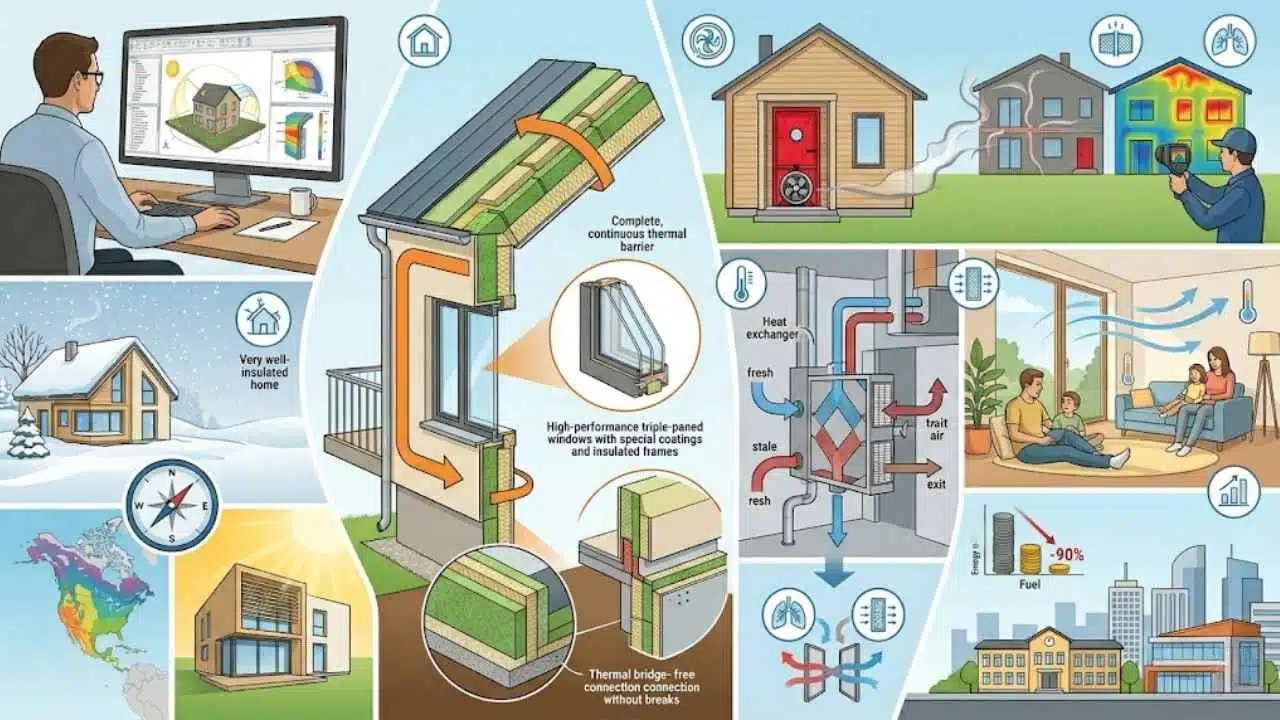
Passive House cuts heating and cooling energy use by up to 90 percent, while making indoor comfort feel much more steady and predictable.
Passive House is a certified, performance-based building standard. It focuses on how a building actually performs, not how green it sounds on paper.
The standard was developed by the Passive House Institute, and in the US, Phius adapted passive building standards for North American climate zones. That matters because a house in Minnesota should not be detailed the same way as one in Georgia or Arizona.
- Measured airtightness: classic Passive House certification uses a maximum airtightness target of 0.6 ACH50.
- Verified ventilation: the standard expects heat-recovery ventilation that can recover at least 75 percent of the heat in exhaust air.
- Modeled performance: teams use tools such as PHPP or WUFI Passive before construction, then confirm results with testing after the build is complete.
That testing piece is what sets passive house certification apart from ordinary marketing claims. If you want the real benefits, ask whether the project is being modeled, tested, and certified, not just described as energy-efficient.
In the US, the early work of builders and designers such as Katrin Klingenberg helped show that passive buildings were practical here, not just in Europe. Today, the method is used in homes, schools, affordable housing, and commercial buildings.
The Core Principles of Passive House Design
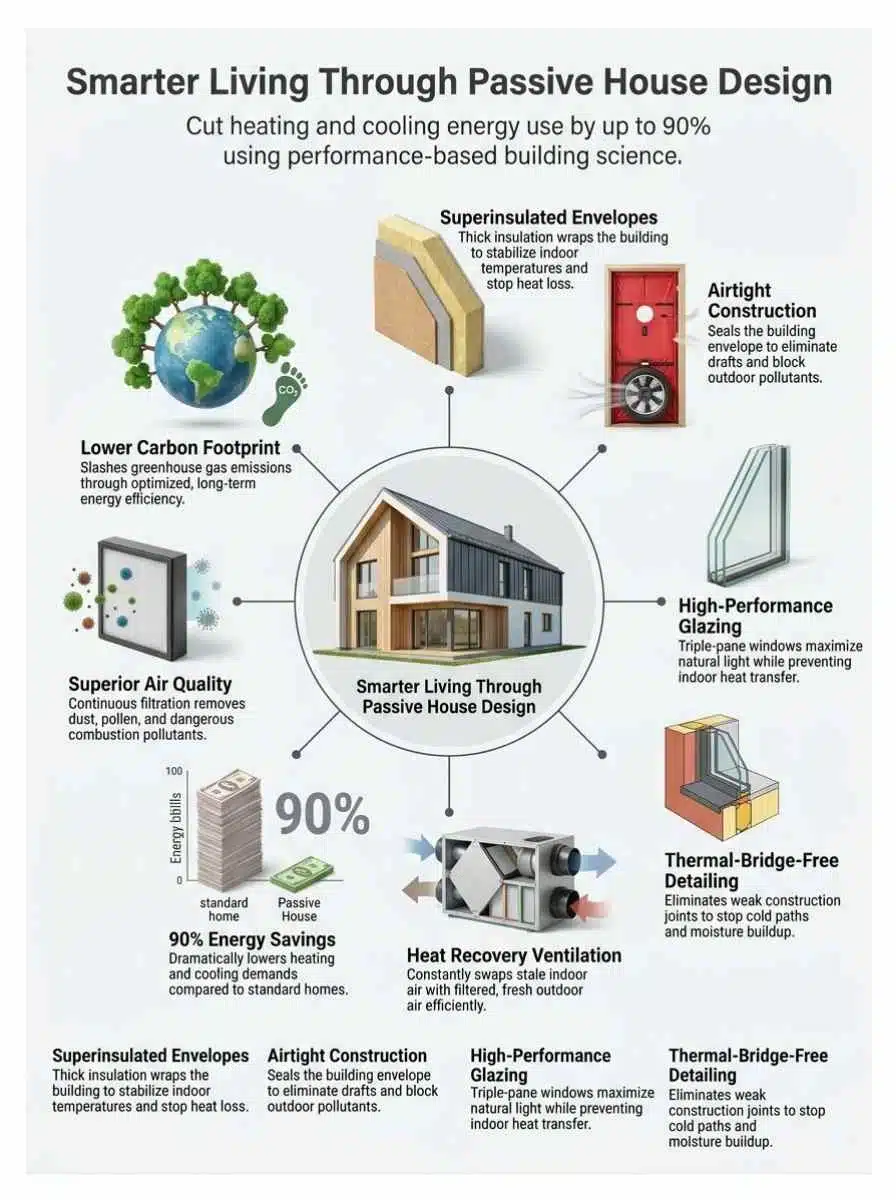
The five core principles work as one system. If even one part is weak, the building loses energy efficiency, comfort, and durability.
Superinsulated Envelopes
A superinsulated envelope wraps the roof, walls, and floor in enough insulation to slow heat flow in both directions. In the US, Phius uses climate-specific targets, so the right insulation package changes with local weather, humidity, and solar exposure.
This is where the building envelope becomes your first line of defense against high energy consumption. The best assemblies keep insulation continuous at the slab edge, rim joist, roof-wall junction, and around openings, because small weak spots can undo a lot of expensive insulation.
- Focus first on continuity: a pretty wall section means little if insulation stops at the slab or eave.
- Prioritize roof and slab edges: these spots are common heat-loss paths in US homes.
- Match the assembly to your climate zone: dry cold climates and mixed-humid climates need different moisture and condensation strategies.
Airtight Construction
Airtight construction controls air leakage through the shell, so your heating and cooling system is not fighting random drafts all day. In classic Passive House terms, that means a blower door result of 0.6 ACH50 or better, while Phius commonly uses an enclosure-based airtightness threshold of 0.060 CFM50 per square foot for many projects.
That number sounds technical, but the lesson is simple: airtightness needs to be planned, not guessed. If your builder cannot point to the air barrier on the drawings, the job will almost always get harder and more expensive in the field.
- Ask where the air barrier is on every drawing.
- Ask who owns each penetration, including plumbing, wiring, and HVAC crews.
- Ask when blower door testing happens, because a mid-construction test catches leaks while they are still easy to fix.
High-Performance Glazing
Windows are a huge part of passive design. The Department of Energy notes that heat gain and heat loss through windows account for 25 percent to 30 percent of residential heating and cooling energy use, so better glazing can change both comfort and bills in a visible way.
Low-e coatings are one of the most valuable features to look for. DOE guidance says low-e windows usually cost about 10 percent to 15 percent more than standard units, yet they can reduce energy loss by about 30 percent to 50 percent, which is why high-performance glazing often pays off faster than people expect.
Placement matters just as much as the glass itself. South-facing windows that sit within about 30 degrees of true south can help with passive heating in winter, while proper shading keeps them from causing summer overheating.
East- and west-facing glass needs extra care, because it catches lower-angle sun that is harder to block. Skylights and roof windows can be useful for daylighting, but they should be sized carefully and detailed with the same attention you would give to wall windows.
Thermal-Bridge-Free Detailing
A thermal bridge is any place where heat finds an easier path through the building envelope. Common trouble spots include slab edges, balcony connections, window bucks, shelf angles, and poorly detailed fasteners.
This is not just an energy issue. Thermal bridges create cold interior surfaces, and cold surfaces raise the risk of condensation, mold, and finish damage.
- Use continuous exterior insulation where the assembly allows it.
- Break metal connections at balconies, canopies, and clip systems.
- Pay close attention to window installation, because even excellent glazing underperforms if the frame and sill are weak points.
On complex projects, teams use PHPP or WUFI Passive to model these weak areas before construction starts. That kind of building science work saves money later, because it catches moisture and durability issues before they are buried behind drywall.
Heat Recovery Ventilation
A heat recovery ventilator, or HRV, and its close cousin the ERV, bring in fresh air while capturing heat from outgoing air. DOE guidance says many whole-house energy recovery systems can recover about 70 percent to 80 percent of the energy in exhaust air, which is why a tight passive house can still have fresh air without a big energy penalty.
This is one of the reasons passive buildings feel healthier. You are not relying on random leaks for ventilation, and you are not forced to open windows in bad weather just to get fresh air.
- Commission the system: balanced airflow matters as much as the equipment itself.
- Change filters on schedule: dirty filters reduce airflow and make the system noisier.
- Keep source control in place: use a vented range hood and manage moisture at bathrooms and laundry areas.
For colder parts of the US, this becomes even more practical. In the latest DOE Efficient New Homes requirements, balanced HRV or ERV ventilation is required in climate zones 6 through 8, which tells you how important controlled mechanical ventilation has become in serious high-performance design.
How Passive House Design Reduces Energy Consumption
Passive House lowers energy consumption by reducing demand first. That sounds simple, but it changes the whole design process.
- It cuts heat flow with a superinsulated envelope and airtight construction.
- It manages solar gain with orientation, shading, and high-performance glazing.
- It keeps fresh air efficient through balanced mechanical ventilation and heat recovery.
- It right-sizes equipment so the remaining heating and cooling loads can often be handled by smaller systems.
This demand-first logic is why passive house and renewable energy work so well together. If you shrink the heating and cooling load first, the heat pump can be smaller, the ductwork can be simpler, and the solar array needed for a net zero target can be smaller too.
Passive solar ideas help here as well. DOE guidance notes that thermal mass, such as concrete, brick, tile, or even a slab floor, can absorb heat during the day and release it later, which smooths out temperature swings and supports passive heating and passive cooling.
That is the real engine of energy use reduction. You stop wasting energy through the shell, then you let better equipment do a smaller, easier job.
Key Benefits of Passive House Design
The biggest benefits of passive house design show up in daily life. You feel them in your utility bills, your indoor air quality, and the way your home stays comfortable from room to room.
Energy Efficiency
Passive house delivers deep energy efficiency because it attacks the biggest losses first. Phius says a passive building typically costs about 3 percent to 5 percent more than a conventional single-family home, while multifamily projects often come in around 0 percent to 3 percent above a standard baseline, which is one reason passive design has gained traction in affordable housing.
That extra upfront cost needs to be judged against decades of lower operating costs. For builders, the math can look even better right now, because as of June 2026 the IRS still allows a Section 45L credit of up to $5,000 per qualifying efficient new home acquired before July 1, 2026.
Improved Indoor Air Quality
EPA notes that Americans spend about 90 percent of their time indoors. That makes indoor air quality a real health issue, not a nice bonus.
Fuel-burning appliances can release carbon monoxide, nitrogen dioxide, and particles, so passive house works best when tight construction is paired with source control and steady fresh air. In practice, that means using heat-recovery ventilation, sealing the shell well, choosing low-emission materials, and making sure kitchen exhaust actually vents outside.
Enhanced Comfort
Comfort in a passive house feels different from comfort in a standard home. Rooms stay more even, floors and walls feel less cold in winter, and you do not get the usual hot-and-cold swings near windows or exterior walls.
The classic Passive House comfort criteria also aim to keep overheating low, with no more than 10 percent of the hours in a year above 77°F. That is why shading, glazing choice, and nighttime cooling strategies matter just as much as insulation.
You also get a quieter interior. Thick insulation, airtight construction, and better windows do a great job blocking traffic noise, neighborhood noise, and the constant hum that often leaks through ordinary exterior walls.
Reduced Carbon Footprint
A passive house cuts emissions because it needs much less energy for space conditioning in the first place. That is good for your utility budget, and it is good for the electricity grid during hot afternoons and cold snaps.
If you are working on an existing building, the carbon story can get even better. Phius REVIVE 2024 and the Passive House Institute’s EnerPHit pathway both recognize that upgrading what you already have can deliver major savings while avoiding the embodied carbon that comes with tearing everything down and starting over.
Passive House Design vs. Net Zero Energy Buildings
Passive House and Net Zero Energy Buildings often work together, but they are not the same thing. Passive House focuses on reducing demand through the building itself, while net zero focuses on balancing annual energy use with renewable energy generation.
| Comparison Point | Passive House Design | Net Zero Energy Buildings |
|---|---|---|
| Main target | Cut heating and cooling demand as deeply as possible, often by up to 90 percent. | Match annual energy use with on-site or off-site renewable energy. |
| What happens first | Envelope, airtightness, glazing, shading, and ventilation are optimized before equipment is sized. | Efficiency upgrades are usually combined with solar, storage, or other generation strategies. |
| Role of renewable energy | Helpful, but not always required for core certification paths such as Phius CORE. | Essential, because the building must offset its annual energy use. |
| Mechanical systems | Often smaller and simpler because the building load is already low. | Can still be larger if the envelope is only average and solar is doing the heavy lifting. |
| Comfort and indoor air | Strong, because the standard directly targets airtightness, ventilation, and thermal comfort. | Varies a lot, because net zero does not automatically guarantee a quiet, draft-free, well-ventilated interior. |
| Best fit | Great for owners who want dependable comfort, lower bills, and lasting energy conservation. | Great for owners with good solar access who want very low or zero annual utility use. |
| Smart decision rule | Choose this path if you want the shell to do most of the work. | Choose this path if you can pair a strong envelope with enough renewable energy to close the gap. |
If roof space is limited, the passive house path often gives you the stronger first move. If the envelope is already excellent and you have good solar access, net zero becomes much easier to reach.
Applications of Passive House Design
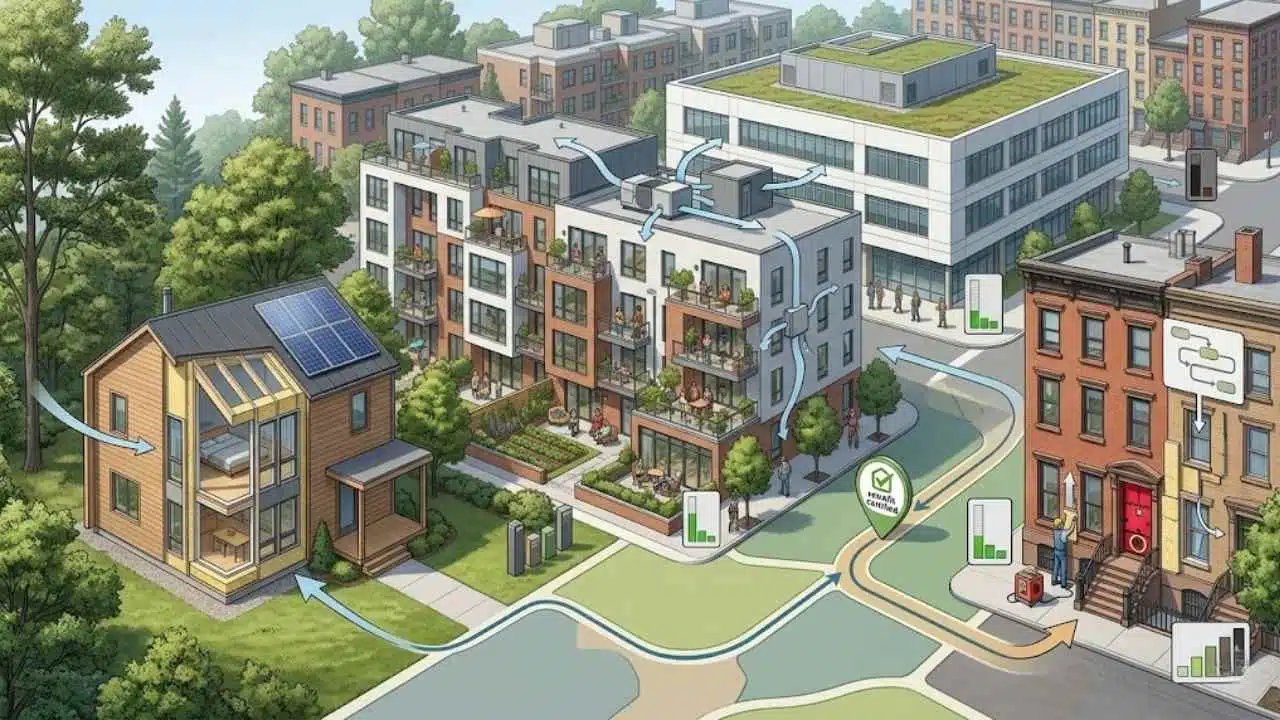
Passive House works far beyond one custom home. It fits single-family houses, apartments, schools, clinics, offices, and deep energy retrofits.
Residential Homes
The residential sector helped put passive house on the map in the US. One early milestone was the Smith House in Urbana, Illinois, designed by Phius founder Katrin Klingenberg, which showed that passive building principles could be adapted for American construction and climate conditions.
For homeowners, the appeal is easy to understand: lower energy costs, cleaner air, fewer drafts, and a more stable indoor temperature all year. A good passive house also makes future electrification easier, because the heating and cooling loads are already small.
Commercial Buildings
Commercial and multifamily projects often benefit even more because larger buildings can spread the cost of high-performance assemblies across more floor area. New York City Housing Preservation and Development says buildings certified to Passive House standards can reduce heating and cooling energy by up to 90 percent and overall energy use by up to 75 percent compared with existing buildings.
That is why passive design shows up more and more in affordable housing and civic work. NYC HPD now highlights completed projects such as Knickerbocker Commons, Beach Green Dunes, and HANAC Corona Senior Residence, which shows this is no longer a niche idea reserved for luxury homes.
Retrofitting Existing Structures
Existing buildings are a huge part of the opportunity. The Passive House Institute created EnerPHit for retrofits that cannot realistically hit full new-build passive house targets, and that pathway can still deliver energy savings in the 75 percent to 90 percent range.
- Start with testing: use a blower door test and insulation review to find the biggest losses.
- Upgrade the envelope first: roof, walls, slab edges, and windows usually matter more than fancy equipment.
- Add balanced ventilation: fresh air and moisture control become more important as the shell gets tighter.
- Phase the work if needed: deep energy retrofits can be planned over time instead of done all at once.
This phased approach is especially helpful for older homes and buildings with preservation constraints. You may not get every detail perfect in one round, but you can still make major gains if the roadmap is clear and the envelope strategy stays consistent.
Future of Passive House Design
The future of passive house design looks less experimental and more practical. Better materials, better modeling, and tougher building energy codes are pushing the market in the same direction.
Advancements in Materials and Technology
High-performance windows, better low-e coatings, prefabricated wall panels, and smarter air barrier systems are making passive construction easier to repeat. Phius now certifies products such as windows and prefabricated panels, which helps builders compare options that are actually suited to passive buildings.
Modeling is improving too. Phius reports that measured performance in its certified projects has come within 7 percent of predicted results when modeled in WUFI Passive, which is a big reason owners and developers are more willing to trust the numbers during design.
That means fewer surprises after move-in. It also means teams can right-size heat pumps, avoid moisture risk, and plan for passive cooling with more confidence than they could a decade ago.
Potential for Widespread Adoption
Passive house is moving into the mainstream because the case is getting easier to prove. Phius says it has certified more than 11.2 million square feet of passive building projects and now certifies the majority of passive house projects in North America.
- Codes are tightening, so better envelopes and better ventilation are becoming normal practice.
- Affordable housing programs are paying attention, because lower utility bills help residents and owners at the same time.
- More trained professionals are entering the field, which makes design and construction less risky for first-time teams.
For readers and property owners, that is good news. You no longer have to chase a rare specialist to apply passive design principles well, and you can expect these ideas to show up more often in mainstream housing, schools, and zero carbon building programs.
Final Thoughts
Passive house is not a style trend. It is a clear building-science method for cutting energy consumption by fixing the envelope, the windows, and the ventilation strategy first.
If you are building new, compare teams on airtightness targets, glazing specs, shading, and ventilation design, not just price per square foot. If you are upgrading your home, start with insulation, air sealing, and a fresh-air plan, then add right-sized equipment and renewable energy where it makes sense.
That is why passive house design matters: you get lower bills, better indoor air quality, quieter rooms, and comfort that lasts for years.
Frequently Asked Questions (FAQs) About Passive House Design
1. What is passive house design?
Passive house design builds homes to use very little energy, by tightening the building envelope, adding strong insulation, and using a controlled ventilation system.
2. Why does passive house design matter?
It boosts energy efficiency, cuts bills, and raises indoor air quality. It also helps the climate, and adds long-term savings.
3. How does passive house design work?
Designers make the house airtight, stop thermal bridges, and add deep insulation, they place windows for passive solar gain, and they use a ventilation system that recovers heat. The house holds heat or keeps out heat with little active heating. It feels like a warm sweater for your whole home.
4. Is passive house design expensive?
It can cost more up front, for better windows, tighter work, and careful design. Over time, owners often save money, new builds usually see faster payback than retrofits, and the comfort and indoor air quality pay off too.