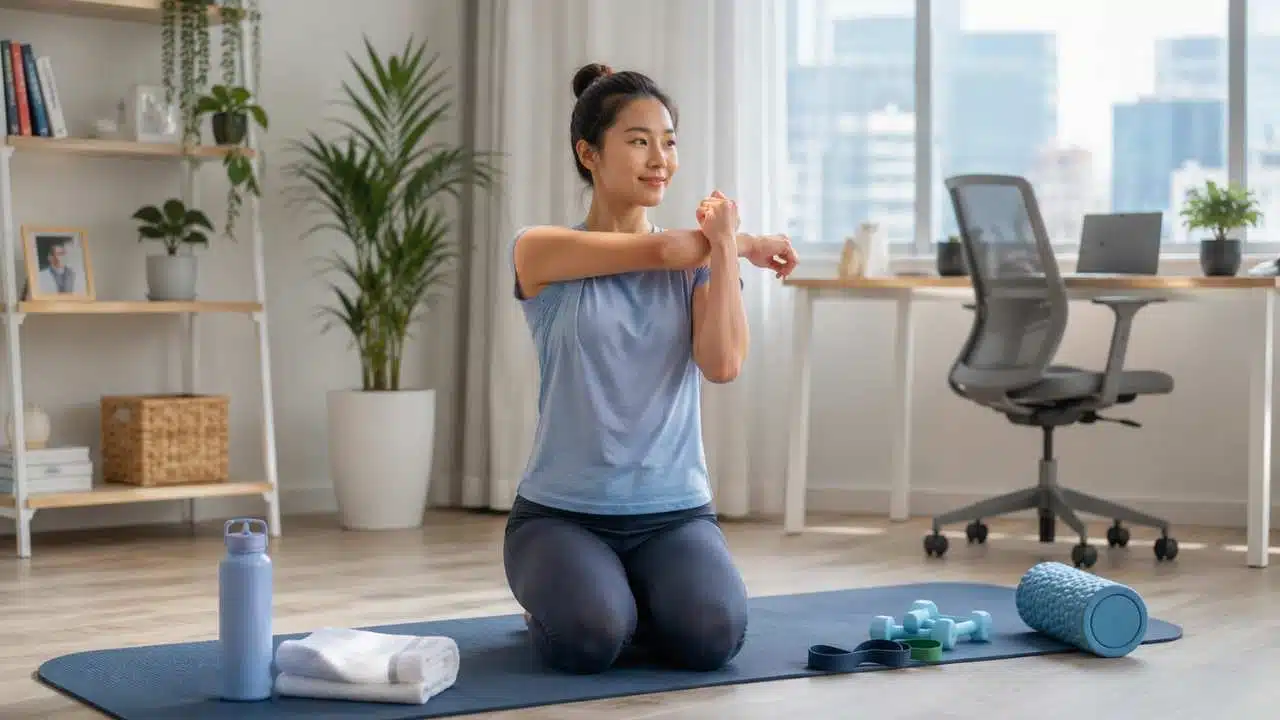
Warm up cool down essentials are usually the first things beginners skip and the first things their bodies complain about later. I understand why it happens. When you are new to fitness, the workout itself already feels like a big task. You may already be thinking about squats, walking, dumbbells, treadmill time, soreness, time management, and whether you are doing things correctly. So adding extra minutes before and after the workout can feel unnecessary.
But from practical experience, warm-ups and cool-downs can change the entire workout experience. They make movement smoother, reduce the awkward “cold body” feeling, help you notice stiffness early, and make recovery feel more organized. They do not need to be complicated. They just need to be consistent.
Beginners often think warm-ups are only for athletes. That is not true. If you sit at a desk for long hours, you may need warm-ups even more than someone who moves all day. Long sitting can make your hips tight, glutes inactive, shoulders rounded, upper back stiff, and breathing shallow. If you jump straight from that posture into exercise, even simple movements can feel uncomfortable.
A proper pre-workout warm-up prepares your body before training. A proper post-workout stretching and recovery routine helps your body settle afterward. Together, they make your beginners workout routine easier to repeat. That matters because consistency is the real foundation of fitness for beginners.
This article is part of the broader Beginner’s Complete Fitness Guide cluster. It also connects naturally with the beginners workout routine article because a workout routine is not only about the main exercises. It is also about how you start, how you finish, and how well your body recovers before the next session.
For desk workers, creators, founders, and busy professionals, warm-ups and cool-downs are not small details. They are part of the Corporate Athlete lifestyle. You are not only training for the gym. You are training to move better, sit better, recover better, and protect your body from the daily stress of modern work. HappinessFit.com can also support this practical wellness mindset by helping readers build healthier habits around movement, recovery, and fitness.
Why Warm-Up and Cool-Down Essentials Matter for Beginners?
Warm-up and cool-down essentials matter because beginners are still learning how their bodies respond to exercise. When you are experienced, you usually know how your knees feel before squats, how your back responds to hinges, or how much walking your body can handle. Beginners do not always have that awareness yet, so they need a smoother entry and exit from training. A warm-up gives your body a gradual start. Instead of suddenly asking your joints, muscles, heart, lungs, and nervous system to perform, you build intensity step by step. This helps the first real exercise feel less stiff and more controlled. I have seen beginners move much better after only five minutes of warm-up because their hips, shoulders, and breathing finally catch up.
A cool-down does the opposite. It helps your body shift out of exercise mode. After a workout, your heart rate may be elevated, your muscles may feel warm, and your breathing may still be faster than normal. If you stop suddenly and sit down immediately, your body can feel stiff or unsettled. These routines also teach body awareness. During a warm-up, you may notice that your left hip feels tighter than usual or your shoulders feel tired from laptop work. During a cool-down, you may notice which muscles worked hardest or whether any joint felt irritated. That feedback helps you adjust future workouts.
For beginners, this awareness is valuable because it prevents blind training. You stop treating every workout like a test and start treating it like a conversation with your body. That is how safer, smarter fitness habits begin.
| Why It Matters | What Beginners Often Do | Better Beginner Approach |
| Prepares the body | Start exercising cold | Use 5–10 minutes of easy movement |
| Improves movement quality | Feel stiff during first exercises | Add dynamic mobility before training |
| Reduces sudden stress | Jump into hard effort quickly | Gradually raise intensity |
| Builds awareness | Ignore tightness or discomfort | Use warm-up as a body check |
| Supports recovery | Stop suddenly after training | Cool down with slow movement |
| Reduces stiffness | Sit immediately after exercise | Stretch gently after the body is warm |
| Improves consistency | Dread uncomfortable workouts | Make sessions feel smoother |
| Protects confidence | Think discomfort means failure | Learn how preparation changes performance |
A warm-up and cool-down are not extra decorations. They are part of the workout system.
What a Pre-Workout Warm-Up Actually Does?
A pre-workout warm-up prepares your body for the work ahead. It gradually increases blood flow, raises body temperature, wakes up the muscles, moves the joints, and helps your mind shift from normal life into training mode. For beginners, this is especially important because the body may not feel ready at the start. If you have been sitting for hours, your hips may feel tight, your ankles may feel stiff, your glutes may feel inactive, and your upper back may feel rounded. A proper pre-workout warm-up helps bring those areas back into movement. It does not magically fix everything, but it gives your body a better starting position.
A good warm-up should match the workout. If you are going to walk, jog, or cycle, start with a slower version of that activity. If you are going to strength train, use light dynamic movements that prepare the same patterns. Before squats, practice easy squats. Before push-ups, prepare the shoulders and chest. Before rows, wake up the upper back. The warm-up should not exhaust you. This is a common beginner mistake. Some people turn the warm-up into a mini workout with jumping jacks, burpees, and long planks, then wonder why the main workout feels harder. A warm-up should make the workout easier, not drain your energy before it begins.
I usually prefer warm-ups that include three simple layers: general movement, mobility, and exercise-specific practice. That structure works because it starts broad and then becomes more focused. You wake up the whole body first, then prepare the areas you need most.
| Warm-Up Layer | What It Means | Beginner Example |
| General movement | Light activity to raise temperature | Marching, easy walking, light cycling |
| Joint mobility | Moving joints through comfortable range | Shoulder circles, hip circles, ankle rolls |
| Muscle activation | Waking up muscles you will use | Glute bridges, band pull-aparts |
| Pattern practice | Light version of workout movement | Chair squats before squats |
| Mental preparation | Focusing on breathing and control | Slow breaths before first set |
| Gradual intensity | Slowly building effort | Walk before brisk walk |
| Body check | Noticing tightness or pain | Adjusting if knees or back feel off |
| Exercise rehearsal | Practicing the session’s main movement | Wall push-ups before incline push-ups |
A pre-workout warm-up is not about doing more. It is about doing the main workout better.
Dynamic Stretching vs Static Stretching Before Workouts
Beginners often confuse dynamic stretching and static stretching. This matters because both can be useful, but they are not the same thing. They also do not always belong at the same time in your workout. Dynamic stretching means moving through a range of motion. It includes movements like arm circles, hip circles, leg swings, bodyweight squats, walking lunges, ankle rocks, and thoracic rotations. These movements prepare the body because they involve motion, balance, control, and light muscle activation.
Static stretching means holding a stretch in one position for a period of time. Examples include holding a hamstring stretch, calf stretch, chest stretch, quad stretch, or hip flexor stretch. Static stretching can be helpful, especially after training or during separate flexibility sessions, but it is not always the best first step before strength work. In practical beginner routines, dynamic movement usually works better before exercise. It helps the body feel awake and ready. Long static holds before lifting can sometimes make the body feel too relaxed or less prepared for strength, especially if the stretch is aggressive.
That does not mean static stretching is bad. It simply needs the right place. After a workout, when the muscles are warmer, gentle static stretching can help you relax and reduce tightness. The key word is gentle. Stretching should not feel like a fight.
A simple beginner rule works well: move before training, hold stretches after training. This keeps the process easy to remember and reduces confusion.
| Stretch Type | Best Timing | Beginner Example | Main Purpose |
| Dynamic stretching | Before workout | Hip circles, arm swings, leg swings | Prepares body for movement |
| Static stretching | After workout | Hamstring hold, calf hold, chest stretch | Helps flexibility and relaxation |
| Mobility drills | Before or separate session | Ankle rocks, thoracic rotations | Improves joint movement |
| Activation drills | Before strength work | Glute bridges, band rows | Wakes up key muscles |
| Gentle holds | After workout | 20–30 second relaxed stretch | Reduces tightness |
| Aggressive stretching | Avoid before hard training | Forcing deep positions | Can irritate tissues |
| Movement rehearsal | Before strength exercises | Chair squat practice | Improves exercise control |
| Relaxed flexibility work | Separate session or after workout | Easy full-body stretching | Supports long-term mobility |
Beginners do not need complicated stretching rules. Use movement before training and relaxed holds after training.
How Long Should a Beginner Warm-Up Be?
A beginner warm-up does not need to be long. For most simple workouts, 5–10 minutes is enough. If the session is harder, the weather is cold, your body feels stiff, or you have been sitting all day, you may need a little longer. The warm-up should match the workout and the body you are bringing into that workout. For an easy walk, a few minutes of slow walking may be enough. For strength training, you may need mobility and activation before the first exercise. For a brisk cardio session, you should gradually build pace instead of starting fast immediately. For a full-body home workout, 6–10 minutes can make a big difference.
Beginners sometimes skip warm-ups because they think warm-ups must be long and complicated. That is not true. A short, focused warm-up done consistently is far better than an elaborate warm-up you never do. Five useful minutes can change how your first set feels. The best signal is readiness. After a warm-up, your body should feel warmer, looser, and more coordinated. Your breathing should be slightly elevated but controlled. Your first exercise should feel smoother than it would have felt cold.
If you feel tired before the workout begins, the warm-up was too intense. If you still feel stiff and awkward after the warm-up, you may need a few more minutes or better movement choices. Over time, you will learn what your body needs. Desk workers may need extra attention around hips, shoulders, upper back, and ankles. Someone who has been moving all day may need less. That is why warm-up length should be flexible, not fixed forever.
| Workout Type | Suggested Warm-Up Time | What to Include |
| Easy walking | 3–5 minutes | Slow walking, gentle pace build-up |
| Beginner strength workout | 5–8 minutes | Mobility, activation, light practice reps |
| Brisk cardio | 5–10 minutes | Easy cardio, gradually faster pace |
| Full-body home workout | 6–10 minutes | Joint movement, bodyweight practice |
| Cold morning workout | 8–12 minutes | More gradual movement |
| Stiff desk-worker session | 8–10 minutes | Hips, shoulders, upper back |
| Higher-intensity session | 10–15 minutes | Longer build-up and specific prep |
| Short mobility session | 3–5 minutes | Gentle movement and breathing |
A warm-up should earn its place by making the workout feel better, not longer for no reason.
A Simple Pre-Workout Warm-Up Routine for Beginners
A simple pre-workout warm-up should prepare the whole body without turning into another workout. The goal is to move from general to specific. Start with easy movement, loosen the joints, activate key muscles, and then practice the first exercise lightly. This routine works well before a beginner strength workout, home workout, or mixed cardio-strength session. It is especially useful if you sit for long hours and feel stiff before training. I like this kind of warm-up because it is short enough to repeat and complete enough to cover the major areas.
Start with light movement. March in place, walk around the room, or use an easy treadmill pace. This raises body temperature and helps you transition from stillness to movement. Then move the shoulders, hips, and ankles because those joints often feel restricted after sitting. Next, wake up the glutes and upper back. Beginners often struggle with squats and hinges because their hips and glutes are not active. They also struggle with posture because the upper back is weak or stiff. Light activation work helps you feel more connected to the muscles you are about to use.
Finally, do a few easy practice reps of your first exercise. If your workout starts with chair squats, do slow bodyweight chair squats first. If it starts with push-ups, do wall push-ups first. If it starts with rows, do light band rows first. This routine is not meant to impress anyone. It is meant to make the real workout smoother.
| Warm-Up Step | Time or Reps | Why It Helps |
| Easy march or walk | 1–2 minutes | Raises temperature gradually |
| Shoulder circles | 30–45 seconds | Prepares shoulders |
| Hip circles | 30–45 seconds | Loosens hips |
| Ankle rocks | 8–10 each side | Helps squats and walking |
| Bodyweight good mornings | 8–10 reps | Prepares hip hinge |
| Glute bridges | 8–12 reps | Activates glutes |
| Wall push-ups | 8 reps | Prepares upper body |
| Chair squats | 8 reps | Prepares lower body |
This warm-up is simple enough for beginners and practical enough to use before most workouts.
Warm-Up Routine Before Cardio Workouts
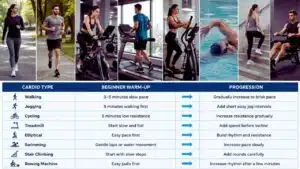
A cardio warm-up should gradually move you from rest to your planned pace. This sounds simple, but beginners often start too fast. They begin walking, jogging, cycling, or using the treadmill at the pace they want to maintain, then feel uncomfortable within minutes. For walking, start slower than your normal pace. After a few minutes, gradually increase speed. For jogging, begin with walking, then brisk walking, then short easy jogging intervals. For cycling, start with low resistance. For swimming, begin with easy laps or gentle water movement.
The goal is to prepare your heart, lungs, muscles, and joints. Cardio should not feel like a sudden shock. A good warm-up makes breathing feel more controlled and helps your legs feel ready. If you feel out of breath immediately, you started too hard. The talk test is useful for beginners. During an easy warm-up, you should be able to talk comfortably. During moderate cardio, you should still be able to speak in short sentences. If you are gasping early, slow down and let your body catch up.
Desk workers may benefit from a few mobility movements before cardio, especially after long sitting. Ankle rocks, hip circles, calf raises, and gentle marching can make the first few minutes of walking or jogging feel better. A cardio warm-up should feel like a ramp, not a jump. The body usually responds better when intensity rises gradually.
| Cardio Type | Beginner Warm-Up | Progression |
| Walking | 3–5 minutes slow pace | Gradually increase to brisk pace |
| Jogging | 5 minutes walking first | Add short easy jog intervals |
| Cycling | 5 minutes low resistance | Increase resistance gradually |
| Treadmill | Start slow and flat | Add speed before incline |
| Elliptical | Easy pace first | Build rhythm and resistance |
| Swimming | Gentle laps or water movement | Increase pace slowly |
| Stair climbing | Start with slow steps | Add rounds carefully |
| Rowing machine | Easy pulls first | Increase rhythm after a few minutes |
A good cardio warm-up helps you avoid that “why does this feel terrible already?” feeling.
Warm-Up Routine Before Strength Training
A strength training warm-up should prepare the joints and movement patterns you are about to use. If your workout includes squats, you need hips, knees, ankles, and core ready. If it includes push-ups, you need shoulders, wrists, chest, and upper back prepared. If it includes rows, your shoulder blades need to move well. Beginners often think lifting light weights automatically counts as a warm-up. It can help, but a better warm-up usually includes mobility and activation first. This is especially important for people who sit for long periods or feel stiff before training.
For strength training, I like movement-specific preparation. Before squats, do chair squats or bodyweight squats. Before hip hinges, practice good mornings. Before push-ups, do wall push-ups. Before rows, do band pull-aparts or light band rows. These movements tell the body what is coming. The first set of each strength exercise can also act as a warm-up set. Use a lighter effort before your working sets. This helps you check form, range of motion, and comfort before adding more challenge.
Do not make the warm-up too intense. If your legs are tired before squats or your shoulders are tired before push-ups, you did too much. The goal is readiness, not fatigue. Strength warm-ups are especially important for beginners because strength training requires control. A good warm-up helps you move with better alignment and confidence.
| Strength Exercise | Warm-Up Movement | Beginner Tip |
| Squat | Chair squat practice | Keep feet stable and chest tall |
| Hip hinge | Bodyweight good morning | Push hips back, do not round back |
| Push-up | Wall push-up | Warm shoulders and chest |
| Row | Band pull-apart | Wake up upper back |
| Lunge | Supported split stance | Use balance support |
| Glute bridge | Bodyweight bridge | Squeeze glutes gently |
| Core work | Dead bug practice | Move slowly and breathe |
| Carry | Light suitcase hold | Stand tall before walking |
A strength warm-up should make each exercise feel cleaner, not harder.
What a Cool-Down Actually Does After a Workout?
A cool-down helps your body transition from exercise back to normal. After training, your breathing may be elevated, your heart rate may be higher, and your muscles may feel warm or tight. Stopping suddenly and sitting immediately can make some beginners feel uncomfortable or stiff. A cool-down does not need to be complicated. Slow walking, easy cycling, relaxed breathing, and gentle stretching can work well. The main goal is to lower intensity gradually and help your body settle. Think of it as landing the workout instead of abruptly cutting it off.
I also find cool-downs useful for reflection. After a workout, you can quickly notice what felt good, what felt tight, and whether anything felt painful. This is important for beginners because every workout teaches you something about your body. Cool-downs can also create a mental ending to the workout. That matters more than people think. When you finish calmly, the session feels complete. You are less likely to feel rushed or scattered. This makes the routine easier to repeat.
For desk workers, cool-downs are especially valuable because many return straight to sitting. If you exercise and then immediately sit for another three hours, your hips and back may feel stiff. A short cool-down helps reduce that harsh transition. A good cool-down should leave you feeling calmer, not more tired. It should help your body feel organized after training.
| Cool-Down Purpose | What It Helps With | Beginner Example |
| Gradual transition | Lowers intensity slowly | 3-minute slow walk |
| Breathing control | Helps calm the body | Slow nasal breathing |
| Muscle relaxation | Reduces tight feeling | Gentle stretching |
| Body awareness | Notices pain or fatigue | Quick post-workout check |
| Recovery mindset | Signals workout completion | Short routine after every session |
| Desk-worker support | Reduces stiffness before sitting | Hip flexor and chest stretch |
| Habit building | Makes workouts feel complete | Same cool-down each time |
| Nervous system reset | Helps shift out of effort mode | Slow breathing and relaxed movement |
A cool-down is not about doing more work. It is about finishing the workout properly.
Post-Workout Stretching for Beginners
Post-workout stretching works best when it is gentle, slow, and focused on areas that actually feel tight. Beginners often stretch too aggressively because they think deeper is better. It is not. Stretching should feel like mild tension, not pain. After a workout, your muscles are warmer, which usually makes stretching feel easier. This is why static stretching often fits better after training than before. You can hold a stretch, breathe slowly, and let the body relax.
The main areas beginners often need to stretch include calves, hamstrings, hip flexors, glutes, chest, shoulders, and upper back. Desk workers may especially benefit from hip flexor and chest stretches because sitting keeps the front of the hips shortened and often encourages rounded shoulders. Hold each stretch for about 20–30 seconds if it feels comfortable. You do not need to force long holds. One or two rounds per area is enough for most beginners. Stretching should be calm and controlled, not aggressive.
Post-workout stretching should not replace strength training or mobility work. Flexibility is useful, but strength and control matter too. If a muscle always feels tight, it may also need strengthening, not only stretching. Think of post-workout stretching as one part of your workout recovery routine. It helps you finish calmly, but the bigger recovery picture also includes sleep, hydration, nutrition, and rest days.
| Stretch | Area Targeted | Beginner Tip |
| Calf stretch | Lower leg | Keep heel down gently |
| Hamstring stretch | Back of thigh | Avoid rounding aggressively |
| Hip flexor stretch | Front of hip | Squeeze glute lightly |
| Glute stretch | Hips and glutes | Keep breathing slow |
| Chest stretch | Chest and shoulders | Do not force the shoulder |
| Child’s pose | Back and hips | Relax and breathe |
| Upper back stretch | Mid-back and shoulders | Keep neck relaxed |
| Quad stretch | Front of thigh | Hold support if needed |
Post-workout stretching should leave you calmer, not irritated.
A Simple Workout Recovery Routine After Training

A workout recovery routine does not need to be fancy. Beginners often think recovery means expensive tools, supplements, massage guns, ice baths, or complicated routines. Those things can help some people, but the basics matter more: cooling down, hydration, food, sleep, and light movement. After training, start with slow movement. Walk for a few minutes or move gently until your breathing feels calmer. Then stretch the areas that feel tight. Drink water. Eat a balanced meal when possible, especially if the workout was challenging.
Protein and carbohydrates can be useful after exercise because your body needs building materials and energy. You do not need to panic about perfect timing, but you should avoid ignoring food completely if you feel drained after training. Sleep is the biggest recovery tool many beginners ignore. If you train regularly but sleep poorly, your body may feel tired, sore, and unmotivated. Recovery happens between workouts, not only during the cool-down.
Light movement on rest days also helps. A short walk can reduce stiffness and improve how your body feels after strength training. Beginners often think rest means doing absolutely nothing, but gentle movement can be useful. The best recovery routine is simple enough to repeat. If your recovery routine is too complicated, you will skip it. Start with the basics and build from there.
| Recovery Step | What to Do | Why It Matters |
| Slow movement | Walk 2–5 minutes | Helps body settle |
| Gentle stretching | Hold easy stretches | Reduces tightness |
| Hydration | Drink water | Supports normal function |
| Balanced meal | Include protein and carbs | Supports repair and energy |
| Sleep | Keep consistent bedtime | Helps adaptation |
| Light movement | Walk on rest days | Reduces stiffness |
| Pain check | Notice warning signs | Helps prevent bigger issues |
| Routine review | Record what felt good | Improves future workouts |
Recovery is where your body earns the benefits of training.
Warm-Up and Cool-Down Routine for Desk Workers
Desk workers need special attention because sitting changes how the body feels. Long hours at a desk can make the hips tight, glutes inactive, chest tight, shoulders rounded, and upper back stiff. If you go straight from laptop posture into training, your body may not move well at first. A good warm-up for desk workers should open the hips, activate the glutes, move the upper back, and prepare the shoulders. This does not need to take long. Even 6–8 minutes can make a noticeable difference before a beginner workout.
Before workouts, desk workers should focus on dynamic movements like hip circles, glute bridges, thoracic rotations, wall push-ups, and band pull-aparts. These movements address common desk-related stiffness and make strength exercises feel more natural. After workouts, desk workers may benefit from hip flexor stretches, chest stretches, calf stretches, and gentle breathing. This is especially useful if they plan to return to the desk after training. Finishing a workout and sitting immediately can bring stiffness back quickly.
The cool-down is also a chance to reset posture. Stand tall, breathe slowly, loosen the chest, and move the hips before returning to work. This can make the rest of the workday feel better. This is where the Corporate Athlete idea becomes practical. You are not just training for exercise. You are building a body that can handle long workdays with less stiffness and better resilience.
| Desk-Worker Problem | Warm-Up Solution | Cool-Down Solution |
| Tight hips | Hip circles, glute bridges | Hip flexor stretch |
| Rounded shoulders | Band pull-aparts, wall slides | Chest stretch |
| Stiff upper back | Thoracic rotations | Child’s pose or upper-back stretch |
| Sleepy glutes | Glute bridges | Gentle walking |
| Neck tension | Shoulder circles | Slow breathing and posture reset |
| Low energy | Easy walking warm-up | Hydration and recovery meal |
| Long sitting after workout | Movement prep | Walk before returning to desk |
| Wrist stiffness | Wrist circles and wall push-ups | Gentle wrist stretch |
Desk workers should treat warm-ups and cool-downs as posture support, not just exercise extras.
Common Warm-Up Mistakes Beginners Make
Warm-up mistakes are common because beginners often do not know what a warm-up should feel like. Some skip it completely. Others do random stretches. Some make it too hard. Some hold deep stretches before lifting and wonder why the workout feels weak. The most common mistake is doing nothing. Beginners often go straight into squats, treadmill speed, or dumbbells. This can make the first few minutes feel stiff and uncomfortable. A short warm-up solves much of that.
Another mistake is using only static stretching before a workout. Holding a deep hamstring or quad stretch before strength training may not prepare your body as well as dynamic movement. Moving through a comfortable range of motion is usually more useful before training. Some beginners turn the warm-up into a workout. They do jumping jacks, burpees, long planks, and intense circuits before the actual routine. Then they are already tired when the workout starts. That defeats the purpose.
Another mistake is using the same warm-up for every workout. A walking session, strength session, and upper-body workout do not need identical preparation. Your warm-up should match the workout. A good warm-up should be specific, gradual, and repeatable. It should prepare your body without stealing energy from the session.
| Warm-Up Mistake | Why It Hurts | Better Choice |
| Skipping warm-up | Body feels stiff and unprepared | Use 5–10 minutes of easy movement |
| Only static stretching | May not prepare movement well | Use dynamic mobility first |
| Too intense | Causes fatigue before workout | Keep effort light to moderate |
| Random movements | Does not match workout | Prepare the muscles you will use |
| No body check | Misses pain or stiffness | Notice how joints feel |
| Too long | Feels like another workout | Keep it focused |
| Same warm-up for everything | May not fit the session | Match warm-up to workout type |
| Rushing the first set | Form feels awkward | Use light practice reps first |
A warm-up should prepare you, not punish you.
Common Cool-Down Mistakes Beginners Make
Cool-down mistakes usually happen because beginners are in a hurry. They finish the last set, feel relieved, and immediately stop. If they are at home, they sit down. If they are at the gym, they leave. If they work from home, they go straight back to the laptop. The first mistake is stopping suddenly after harder cardio. A gradual cool-down often feels better because it lets breathing and heart rate settle naturally. Even a few minutes of slow walking can help.
Another mistake is stretching too aggressively. Post-workout stretching should feel gentle. If you force a deep stretch, especially when tired, you may irritate the muscle or joint. Stretching should never feel like a test of toughness. Beginners also ignore hydration and food. A cool-down is not only stretching. Recovery includes water, balanced meals, and rest. If you finish a workout and then skip food for hours while feeling weak, your recovery may suffer.
The final mistake is ignoring pain. If something felt sharp during the workout, do not stretch it aggressively and hope it disappears. Pain is feedback. Modify next time and seek professional guidance if needed. A good cool-down is short, calm, and useful. It should make you feel more settled after exercise.
| Cool-Down Mistake | Why It Hurts | Better Choice |
| Stopping suddenly | Body may feel uncomfortable | Slow down gradually |
| Sitting immediately | Can increase stiffness | Walk for a few minutes |
| Stretching too hard | Can irritate tissues | Use gentle tension only |
| Ignoring hydration | Recovery may feel worse | Drink water after training |
| Skipping food when drained | Energy stays low | Eat balanced meal or snack |
| Ignoring pain | Small issues may grow | Modify and monitor |
| Making it too complicated | Hard to repeat | Use a simple 5–8 minute routine |
| Returning to desk instantly | Stiffness returns quickly | Walk, stretch, then sit |
A cool-down should help you leave the workout feeling better than when you rushed into it.
Warm-Up and Cool-Down Essentials for Different Workout Types
Different workouts need slightly different preparation and recovery. A walking session does not need the same warm-up as a strength workout. A full-body workout does not need the same cool-down as a short mobility session. For cardio, the warm-up should gradually increase pace. For strength training, the warm-up should prepare movement patterns. For mobility sessions, the warm-up can be very gentle. For desk-worker workouts, hips and shoulders usually need extra attention.
Cool-downs also change depending on the session. After cardio, slow movement works well. After strength training, gentle stretching for the worked muscles is useful. After a hard lower-body session, hips, hamstrings, calves, and glutes may need attention. After upper-body training, chest, shoulders, and upper back may need gentle stretching. Beginners should avoid using one random warm-up forever. Instead, learn a few basic patterns and adjust them based on the workout. This makes your routine more useful without making it complicated.
This is also where body awareness improves. Over time, you will know whether your ankles need more preparation before squats, whether your shoulders need more movement before push-ups, or whether your hips need more stretching after a long walk. Matching your warm-up and cool-down to the workout makes the whole session feel more professional and less random.
| Workout Type | Warm-Up Focus | Cool-Down Focus |
| Walking | Slow pace build-up | Easy walk and calf stretch |
| Jogging | Walk, brisk walk, easy jog | Slow walk and leg stretches |
| Strength training | Mobility and activation | Gentle stretches for worked muscles |
| Lower-body workout | Hips, ankles, glutes | Hip flexors, calves, hamstrings |
| Upper-body workout | Shoulders, upper back, wrists | Chest, shoulders, neck relaxation |
| Core workout | Breathing and trunk control | Back relaxation and breathing |
| Desk-worker session | Hips, glutes, upper back | Hip and chest stretches |
| Mixed home workout | Full-body mobility | Slow walk and full-body stretch |
The more your warm-up matches the workout, the better your body usually responds.
A Complete 10-Minute Warm-Up and Cool-Down Template
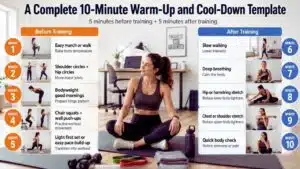
If you want one simple template, use a 10-minute structure: 5 minutes before training and 5 minutes after training. This is short enough for busy beginners and useful enough to make a difference. Before training, start with light movement, then move your joints, then practice the first exercise. After training, slow down, breathe, stretch gently, and check how your body feels. This gives your workout a clear beginning and ending.
This template works especially well for beginners who say they do not have time. It removes the excuse because the routine is short and clear. You can expand it to 15 minutes if your workout is harder or your body feels especially stiff. The most important thing is consistency. A short warm-up and cool-down done every session is better than an elaborate routine done once per month. Beginners do not need a perfect system. They need a repeatable one.
Once this becomes automatic, your workouts will feel more organized. You will not feel like you are randomly jumping into exercise. You will have a proper start and finish. Use this as a base template and adjust it based on your workout. Add more hip work before lower-body days, more shoulder work before upper-body days, and more slow walking after cardio.
| Time | What to Do | Purpose |
| Minute 1 | Easy march or walk | Raise body temperature |
| Minute 2 | Shoulder circles and hip circles | Move major joints |
| Minute 3 | Bodyweight good mornings | Prepare hinge pattern |
| Minute 4 | Chair squats and wall push-ups | Practice workout movement |
| Minute 5 | Light first set or easy pace build-up | Transition into workout |
| Minute 6 | Slow walking after workout | Lower intensity |
| Minute 7 | Deep breathing | Calm the body |
| Minute 8 | Hip or hamstring stretch | Reduce lower-body tightness |
| Minute 9 | Chest or shoulder stretch | Reduce upper-body tightness |
| Minute 10 | Quick body check | Notice soreness or pain |
This is one of the simplest ways to make beginner workouts feel better and more complete.
How to Know If Your Warm-Up and Cool-Down Are Working?
You can tell your warm-up and cool-down are working by how your workouts feel. The first exercise should feel smoother. Your joints should feel less stiff. Your breathing should feel more controlled. You should feel mentally ready instead of rushed. During strength training, a good warm-up may help you squat, push, pull, or hinge with better control. During cardio, it may help you avoid that uncomfortable “too fast too soon” feeling. During home workouts, it may help you transition from work mode to training mode.
A good cool-down should leave you feeling calmer. You should not feel like you slammed the brakes on your body. Your breathing should settle. Your muscles may still feel worked, but they should not feel tense or panicked. Recovery over time also gives clues. If you feel less stiff after workouts, recover better, and feel more willing to train again, your warm-up and cool-down are helping. If you still feel stiff, rushed, or sore in a bad way, adjust the routine.
Beginners should track this lightly. You do not need a complicated system. Just note how the workout felt before and after. This can help you learn what your body responds to best. The best warm-up and cool-down routine is the one that makes training easier to repeat. If it helps you stay consistent, it is working.
| Sign It Is Working | What It Means |
| First set feels smoother | Body is better prepared |
| Less stiffness early in workout | Warm-up is effective |
| Better exercise control | Muscles and joints are ready |
| Easier breathing during cardio | Intensity build-up is better |
| Less post-workout tightness | Cool-down is helping |
| Better recovery next day | Routine supports adaptation |
| More confidence starting workouts | Mental preparation improved |
| Fewer skipped sessions | Workouts feel less uncomfortable |
Your body usually tells you whether your preparation and recovery are helping. You just need to pay attention.
Final Thoughts
Warm up cool down essentials are not complicated, but they can make a big difference. A good warm-up helps your body enter the workout smoothly. A good cool-down helps your body exit the workout calmly. Together, they make exercise feel safer, more organized, and easier to repeat. Beginners should not treat these steps as optional. If you are new to fitness, your body needs preparation. If you sit for long hours, your body needs even more preparation. If you want to recover well, you need a better ending than simply stopping and sitting down.
Start with a short routine. Move before training. Stretch gently after training. Breathe. Hydrate. Notice how your body feels. Keep it simple enough to repeat every time. This is how beginners build a better relationship with exercise. Not by rushing into workouts. Not by forcing painful stretches. Not by copying advanced routines that do not fit their body.
For the Corporate Athlete lifestyle, this matters even more. Your body is part of your performance system. If you want to work better, move better, and recover better, your workouts need a proper beginning and ending. Start well. Train smart. Finish calmly. Then come back stronger for the next session.
Frequently Asked Question (FAQs) About Warm-Up and Cool-Down Essentials
What Are Warm-Up and Cool-Down Essentials?
Warm-up and cool-down essentials are the simple steps you use before and after exercise. A warm-up prepares your body for training through easy movement, dynamic mobility, and light practice reps. A cool-down helps your body gradually settle after training through slow movement, breathing, and gentle stretching. Beginners should treat both as part of the workout, not optional extras.
How Long Should a Beginner Warm Up?
Most beginners can warm up for 5–10 minutes. Easy workouts may need less, while harder sessions or stiff bodies may need more. The goal is to feel ready, not tired. If the warm-up drains your energy, it is too intense.
Should I Stretch Before or After a Workout?
Before a workout, dynamic movement is usually more useful than long static holds. After a workout, gentle static stretching can be helpful because the muscles are already warm. A simple rule is to move before training and hold stretches after training.
What Is a Good Pre-Workout Warm-Up for Beginners?
A good pre-workout warm-up includes light walking or marching, shoulder circles, hip circles, ankle movement, glute bridges, wall push-ups, and easy practice reps of the first exercise. It should take around 5–8 minutes. The routine should prepare your body without making you tired.
What Is a Good Post-Workout Stretching Routine?
A good post-workout stretching routine includes gentle stretches for the calves, hamstrings, hip flexors, glutes, chest, shoulders, and upper back. Hold each stretch comfortably and breathe slowly. Do not force deep positions or stretch through pain.
Do I Need to Cool Down After Every Workout?
Yes, it is a good habit, especially for beginners. A cool-down does not need to be long. Even 5 minutes of slow walking, breathing, and gentle stretching can help your body transition out of exercise. It also makes the workout feel more complete.
Can Skipping Warm-Ups Cause Injury?
Skipping warm-ups does not guarantee injury, but it can make your body feel less prepared, especially before strength training or harder cardio. Beginners, desk workers, and people with stiffness usually benefit from warming up properly. A short warm-up can improve comfort and control.
What Should I Avoid During Warm-Up and Cool-Down?
Avoid aggressive stretching, rushing, skipping body checks, and turning the warm-up into a hard workout. During cool-down, avoid stopping suddenly after intense effort or forcing painful stretches. The goal is preparation before training and calm recovery afterward.