
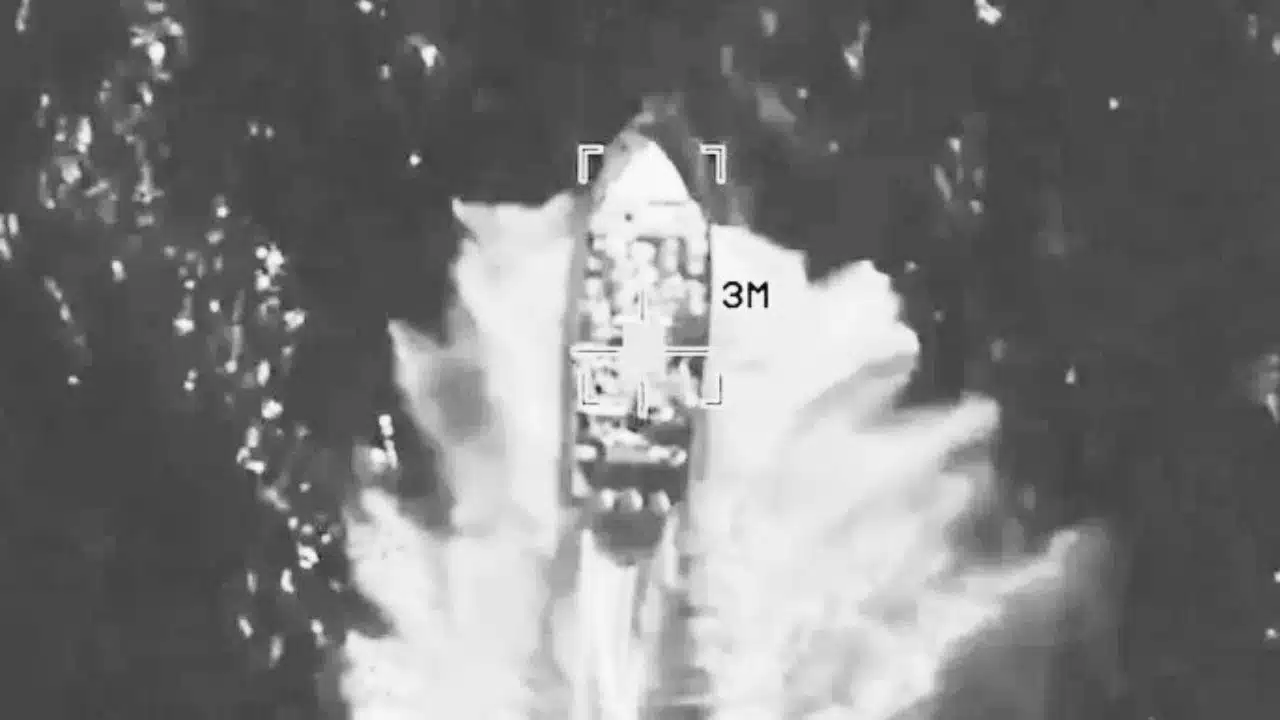
The US military has carried out a new strike on a suspected drug‑trafficking boat in the eastern Pacific Ocean, killing four men and intensifying debate over Washington’s widening maritime anti‑drug campaign.
Strike in Eastern Pacific Kills Four
US Southern Command said a Joint Task Force under Operation Southern Spear conducted a lethal strike on Thursday, 4 December 2025, against a fast-moving vessel in international waters of the eastern Pacific. Officials said intelligence indicated the boat was operated by a group designated as a terrorist organization and was carrying illicit narcotics along a well-known trafficking route.
According to the command’s statement, four men on board were killed in the explosion, and no survivors were reported. A short video released on social media showed a small craft speeding across the water before being hit and engulfed in flames, underscoring the use of precision air or maritime strike capabilities in these operations.
Key details of the latest strike
| Item | Detail |
| Date of strike | 4 December 2025 (Thursday) |
| Location | International waters, eastern Pacific Ocean |
| Casualties | 4 men killed on the suspect boat |
| US command | US Southern Command / Joint Task Force Southern Spear |
| Alleged role | Suspected drug‑trafficking narco‑terrorist vessel |
| Cargo | Intelligence indicated illicit narcotics on board |
| Target status | Linked to a Designated Terrorist Organization, according to US officials |
Part of Operation Southern Spear
The strike forms part of Operation Southern Spear, a Trump administration campaign that targets alleged drug‑smuggling boats in the Caribbean and eastern Pacific using US military assets rather than traditional law‑enforcement interdictions. The operation is run through US Southern Command and a joint task force structure that uses crewed and uncrewed systems to locate, track, and destroy suspected trafficking vessels at sea.
Officials have framed the campaign as aimed at disrupting cocaine and other narcotics shipments moving from Latin America toward the United States and beyond. Earlier operations have involved coordination with regional navies and coast guards, including follow‑on efforts to recover seized drugs or search for survivors after strikes on small boats.
Operation Southern Spear snapshot
| Aspect | Information |
| Campaign name | Operation Southern Spear |
| Lead US command | US Southern Command (SOUTHCOM) |
| Geographic focus | Caribbean Sea and eastern Pacific Ocean |
| Assets used | Air and maritime platforms, including autonomous systems |
| Primary objective | Disrupt maritime narcotics trafficking networks |
| Public unveiling | Announced publicly in mid‑November 2025 |
Rising Death Toll and Number of Strikes
The latest incident is one of more than 20 strikes carried out against suspected drug boats since early September, according to public tallies based on Pentagon and Southern Command statements. News outlets citing US officials report that at least 87 people have been killed in these actions across the Caribbean and Pacific, including the four men killed in Thursday’s operation.
Some reporting, citing defense officials, describes the most recent strike as roughly the 22nd in the series, underscoring how frequently the military has been employed in a mission that previously relied more on interdictions and arrests. Casualty figures remain approximate because not all strikes are followed by full recovery operations, and the identities or nationalities of those killed are often not immediately disclosed.
Strikes and deaths since September (publicly reported)
| Measure | Reported figure (approximate) |
| Start of current campaign phase | Early September 2025 |
| Number of boat strikes | More than 20 strikes |
| Estimated people killed | At least 87 dead |
| Latest strike casualties | 4 men killed in Pacific strike |
| Regions targeted | Caribbean and eastern Pacific |
| Some reporting on strike sequence | Roughly 22nd strike under current approach |
Legal and Political Debate in Washington
The campaign has drawn mounting scrutiny in Washington, where lawmakers from both parties have questioned the legal framework and rules of engagement governing the use of lethal force against small boats in international waters. President Donald Trump has formally notified Congress that the United States is engaged in a non‑international armed conflict with drug cartels and related groups, a designation that gives the administration broader authority to treat cartel fighters as enemy combatants under the law of armed conflict.
A particularly controversial early strike on 2 September, in which surviving crew members were reportedly targeted in follow‑up attacks, has become a focal point in congressional hearings and media investigations. In testimony highlighted by US and British media, a senior admiral denied that Defense Secretary Pete Hegseth issued a blanket kill them all order, but questions remain about how much discretion field commanders have when dealing with damaged vessels and potential survivors in the water.
Key points in the policy and legal debate
| Issue | Details |
| Legal characterization | US says it is in a non‑international armed conflict with cartels |
| Authority for strikes | Operations authorized by Defense Secretary Pete Hegseth |
| Role of Congress | Lawmakers seeking clarity on rules of engagement and oversight |
| Controversial early strike | 2 September operation with follow‑up attacks on survivors |
| Senior military testimony | Admiral denied receiving a broad kill them all directive |
Human Rights Concerns and Regional Reaction
Human rights advocates and some legal scholars argue that treating all people on board suspected drug boats as combatants risks blurring the line between law‑enforcement and wartime targeting standards. They warn that crew members may include coerced couriers, low‑level smugglers, or even fishermen misidentified at sea, raising the possibility of unlawful killings if intelligence is incomplete or mistaken.
Regional responses have been mixed, with some Latin American governments cooperating closely on specific operations while others criticize the militarized approach. Earlier in the campaign, for example, Caribbean and Latin American navies have helped recover large quantities of cocaine from destroyed boats, even as leaders in countries such as Venezuela and Colombia have publicly condemned aspects of the US strategy.
Concerns and regional responses
| Stakeholder group | Main concerns or actions |
| Human rights groups | Risk to coerced couriers, due process, and civilian mariners |
| Legal scholars | Debate over applying armed‑conflict rules at sea |
| Supportive governments | Joint operations, salvage of drugs, and search‑and‑rescue |
| Critical governments | Objections to sovereignty risks and escalation |
Impact on Drug Trafficking and Maritime Security
US officials argue that the destruction of multiple high‑value smuggling boats, along with the loss of drugs and specialized crews, is raising the costs and risks for cartels that rely on maritime routes through the Caribbean and eastern Pacific. They say the campaign complements, rather than replaces, traditional interdictions and prosecutions led by the US Coast Guard, Drug Enforcement Administration, and partner nations.
Analysts note, however, that past anti‑drug crackdowns have often pushed traffickers to adapt, shifting to alternative routes, different types of vessels, or overland corridors through Central America and Mexico. The longer‑term impact of Operation Southern Spear on overall drug supply to North America, as well as on violence in coastal communities and ports, is still unclear and will likely take time to assess.
Operational impact highlights
| Aspect | Current assessment |
| Immediate effect | Destruction of multiple smuggling boats and crews |
| Trafficking adaptation | Likely shift to new routes or methods over time |
| Law‑enforcement link | Campaign runs alongside interdictions and arrests |
| Long‑term impact | Too early for clear data on drug flows and violence |
What Comes Next
With the latest Pacific strike, US officials signal that the campaign against maritime drug‑trafficking networks will continue despite growing political and legal challenges. Further congressional oversight, possible court challenges, and negotiations with regional partners are likely to shape how Operation Southern Spear evolves in the coming months.
For now, the strike that killed four men in the eastern Pacific underscores both the reach of US military power at sea and the unresolved questions about how far that power should be used in the name of combating narcotics and narco‑terrorism.