
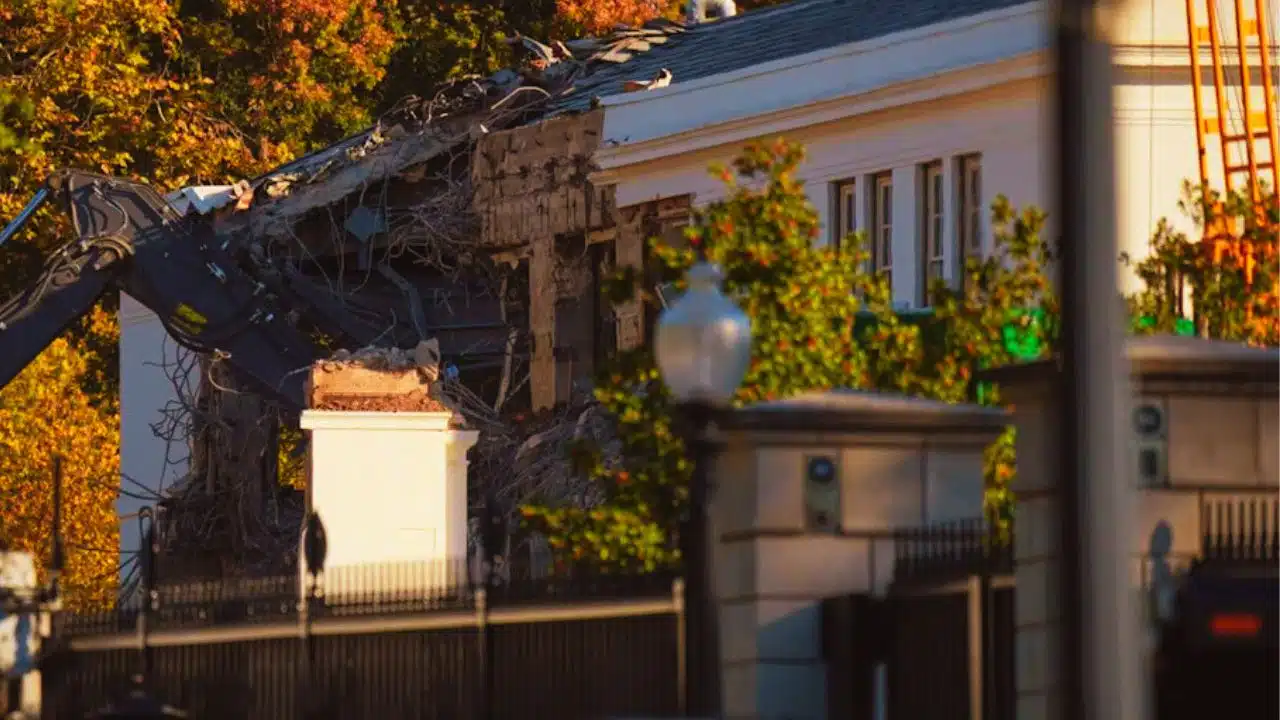
A fierce debate has erupted in Washington over President Donald Trump’s ambitious, and now contentious, plan to demolish a portion of the White House’s historic East Wing to construct a grand ballroom. The National Trust for Historic Preservation is leading a coalition urging an immediate halt, calling the proposal a threat to the architectural and historical integrity of the Executive Mansion.
Quick Take: The East Wing Standoff
- The Plan: Donald Trump has revived a proposal to demolish the East Wing’s Garden Room and some adjoining offices, constructed during the Franklin D. Roosevelt administration, to build a large, modern ballroom.
- The Purpose: Proponents argue the new venue is needed for large-scale diplomatic and social events, as the State Dining Room is often considered too small for major functions.
- The Opposition: A coalition led by the National Trust for Historic Preservation argues the demolition would irreversibly damage a historically significant part of the White House, designed by architect Eric Gugler in 1942.
- Historical Significance: The current East Wing lobby and Garden Room were part of a crucial expansion that defined the modern public entrance to the White House and connected it to a new underground bunker, now the Presidential Emergency Operations Center (PEOC).
- Next Steps: The proposal must undergo a complex review process involving the Commission of Fine Arts (CFA) and the National Capital Planning Commission (NCPC), setting the stage for a high-profile showdown.
A Battle of Modernity vs. Legacy
A plan championed by President Donald Trump to radically alter the White House’s East Wing has ignited a firestorm among historians, architects, and preservationists. The proposal, which involves demolishing the 1942-era Garden Room and adjacent spaces, aims to create a grand, modern ballroom capable of hosting large international delegations and lavish state dinners. While the project is framed by its backers as a necessary upgrade to the presidential residence, opponents decry it as an act of architectural vandalism that would erase a vital chapter of American history.
The National Trust for Historic Preservation, a leading voice in the opposition, has formally called for an immediate pause on all planning. “To demolish this section of the East Wing would be a grave error, erasing a piece of our nation’s resilience and history,” the organization stated in a press release issued on Monday, October 20, 2025.
The core of the dispute centers on a structure built under the direction of President Franklin D. Roosevelt during the darkest days of World War II. It was a project born of necessity, designed not only to create a more formal public entrance but also, crucially, to conceal the construction of the Presidential Emergency Operations Center (PEOC) below ground.
The Roosevelt-Era Expansion: More Than Just an Entrance
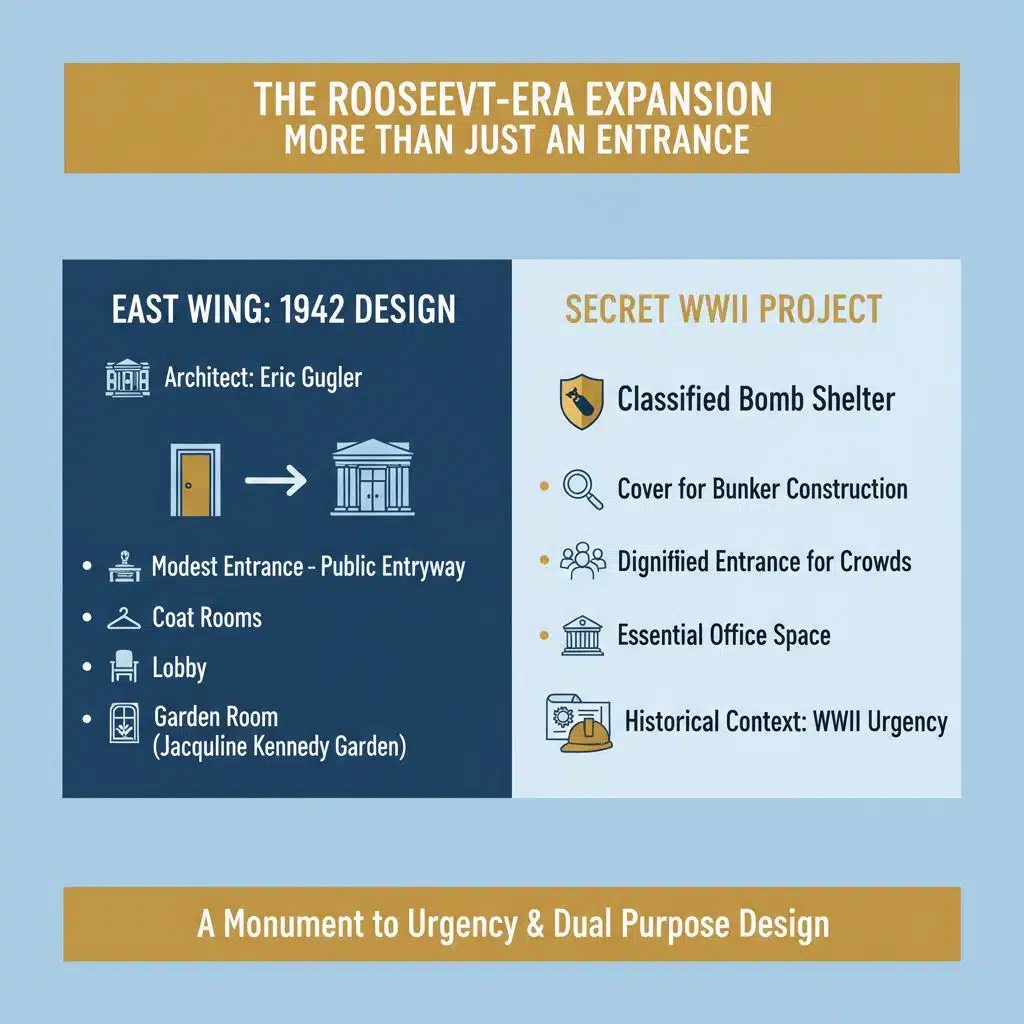
The East Wing as we know it today was designed by architect Eric Gugler and completed in 1942. Before this, the east entrance was a relatively modest structure. Roosevelt’s renovation created the public entryway used by visitors today, along with the coat rooms, lobby, and the Garden Room overlooking the Jacqueline Kennedy Garden. This work was part of a larger, classified project to build a bomb shelter capable of withstanding an enemy attack on Washington D.C.
According to the White House Historical Association, the renovation provided a dignified entrance for large crowds and created essential office space, all while serving as a cover for the bunker construction. Architectural historians emphasize that the design, materials, and layout are intrinsically linked to the urgency and historical context of the WWII era.
Data on White House Events and Capacity
The push for a new ballroom is not without its practical arguments. The current primary space for large events, the State Dining Room, has a limited capacity, which can be a logistical challenge for modern presidential functions.
- State Dining Room Capacity: Can comfortably seat approximately 140 guests for a formal dinner.
- Recent State Dinner Size: The state dinner for Japanese Prime Minister Fumio Kishida in April 2024 hosted over 200 guests, forcing the event to be held in a pavilion constructed on the South Lawn.
- Proposed Ballroom Capacity: Leaked planning documents suggest the proposed new ballroom would accommodate up to 400-500 guests, more than tripling the current indoor capacity for a formal seated event.
This data highlights a recurring issue: for major events, the White House must often resort to temporary outdoor structures, which are costly and weather-dependent. Proponents of the Trump plan argue a permanent ballroom would solve this dilemma.
Official Responses and Expert Condemnation
A spokesperson for Trump’s post-presidency office reiterated his long-standing view. “The White House must have a venue that reflects the power and prestige of the United States,” the spokesperson said in a statement provided to The Associated Press. “A beautiful, grand ballroom is a necessity for modern diplomacy, not a luxury.
However, architectural critic Paul Goldberger, writing for Vanity Fair, called the idea “a solution in search of a problem.” He argues that temporary pavilions offer flexibility and that the permanent alteration of the White House footprint is too high a price to pay.
One anecdote from a former White House social secretary, shared anonymously with The New York Times, highlights the human element. “We once had to move a receiving line for a foreign leader four times because of a sudden thunderstorm. A permanent, large indoor space would have been a godsend. But… not at the cost of the building’s soul.”
What to Watch Next: The Approval Gauntlet
The project is far from a certainty. Any significant architectural changes to the White House exterior and its immediate grounds are subject to a rigorous and often contentious approval process.
The plans must first be submitted to the Commission of Fine Arts (CFA), a federal agency that provides expert advice on matters of design and aesthetics. The CFA’s recommendations are influential and often followed. Following that, the National Capital Planning Commission (NCPC), which has broad authority over federal projects in Washington, must also approve the plan.
Both commissions are expected to hold public hearings, where preservation groups, historians, and the public will have the opportunity to weigh in. This sets the stage for a protracted public relations and legal battle that could last months, if not years. The National Trust for Historic Preservation has already indicated it is exploring legal avenues to challenge the demolition if the project moves forward.
The proposed White House ballroom presents a stark conflict between functional modernization and historical preservation. While advocates see a necessary upgrade to facilitate American diplomacy, opponents see an irreparable wound to a national landmark. The fight is over more than just bricks and mortar; it is about how a nation treats its most sacred public building and which parts of its history it chooses to keep. As the proposal heads to the review commissions, the future of Franklin D. Roosevelt’s architectural legacy hangs in the balance.