Uncensored AI promises to give users more freedom over what they can ask and what a machine will answer. That promise deserves a hearing. A model that refuses legitimate research, difficult political questions, or uncomfortable fiction can become an obstacle to thought. But removing its refusals does not remove the decisions that shaped it. Someone still selects the training material, modifies the model, runs the service, and decides what it can do.
The central question is therefore one of power: when control moves away from the original AI developer, who receives it—and who becomes answerable for the consequences?
This is where the debate needs to become more demanding. Corporate restrictions should be open to scrutiny. So should the claim that an unrestricted answer is necessarily a more honest one. Freedom to question a system matters. The freedom of a system’s operator to avoid explaining its failures is a different proposition.
What Uncensored AI Actually Promises
“Uncensored” is an imprecise label. It can describe a model modified to refuse fewer requests, a service with permissive content policies, or a product marketed as an alternative to tightly managed chatbots. Those arrangements give users different kinds of control.
An open-weight model makes its learned numerical parameters available under stated terms. A developer may be able to download and adapt it. A hosted service lets customers interact with a system that someone else operates. Either can be described as uncensored, but using a permissive website does not give a customer possession of its underlying model.
Nor does access to model weights establish that every component needed to understand or reproduce its development is available. Editorialge’s examination of open weights versus open source explains why that distinction matters.
One revealing example appears in the model card for Dolphin 2.6 Mistral 7B. Its developer describes the model as uncensored and says its training data was filtered to make it more compliant. The same documentation advises people exposing it as a service to implement their own alignment layer: a set of measures intended to shape acceptable behavior.
That advice exposes the practical bargain. Restrictions can move from the model’s original supplier to the person building the application. Whether the replacement rules are better is something that must be demonstrated.
Four Labels That Should Not Be Confused
Before choosing a product, separate its behavior from its delivery model. These labels describe different properties and can overlap.
| Label | What it describes | What it does not establish |
|---|---|---|
| Uncensored | A claim about permissive responses or fewer refusals. | Accuracy, neutrality, privacy, or permission for every use. |
| Open-weight | Availability of model parameters under a license. | Complete training transparency or unrestricted commercial rights. |
| Self-hosted | Operation on infrastructure you manage. | Offline operation, secure configuration, or the absence of telemetry. |
| Hosted service | Access to a system operated by a provider. | Ownership of its model or control over future policy changes. |
A permissive website may still be a tightly controlled commercial service. A downloadable model may offer considerable operational independence while retaining response boundaries. Buyers should examine these properties separately instead of treating one label as a complete product description.
The Legitimate Complaint Behind the Demand
There is a serious argument for giving users more latitude. Discussing a dangerous subject is not the same activity as carrying out a dangerous act. A historian studying political violence, a novelist writing a disturbing scene, and a security analyst examining malicious software may all need to work with material that a blunt filter treats suspiciously.
Research has recognized this problem. Paul Röttger and colleagues developed XSTest, a test suite for exaggerated safety behavior, to examine cases in which models reject safe requests. The study, accepted at NAACL 2024, includes 250 safe prompts and 200 unsafe contrasts. Its purpose is to distinguish appropriate refusal from an overreaction to sensitive wording.
The implication is straightforward: counting refusals alone is a poor way to judge a model. A refusal may prevent assistance with harm. It may also block a useful answer. Evaluators need to ask which happened and why.
For users, unexplained rejection creates another problem. When a system declines a question without making the relevant boundary intelligible, people cannot easily tell whether they encountered a safety rule, a technical limitation, or a product decision. Repeated ambiguity can make the provider’s judgment seem arbitrary.
Companies that want public trust should take that frustration seriously. Clearer explanations, better handling of context, and ways to challenge mistaken refusals would address a real weakness in AI products. Demanding those improvements does not require accepting every claim made by an “uncensored” competitor.
An Answer Is Not Evidence
A machine’s willingness to answer says little by itself about whether the answer is correct.
Consider a hypothetical user asking for proof that a disliked public figure secretly committed a crime. A highly compliant model could produce a persuasive narrative that fits the premise. The user might experience that response as candor. Without verifiable evidence, however, the system has only made the accusation easier to believe.
This is the weakness in selling unrestricted output as truth. A restriction concerns whether the system responds. Reliability concerns what grounds the response, how it handles uncertainty, and whether its claims survive checking. These are different questions.
The technical research reinforces the need to separate them. In a study first released in June 2024, Andy Arditi and colleagues identified a direction in the internal representations of 13 chat models that strongly mediated refusal. Altering that mechanism could suppress refusal in the models they examined.
That finding is significant evidence about how certain models behave. It does not establish that removing a refusal mechanism makes their outputs unbiased or factually sound. Nor should a result from a defined set of models be treated as a universal account of every AI system.
A useful evaluation would measure legitimate questions answered correctly, harmful assistance produced, and confident errors separately. A system that says more can still know less than its tone suggests.
What Newer Research Adds
A 2026 preprint by Faaiz Joad and colleagues, There Is More to Refusal in Large Language Models than a Single Direction, complicates the earlier picture. The researchers describe distinct internal directions across refusal categories, alongside a shared control effect when those directions are manipulated. Their findings suggest that apparently simple changes in refusal behavior can conceal a more structured underlying process.
This is a research finding within a particular experimental setting, not a verdict on every commercial chatbot. For readers, the important caution is practical: a demonstration that a model can be made more compliant tells us less than a full evaluation of the resulting system. It does not prove that a single switch separates a censored machine from an objective one.
Who Controls the Answer? Follow the Decisions
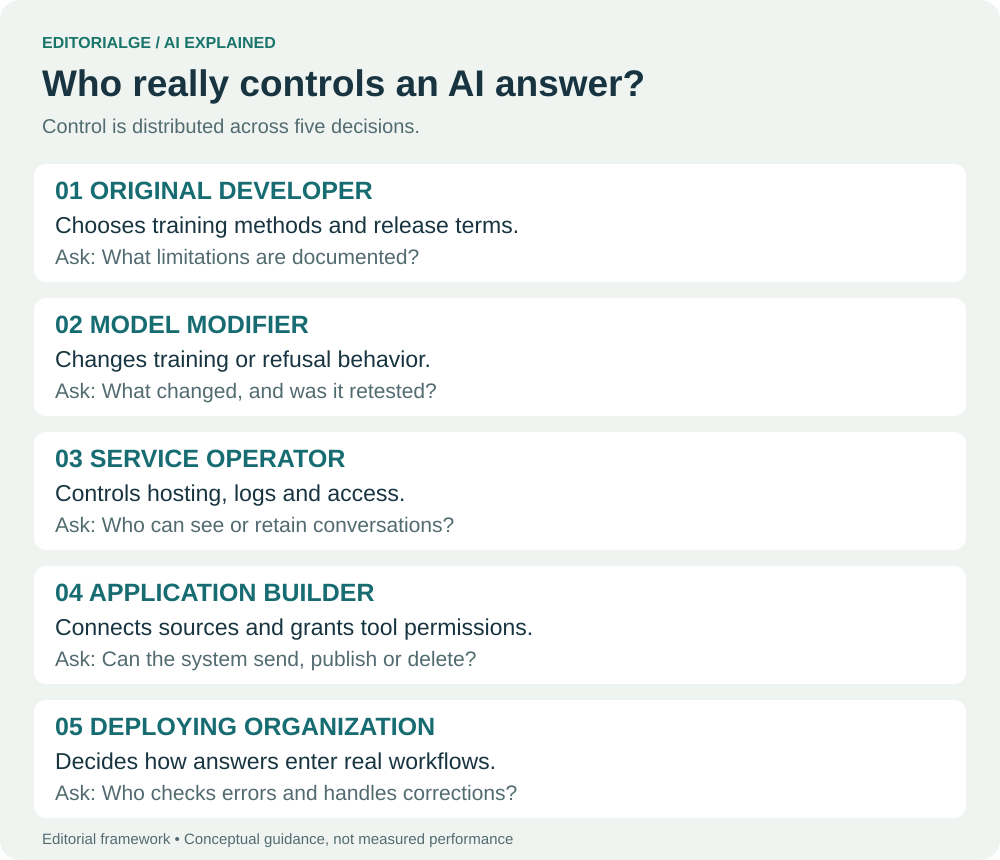
The debate often imagines two parties: the company imposing restrictions and the user seeking freedom. In practice, several parties can shape the same response.
The original developer chooses a training process. A modifier changes the resulting model. A hosting company decides how it is served. An application developer supplies instructions, connects information sources, and grants access to tools. The user contributes a request and decides what to do with the result.
Each decision creates a different kind of power.
| Participant | What they can influence | What deserves scrutiny |
|---|---|---|
| Original developer | Training choices and release conditions | Documented limitations and evidence supporting claims |
| Model modifier | Additional training and refusal behavior | What changed and whether the modified version was evaluated |
| Service operator | Access, logging, runtime rules, and availability | Privacy practices, policy changes, and incident handling |
| Application builder | Retrieved information and tool permissions | Which actions the system can take and who authorizes them |
| User or deploying organization | Task selection and use of outputs | Verification, supervision, and effects on other people |
This is a map of practical responsibility, not a formula for assigning legal liability. It helps identify the decision that needs examination when something goes wrong.
For example, a model may produce a false statement because of its underlying limitations. An application may amplify that error by presenting it as verified fact. A deploying organization may then make matters worse by publishing it without review. Naming only the model misses consequential choices made elsewhere.
The reverse also matters. A developer cannot reasonably be assumed to control every later modification of a downloadable model. Accountability becomes more credible when it follows actual knowledge, choices, and control rather than assigning everything to the most visible participant.
The Stakes Change When AI Can Act
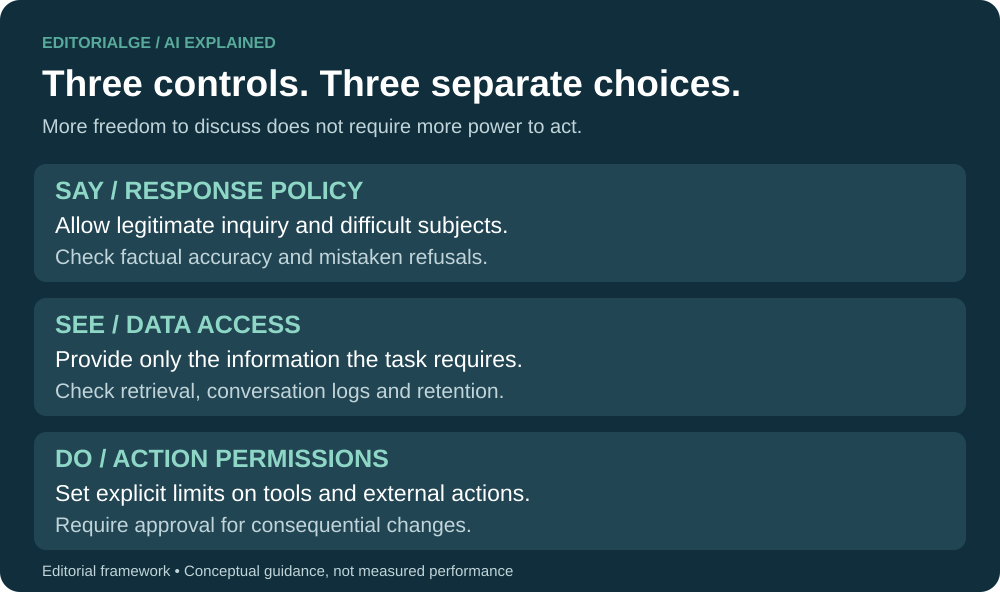
Imagine two systems using the same permissive model. One helps a writer explore a fictional scene in a private workspace. The other can access a company’s customer records, send emails, and modify operational files.
Their refusal behavior might be similar. Their consequences are not.
In the second system, an inaccurate or manipulated instruction can become an external action. The practical questions concern access: which records can it read, which destinations can it contact, and which changes require authorization? These controls need to exist in the surrounding application. A promise that the model will behave responsibly is insufficient.
This is why AI agent security belongs in the discussion. Once software can act on a model’s output, permissions and verification become central to the design.
A business could allow broad discussion while requiring approval before customer messages are sent. A research environment could permit sensitive analysis while keeping the model away from production systems. These are coherent choices. Intellectual latitude and operational authority do not have to expand together.
The same distinction helps clarify privacy claims. A service can answer controversial questions while retaining user conversations. A locally operated model can reduce reliance on an external inference provider, but its surrounding software, connected services, and device security still matter. “Uncensored” does not tell a user where their data goes.
Three Everyday Situations Where the Difference Matters
A Newsroom Researching a Controversial Claim
Suppose a reporter asks for the history of a disputed political allegation. A useful assistant should distinguish established facts, attributed claims and unresolved questions. It should help locate evidence without silently adopting the allegation as true. If the output supplies a quotation, the reporter needs the original source and its surrounding context before publication.
Here, a less restrictive model could improve access to legitimate analysis. It could also make an unsupported story sound more convincing. The editorial safeguard is source verification and accountable review. The tone of the answer cannot substitute for either.
A Small Business Answering Customer Complaints
Consider a hypothetical support assistant that drafts replies about delayed deliveries. It needs relevant order information, but it does not need unrestricted access to every customer’s account. It may propose a refund without having authority to issue one. A human can review unusual cases while routine drafts remain useful.
Choosing a permissive model does not settle any of those design questions. The business must still decide which records are available, how permissions are enforced and who handles a mistaken promise. A polished apology is little comfort if the system has disclosed another person’s details.
A Researcher Working With Sensitive Material
A researcher may reasonably want to analyze disturbing historical documents without repeated generic refusals. A bounded research environment can support that work while limiting access to unrelated private information and external tools. Broader discussion can be appropriate without granting permission to publish findings automatically.
These are illustrative scenarios, not reported case studies or hands-on tests. Their shared lesson is that the right level of freedom depends on the activity and the people affected by it.
Why the Dark-Web Analogy Falls Short
Calling uncensored AI the dark web of the API economy is an arresting metaphor. It captures anxiety about capabilities operating beyond familiar gatekeepers. As an explanation, however, it bundles together questions that should remain separate.
Reduced refusal does not itself imply anonymity, concealed infrastructure, or criminal purpose. A publicly documented research model and a service intended to facilitate abuse should not be treated as equivalent simply because both depart from a major provider’s policies.
The metaphor also risks making centralization look like a guarantee of responsible conduct. A closed provider can make poor decisions. A community project can document its limitations carefully. Ownership structure alone does not settle the quality of governance.
The more useful inquiry is specific: what capability is being provided, to whom, under which conditions, and with what means of correction? Those questions can expose a dangerous service without casting suspicion on everyone who wants a model they can inspect or run independently.
Freedom Needs a Credible Account of Responsibility
The strongest case for open models is that people should be able to investigate, adapt, and challenge systems that increasingly mediate their access to information. Concentrating those decisions in a small number of companies deserves scrutiny.
The strongest objection to unrestricted deployment is equally serious. People affected by an AI system may never have agreed to use it. A target of a fabricated accusation, an employee whose information is exposed, or a customer receiving a misleading automated message does not benefit merely because the operator enjoyed greater freedom.
Those competing interests cannot be resolved by declaring either unrestricted access or centralized control morally sufficient.
A credible operator should be able to explain the model’s provenance, identify material modifications, describe its data practices, and specify the actions it can perform. Evaluation should include safe requests wrongly rejected as well as unsafe requests wrongly fulfilled. People affected by errors need a usable reporting and correction process.
These are proposed standards for earning trust. Their purpose is to make promises testable. If a provider advertises fewer restrictions, it should explain what was removed, what remains, and what evidence supports the resulting product’s suitability for its intended use.
There is a cost here. Testing, maintaining controls, and responding to failures require work. Some of the apparent freedom offered by a permissive model can amount to transferring that work downstream. Buyers should know whether they are gaining useful discretion or inheriting obligations they are unprepared to meet.
How to Evaluate Uncensored AI Before Using It at Work
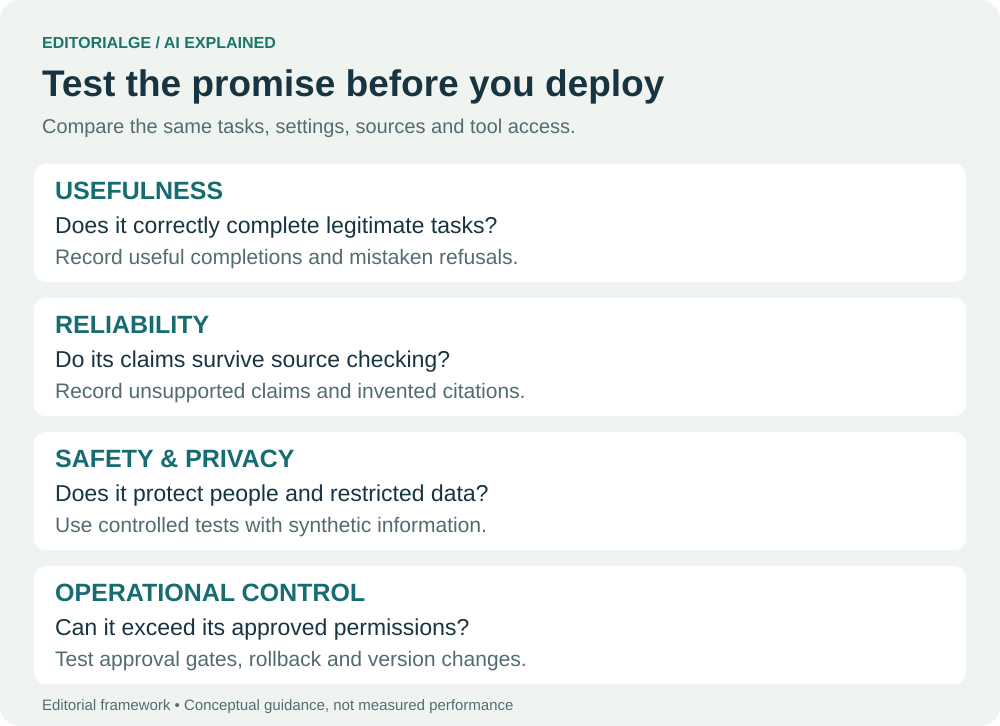
Start with the work you actually need done. A spectacular answer to a provocative prompt tells you little about whether a model can summarize a contract accurately, handle a Bengali research question fairly or protect customer information. A small, well-designed pilot is more informative than a collection of flattering demonstrations.
1. Build a Balanced Test Set
Include ordinary tasks, legitimate questions with sensitive wording, questions with false premises, and tasks that require admitting uncertainty. For a multilingual team, include the languages and local contexts its customers use. Keep expected answers or review criteria separate from the prompts. Avoid using confidential customer material when synthetic examples will do.
2. Compare Like With Like
Use the same prompts and source documents, and record the exact model version, settings, system instructions and available tools. If one system can browse current information and another cannot, report that difference. Otherwise, an apparent advantage in truthfulness may reflect access to sources rather than a superior underlying model.
3. Separate the Outcomes
Count correct and useful completions, mistaken refusals, unsupported assertions and inappropriate assistance separately. If a system answers an unsafe request but provides incorrect information, that is still a failure of the intended boundary; factual error does not make the response responsible. For legitimate questions, a long answer should not score better merely because it is longer.
4. Test the Surrounding Application
With synthetic records and a controlled environment, check whether users can retrieve information outside their role, whether external actions require the intended approval, and whether corrections reach downstream outputs. Record failures and retest after changes. Access rules should be enforced by the application rather than left entirely to instructions given to the model.
5. Set Acceptance Criteria Before Looking at Results
Decide which failures make the system unsuitable for the intended task. A fiction-writing assistant and an assistant producing customer-facing financial explanations should not have identical criteria. Name the person responsible for the deployment decision and retain a way to return to the previous version. A trial is useful only if disappointing results can change the decision.
The Hidden Cost of Taking Control
A downloadable model can reduce dependence on one service provider. It can also make your organization responsible for infrastructure, updates, access management and incident response. Compare the full operating burden rather than treating the absence of a subscription fee as the absence of cost.
Before adopting a service or model, ask who maintains it, what license governs the intended use, how changes are communicated and how your team can leave. For a hosted service, examine retention and export arrangements. For self-hosting, examine the complete software stack and its connections. Neither setup earns trust solely through its marketing language.
The person who benefits from a permissive answer may not be the person who bears the consequences of an error. That gap is why a correction channel matters: an affected customer or wrongly described individual needs a practical route to a responsible human, not an argument about which layer of the system generated the words.
Uncensored AI: What Would Make the Argument Stronger?
The case for fewer restrictions would strengthen if independent evaluations showed consistent improvements on legitimate tasks without unacceptable increases in harmful assistance or factual errors. Evidence should identify the model version, tasks, settings, and limits of the comparison.
The case for tighter controls would strengthen where credible evidence showed that particular capabilities materially enabled harm and that narrower safeguards could not adequately address it. An alarming demonstration deserves attention, but it does not by itself measure the prevalence or real-world impact of a problem.
The standard should apply to both camps. Providers defending restrictions need to show what those restrictions accomplish and where they fail. Providers removing them need to show what users gain and what additional risks they assume.
Uncensored AI raises an important demand: people want more say over the machines that increasingly answer their questions. That demand deserves better than a promise that the machine will always comply.
Who controls the system should be discoverable. Who can challenge its decisions should be clear. And when an answer causes harm, responsibility should not vanish into the gap between the company that trained the model, the operator that served it, and the person who put it to work.
Disclosure: This research-based editorial was prepared with AI assistance. It does not report original interviews or hands-on model testing.