AI Video and Visual Content Providers for Danish Business Teams serve several different jobs: producing presenter-led training, adapting a campaign into Danish, editing interviews, and creating visual assets for daily marketing. Start with the work your team repeats most often. Synthesia, HeyGen and Colossyan deserve attention for presenter and localization workflows; Canva and Adobe suit broader visual production; VEED, Descript, Invideo, Pictory and Runway address different editing and generation needs.
The useful question is not which service makes the most impressive demo. It is which one lets your team produce an approved asset, in the right language and format, at a repeatable cost. A Danish sales video with a mispronounced company name or an incorrect price still needs fixing, however convincing its presenter looks.
AI Video and Visual Content Providers for Danish Business Teams: quick comparison
This is a shortlist for teams working in Denmark, not a list of ten Danish-owned companies. It includes international software providers. Danish-language features are identified separately from local purchasing, support and hosting: a language option does not establish a Danish office, DKK billing or EU-only processing.
| Provider | Best starting use | Danish-market relevance | Main buying distinction |
|---|---|---|---|
| Synthesia | Repeatable presenter-led training | Danish listed for translation | Credits and plan-specific team controls |
| HeyGen | Video localization and digital presenters | Danish (Denmark) in translation documentation | Creator access differs from shared business workspaces |
| Colossyan | Training with learning-system delivery | Danish language variants documented | Generation minutes, editors and SCORM allowance |
| Canva | Branded graphics and short video assets | Danish help resources; suitable for reviewed local layouts | Per-person plan plus AI limits |
| Adobe Firefly | Creative production within Adobe workflows | Dedicated Danish storefront | Native and partner models have different conditions |
| Runway | Custom generated shots and visual concepts | Danish available in documented voice-dubbing workflow | Model-specific credit use; language support varies by feature |
| VEED | Captioned social and business video | Danish subtitle transcription and translation documented | Translation consumes AI credits |
| Descript | Editing recorded speech through text | Danish transcription, captions and dubbing listed | Editor seats, media hours and AI credits |
| Invideo | Combining stock, generated media and editing | Useful for visual or English-language export campaigns; Danish workflow needs a pilot | Per-seat credits and model access |
| Pictory | Turning approved written content into video | Danish narration through multilingual premium voices | Trial, generation allowances and collaboration tier |
How we selected the providers
We reviewed official product, pricing and language documentation on November 15, 2026. Selection reflects a defined business workflow, a documented production capability and a meaningful reason to consider the service alongside the others. The order groups related uses; it is not a performance ranking. We did not conduct hands-on output tests or complete Danish billing checkouts.
Official pricing-page screenshots were captured during browser navigation on November 15, 2026. They document the displayed pages, not tested output quality. Currency, billing period, promotions and account eligibility can differ; confirm the final Danish quote before purchase.
Prices below are selected public examples, not like-for-like quotations for a Danish organization. Dollar amounts are US dollars as displayed on the reviewed pages. We have not converted them into kroner or assumed a particular VAT treatment. Local checkout, invoice requirements and account eligibility remain purchasing checks. Temporary offers are identified rather than treated as permanent prices.
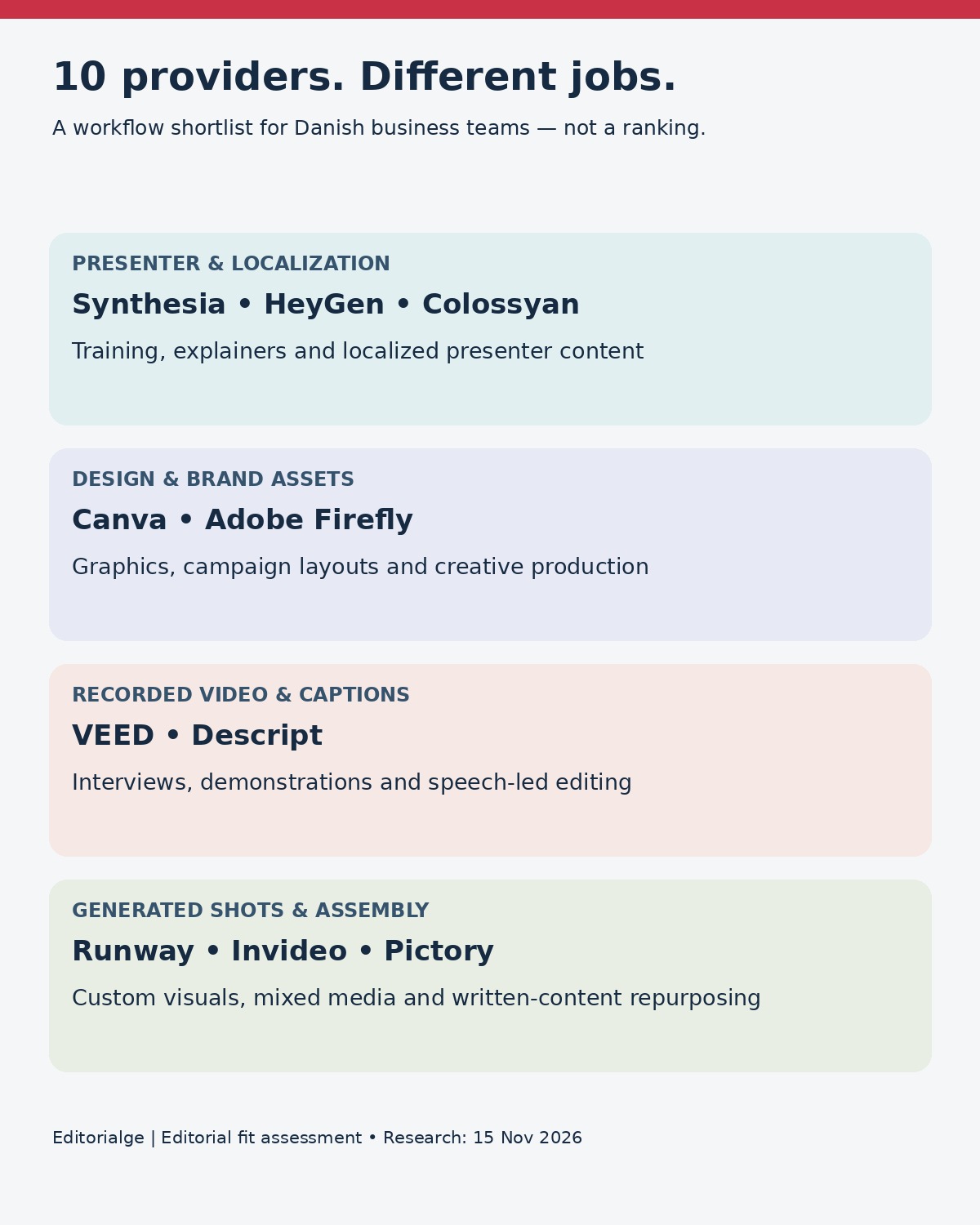
10 providers to compare by production task
1. Synthesia — for repeatable presenter-led communication
Synthesia is a sensible starting point when the script is the main asset: onboarding instructions, a product explanation or an internal process update. Its platform combines avatar presentation, video creation and translation. Danish appears in its translation documentation, which gives a Denmark-based team a concrete localization route to investigate.
The practical attraction is maintaining a structured explanation as the underlying information changes. Consider an illustrative onboarding project with a Danish version and an English version for international colleagues. The team can work from approved scripts, then review the two outputs for matching meaning. That is a proposed workflow, not a measured saving from our testing.
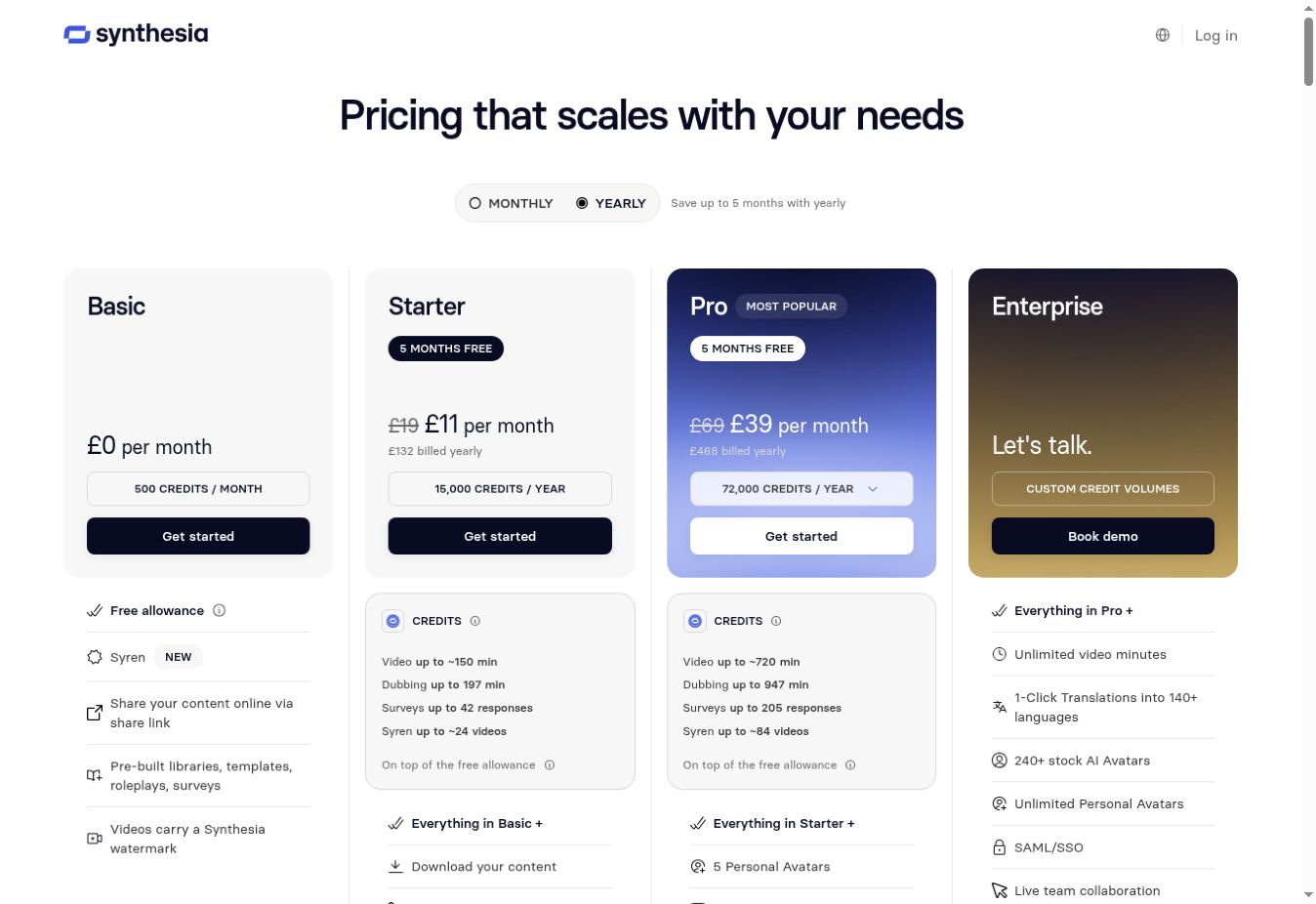
The earlier US-dollar pricing reference showed Starter at $29 monthly. The browser capture above instead shows a promotional yearly view in GBP; these are different billing and currency contexts, not equivalent Danish quotes. More advanced controls, including live team collaboration, SAML/SSO and SCORM export, were listed under Enterprise. A low entry price therefore does not establish that the subscription meets a department’s access or learning-platform requirements.
Choose it for controlled explanations rather than assuming an avatar can replace authentic customer testimony. Preserve real screen recordings where a viewer needs to see the actual product, and have a Danish speaker review names, abbreviations and pacing.
2. HeyGen — for adapting presenter videos across languages
HeyGen is especially relevant when localization is central to the brief. Its documentation lists Danish (Denmark) among the languages available for video translation, including audio-only translation and lip-sync. This makes it a candidate for adapting an approved presenter video for Danish viewers or preparing another language version of local content.
For example, a sales team could evaluate a short product introduction with the same speaker and message in two languages. Review the translated script before judging the facial animation. Fluent delivery can make an inaccurate translation harder to notice, particularly when a sentence includes an offer, deadline or product limitation.
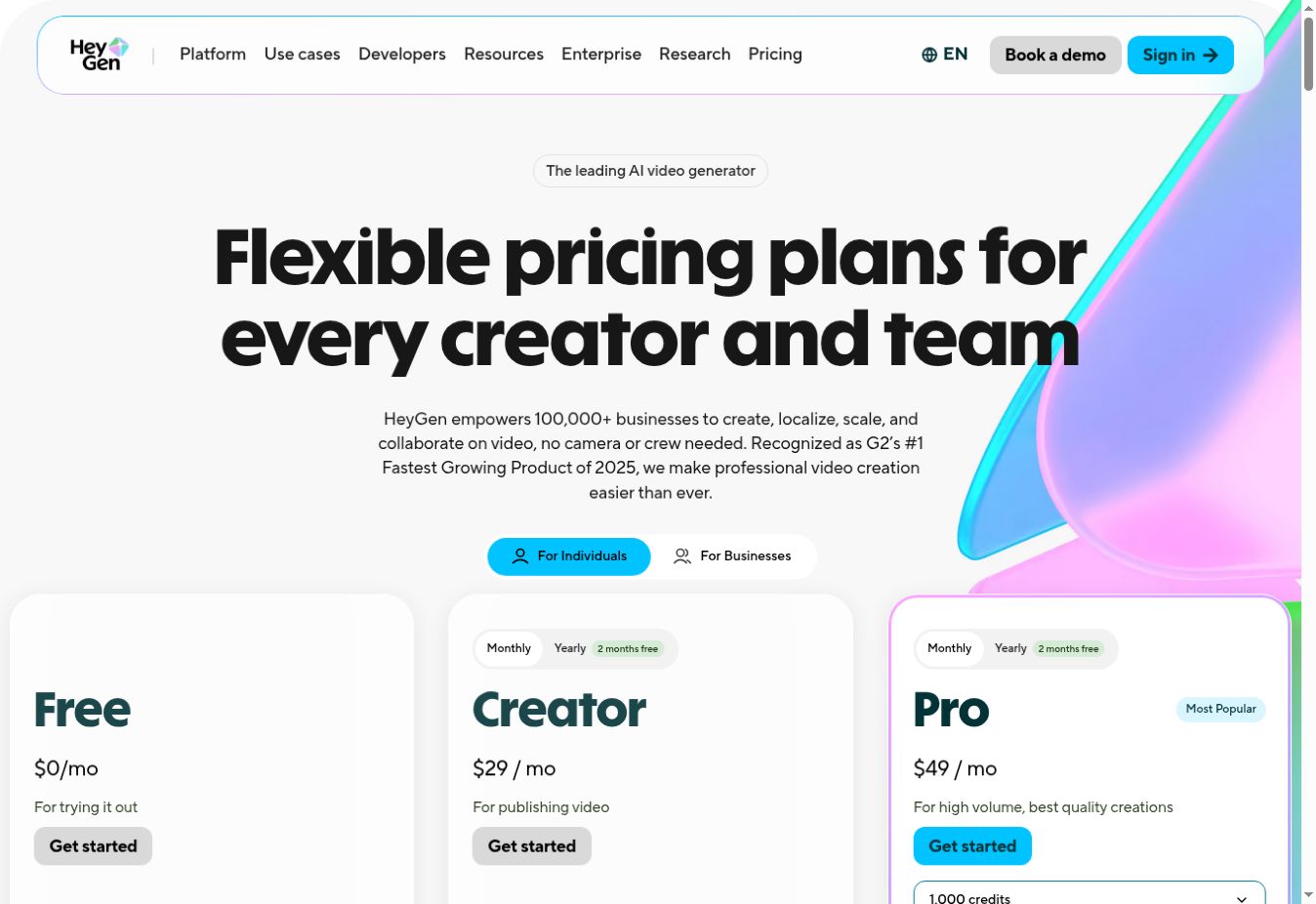
Creator was displayed at $29 per month with 600 credits and 1080p exports. The Business offering adds a shared workspace and centralized billing, with additional member charges. These are different buying decisions: a single person’s production subscription is not automatically the right arrangement for a team.
HeyGen is worth shortlisting when presentation and localization outweigh the need for intricate scene editing. For any custom likeness or voice, agree whose identity is being used, for which projects, and who can authorize future versions.
3. Colossyan — for training that needs structured delivery
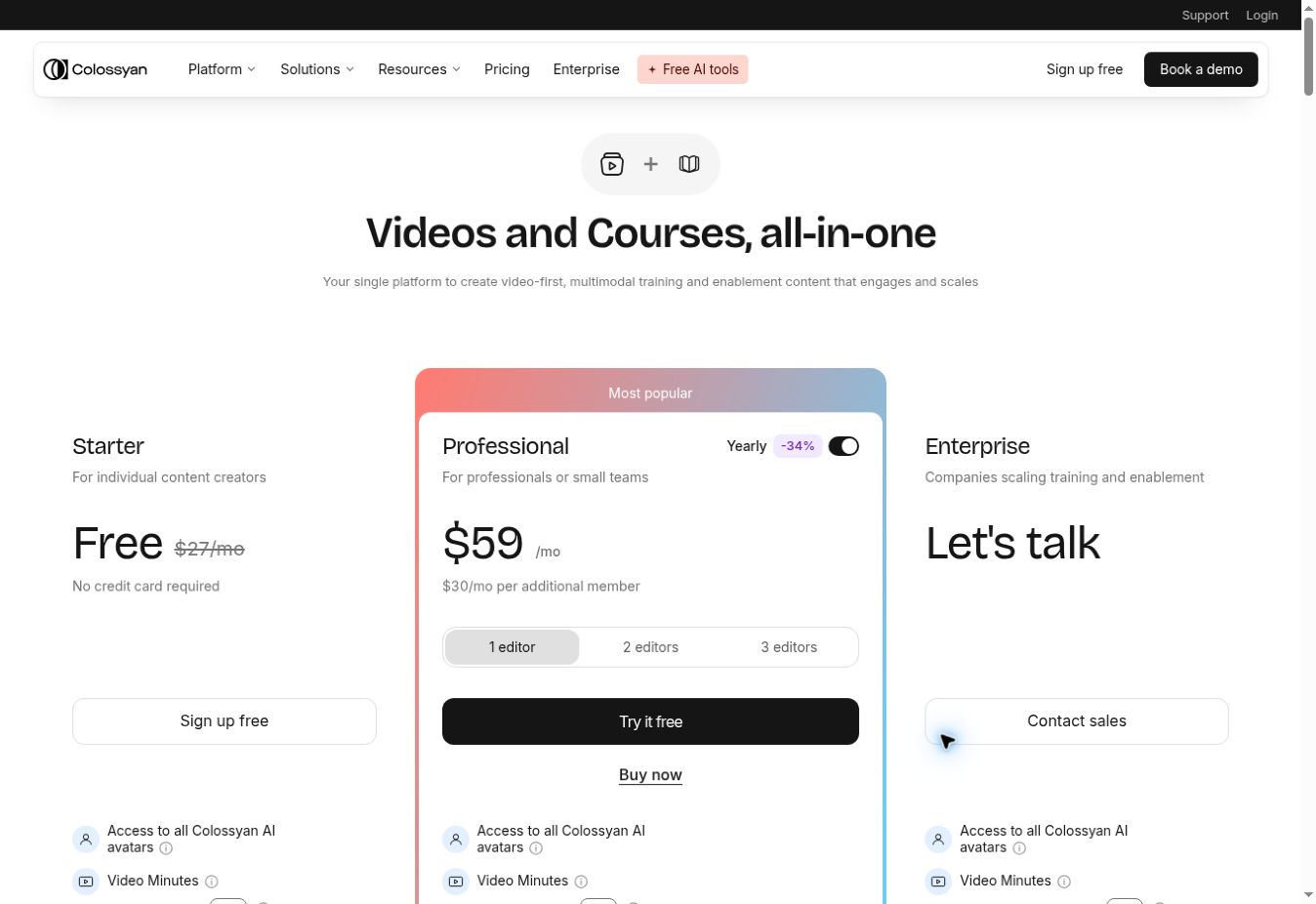
Colossyan focuses on training and enablement, with presenter videos, interactive elements and learning-system delivery. Its language-variant documentation includes Danish. A learning team can therefore assess it as a way to maintain localized versions of a course rather than as a general-purpose advertising studio.
The distinction becomes useful when an HR or operations department needs more than an MP4. SCORM is a packaging standard commonly used to deliver content through learning management systems. Colossyan lists SCORM exports within its paid offering, but the allowance matters: the reviewed Professional tier included five streaming SCORM exports per month.
Professional was displayed at $59 per month on an annual plan, with 30 monthly NEO minutes and 10 NEO2 minutes. Additional editors were separately priced. Different generation allowances should not be added together as though every output uses the same engine.
Ask the training owner to test the exported package inside the actual learning system. Confirm the behavior that matters—such as course access and completion reporting—rather than treating a supported format as proof that the whole workflow works. For quick promotional clips without learning-system requirements, this specialization may be unnecessary.
4. Canva — for everyday branded visual production
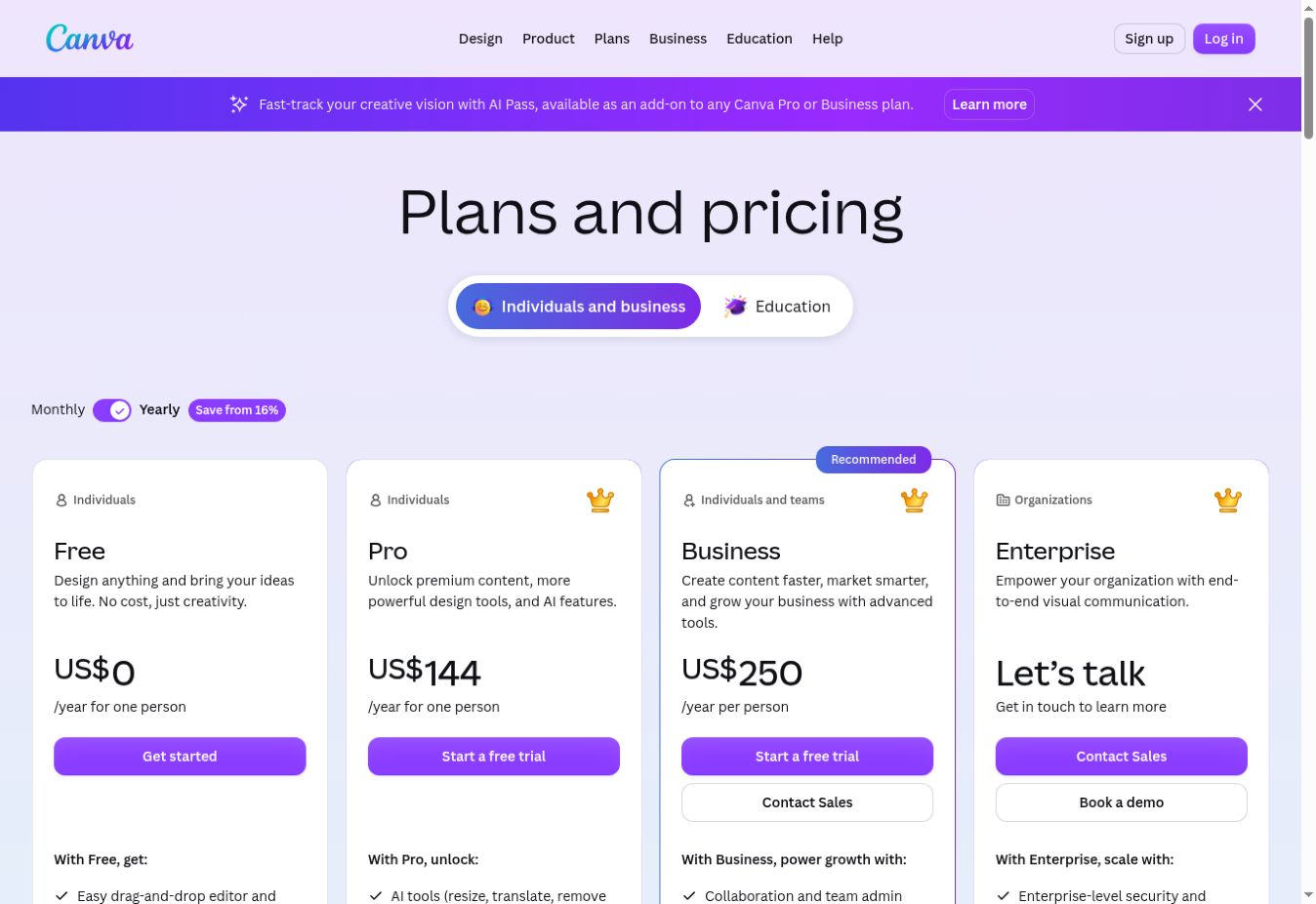
Canva belongs on the shortlist when the team needs social graphics, slides and short videos within one design environment. Its Business plan lists collaboration, team administration, brand kits and approvals. Those capabilities can matter more than a standalone generation model when several colleagues regularly create public-facing material.
A Danish retailer, for example, could keep approved logos, colors and layouts together while adapting campaign copy for local channels. That is an illustrative use. Put exact prices, product names and calls to action in editable text layers rather than relying on a generated image to reproduce them faithfully.
Canva’s reviewed video-generation page describes short generated clips that can be added to a design for further editing. Access is limited by plan; a paid design subscription should not be interpreted as unlimited video generation. The pricing page displayed Business at $250 per person per year before applicable tax, but that is the observed US-dollar listing, not a confirmed Danish quote.
Canva permits commercial AI uses subject to its terms while warning that outputs may not be exclusive or cleared of third-party rights. It suits coordinated everyday design; a more specialized editor may be preferable when shot-level control dominates the assignment.
5. Adobe Firefly — for teams already working in Adobe
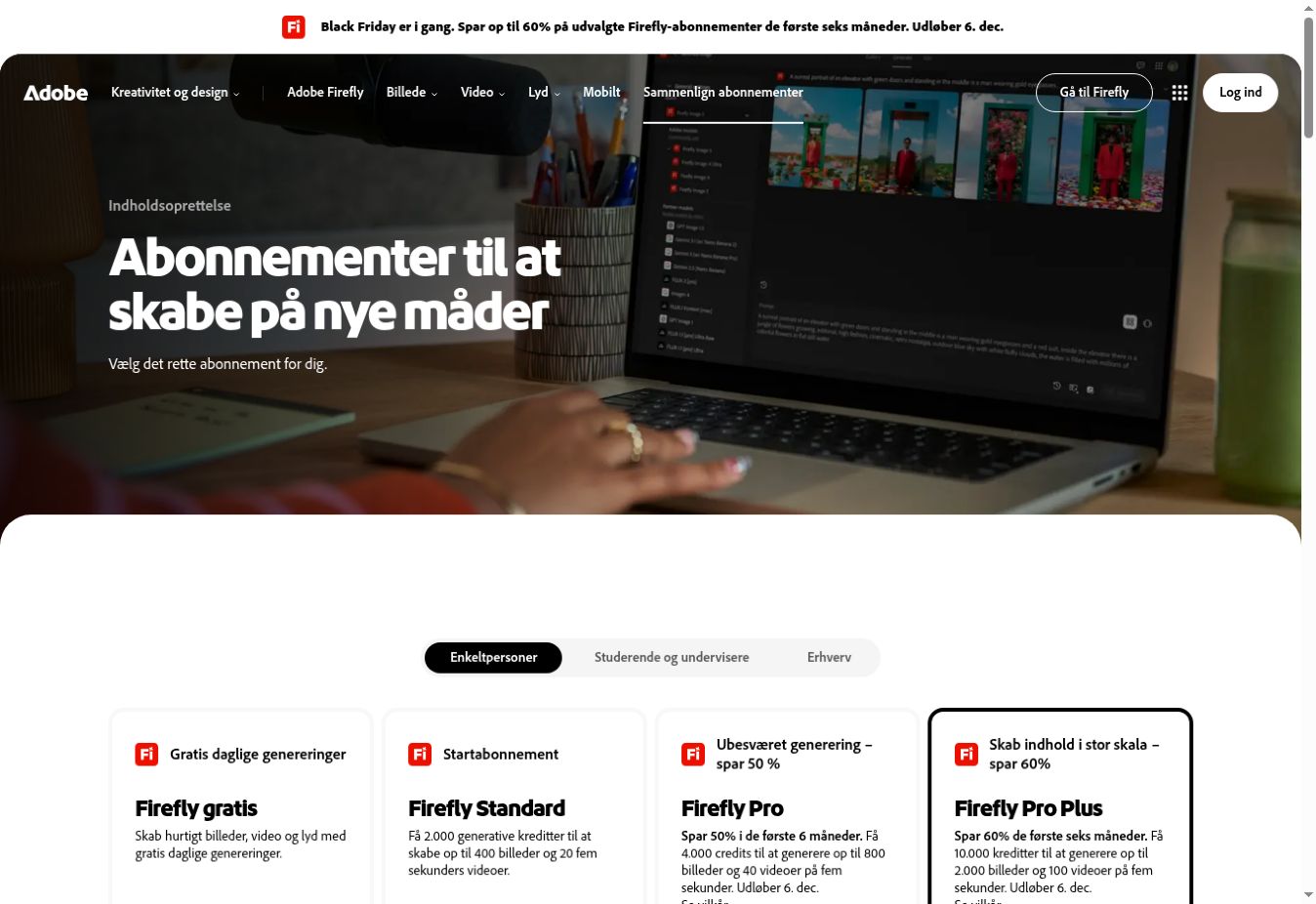
Adobe Firefly is relevant to creative teams that want generated material to fit an existing Adobe production process. Adobe describes Firefly integrations with applications including Photoshop and Illustrator, alongside its web-based creation tools. Its dedicated Danish storefront provides a local route for reviewing plans, rather than requiring buyers to infer Danish pricing from a US offer.
The important distinction is the model used. Firefly now also provides access to partner models. Adobe’s statements about its own model training and commercial approach should not be casually extended to every third-party model available through the same interface.
Adobe says commercial use is allowed for Firefly outputs subject to applicable product conditions. Contractual IP indemnification is a separate entitlement with terms and exclusions, not a blanket feature of every subscription. Procurement should identify the exact plan and covered outputs.
Premium video operations consume generative credits, and Adobe’s documentation distinguishes these from standard image features. This makes Firefly a strong candidate when designers need integrated creative control, but the budget still depends on the actual video workload. A Danish storefront also does not prove that every audio or translation function supports Danish.
6. Runway — for custom shots and visual exploration
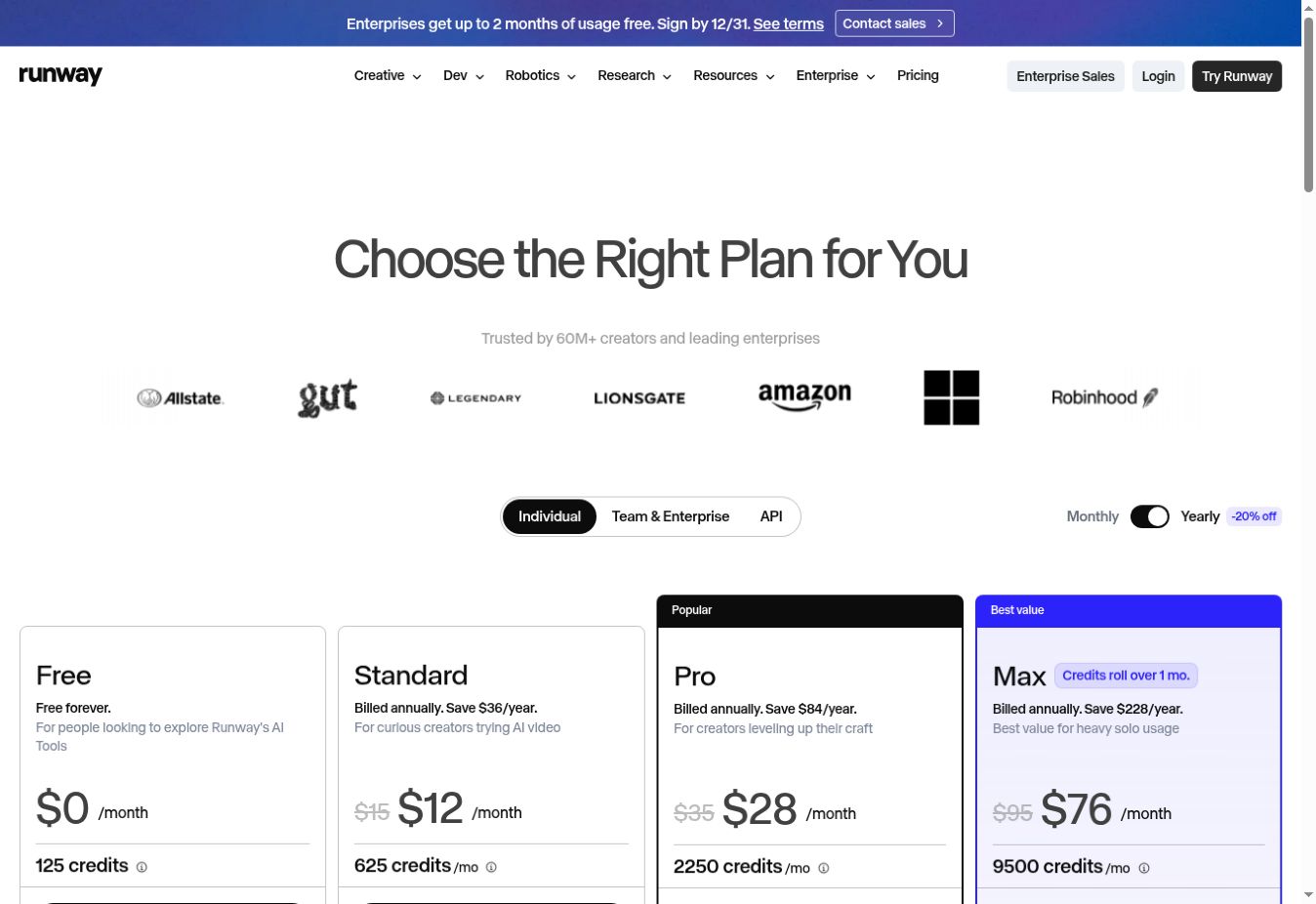
Runway is a candidate when the missing asset is a visual sequence: an imagined environment, a stylized transition or a concept shot that would otherwise require a separate production step. Its offering includes image and video generation with model-specific credit consumption. It is particularly useful to evaluate when a creative team can direct, select and edit individual outputs.
The reviewed Standard plan displayed $12 per month billed annually, with 625 monthly credits. Free access included 125 one-time credits. That distinction matters: a one-time testing allowance is not a recurring production budget, and different models turn the same credit balance into different quantities of footage.
Runway’s audio documentation includes Danish for its voice-dubbing workflow, but its listed preset speech languages are narrower. Do not turn support in one workflow into a claim that every voice feature works in Danish.
For a Danish brand campaign, generate the visual idea first and add verified copy in an editor. Keep genuine product footage where dimensions, packaging or performance must be accurate. Runway is less attractive if the team expects a finished, fact-checked business video from a single instruction.
7. VEED — for Danish captions and practical browser editing
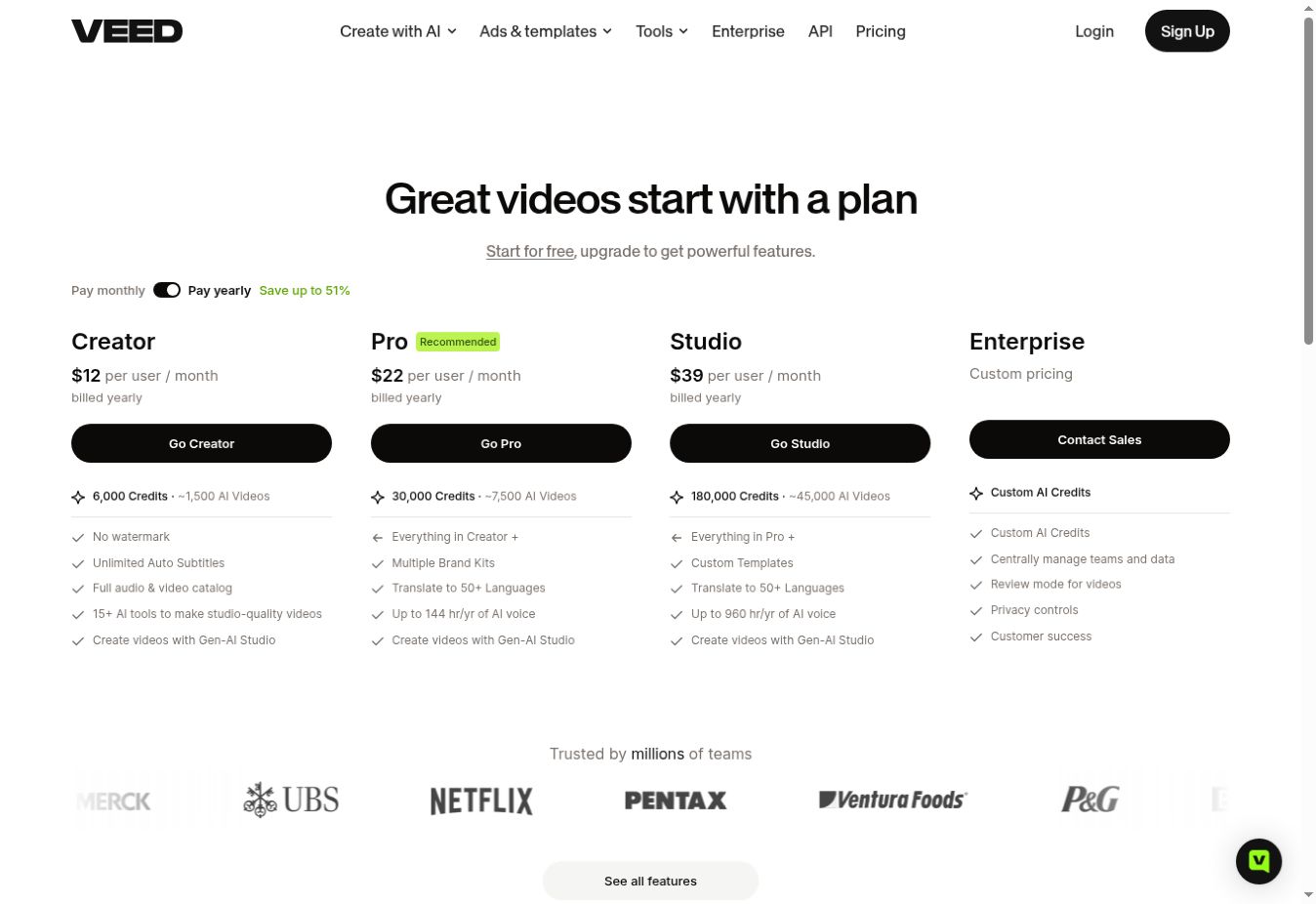
VEED offers a direct route for teams whose immediate need is to make existing video easier to publish and understand. Its official language matrix explicitly supports Danish subtitle transcription and translation. The documentation also states that subtitle translation uses AI credits, which separates it from a simple assumption that every caption operation has the same allowance.
This is useful for interviews, short demonstrations and social clips. A team can begin with real footage, produce a draft transcript, correct the wording, and adapt the captions to the target audience. The Danish subtitle page also describes ordinary editing actions such as cutting, cropping and rotating video.
The interactive pricing page displayed Creator, Pro, Studio and Enterprise, with yearly billing selected and self-service rates charged per user. The screenshot records that view; confirm the currency, tax and billing terms offered to a Danish account. Compare the required editing plan plus its translation and AI allowances, rather than the headline price alone.
Review subtitles with the sound off as well as on. Accurate words can still be difficult to read if they change too quickly or cover a demonstration. VEED is a logical pilot choice for caption-heavy production; that does not establish the quality of its separate avatar or voice features.
8. Descript — for teams starting with recorded speech
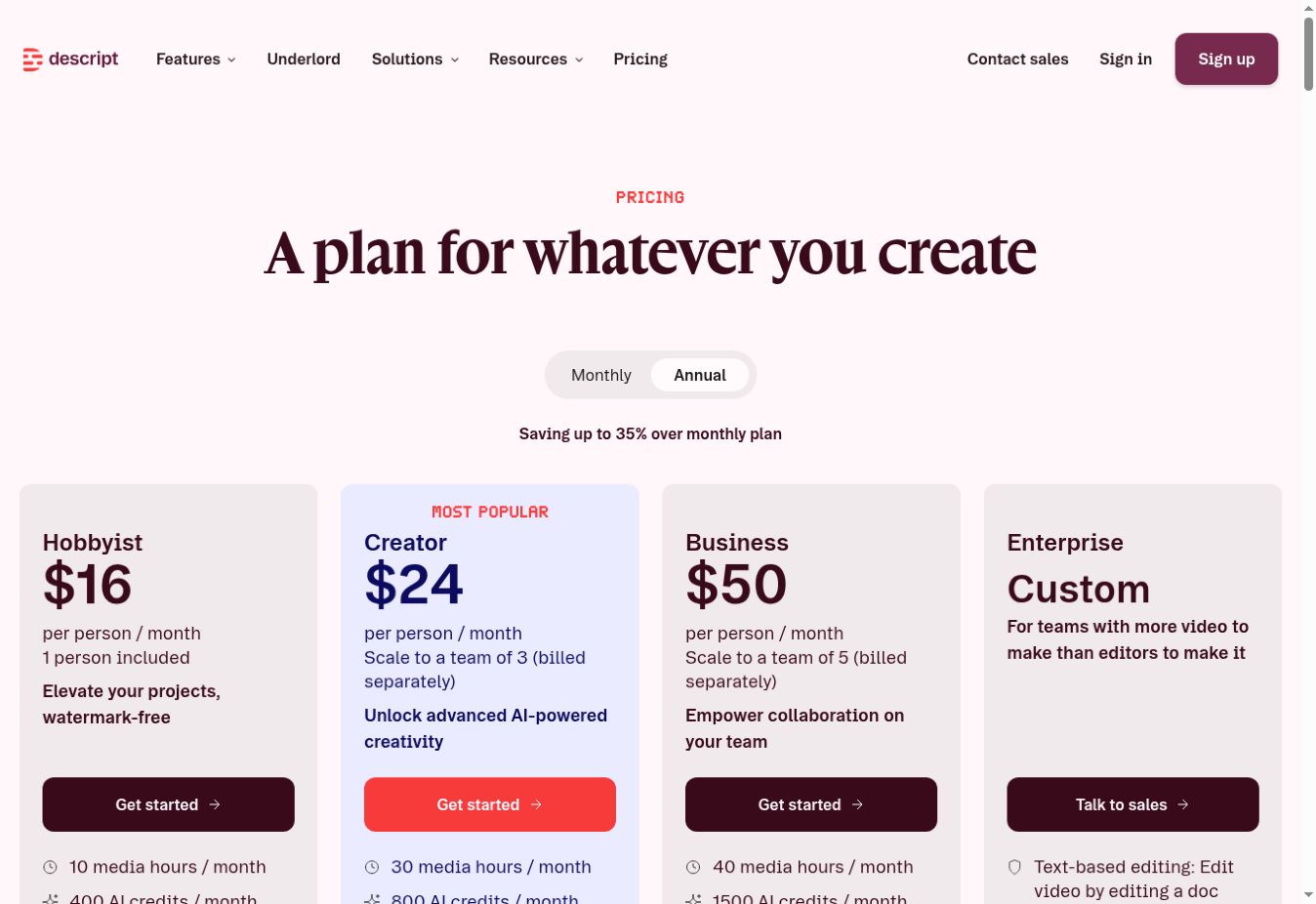
Descript approaches video editing through a transcript. That makes it relevant to a team repurposing interviews, webinars, screen recordings or spoken explanations. Instead of treating every edit as a timeline operation, an editor can work with the words while retaining access to the media.
The reviewed pricing matrix lists Danish transcription, caption translation and audio dubbing. These are separate capabilities with plan limits. The service also separates imported or recorded media allowances from AI credits and editor seats. A department processing many long recordings should estimate input volume, not only the length of its final clips.
An illustrative workflow is a recorded Danish product walkthrough edited into a concise customer explanation. First correct names and technical terms in the transcript; then remove irrelevant sections and review whether the remaining sequence still makes sense. AI cleanup should not change a speaker’s intended claim.
Descript is a strong candidate when useful footage already exists. If the main brief is to invent a new visual world, a generation-focused service may be a better starting point. Test the particular Danish editing and voice operations you need; broad language support is not a guarantee that every AI feature behaves identically across languages.
9. Invideo — for combining generated and stock material
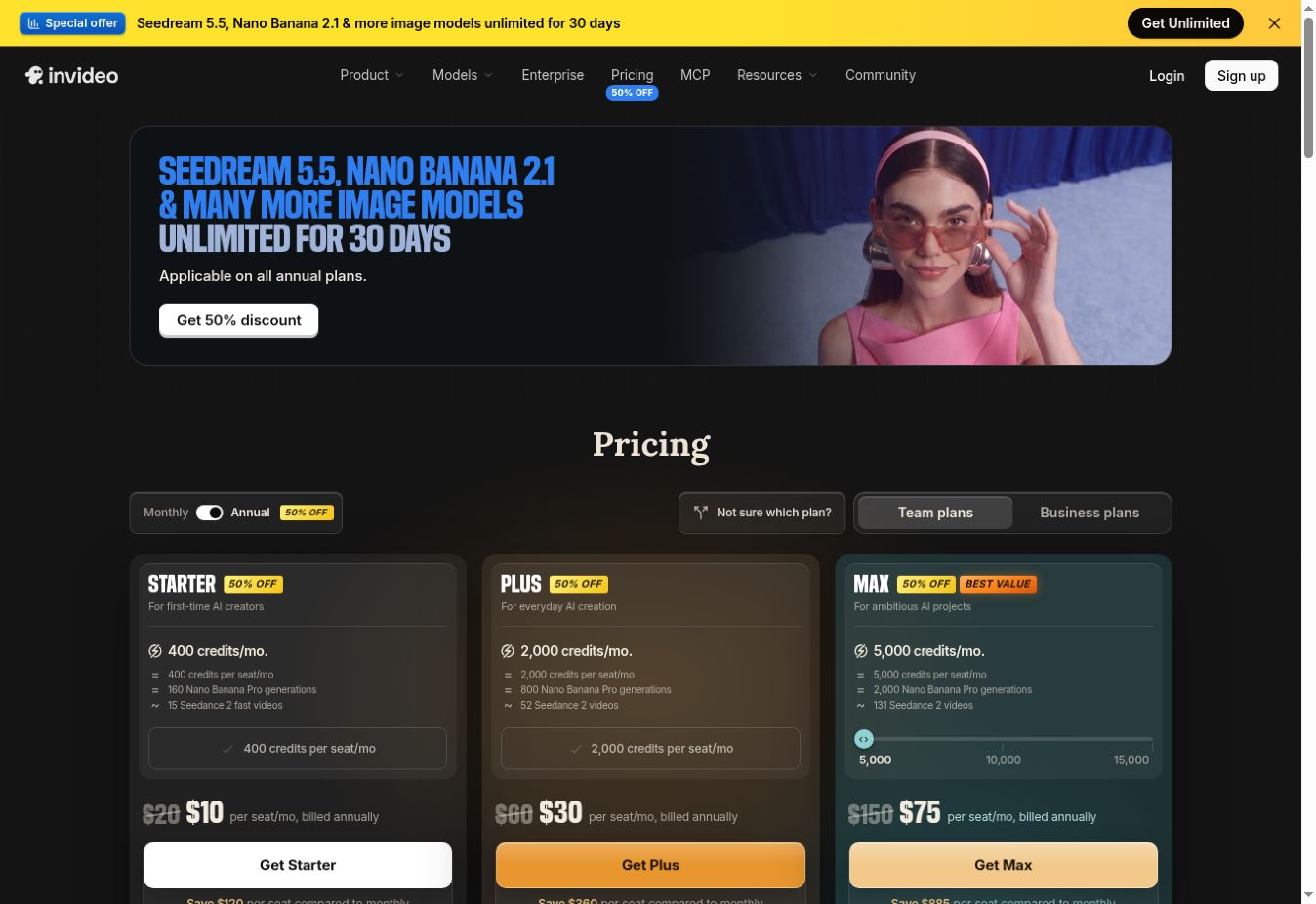
Invideo combines AI creation with editing and access to stock and generated media. Its current pricing page lists timeline editing and multiplayer work, alongside plan-dependent model access. This makes it worth investigating for a marketing team assembling campaigns from several kinds of asset rather than relying exclusively on an avatar or recorded interview.
The reviewed page displayed Starter at a promotional $10 per seat per month billed annually, with 400 monthly credits per seat. It also listed restrictions on which models the tier could use. The displayed promotion should not become an assumed renewal price, and a credit balance does not translate into a fixed number of finished ads.
Invideo’s help documentation explains that credits cover AI work such as processing and generation. That means iteration belongs in the estimate, not just the first draft.
We did not establish a sufficiently clear current Danish feature matrix for this comparison. Its inclusion is therefore for visual production and English-language export content, with Danish narration or translation subject to a pilot. If a documented Danish localization route is a nonnegotiable requirement, begin with one of the providers whose language documentation explicitly names it.
10. Pictory — for repurposing approved written content
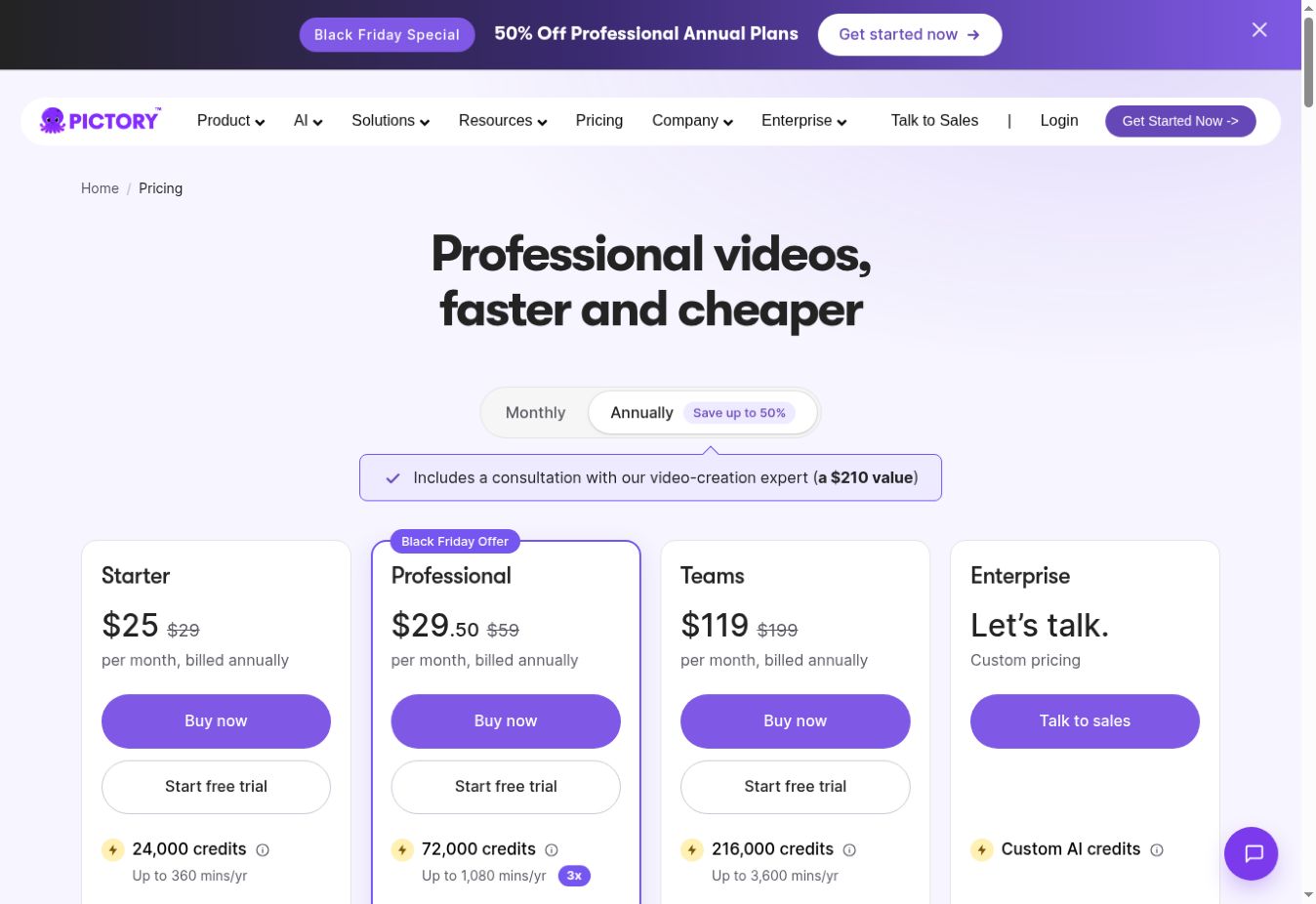
Pictory is relevant when a team already has the explanation in writing. Its product offering includes script-, URL- and document-to-video workflows, alongside captions, voiceover and brand assets. That makes it a candidate for turning an approved article, service explanation or internal document into a shorter visual presentation.
The Danish-language detail deserves care. Pictory’s voice documentation says multilingual premium voices can narrate Danish, while distinguishing them from language-specific premium voices. Do not interpret that as a promise of a dedicated Danish voice or a particular local accent. Listen to the actual voice with your own terminology before choosing it.
Starter was listed at $25 per month billed annually, compared with $29 on monthly billing. The site also offered a 14-day trial and separate Teams collaboration features. Its generation allowances and voice access should be checked against the intended workload; an annual headline amount is not the monthly cancellation price.
Pictory suits a structured repurposing process. It still needs an editor to remove unsupported claims, select relevant visuals and check that stock scenes do not imply a real customer or workplace. Use original footage when the audience needs proof of the service being delivered.
What Danish teams should test before buying
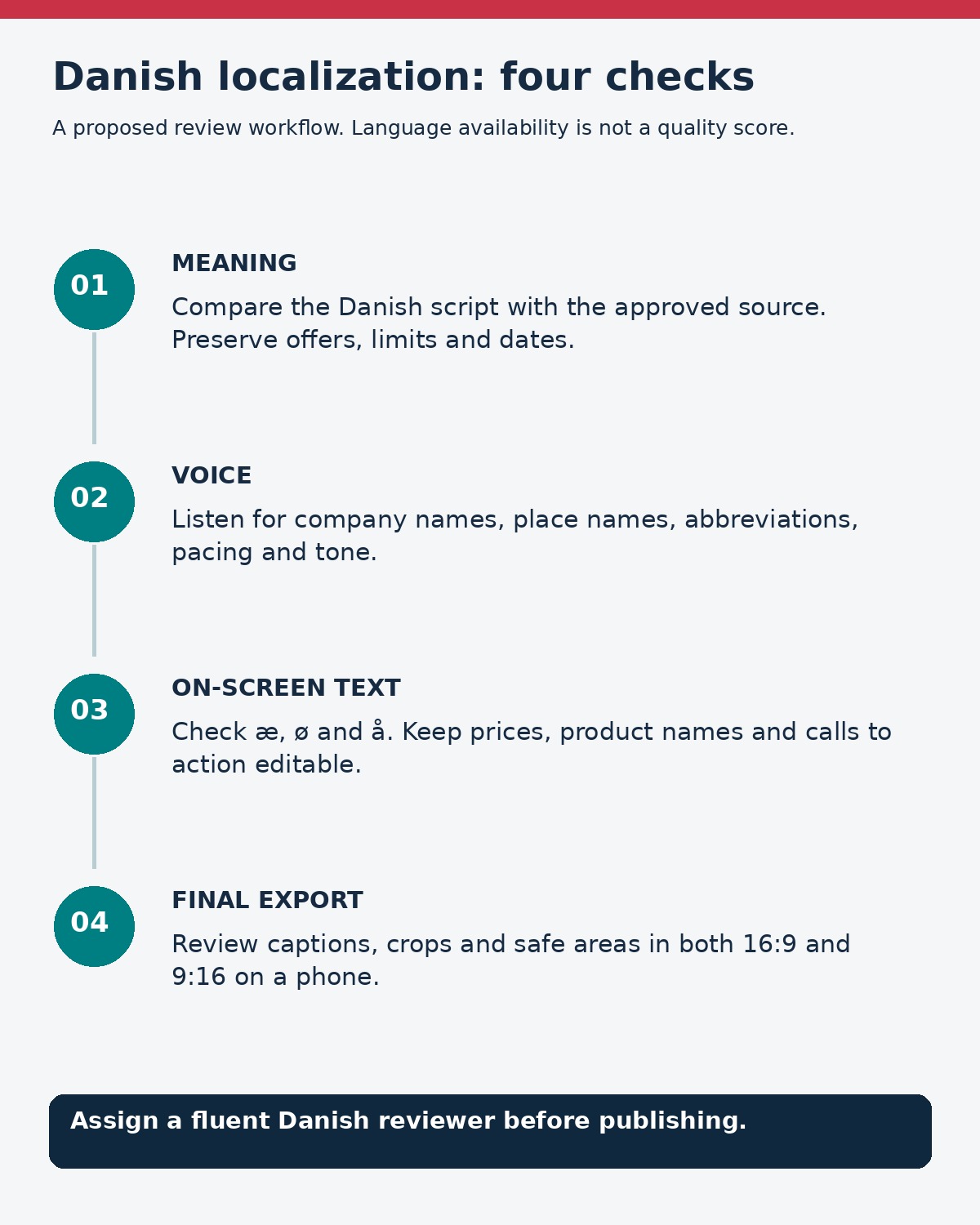
A language checkbox is only the start. Prepare a short approved Danish script containing the company name, a place name, an abbreviation, a date and a price. Include æ, ø and å in captions and on-screen copy. Ask a fluent Danish reviewer to judge meaning, pronunciation, pacing and tone. If colleagues also need English, review the two versions against the same approved source.
Keep visual text editable wherever possible. Product names, figures, availability and offer conditions should survive revisions without requiring repeated image generation. Check both 16:9 and 9:16 exports on the devices where viewers will actually watch them. A technically correct caption can become unreadable after a social platform crops the frame.
For account approval, document the contracting entity, invoice currency, renewal basis, editor permissions, support arrangements and what happens to projects when someone leaves. Request the relevant processing terms, subprocessors, retention options and deletion process for the intended account. EU hosting, where offered, is one procurement fact rather than a complete compliance assessment.
Denmark’s data protection authority, Datatilsynet, has warned about staff placing workplace personal data into generative AI services without organizational awareness or authorization. Its guidance on workplace AI use supports setting clear internal rules. For a pilot, use synthetic or already-approved material rather than customer records or confidential recordings.
Compare cost per approved asset
A subscription price answers only part of the budget question. Add the editor seats, generation or translation usage, licensed material and review time needed to produce something the business can actually publish. Separate those costs from the number of outputs the service can technically generate.
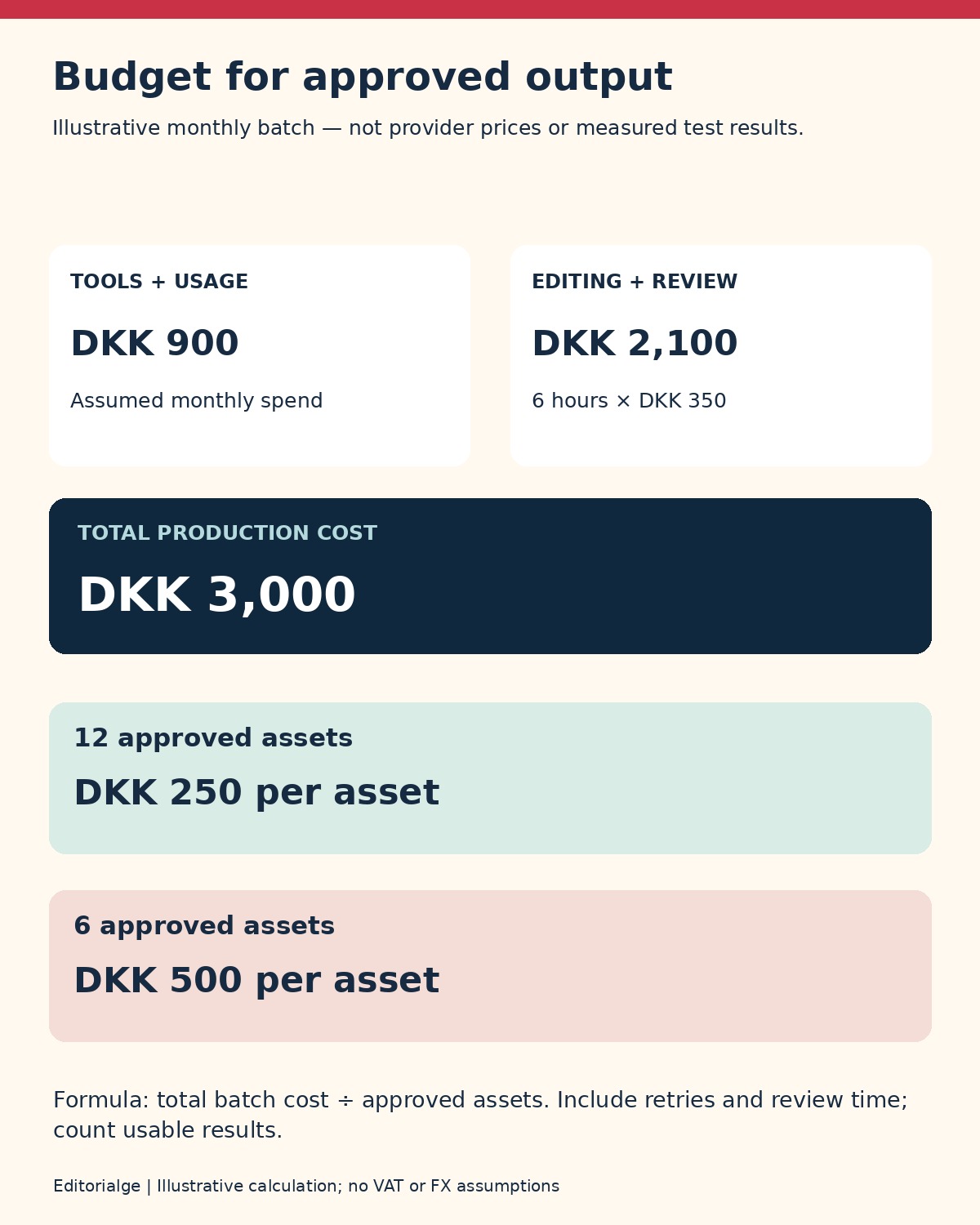
Here is an illustrative calculation, not a provider benchmark. Suppose a monthly production batch uses DKK 900 in subscriptions and usage, plus six hours of editing and review valued internally at DKK 350 per hour. Total production cost is DKK 3,000. If 12 assets are approved, the cost is DKK 250 per approved asset. If only six are usable, it rises to DKK 500. The assumed labor value and software spend are examples, not market rates or currency conversions.
This approach also explains why the cheapest generation option may not be the cheapest workflow. Fewer corrections, reusable templates and clear approvals can matter more than extra raw outputs. Conversely, an expensive team tier is difficult to justify when only one employee creates content and the extra administration features are unused.
A practical two-week comparison
Choose two candidates from the same workflow category. Comparing a transcript editor against an avatar tool on unrelated tasks produces an unhelpful winner. Give both the same approved brief, source assets, target length and export requirements.
- Prepare one Danish business explainer, one short social asset and one revision request relevant to your real work.
- Record generation usage, editing time, language corrections and any export restrictions.
- Have a Danish reviewer and the business owner assess the finished files without treating visual polish as factual accuracy.
- Change one important detail—such as an offer date—and measure how reliably the team can update every version.
- Choose the workflow that meets the acceptance criteria and budget, then record ownership and approval steps.
This is a proposed evaluation method; no results are implied. The Danish Agency for Digital Government’s guides to responsible generative AI use provide a local starting point for organizational rules. For the asset record itself, Editorialge’s AI video copyright guide discusses documenting inputs, licenses and approvals.
Questions that often change the shortlist
Does Danish language support mean Danish customer support?
No. A service may transcribe or generate Danish while providing account support in another language. Ask separately about help-desk language, support hours and the level of assistance included in the contract.
Can a free plan support business publishing?
Sometimes a free tier is useful for evaluation, but examine watermarks, downloads, commercial terms and recurring allowances. Runway’s one-time free credits, for example, are different from a monthly allocation. A trial should not be budgeted as permanent free production.
Should every team use an AI presenter?
No. A presenter can help deliver a structured explanation, but a genuine demonstration or interview may be more appropriate when viewers need to see real behavior, a real person’s experience or an actual product. Choose the format before choosing the vendor.
Choose the provider that fits the next production job
The most useful AI Video and Visual Content Providers for Danish Business Teams are the ones that match a repeatable task and survive local review. Start with Synthesia, HeyGen or Colossyan for presenter-led communication; Canva or Adobe for broader visual work; VEED or Descript for recorded material; and Runway, Invideo or Pictory when the brief calls for generated shots or repurposed content.
Shortlist two, run the same small project through both, and compare approved output rather than promotional demos. Keep the Danish language review, asset permissions and final business approval inside the workflow. That is how a promising tool becomes a useful production service.