

The U.S. has intensified a Venezuela oil quarantine by concentrating military assets in the Caribbean—more than 15,000 troops alongside major naval forces—to interdict crude shipments, escalating a sanctions-enforcement campaign that Venezuela is challenging at the United Nations.
What’s happening now
U.S. officials say the current approach prioritizes economic pressure—tightening enforcement on Venezuelan oil exports—rather than immediate direct strikes on land, framing the operation as sanctions enforcement with military support.
Over recent months, the U.S. posture in and around the Caribbean has expanded to include more than 15,000 troops, an aircraft carrier, multiple warships, and advanced fighter aircraft—capabilities that can support surveillance, interdiction, and deterrence around key shipping routes.
Venezuela’s government has condemned the interdictions as piracy and argues that using force to impose unilateral measures at sea violates international law and national sovereignty.
The two developments—combined
The story blends two connected moves: (1) a large-scale U.S. force presence positioned to sustain maritime enforcement and (2) an operational directive for U.S. forces to focus heavily on stopping Venezuelan oil flows for a defined period.
U.S. messaging has emphasized that oil exports are the core financial channel sustaining Nicolás Maduro’s government, while Venezuela argues the policy is designed to strangle the economy and force political outcomes from abroad.
The dispute has spilled into international forums, including an emergency UN Security Council meeting requested by Venezuela after tanker seizures and the broader quarantine/blockade posture were announced and enforced.
What the U.S. has deployed
Public reporting describes a force package far larger than typical maritime law-enforcement operations, combining Coast Guard authorities with Navy support and a broader Defense Department footprint.
U.S. force posture (reported)
| Element | Reported presence tied to enforcement posture | What it enables (in practice) |
| Personnel | More than 15,000 troops in the Caribbean area | Sustained operations, logistics, intelligence support, rapid response. |
| Major naval aviation | At least one aircraft carrier referenced in reporting | Airborne surveillance, deterrence, air cover for maritime operations. |
| Warships | 11 other warships plus the carrier cited in reporting | Maritime domain awareness, interdiction support, escort and presence missions. |
| Aircraft | More than a dozen F-35 aircraft cited in reporting | Air patrols and reconnaissance; also signals escalation capacity. |
Tanker interdictions and seizures
Venezuela’s National Assembly moved to criminalize support for tanker seizures, blockades, or other actions that hinder navigation and commerce involving the country, with penalties described as up to 20 years in prison for certain conduct.
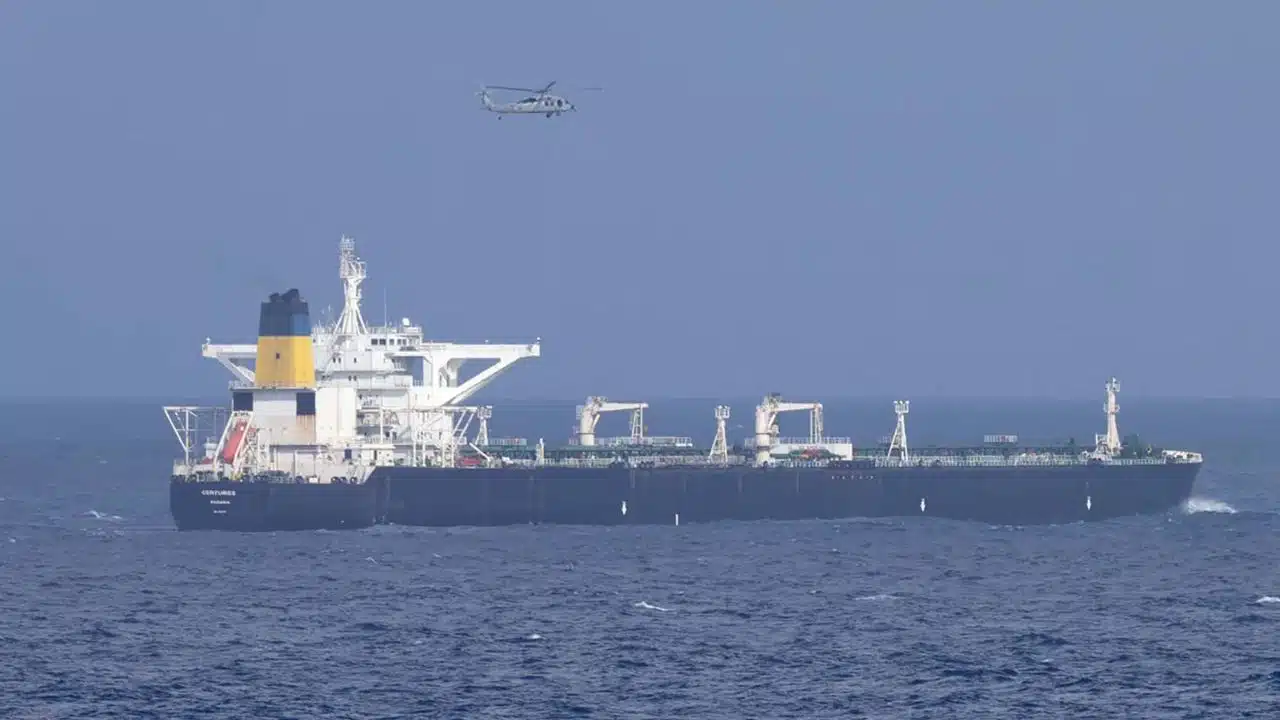
The same report says U.S. forces seized two tankers carrying Venezuelan oil in international waters this month, identifying the vessels as Centuries and Skipper and describing Navy support for at least one of the actions.
Separately, reporting has described the U.S. Coast Guard intercepting two tankers and pursuing a third, underscoring that the quarantine is being operationalized through ship tracking, boarding risk, and cargo control rather than only financial restrictions.
Key timeline (reported)
| Date (2025) | Event | Why it matters |
| Dec. 10 | Skipper seized with Coast Guard action supported by the Navy, per reporting | Marked a visible shift from sanctions on paper to physical interdiction at sea. |
| Mid–late Dec. | Centuries seized; Venezuela escalates diplomatic response at UN | Triggered legal/diplomatic pushback and broadened the dispute internationally. |
| Late Dec. | U.S. direction emphasizes a quarantine focus for at least the next two months | Signals a sustained campaign window, not a one-off interdiction. |
Why Venezuelan oil is the pressure point
Venezuela’s oil sector remains central to state revenue, and enforcement aimed at shipments targets the country’s most important export stream.
OPEC secondary-source estimates in 2025 placed Venezuelan crude output around the high-800,000s to mid-900,000 barrels per day range in different months, indicating constrained but meaningful production capacity that still feeds export earnings.
Analysts widely note that any disruption to these barrels can ripple through specific refining networks that historically relied on heavy crude, even if Venezuela represents a relatively small share of total global supply.
Legal and policy framework behind enforcement
U.S. sanctions on Venezuela are administered through the Treasury Department’s Office of Foreign Assets Control (OFAC), which maintains the Venezuela-related sanctions program, regulations, and licensing pathways.
OFAC’s program references multiple executive orders and legal authorities, and it also outlines general licenses that permit limited categories of otherwise-prohibited transactions, showing how sanctions enforcement can combine broad prohibitions with narrow exemptions.
Venezuela, by contrast, argues that enforcement through an armed blockade/quarantine posture amounts to coercion and a sovereignty breach—an argument it has advanced in international venues, including the UN Security Council.
Regional and geopolitical fallout
At the UN meeting described in reporting, Venezuela’s envoy questioned the legality of tanker seizures and cited an estimate of almost 4 million barrels of oil taken to date from the two seized tankers, framing the actions as an attack on Venezuelan commerce.
The same account described U.S. arguments that sanctioned tankers function as a financial lifeline for the Maduro government, and that Washington intends to enforce sanctions to the maximum extent.
Some states reportedly expressed concern about maritime-law and UN Charter principles, while a smaller number backed Washington’s posture—highlighting how the issue is splitting regional diplomacy and raising the stakes for shipping and insurance.
Final thoughts
If the Venezuela oil quarantine continues on the stated timetable, the next test will be operational: whether interdictions expand beyond isolated seizures into routine, scalable disruption of tanker flows.
The parallel diplomatic track is also intensifying, as Venezuela pushes legal countermeasures at home and escalates complaints in global forums, raising the likelihood of further retaliation—legal, economic, or maritime—short of direct conflict.
For markets, the immediate question is not global supply collapse but localized dislocation: where Venezuela’s heavy crude can still move, under what flags and insurers, and at what discount as enforcement risk rises.
























