In the current gaming landscape, a significant shift has occurred. While AAA blockbusters still dominate opening weekend sales through sheer marketing force, the battle for long-term player time—retention—is increasingly being won by “AA” (mid-market) titles. Players are moving away from bloated, expensive ecosystems toward focused, respectful, and distinct experiences.
This guide explores the data, psychology, and design philosophies driving this trend.
Why AA is Winning the Long Game
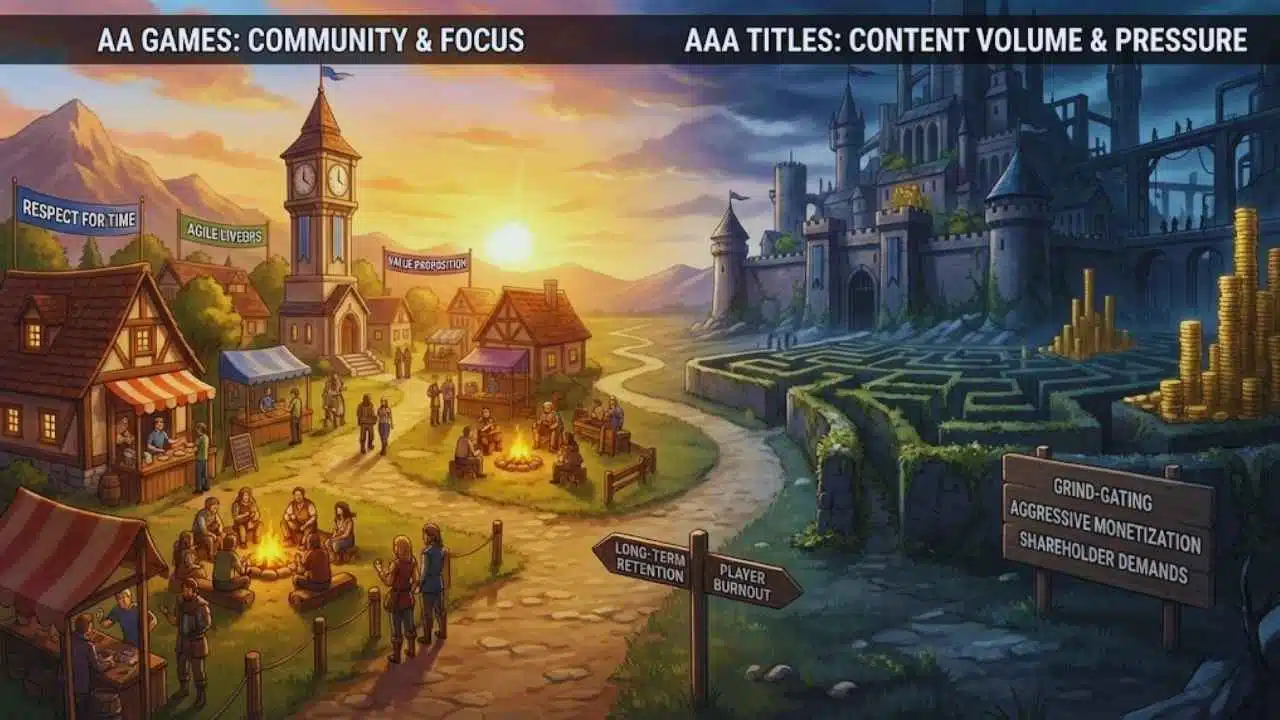
Mid-market (AA) games are outperforming AAA titles in retention because they prioritize focused gameplay loops over content volume. By operating with agile budgets ($10M–$50M), AA studios can take creative risks, maintain faster update cadences, and foster genuine community trust without the aggressive monetization pressure that often causes “player burnout” in AAA live services.
The 5 Pillars of AA Retention Success:
- Respect for Time: Faster “time-to-fun” and less grind-gating.
- Focused Identity: Polished core mechanics instead of diluted “do-everything” designs.
- Community Integration: Direct developer-to-player communication reduces toxicity.
- Value Proposition: Lower price points ($30–$40) lower the psychological barrier to return.
- Agile LiveOps: Updates are released based on player feedback, not quarterly shareholder demands.
Budget, Scope, and Risk Profiles
To understand retention data, we must first distinguish the products. The “AA” label is often fuzzy, but from a business and development perspective, distinct characteristics separate it from the AAA heavyweights.
The Structural Differences
AA games sit in the “Goldilocks Zone”—big enough to have high production values (voice acting, good graphics) but small enough to take risks that a $200M project cannot.
| Feature | AA (Double-A) | AAA (Triple-A) |
| Typical Budget | $10 Million – $50 Million | $100 Million – $500 Million+ |
| Team Size | 25 – 100 Developers | 500 – 1,000+ Developers |
| Risk Tolerance | Moderate: Can profit with <1M sales. | Low: Needs 5M–10M+ sales to break even. |
| Design Focus | Specialized (e.g., “Hardcore Co-op”). | Broad Appeal (e.g., “Open World Action-RPG”). |
| Monetization | Fair price + cosmetic DLCs. | Full price + Battle Pass + Store + Expansions. |
| Examples | Helldivers 2, Palworld, Hades II | Call of Duty, Assassin’s Creed, Suicide Squad |
Why This Impacts Retention
AAA games are often forced to be “everything to everyone” to justify their budget. This leads to design dilution—adding stealth, crafting, and puzzles to a shooter just to extend playtime. AA games, by contrast, focus on doing one thing perfectly. Players return to AA games because they deliver a specific, reliable “dopamine hit” without the fluff.
Decoding Retention: Metrics That Actually Matter
“Retention” is not a vague feeling; it is a measurable science. When analysts say AA is winning, they are looking at specific key performance indicators (KPIs).
The Retention Toolkit
Understanding these metrics reveals why “Player Count” alone is misleading. A game might have fewer players but better retention.
| Metric | Definition | Why AA Often wins Here |
| D30 Retention | % of players returning 30 days after install. | AA games often have “sticky” loops that don’t burn players out in week 1. |
| Churn Rate | % of players who stop playing entirely. | AA titles generate less “fatigue” due to lower monetization pressure. |
| Session Frequency | How often a player logs in per week. | Shorter, focused missions (20-30 mins) fit better into adult schedules. |
| Reactivation | % of lapsed players returning for updates. | Lower file sizes and simpler onboarding make it easier to “hop back in.” |
| CCU Stability | Consistency of Concurrent Users. | AA games often see a “sawtooth” pattern (stable base + spikes) rather than a crash. |
The “Content vs. Loop” Fallacy
AAA studios often attempt to brute-force retention by adding Content Volume (more map icons, more quests).
AA studios achieve retention through Loop Mastery (making the core 30 seconds of fun repeatable).
Insight: 100 hours of mediocre content results in lower D30 retention than 20 hours of incredible content that is replayable.
The 9 Core Drivers of Mid-Market Player Loyalty
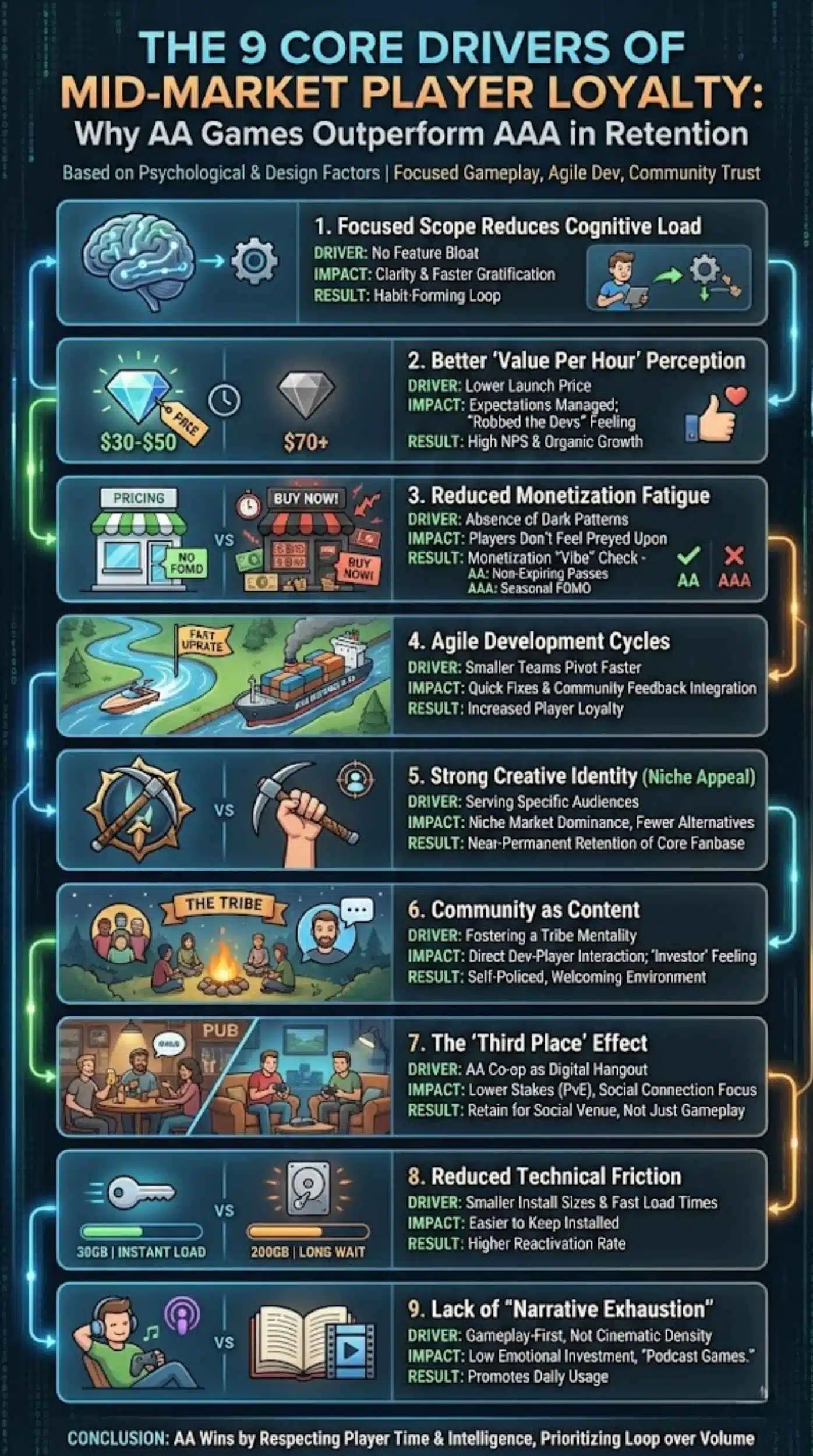
Why are players sticking with Deep Rock Galactic or Remnant 2 for years? It comes down to these specific psychological and design factors.
1. Focused Scope Reduces Cognitive Load
- The Driver: AA games usually lack “feature bloat.”
- The Impact: Players know exactly what experience they are signing up for. There is no need to learn a complex crafting system if you just want to shoot bugs.
- Result: Faster gratification leads to a habit-forming loop.
2. Better “Value Per Hour” Perception
- The Driver: Launch pricing of $30–$50 vs. $70+.
- The Impact: When a player pays less, their expectations for “endless content” are managed. Paradoxically, if they get 30 great hours for $40, they feel they “robbed the devs” and become evangelists for the game, returning for DLC.
- Result: High “Net Promoter Score” (NPS) which drives organic growth.
3. Reduced Monetization Fatigue
- The Driver: Absence of aggressive “dark patterns” (FOMO shops, confusing currencies).
- The Impact: Players do not feel preyed upon. AAA live services often feel like a storefront with a game attached. AA games feel like a game with a gift shop attached.
The Monetization “Vibe” Check
| Feature | AA Approach | AAA Live Service Approach |
| Battle Pass | Often non-expiring (e.g., Deep Rock Galactic, Helldivers 2). | Expires seasonally; utilizes FOMO to force play. |
| Currencies | Usually 1 or 2 (Gold + Premium). | Multiple (Gold, Crystals, Tokens, Shards) to obscure value. |
| Store Placement | Tucked away in a menu. | Pop-up on login; main menu integration. |
4. Agile Development Cycles
- The Driver: Smaller teams (50–80 people) can pivot faster than 800-person teams.
- The Impact: If the community hates a weapon balance change, an AA studio can fix it in a week. A AAA studio often requires weeks of meetings and QA certification across five support studios to change a variable.
- Result: Players feel heard, increasing loyalty.
5. Strong Creative Identity (Niche Appeal)
- The Driver: Serving a specific audience (e.g., “Extraction Shooter fans”) rather than the mass market.
- The Impact: Niche audiences have few alternatives. If you make the best game in a specific sub-genre, players have nowhere else to go.
- Result: Near-permanent retention of the core fanbase.
6. Community as Content
- The Driver: Fostering a “tribe” mentality.
- The Impact: In AA games, developers often interact directly on Discord/Reddit. This parasocial bond makes players feel like “investors” in the game’s success.
- Result: Toxicity is often self-policed by the community, creating a more welcoming environment for new players.
7. The “Third Place” Effect
- The Driver: AA Co-op games function as a digital hangout spot.
- The Impact: Because the stakes are often lower (PvE vs. PvP), these games become social hubs. Players retain not for the gameplay, but for the venue to chat with friends.
8. Reduced Technical Friction
- The Driver: Smaller install sizes and faster load times.
- The Impact: It is easier to keep a 30GB game installed “just in case” than a 200GB behemoth like Call of Duty or Ark.
- Result: Higher “Reactivation Rate” because the barrier to re-entry is disk space.
9. Lack of “Narrative Exhaustion”
- The Driver: Gameplay-first focus over cinematic density.
- The Impact: AAA games often demand high emotional investment. AA games are often “podcast games”—activities you can do while relaxing, which promotes daily usage.
Real-World Success Stories: AA vs AAA
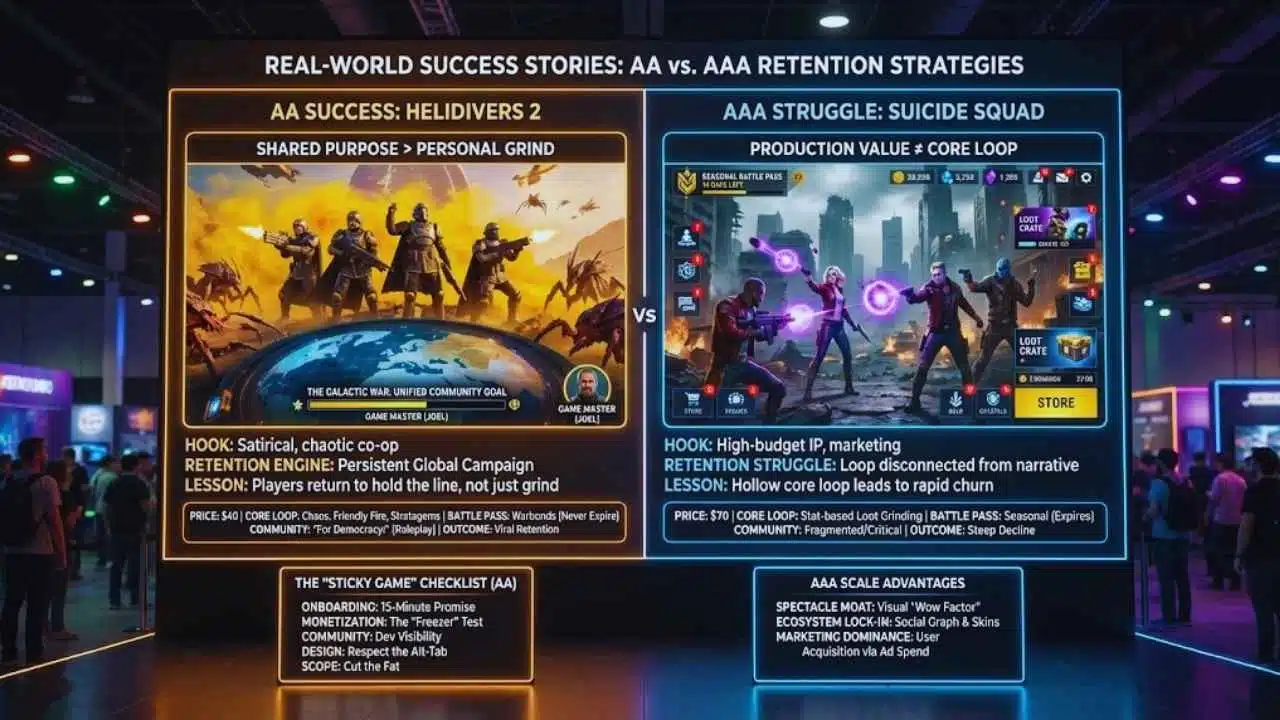
Analyzing specific titles reveals the stark contrast in retention strategies.
Case Study A: Helldivers 2 (AA Success)
- The Hook: Satirical, chaotic co-op shooter.
- Retention Engine: “The Galactic War.” A unified community goal where every player’s match contributes to a global map.
- Why it Worked: It turned the game into a persistent D&D campaign managed by a “Game Master” (Joel). Players returned daily not to grind loot, but to “hold the line” for the community.
- Lesson: Shared Purpose > Personal Grind.
Case Study B: Suicide Squad: Kill the Justice League (AAA Struggle)
- The Hook: High-budget IP, massive marketing, looter-shooter mechanics.
- Retention Struggle: The gameplay loop (shooting purple orbs) disconnected from the narrative fantasy (being a villain). The UI was cluttered with currencies and battle passes from Day 1
- Outcome: Rapid player churn. By month 2, it had fewer concurrent players than Batman: Arkham Knight (a single-player game from 2015).
- Lesson: Production value cannot fix a hollow core loop.
Side-by-Side Comparison
| Feature | Helldivers 2 (AA) | Suicide Squad (AAA) |
| Price | $40 | $70 |
| Core Loop | Chaos, Friendly Fire, Stratagems | Stat-based Loot Grinding |
| Battle Pass | Warbonds (Never Expire) | Seasonal (Expires) |
| Community | “For Democracy!” (Roleplay) | Fragmented/Critical |
| Outcome | Viral Retention | Steep Decline |
The Flip Side: Where AAA Scale Still Dominates
While AA is winning on sentiment and efficiency, AAA still holds specific advantages in retention that cannot be ignored.
- The “Spectacle” Moat: Some players retain purely for graphical fidelity and cinematic scale. AA cannot compete with the visual “wow factor” of GTA VI or Cyberpunk 2077.
- Ecosystem Lock-in: Games like Fortnite, Roblox, and Call of Duty are platforms, not just games. They hold a player’s social graph, skins, and digital identity. Leaving these games feels like deleting a social media account.
- Marketing & Cultural Dominance: AAA games can force their way into the cultural zeitgeist through ad spend, ensuring a steady stream of new users (User Acquisition) even if churn is high.
Actionable Strategies for Publishers and Developers
For developers aiming to replicate AA retention success, the following checklist provides a roadmap based on the current market data.
The “Sticky Game” Checklist
| Category | Actionable Step | Why it Works |
| Onboarding | The “15-Minute Promise” | Ensure the player experiences the core fun (not a tutorial) within 15 mins. |
| Monetization | The “Freezer” Test | If a player stops paying/playing for a month, do they lose content? If yes, change it. |
| Community | Dev Visibility | Have developers post “Work in Progress” shots on Discord. Humanizes the studio. |
| Design | Respect the Alt-Tab | Can the game be paused? Is it crash-resilient? Reduces friction. |
| Scope | Cut the Fat | Remove one major weak system (e.g., crafting) to polish the combat. |
3 Practical Experiments to Run
- The “Welcome Back” Bonus: Instead of punishing lapsed players, offer a “Welcome Back” resource boost that triggers after 14 days of inactivity.
- Community Goal Events: Create a server-wide kill count goal (e.g., “Kill 1 Million Bugs”) with a cosmetic reward for everyone.
- The “Starter Pack” Pivot: If selling a game for $30, offer a $10 “Supporter Upgrade” purely for cosmetics. AA audiences love supporting devs voluntarily rather than forcefully.
Final Thoughts
The data is clear: Players are not tired of games; they are tired of friction.
AA games are outperforming AAA titles in retention because they have returned to the fundamental contract of video games: Pay a fair price, get a fun experience. By removing the layers of corporate obligation—FOMO, daily login chores, and aggressive upsells—AA developers are finding that players naturally want to stay.
- For Players: The “Golden Age” is in the mid-market. Look for games priced at $30–$40 with “Overwhelmingly Positive” Steam reviews.
- For Studios: You cannot out-spend the competition, but you can out-respect them. Trust is the new retention currency.