


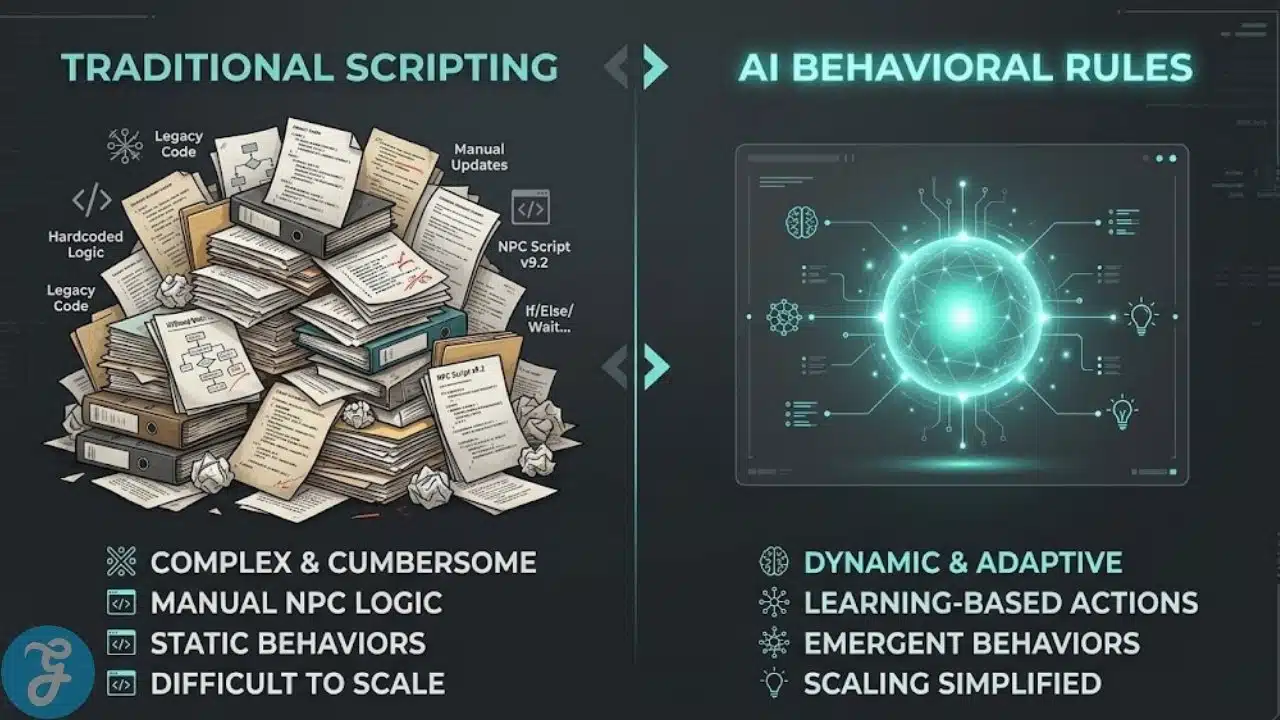
The traditional era of static dialogue trees and predictable artificial intelligence in gaming is rapidly coming to an end. Today, a new wave of highly specialized SMEs for Ai NPCs & Behavior is fundamentally altering how players interact with digital worlds, creating agents that possess situational awareness, emotional depth, and autonomous decision-making capabilities.
For studios looking to build deeply immersive experiences, partnering with these agile startups provides the technological leap necessary to meet modern player expectations in an increasingly competitive market.
Our Selection Criteria
Evaluating the top startups in the artificial character space requires looking beyond basic language model wrappers to find true proprietary technology. The following filters were used to identify the most impactful organizations currently shaping the ecosystem.
-
Proprietary Architecture: We prioritized firms building custom behavior engines or neuro-symbolic AI rather than those simply routing prompts to public APIs.
-
Engine Integration: Assessment of how seamlessly their SDKs integrate with industry-standard platforms like Unreal Engine and Unity.
-
Latency & Performance: Evaluation of the technology’s ability to generate real-time responses without breaking immersion or demanding excessive local compute power.
-
Funding & Viability: Focusing on organizations with strong venture backing from reputable sources, ensuring they can survive the intensive R&D phases of AI development.
While the United States serves as the primary hub and testing ground for these technologies, the demand for intelligent virtual characters has attracted a global cohort of innovators. The following companies represent the vanguard of this movement, bringing cutting-edge behavioral simulation directly to American studios and developers.
1. Inworld AI
Headquarters: Mountain View, CA
Website: inworld.ai
Email: hello@inworld.ai
Operating at the forefront of character intelligence, this Silicon Valley startup provides a comprehensive engine for studios to create distinct digital brains. By overlaying foundational models with purpose-built gaming AI, they give characters the ability to maintain emotional ranges, execute autonomous decisions, and react dynamically to player choices. Supported by massive venture capital, they are rapidly becoming the infrastructure layer for next-generation interactive storytelling.
Best Feature/For:
-
Comprehensive personality crafting and deep emotional memory retention.
Why We Chose It:
-
Raised over $100 million, making them one of the best-funded startups in this specific niche.
-
Offers incredibly robust integrations for both AAA and indie game engines.
-
Provides situational awareness features that allow characters to react to the in-game physical environment.
Things to consider:
-
The premium tier pricing may be prohibitive for micro-indie studios operating on tight budgets.
2. Convai
Headquarters: San Jose, CA
Website: convai.com
Email: support@convai.com
This developer platform focuses intensely on creating lifelike, voice-driven virtual characters that can seamlessly interact within 3D spaces. Their SDKs go beyond mere speech generation, incorporating LLM reasoning, perception, and action execution so characters can actually perform tasks based on natural language commands. With over a thousand active studios utilizing their tools, they are a dominant force in the democratization of intelligent agents.
Best Feature/For:
-
Voice-driven interactions and in-world action execution.
Why We Chose It:
-
Excellent end-to-end pipeline that handles everything from speech recognition to character animation.
-
Highly accessible tools that lower the barrier to entry for smaller development teams.
-
Strong focus on contextual understanding, preventing characters from giving nonsensical responses.
Things to consider:
-
Heavily reliant on persistent cloud connectivity for real-time processing.

3. Altera
Headquarters: Palo Alto, CA
Website: altera.al
Email: hello@altera.al
Founded by former neuroscientists, this newly minted startup approaches character creation from a fundamentally different scientific perspective. Their autonomous agents are designed to act as true digital companions rather than simple assistants, capable of playing complex games like Minecraft alongside human users by crafting, building, and trading. Their rapid funding success highlights the industry’s hunger for agents that possess genuine mechanical agency.
Best Feature/For:
-
Autonomous gameplay agents and true digital companionship.
Why We Chose It:
-
Unique neuroscientific approach to designing artificial motivations and behaviors.
-
Proven capability to navigate complex, open-world gaming environments autonomously.
-
Backed by prominent investors including Riot Games alumni, signaling strong industry trust.
Things to consider:
-
Still in the very early stages of commercial deployment compared to older competitors.
4. Artificial Agency
Headquarters: Edmonton, AB (US-Facing)
Website: artificialagency.com
Email: info@artificialagency.com
Originating from former DeepMind researchers, this agency has completely discarded the traditional decision-tree framework used in game design for decades. Instead, their behavior engine requires developers to assign motivations, rules, and goals, allowing the NPC to dynamically calculate its own responses and actions in real-time. Despite being based in Canada, their massive venture backing positions them as a critical technology provider for major US studios.
Best Feature/For:
-
Goal-oriented behavior simulation and dynamic rule-based autonomy.
Why We Chose It:
-
Completely disrupts traditional branching narrative design with genuine systemic intelligence.
-
Built by researchers with world-class pedigrees in advanced machine learning.
-
Allows for infinite replayability as characters react differently to the same stimuli based on shifting internal goals.
Things to consider:
-
Requires a significant paradigm shift in how narrative designers approach writing and plotting.
5. NPCx
Headquarters: Estero, FL
Website: npcx.ai
Email: info@npcx.ai
This Florida-based company targets a very specific and notoriously difficult aspect of character behavior: physical movement. By utilizing neural networks and biomechanical models, they aim to transform and streamline motion capture data, significantly reducing the manual processing time traditionally required. They are essential for studios looking to make their characters move with the same fluid intelligence with which they speak.
Best Feature/For:
-
Biomechanical movement intelligence and motion capture optimization.
Why We Chose It:
-
Solves a massive pipeline bottleneck in traditional AAA game development.
-
Focuses on the physical realism of NPCs, complementing text-based behavior engines.
-
Strong seed funding indicates market validation for AI-assisted animation tools.
Things to consider:
-
Their focus is strictly on animation and movement, not conversational intelligence.
6. Fable Studio
Headquarters: San Francisco, CA
Website: fable-studio.com
Email: contact@fable-studio.com
Operating at the intersection of gaming, virtual reality, and generative television, this startup builds next-generation authoring tools for interactive storytelling. They are famous for developing simulated realities where characters can live, learn, and make decisions autonomously, effectively acting as “showrunners” for custom virtual experiences. They are pushing the boundaries of what constitutes a game versus an interactive, ever-evolving narrative.
Best Feature/For:
-
Generative storytelling and evolving virtual reality narratives.
Why We Chose It:
-
Pioneering the concept of characters that “live” even when the player is not interacting with them.
-
Strong background in high-end VR and immersive media.
-
Provides highly sophisticated authoring tools for non-technical creative writers.
Things to consider:
-
Their technology bridges into linear media, which may be too experimental for traditional game loops.
7. Charisma.ai
Headquarters: Oxford, UK (US-Facing)
Website: charisma.ai
Email: hello@charisma.ai
This international firm provides advanced conversational simulations that are heavily utilized in both the gaming and corporate training sectors. Their vision is to power characters across the Metaverse using creative machine learning that understands narrative pacing and emotional context. By securing clients like major global broadcasters, they have proven their technology’s viability in the highly demanding American entertainment market.
Best Feature/For:
-
Narrative-driven conversational AI and immersive training simulations.
Why We Chose It:
-
Excellent tools for writers wanting to create branching, emotionally intelligent dialogue.
-
Proven track record with massive media conglomerates and entertainment brands.
-
Highly accessible interface designed specifically for creative professionals.
Things to consider:
-
Their focus is heavily weighted toward dialogue rather than autonomous physical gameplay.
8. modl.ai
Headquarters: Copenhagen, Denmark (US-Facing)
Website: modl.ai
Email: contact@modl.ai
While headquartered in Europe, this startup’s technology is critical for the US development pipeline, focusing specifically on NPC behavior simulation for Quality Assurance (QA). They build AI bots that playtest games, mimicking human behavior to find bugs, exploits, and navigational errors before a game ships. Supported by major American venture funds like Microsoft’s M12, they are automating one of the most tedious aspects of game development.
Best Feature/For:
-
Automated QA testing and player behavior mimicry.
Why We Chose It:
-
Solves an immediate, high-cost problem for game developers regarding testing at scale.
-
Bots can simulate thousands of hours of human gameplay in a fraction of the time.
-
Backed by heavy-hitting US corporate venture capital.
Things to consider:
-
Their AI is built for testing and breaking games, not for player-facing interaction.
9. Promethean AI
Headquarters: Los Angeles, CA
Website: prometheanai.com
Email: info@prometheanai.com
Backed by the Disney Accelerator, this boutique firm focuses on the environmental behavior and world-building aspects of digital creation. Their artificial intelligence acts as an assistant to artists, managing mundane tasks and suggesting asset placements to build complex virtual worlds rapidly. They are heavily utilized by top-tier studios to free up creative talent from the repetitive labor of environmental design.
Best Feature/For:
-
AI-assisted world-building and environmental asset management.
Why We Chose It:
-
Incredible efficiency gains for 3D artists and level designers.
-
Trusted by major console manufacturers and AAA development houses.
-
Empowers creators rather than attempting to replace them.
Things to consider:
-
The tool is built for environmental creation, not for crafting the conversational brains of the characters.
10. Soul Machines
Headquarters: Auckland, NZ (US-Facing)
Website: soulmachines.com
Email: support@soulmachines.com
Specializing in autonomous digital humans, this firm creates agents with highly sophisticated emotional intelligence models designed for enterprise, simulation, and gaming. Their “Digital Brain” technology allows avatars to read user expressions via webcam and react with stunning micro-expressions. While based in New Zealand, their technology is heavily deployed in the US market to bridge the gap between digital interfaces and human empathy.
Best Feature/For:
-
Visually realistic digital humans and visual emotion recognition.
Why We Chose It:
-
Unparalleled visual fidelity regarding facial micro-expressions and lip-syncing.
-
Technology scales easily from gaming into customer service and digital health.
-
Creates a deeply empathetic connection between the user and the digital agent.
Things to consider:
-
The hyper-realistic visuals can sometimes trigger the “uncanny valley” effect for certain users.
An Overview Of Market Dynamics and SMEs for Ai NPCs & Behavior
The current market is highly fragmented, with different startups tackling specific bottlenecks in the character creation pipeline—from how they speak to how they walk. Understanding where each firm specializes is crucial for studios looking to integrate these technologies without overlapping toolsets.
The following information breaks down the core competencies of these leaders to provide a clearer picture of how the ecosystem functions across various development phases.
Overview Comparison Table
| SME | Core Focus | HQ Location | Primary Use Case |
| Inworld AI | Digital Brains | USA | Deep Character Personalities |
| Convai | Voice & Action | USA | Interactive 3D NPCs |
| Altera | Autonomous Agents | USA | Gameplay Companions |
| Artificial Agency | Goal-based Logic | Canada | Systemic Narrative Design |
| NPCx | Biomechanics | USA | Motion Capture Optimization |
| Fable Studio | Generative Story | USA | Autonomous Virtual Realities |
| Charisma.ai | Conversational AI | UK | Interactive Dialogue |
| modl.ai | QA Automation | Denmark | AI Playtesting |
| Promethean AI | World-building | USA | Environmental Design |
| Soul Machines | Digital Humans | New Zealand | Visual Emotional Intelligence |
Our Top 3 Picks and Why?
While all these firms offer remarkable technology, three stand out for their immediate applicability to modern development workflows.
-
Inworld AI: They represent the most complete package for developers who want to plug a sophisticated “brain” directly into their existing engine. Their funding guarantees they will be around for the long haul.
-
Altera: For studios looking to push boundaries, Altera’s approach to creating agents that actually play the game alongside you represents the next massive paradigm shift in multiplayer design.
-
NPCx: While conversational AI gets all the headlines, NPCx is solving the quiet, expensive nightmare of animation processing, making them an unsung hero of the development cycle.
Why are SMEs for Ai NPCs & Behavior Booming in USA
The United States represents the perfect storm for this specific technological niche. With the world’s largest concentration of AAA gaming studios, massive venture capital reserves, and the presence of foundational AI companies like OpenAI and Anthropic, the infrastructure for rapid iteration is unmatched. These SMEs act as the necessary bridge, taking the raw power of large language models and refining them into usable, performant tools for the entertainment sector.
What’s their secret sauce?
The distinct advantage of these startups is their hyper-focus on “contextual guardrails.” A raw AI model is prone to hallucinations or breaking character, which instantly ruins game immersion. These companies have developed proprietary layers of technology that force the AI to remember its specific lore, adhere to its personality constraints, and react within the physical boundaries of the game engine, turning unpredictable math into reliable art.
Beyond the Turing Test: The Ethics of Digital Autonomy
As we look toward the future of interactive media, the integration of these technologies brings significant philosophical and operational challenges. The uncomfortable truth is that while these tools promise infinite replayability, they also threaten to homogenize narrative design. If every NPC can talk endlessly about anything, the curated, hand-crafted moments that define gaming masterpieces may be lost in a sea of procedurally generated mediocrity.
Furthermore, there is a looming crisis regarding the “uncanny valley” of behavior. As agents from these SMEs for Ai NPCs & Behavior become more lifelike, players will expect them to possess deeper memories and moral complexities. When a digital companion inevitably fails to recall a specific emotional beat from thirty hours prior, the break in immersion will be far more jarring than a simple pathfinding glitch. The ultimate success of this sector relies not on making characters smarter, but on making their limitations invisible, ensuring that the illusion of life is never broken.
Frequently Asked Questions (FAQs) About SMEs for Ai NPCs & Behavior
Question 1: Do these AI systems require a constant internet connection?
Answer: Currently, yes. Most advanced behavioral models rely on cloud-based processing because the compute required to generate real-time responses is too heavy for local consumer hardware like consoles or standard PCs.
Question 2: Can players trick these NPCs into breaking character?
Answer: While “jailbreaking” is a concern, top-tier firms use strict contextual guardrails and safety filters that heavily penalize the AI for stepping outside its programmed lore or adopting inappropriate tones.
Question 3: Will these tools replace narrative writers in gaming?
Answer: No; they actually shift the writer’s role. Instead of writing linear dialogue trees, writers now act as “personality architects,” writing the deep lore, motivations, and psychological profiles that guide the AI’s generation.
Question 4: How much latency is introduced when talking to these NPCs?
Answer: The industry standard is rapidly shrinking. The best providers have optimized their pipelines to keep voice-to-voice latency under one second, mimicking the natural pause in human conversation.
Question 5: Can I integrate these tools into an indie game on a small budget?
Answer: Yes. Companies like Convai and Inworld offer scalable pricing models and free tiers specifically designed to let indie developers experiment and build prototypes without massive upfront costs.





















