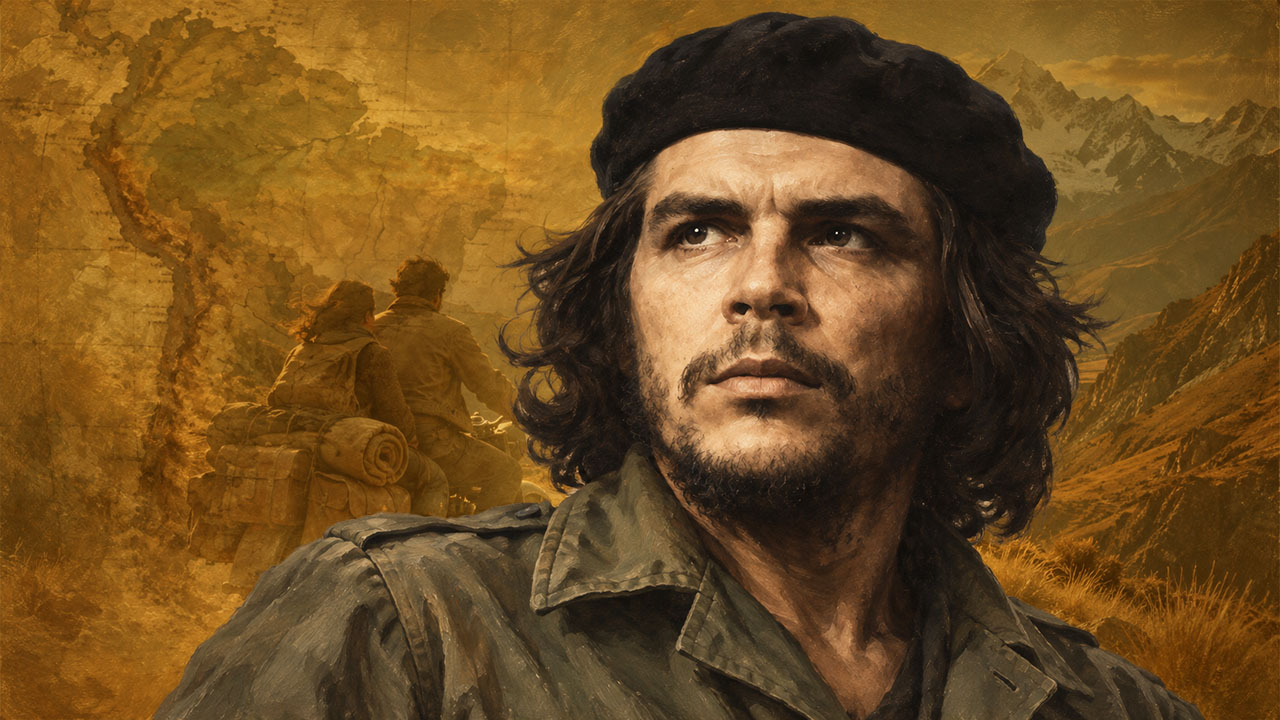
In January 1952, a 23-year-old medical student climbed onto an old motorcycle in Buenos Aires with his best friend. He wanted adventure and a look at the rest of South America. He came home a different man. This is the story of the road trip that changed Che Guevara and how a journey of a few months set him on the path to revolution.
October 9, 2026, marks 59 years since his death in Bolivia. To understand the man on all those posters, it helps to start with the young traveler.
Who Was Ernesto Before He Became Che?
He was born Ernesto Guevara in Rosario, Argentina, on June 14, 1928. His family was middle class and well-read. He suffered from asthma all his life, yet he played rugby and loved long trips.
In 1952, he was still studying medicine in Buenos Aires. Friends called him “Fuser,” not Che. That nickname came later, from Cubans who noticed he used the Argentine word “che,” which means something like “hey, buddy.” Before the road trip that changed Che, he was a smart, restless young man with no clear plan for his life.
The Plan: Two Friends and an Old Motorcycle
His travel partner was Alberto Granado, a 29-year-old biochemist who worked with leprosy patients. Leprosy is a disease that damages the skin and nerves. People who had it were often sent to live apart from everyone else.
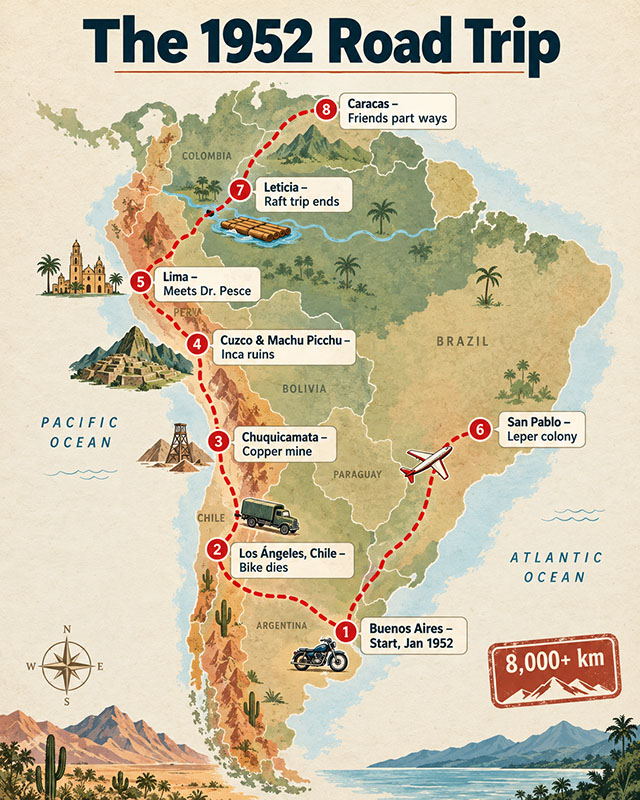
The two friends set out on January 4, 1952, on Granado’s 1939 Norton 500 motorcycle. They called it “La Poderosa II,” which means “The Mighty One II.” The name was a joke. The bike was old, overloaded, and broke down again and again.
Their goal was to cross the continent and reach a leper colony in the Peruvian Amazon, where they planned to help as volunteers. In total, the road trip that changed Che covered more than 8,000 kilometers, or about 5,000 miles.
What He Saw on the Road
The motorcycle died for good in Chile, in the town of Los Ángeles, south of Santiago. From then on, the two men traveled however they could: on trucks, on foot, on boats, and by asking strangers for rides. This turned out to matter. Without the motorcycle, they met ordinary people up close, and those meetings are what made it the road trip that changed Che.
The Copper Mine in Chile
In northern Chile, they visited Chuquicamata, one of the biggest open-pit copper mines in the world. It was run by American companies at the time.
On the way, they met a poor married couple searching for work. The husband had been jailed for being a communist. The couple had no blanket, so the travelers shared theirs on a freezing desert night. Ernesto wrote about this meeting with deep feeling. It was one of the first moments on the road trip that changed Che when he saw how hard life was for working people and how little power they had.
The Ancient Land of Peru
In Peru, the road trip that changed Che took the pair to Cuzco and the ruins of Machu Picchu. Ernesto was amazed by the old Inca world. He was also upset by how poorly the native people were treated in their own land. Many lived in deep poverty while a small group owned most of the wealth.
In Lima, they met Dr. Hugo Pesce, a leprosy expert with strong political ideas. He helped them get to the leper colony and spent long hours talking with them. Ernesto later said those talks shaped his thinking.
The Leper Colony on the Amazon
The San Pablo leper colony sat on the banks of the Amazon River. The staff lived on one side of the river. The patients lived on the other.
Ernesto and Alberto broke the rules of the time. They shook hands with patients, ate with them, and played soccer with them, without gloves. Years later, patients remembered that he showed no fear of hugging them or sharing meals.
Ernesto turned 24 at San Pablo on June 14, 1952. At a small party, he gave a toast. He said that Latin America was one people, from Mexico to the far south of the continent, and that the borders between countries were not real divisions. Before he left, he swam across the wide Amazon to reach the patients’ side, even with his asthma.
Of all the stops on the road trip that changed Che, many readers see San Pablo as the heart of the story.
How the Trip Ended
When they left San Pablo, the patients gave them a wooden raft they named the “Mambo Tango.” They floated down the Amazon and reached Leticia, Colombia, in July 1952.
From there they moved on through Colombia to Caracas, Venezuela. Granado took a job at a leprosy clinic and stayed. Ernesto caught a flight home that stopped in Miami. He got stuck there for about a month and worked odd jobs before he could fly back to Argentina.
So the road trip that changed Che ended quietly, with one friend staying behind and the other flying home alone.
From Doctor to Revolutionary
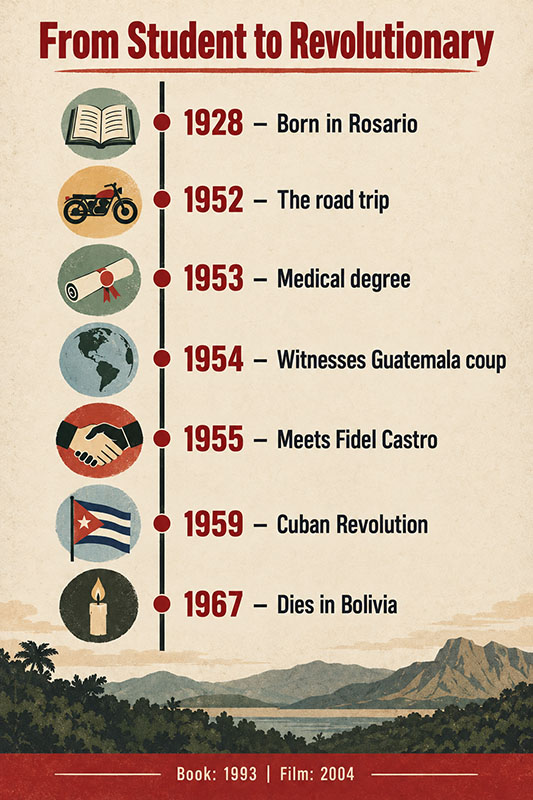
Back in Buenos Aires, Ernesto rushed to finish his studies. He earned his medical degree in June 1953. Then he left again, this time for good.
He went to Guatemala, where he saw a government he admired removed in a 1954 coup backed by the United States. That event hardened his views. In 1955, in Mexico, he met Fidel Castro and joined the plan to overthrow Cuba’s dictator. The young doctor became a guerrilla fighter, then a leader of the Cuban Revolution.
Looking back, the road trip that changed Che was the first step. It gave him his anger at poverty and his dream of one united Latin America. The guns came later. To see how that path ended, read about the final 100 days of Che Guevara in Bolivia.
The Book and the Film
Ernesto kept a diary on the road and later rewrote it as a book. It sat unpublished for decades. It finally came out in Spanish in 1993 and in English in 1995 as The Motorcycle Diaries.
The book opens with a line that sums up the whole trip. He wrote that the person who took these notes “passed away the moment his feet touched Argentine soil again,” and that the man rewriting them was no longer the person he once was.
In 2004, director Walter Salles turned the diary into a film. Gael García Bernal played Ernesto, and Rodrigo de la Serna played Alberto. The movie won the Oscar for Best Original Song for “Al otro lado del río” by Jorge Drexler. For many young people, this film is their first look at the road trip that changed Che.
Why the Trip Still Matters
The 1952 journey is the easiest part of Che’s life to love. It shows a young man who cared about the sick and the poor. That is why his face still sells T shirts around the world, as explored in our piece on the man behind the T shirt.
But the full story is harder. The same beliefs that grew on the road trip that changed Che later led him to support armed struggle and the execution of enemies after the Cuban Revolution. Some people see him as a hero of the poor. Others see a man who chose violence too easily. Both views are part of the legacy of Che Guevara, and an honest tribute should hold both.
Alberto Granado lived much longer than his friend. He moved to Cuba and died in Havana in 2011, at 88.
Final Thoughts
The road trip that changed Che did not turn him into a revolutionary overnight. It showed him a side of his continent he had never seen up close: miners without blankets, native farmers without land, and patients cut off from the world. What he did with that anger is still debated today.
If you want to understand Che, start where he started. Read The Motorcycle Diaries or watch the film, then ask yourself the question he faced at 24: what do you owe to people whose lives are harder than yours?