Tesla CEO Elon Musk is known for making ambitious predictions about the company’s future, but his latest forecast is the boldest yet. During the fourth-quarter earnings call for 2024, Musk stated that Tesla could one day surpass the combined market capitalization of the five largest companies in the world—Apple, Nvidia, Microsoft, Amazon, and Alphabet. These companies currently have a combined valuation of $14.7 trillion.
But can Tesla really reach such heights? According to Musk, the answer lies in a massive $10 trillion opportunity that has little to do with its electric vehicle (EV) business. While Tesla’s EV segment is facing significant challenges, Musk is betting on two key developments—its autonomous ride-hailing Cybercab and its humanoid robot, Optimus—to transform the company’s future. Here’s an in-depth look at Tesla’s current struggles, its ambitious projects, and whether it can live up to Musk’s predictions.
Tesla’s Core Business Faces Challenges
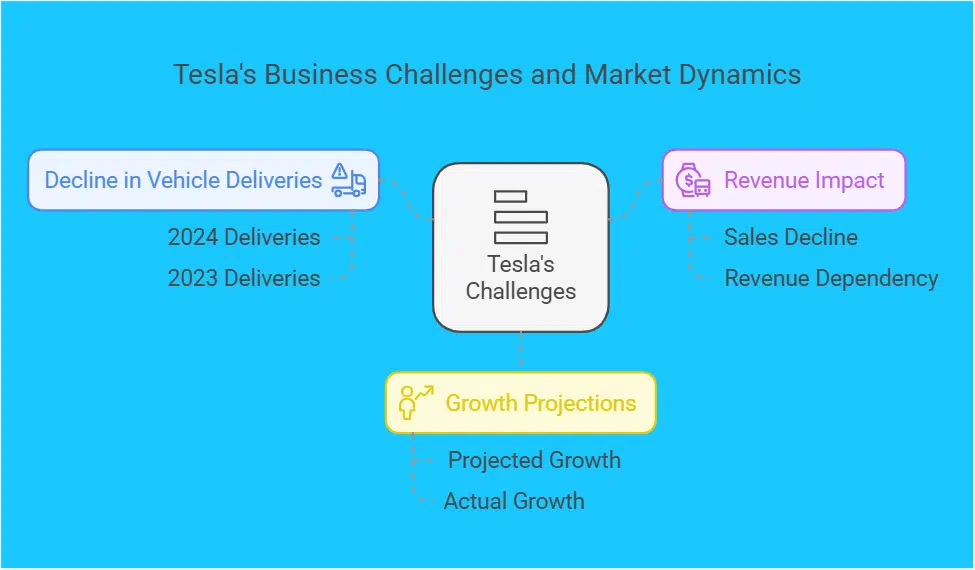
Before diving into Tesla’s potential, it’s important to acknowledge the challenges the company is currently facing. In 2024, Tesla delivered 1.78 million vehicles, which marks a 1% decline from 2023. This is a worrying sign given that passenger EV sales still make up nearly 79% of Tesla’s total revenue.
For years, Musk projected a 50% annual growth in vehicle deliveries, expecting demand for EVs to continue increasing indefinitely. However, Tesla has encountered several obstacles, including:
- Rising Competition: Traditional automakers like Ford, GM, and Volkswagen, as well as newer EV startups such as Rivian and Lucid, have intensified competition in the market.
- Softening Demand: Consumer demand for EVs has started to slow in some regions, as affordability remains a concern and charging infrastructure expansion is still lagging.
- Price Cuts Hurting Profitability: To stay competitive, Tesla has repeatedly slashed prices on its models, which has impacted its profit margins.
Given these hurdles, Musk is shifting Tesla’s focus toward autonomous vehicles, aiming to launch a new robotaxi service that could revolutionize the transportation industry.
The Cybercab: Tesla’s Autonomous Ride-Hailing Vision
Musk has long been a strong advocate for self-driving technology, and he believes Tesla’s upcoming Cybercab will be a game-changer. The Cybercab is designed to operate exclusively on Tesla’s Full Self-Driving (FSD) software, eliminating the need for a steering wheel or pedals.
Full Self-Driving (FSD) Advances
Tesla’s FSD Version 13 is currently in beta testing, allowing Tesla owners to test its autonomous capabilities under supervision. The software has made significant strides, and according to Tesla’s latest vehicle safety report:
- Cars using FSD Version 13 are involved in one crash per 5.9 million miles driven.
- In comparison, the average American driver experiences a crash once every 700,000 miles.
This suggests that Tesla’s self-driving technology is becoming safer, although full regulatory approval for widespread deployment is still pending.
The Rise of the Robotaxi Industry
If Tesla successfully launches the Cybercab, it could completely change the economics of the company. Instead of relying solely on selling cars, Tesla could operate a massive autonomous ride-hailing network where Cybercabs transport passengers and make deliveries 24/7, generating continuous revenue.
Cathie Wood’s ARK Investment Management estimates that the autonomous ride-hailing industry could be worth $14 trillion by 2027. Many analysts agree that Tesla could become a major player in this space, potentially capturing a significant share of this market.
Musk believes that Tesla’s Cybercabs will be running on unsupervised FSD in cities like Austin, Texas, by the end of 2025, marking a crucial step toward full autonomy.
Optimus: Tesla’s $10 Trillion Humanoid Robot Opportunity
While the Cybercab presents a major growth opportunity, Musk is even more excited about Tesla’s humanoid robot, Optimus. According to him, this product has the potential to be more transformative than any car Tesla has ever made.
What is Optimus?
Optimus is a humanoid robot designed to perform repetitive tasks that humans either dislike or find physically demanding. Tesla plans to start deploying several thousand Optimus robots internally within its own factories in 2025, where they will handle tasks such as moving sheet metal to welding stations.
Over time, Musk envisions these robots being used across multiple industries, including:
- Manufacturing: Optimus could be integrated into factories worldwide, automating various assembly-line tasks.
- Logistics: The robot could help companies manage inventory, transport goods, and streamline warehouse operations.
- Households: In the future, Optimus could serve as a personal assistant, helping with cleaning, organizing, and even caregiving tasks.
The Economics of Optimus
Musk believes that humanoid robots will outnumber humans by 2040. He expects Tesla to manufacture Optimus robots at a cost of around $20,000 per unit, which would allow them to be sold for under $30,000. As production scales up, these prices could decrease further, making the robots more accessible to businesses and consumers alike.
Musk has set aggressive production targets, forecasting a fivefold increase in Optimus production each year until Tesla reaches 100 million units annually. If Tesla achieves this, Optimus could generate more than $10 trillion in revenue, potentially making it one of the most lucrative ventures in the company’s history.
Can Tesla Justify Its Sky-High Valuation?
If Tesla’s market capitalization were to surpass the combined value of Apple, Nvidia, Microsoft, Amazon, and Alphabet, its stock price would need to rise to around $4,660 per share, representing a 1,200% increase from its current level.
While such growth is theoretically possible, investors must consider the risks. Tesla’s earnings per share (EPS) dropped 53% in 2024, falling to $2.04. This gives Tesla a price-to-earnings (P/E) ratio of 190.7, making it significantly more expensive than major tech companies, which have an average P/E ratio of 40.2.
For Tesla to justify its current valuation, it must execute its ambitious plans for FSD, Cybercab, and Optimus without major setbacks. If these projects fail to deliver substantial revenue in the coming years, the stock could face significant downside risk—potentially declining by 78% to align with traditional valuations.
What’s Next for Tesla?
The year 2025 will be crucial for Tesla as it transitions into these new business models. However, there are several challenges ahead:
- The Cybercab is not expected to reach mass production until 2026.
- Optimus production is still in its early stages, and Musk is uncertain whether Tesla will achieve its goal of 10,000 humanoid robots in 2025.
- Tesla’s financial performance will continue to rely heavily on passenger EV sales, which declined in 2024.
Should Investors Buy Tesla Stock Now?
Given Tesla’s high valuation and uncertain timeline for new revenue streams, many analysts believe that 2025 will be a transition year rather than a breakout year for the company. Investors who are interested in Tesla should be prepared to hold the stock for at least five years to maximize their chances of a strong return.
While Musk’s vision for Tesla is compelling, execution will be key. If the company can successfully launch its Cybercab network and scale Optimus production, Tesla could indeed become the most valuable company in the world. However, until those milestones are reached, investors should approach Tesla stock with caution.