
If you have been asking, Should Schools Ban AI? What The Evidence Actually Suggests, you are asking the right question. Parents, teachers, and students can all see the risks, but a full ban is not as simple as it sounds.
A 2023 UNESCO survey found that fewer than 10% of schools and universities had formal guidance on generative AI, and a June 2026 Gallup study still found that only 18% of U.S. public K-12 teachers receive any formal guidance on how to use AI at work. That gap helps explain why so many classrooms still feel inconsistent and tense.
The real choice is not between panic and blind adoption.
You need clear rules, better assessment, and practical AI literacy that fits real school life. I am going to walk you through what the evidence says, where bans make sense, and where guided integration does a better job for learning, ethics, and equity.
Read on.
Should Schools Ban AI? The Debate Over AI in Schools
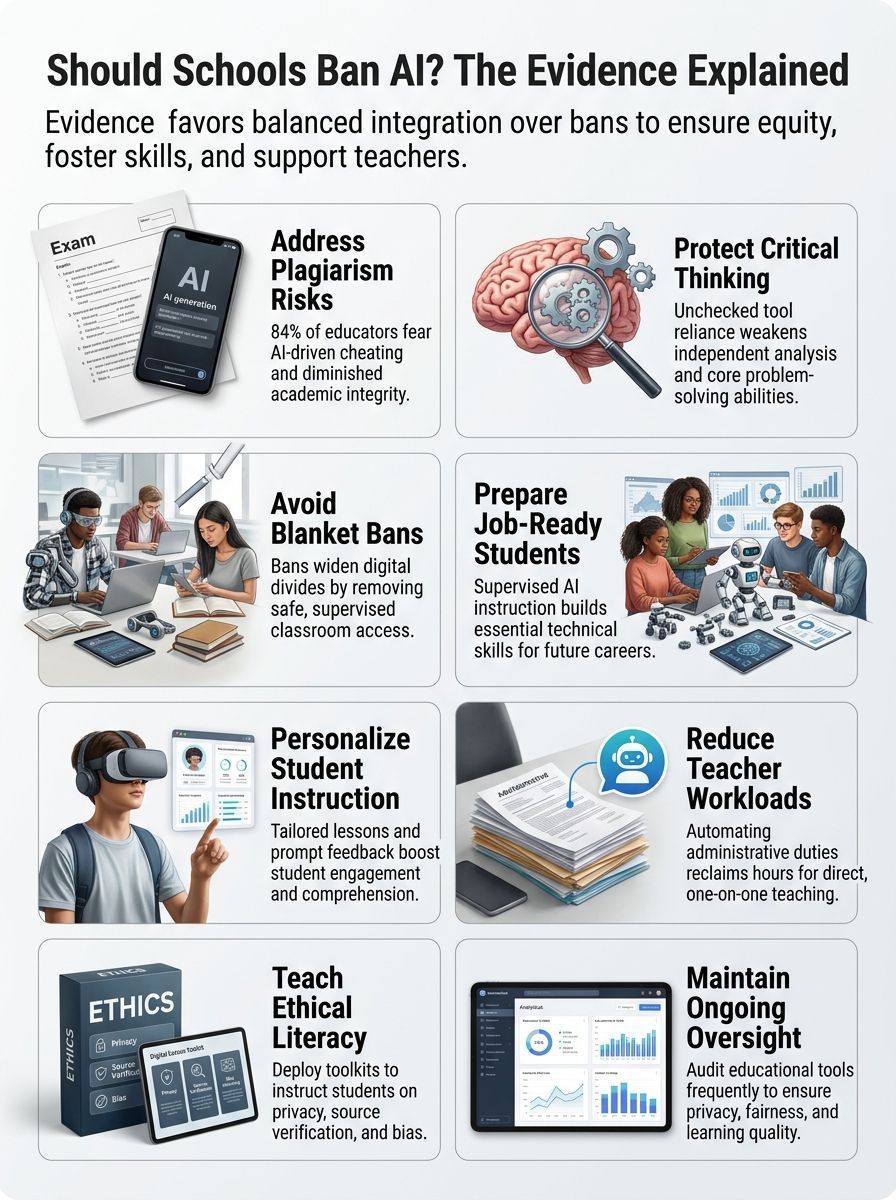
The debate over AI in education is really a debate about trust. Schools have to protect academic integrity, student privacy, and core skills, while still preparing students for a future where artificial intelligence is part of daily work and learning.
Concerns About Cheating and Plagiarism
Cheating is the fear that pushes schools closest to a ban. In Pew Research Center’s February 2026 report, 59% of teens said using AI to cheat happens at least somewhat often at their school.
That matters because AI can help with research, drafting, paraphrasing, and answer generation in seconds. College Board reported that by May 2025, 84% of high school students had used generative AI for schoolwork, so this is no longer a fringe issue.
For teachers, the practical lesson is simple: if an assignment can be completed by pasting a prompt into a chatbot, it needs a redesign. Stronger classroom assessment usually includes process, not just the final product.
- Ask students to turn in notes, outlines, and source annotations.
- Use short in-class writing checks before and after take-home work.
- Add oral defense questions such as, Why did you make this claim?
- Require students to label any approved AI help they used.
Impact on Critical Thinking and Foundational Skills
This is where the debate gets more serious than plagiarism. In a June 2026 NPR/Ipsos poll of K-12 teachers, 55% said AI is mostly a shortcut for students to avoid work, and 54% said it is making it harder for students to learn critical thinking skills.
That concern lines up with what students say too. RAND’s March 2026 youth report found rising AI use for homework along with growing worry that heavier use can weaken critical thinking.
When a tool finishes the hard thinking for a student, the student may finish the assignment without building the skill.
That does not mean every use is harmful. It means schools should protect certain learning moments from automation, especially first-draft writing, mental math practice, close reading, and early problem-solving steps where struggle is part of how learning happens.
Ethical and Privacy Issues
Privacy is another reason schools hesitate, and with good reason. Student prompts can contain writing samples, behavior patterns, and personal details, which makes vendor rules on storage, retention, and model training a school issue, not just a tech issue.
In the United States, schools also have to think about laws such as FERPA and, for younger users, COPPA. That is why recent state guidance has shifted away from casual classroom use and toward approved tools, written notices, and stronger parent visibility.
The California Department of Education’s June 2026 model policy is useful here because it does not stop at broad ethics language. It calls out privacy by design, parent and guardian review rights, and limits on AI detection software.
- Ask vendors whether student prompts are stored.
- Ask whether school data is used to train future models.
- Ask how parents can review or challenge tool use.
- Ask what happens to data when a contract ends.
Arguments for Banning AI
There are real reasons some schools still want a ban. If a district has weak policy, limited staff training, or poor student data controls, saying not yet can be wiser than rolling tools out too fast.
Risks of Overreliance on Technology
The strongest case for a ban is not that AI exists. It is that students can start outsourcing the very practice school is supposed to build.
Teachers are already reacting to that risk. The June 2026 NPR/Ipsos poll found that 39% of K-12 teachers are requiring more assignments to be done by hand, and the same share are requiring more work to be completed in class.
That is a smart signal for policy. Schools do not need to ban every AI tool, but they do need protected no-AI zones for foundational learning.
- Early drafting in English class.
- Fluency work in math.
- Reading response journals.
- Lab reflections written from direct observation.
- Short quizzes completed in class.
Challenges in Monitoring AI Usage
Monitoring sounds easier than it is. AI detectors can help raise questions, but they are weak as proof.
Turnitin’s March 2026 guidance says it does not assign an AI score highlight below its 20% threshold to reduce false positives. That alone should tell schools not to treat detector output like a final verdict.
Recent policy moves are heading in the same direction. California’s 2026 model policy places limits on AI detection software, and North Carolina’s 2026 school AI law builds academic integrity and assessment redesign into educator training.
| Weak response | Stronger response |
|---|---|
| Rely on one detector score | Review drafts, sources, class performance, and student explanation |
| Accuse after one suspicious paper | Look for a pattern across tasks and writing conditions |
| Keep the same easy-to-automate assignments | Redesign tasks so students show thinking, process, and revision |
If your policy starts with detection instead of assessment design, you end up policing symptoms instead of fixing the assignment.
Potential for Widening Equity Gaps
A ban can sound fair because it applies to everyone. In practice, it often is not.
Gallup reported in June 2026 that teachers in higher-income schools are somewhat more likely than teachers in higher-need schools to receive guidance on AI use. That means the students with the least support may also be the least likely to get safe, supervised exposure.
Older guidance data points the same way. UNESCO’s 2023 survey found that only about 7% of schools had any guidance at all, and 40% of the institutions with guidance said those rules were oral rather than written.
When schools ban AI without teaching digital literacy, students with strong home access still experiment in private. Students without that access lose the chance to learn with an adult present.
Arguments for Integrating AI
The best argument for integration is not hype. It is that AI is already here, and students need structure, not silence.
Preparing Students for AI-Driven Careers
Students already expect AI to matter after graduation. Gallup reported in April 2026 that 52% of K-12 students think they will need to know how to use AI in higher education, and 48% expect to use it in their future careers.
At the same time, the Future of Jobs Report 2025 said AI and big data are among the fastest-growing skill areas, while analytical thinking remains a top human skill. That combination matters because schools should teach both tool use and independent judgment.
A good curriculum does not stop at prompts. It teaches students what models are, where bias enters, how deepfakes work, and when a human should override the machine.
One practical example is MIT RAISE’s Day of AI curriculum, which gives K-12 teachers ready-made lessons on topics like bias, deepfakes, ethics, and AI careers. That kind of structured curriculum is much stronger than telling students to experiment on their own.
Opportunities for Personalized Learning and Support
This is where thoughtful AI integration can help. The U.S. Department of Education said in July 2025 that responsible AI use can support high-impact tutoring, personalized learning materials, and differentiated instruction.
Brookings added in January 2026 that AI can give students immediate feedback and more individualized support while freeing teachers to spend more time on direct student attention. The key phrase is while freeing teachers, not replacing them.
| Helpful use | Risky use |
|---|---|
| Extra practice at a student’s level | Completing the assignment for the student |
| Feedback on a rough draft | Writing the final essay |
| Translation, read-aloud, or scaffolded support | Hiding weak instruction behind a chatbot |
For students with disabilities, multilingual learners, and students who need more repetition, this kind of support can improve access. It works best when the teacher still sets the goal, checks the output, and decides what counts as real mastery.
Reducing Teacher Workloads Through Automation
Teachers are stretched thin, so this point matters. Gallup’s 2025 teacher study found that weekly AI users save an average of 5.9 hours per week, which adds up to about six weeks across a school year.
The catch is that workload gains are strongest in systems with policy. That same study found only 19% of teachers worked in schools with an AI policy, yet teachers in those schools were more likely to use AI and report better time savings.
Schools are starting to build around that reality with named tools and tighter oversight. North Carolina’s 2026 law set up state-backed programs for Khanmigo and MagicSchool in grades 6 through 12, paired with annual evaluations, approved rostering systems, and reporting on student use and moderation flags.
- Use AI for lesson drafts, rubrics, and parent communication drafts.
- Keep a human review step before anything reaches students or families.
- Never let AI make final grading or discipline calls on its own.
- Track whether time savings actually turn into more student support.
Moving Forward: Finding a Balanced Approach
A balanced approach is starting to look a lot more concrete in U.S. schools. As of July 1, 2026, Ohio requires every public district, community school, and STEM school to adopt a formal AI policy, while California, Michigan, and New York City Public Schools have all released recent guidance focused on privacy, academic integrity, and human oversight.
Promoting AI Literacy and Responsible Use
The schools making the best progress are not asking whether AI feels good or bad. They are writing down what students may do, what staff may do, and what must stay human.
If you want a policy that works in real classrooms, start with a short written framework that teachers, students, and families can actually use.
| Policy area | Minimum rule |
|---|---|
| Student use | Define where AI is allowed, limited, or prohibited by assignment type |
| Assessment | Require process evidence for major writing and project work |
| Privacy | Use approved tools only and review vendor data practices |
| Transparency | Ask students to disclose approved AI help when a teacher requires it |
| Equity | Give all students supervised access before judging tool quality or value |
| Training | Train teachers on prompts, fact-checking, bias, and classroom limits |
From there, schools can build routines that keep digital learning honest and useful.
- Publish the rules in writing, not by hallway rumor.
- Sort assignments into clear categories such as green, yellow, and red use.
- Teach students to verify claims, sources, and citations every time.
- Use AI for support tasks before high-stakes student output.
- Review approved tools twice a year for privacy, bias, and classroom fit.
- Invite family feedback before a district scales student-facing tools.
That path gives you educational policy with teeth, but without a blanket ban that students will route around by the end of the school day.
Final Thoughts
Should Schools Ban AI? What The Evidence Actually Suggests is that a full ban is too blunt for the problem schools are trying to solve.
Students still need protection around cheating, privacy, assessment, and skill loss, but the stronger answer is careful integration with written rules, smarter teaching methods, and real AI literacy.
Schools that treat AI in education as a governance issue, not a fad, have the best chance of protecting learning while preparing students for the technology they will meet outside the classroom anyway.
FAQs: Should Schools Ban AI?
1. Should schools ban AI?
No, the evidence suggests a full ban usually hurts students, and it does not stop use outside school, so it can feel like locking the barn after the horse ran off, but it does not help learning.
2. Does AI lead to more cheating?
AI can make cheating easier, and some studies show more misuse when rules are vague, but good policy and checks cut dishonest use fast.
3. What does research say about AI and student learning?
Research is mixed, some studies show AI tools boost learning when teachers guide use, others show little gain or harm if students only copy answers, so classroom context matters.
4. What should schools do instead of banning AI?
Update policy, train teachers to use AI tools well, teach students how to think, and protect privacy, all steps that turn a risky tool into a teaching aid.