
“AI” is now attached to almost everything: spam filters, recommendation engines, fraud alerts, image generators, writing assistants, and customer-service chatbots. Putting all of them under one label makes the technology sound more uniform than it really is.
A system that decides whether an email is spam is doing a different job from one that writes a reply. A demand-forecasting model and an AI image generator may both learn from data, but they produce very different results and carry different risks.
That is the practical issue behind the Generative AI vs Traditional AI comparison. Traditional AI usually classifies information, predicts an outcome, detects a pattern, ranks options, or applies a decision rule. Generative AI produces new text, images, audio, video, code, or other open-ended output.
The line is not perfectly clean. Generative models can classify documents, while traditional machine-learning systems can sit inside products that appear conversational. Still, the distinction is useful because it helps businesses and individual users avoid a common mistake: choosing the most fashionable form of AI instead of the one suited to the task.
What “Traditional AI” Actually Covers
Traditional AI isn’t some formal technical category. It is just shorthand for models that process information rather than generate open-ended prose or artwork.
Most of these tools run on supervised machine learning. You feed them historical data, and they learn to spot patterns so they can label, rank, or predict things when new records roll in. Think of everyday background tasks:
- Flagging credit card transactions as fraudulent
- Projecting inventory demands for next quarter
- Recommending a video based on your watch history
- Sorting incoming customer support tickets into predefined tags
Google often frames “traditional AI” in this exact practical sense—focusing on classification and predictive tasks. Crucially, legacy systems and generative tools aren’t mutually exclusive; the best enterprise platforms quietly stack them together.
It’s also worth distinguishing machine learning from pure rules engines. A rules engine follows rigid human instructions (e.g., “If an order exceeds $10,000, hold for review”). A machine learning model calculates probabilities based on thousands of past transactions. Real-world software usually pairs them: the model flags the risk score, but the business rule enforces what action to take.
Calling these systems “traditional” doesn’t mean they’re obsolete. For narrow, measurable jobs, a specialized predictive model is almost always cheaper, faster, and far easier to test than a massive language model.
What Generative AI Changes
Generative AI doesn’t just evaluate data—it constructs a new response based on the prompt or context you feed it.
That output could be a condensed meeting summary, a snippet of Python, a translated paragraph, or a synthetic voiceover. But we need to be careful with the word “new.” Just because an LLM generates a response on the fly doesn’t mean the material is original, accurate, or legally safe to use. It can easily parrot copyrighted training data or hallucinate false claims with complete confidence.
Most consumer tools run on foundation models—massive networks trained on broad datasets. Large Language Models (LLMs) focus on text, while multimodal systems handle mixtures of text, audio, images, and video.
Their real appeal comes down to versatility. Instead of building six different specialized models, a single LLM can summarize, translate, draft, and extract information depending on how you prompt it.
The catch? That same flexibility makes testing a nightmare. Evaluating a spam filter is easy: it’s either spam or it isn’t. Evaluating a three-page generated report means checking dozens of subtle claims, tone nuances, and contextual assumptions line by line.
Generative AI vs Traditional AI: The Useful Distinction
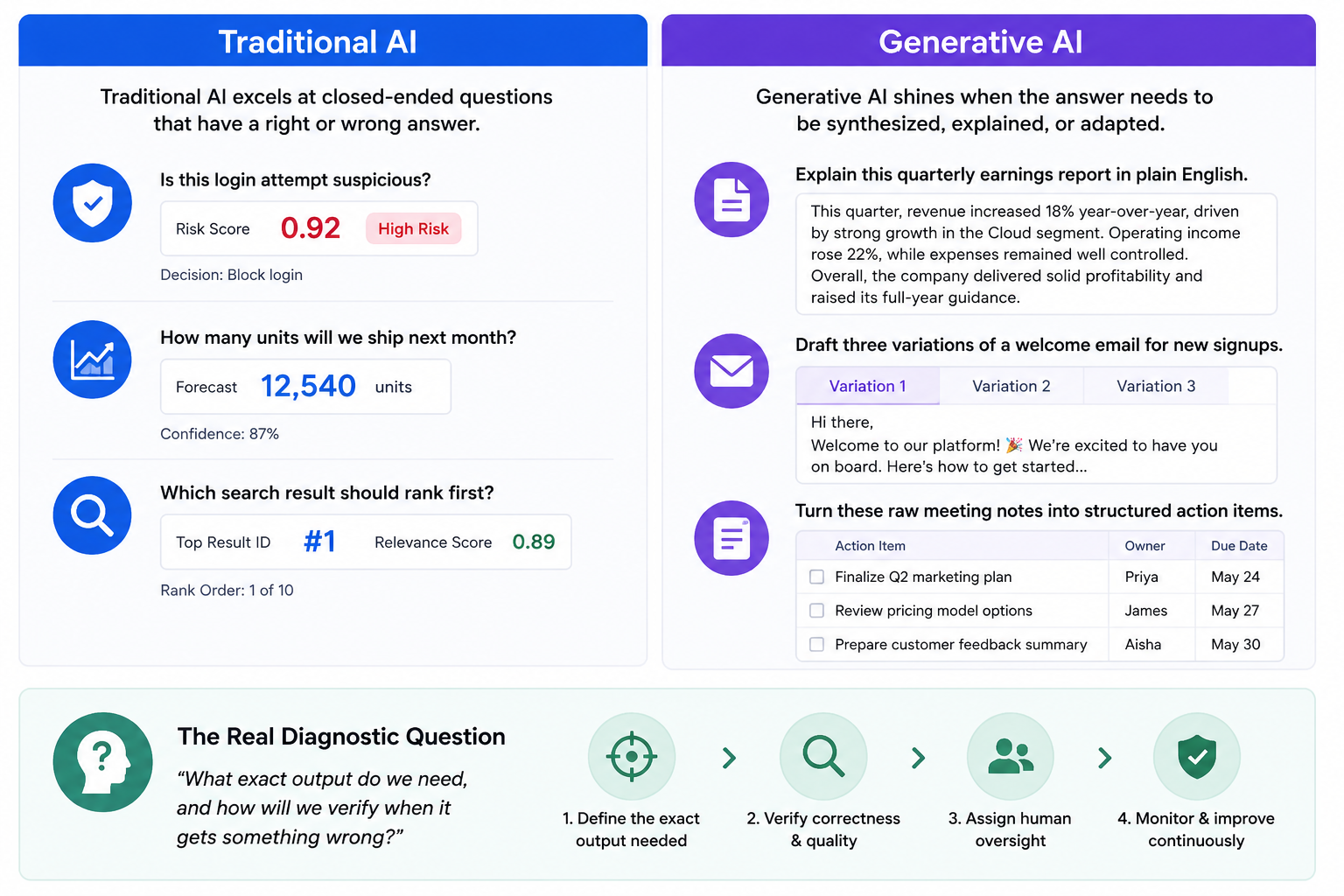
The choice usually comes down to what you expect the system to hand back to you.
Traditional AI excels at closed-ended questions:
- Is this login attempt suspicious?
- How many units will we ship next month?
- Which search result should rank first?
Generative AI steps in when the answer needs to be synthesized or adapted:
- Explain this quarterly earnings report in plain English.
- Draft three variations of a welcome email for new signups.
- Turn these raw meeting notes into structured action items.
The real diagnostic question for your team isn’t “Which technology is more advanced?” It is “What exact output do we need, and how will we verify when it gets something wrong?”
How Traditional Machine Learning Reaches an Answer
Traditional machine learning starts with a concrete target. If an e-commerce brand wants to catch fraud, it feeds the model historical data: order values, account ages, device IDs, and past chargebacks. The system learns which signals correlate with stolen cards and outputs a simple risk score for new orders.
Its job begins and ends right there. It doesn’t write an explanation or draft an email to the cardholder.
Because the output is tightly constrained, benchmarking is straightforward. You can test your model against labeled datasets and measure accuracy, precision, and recall with high mathematical certainty.
That doesn’t make predictive models bulletproof. They can easily absorb historical bias, break down when market conditions shift, or overfit to training data. A credit or fraud model requires continuous monitoring long after it deploys.
How Generative Models Produce a Response
LLMs don’t look up full sentences in a database; they process text as tokens (words or fragments of words). During generation, the model continuously calculates which token is statistically most likely to come next based on your prompt and its previous outputs.
Through this statistical understanding, the model reuses linguistic structures to draft, translate, and rephrase text impressively well.
What it doesn’t have is an internal truth engine. An LLM can drop an accurate historical fact, make a reasonable inference, and fabricate a completely fake citation all in the same sentence—without shifting its confident tone for a second.
Where Traditional AI Is Usually the Better Tool
Generative AI gets all the press because people can chat with it directly. But behind the scenes, conventional models still handle the heavy lifting across most enterprise workflows.
1. Numerical Forecasting
If you need to project next month’s revenue, use a dedicated statistical or predictive model. Asking a general-purpose LLM to guess numbers isn’t a shortcut; it’s bad engineering. You can always use an LLM later to turn those hard numbers into a readable executive memo.
2. High-Volume Classification
Sorting millions of support tickets or scanning factory images for defects requires strict consistency and low latency. Specialized classifiers run circles around general LLMs in both processing speed and cost efficiency.
3. Enforcing Hard Boundaries
Creativity is a liability when dealing with safety cutoffs, account permissions, or regulatory compliance. Explicit software rules and deterministic models ensure hard boundaries stay hard.
Where Generative AI Earns Its Place
Generative tools shine when your goal is transforming, summarizing, or drafting content from trusted source material.
It excels at structural shifts:
- Condensing long policy documents into bulleted summaries
- Translating technical documentation for non-technical readers
- Converting raw user feedback into common themes
- Generating initial boilerplate code for developers
The most reliable workflows treat generative AI as an assistant rather than an oracle. Giving a model a vague prompt like “Write an essay on corporate finance” invites hallucinations. Giving it three approved reports and prompting “Extract the key financial risks mentioned across these files and cite the source paragraph for each” yields actual operational value.
The Best Systems Often Use Both
Framing this as “Generative AI versus Traditional AI” is a false binary. In production, the most effective architectures combine predictive models, business rules, and generative engines into a single pipeline.
Consider a modern customer retention flow:
[ Predictive Model ] –> Flags accounts with high churn risk
│
▼
[ Business Rules ] –> Checks if the account qualifies for a discount
│
▼
[ Generative Model ] –> Drafts a personalized outreach email
│
▼
[ Human Reviewer ] –> Verifies and approves the message before sending
Each piece does what it’s best at. The predictive model spots the signal, explicit rules maintain control over the budget, the LLM crafts the human language, and a human maintains final accountability.
Confident Errors Are a Design Problem
Generative models present false information with the same calm authority as factual statements—a phenomenon NIST terms confabulation.
This becomes dangerous when outputs touch medical advice, legal contracts, financial planning, or system permissions. Risks spike when prompts are vague, source documents are missing, or teams skip human oversight because the draft “looks right.”
Checking a single classification label takes a fraction of a second. Checking a five-page generated document for subtle factual errors takes significant time and subject-matter expertise.
RAG Improves Grounding, Not Certainty
Retrieval-Augmented Generation (RAG) connects an LLM to your company’s internal document store. When a user asks a question, the system searches your files for relevant passages and feeds them to the LLM to ground its answer.
It’s a massive upgrade over raw LLMs, but it doesn’t magically eliminate errors.
A RAG pipeline can easily retrieve an outdated policy version, miss key context, or surface confidential files to unauthorized users. Even when supplied with the exact right document, the LLM can still misinterpret the text. RAG is a search and retrieval pattern—it isn’t a substitute for real document governance.
Operational Mistakes That Ruin AI Projects
- Buying a tool before identifying a problem: Licensing a generative platform and hunting for use cases usually results in impressive internal demos that fail to deliver actual ROI.
- Ignoring human review costs: Speeding up the initial drafting stage doesn’t help much if your senior staff spends twice as long fact-checking and fixing subtle mistakes.
- Overlooking simple software: A basic database query, spreadsheet formula, or standard search bar often solves problems cheaper, faster, and with zero hallucination risk.
How to Choose the Right Approach
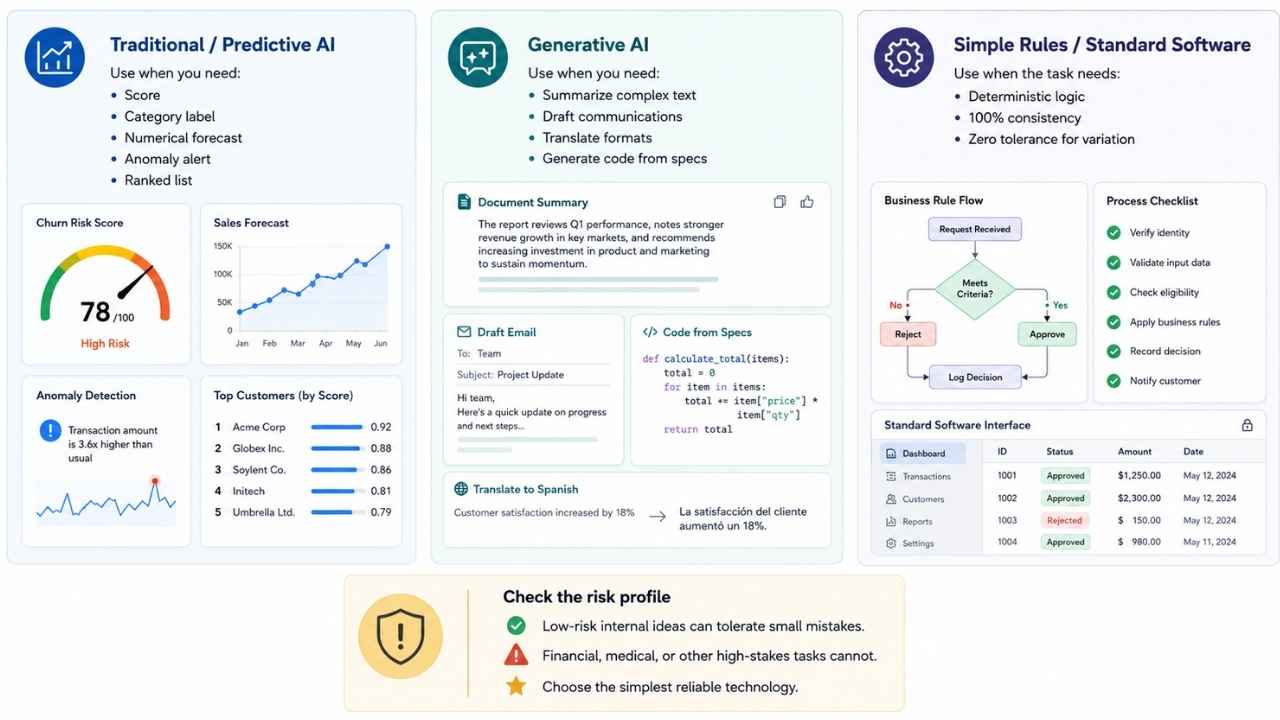
Start with your required output:
- Go with Traditional / Predictive AI if you need a score, a category label, a numerical forecast, an anomaly alert, or a ranked list.
- Go with Generative AI if you need to summarize complex text, draft communications, translate formats, or generate code from specifications.
- Go with Simple Rules / Standard Software if the task requires deterministic 100% consistency with zero tolerance for variation.
Finally, evaluate the risk profile. A tool generating internal ideas can tolerate minor mistakes; a tool touching financial statements or medical guidance cannot. Pick the simplest technology that gets the job done reliably—complexity should always earn its keep.
Final Thoughts
The Generative AI vs Traditional AI distinction is less about old technology versus new technology than about the job each system is expected to perform. Traditional AI remains well suited to forecasting, classification, detection, recommendation, ranking, and structured decisions. Generative AI is valuable when information needs to be created, explained, summarized, translated, or adapted.
Neither should be treated as the automatic default. A chatbot may be the most visible part of a product while a quieter predictive model does the work that actually matters. In other cases, an ordinary rule or search tool may be more reliable than either. Define the output first. Decide how errors will be caught. Then choose the simplest approach that can do the work without creating a larger problem around it.