
Have you ever turned in a paper, read it back, and worried it might sound too polished? That fear is a big reason how schools detect AI-written homework has become such a common question in American education.
Teachers want honest work.
Students want fair treatment, and that is where things get messy. AI detection software can help spot suspicious assignments, but it still makes enough bad guesses that false accusations remain a real concern.
This page walks through the methods schools use, why AI detection keeps failing, and what actually works better for academic integrity and writing assessment.
How Do Schools Detect AI-Written Homework?
Most schools do not rely on one tool. They usually combine automated tools, teacher review, and process checks that help confirm authorship.
| Method | What schools hope it shows | Where it often fails |
|---|---|---|
| AI detection software | Whether text matches patterns associated with machine writing | It can miss edited AI text and falsely flag honest student writing |
| Plagiarism detection | Whether copied passages match published or submitted sources | Fresh AI text can be original enough to avoid a match |
| Draft history and timestamps | How the paper developed over time | It helps only if the student wrote in a trackable tool |
| In-class writing or oral follow-up | Whether the student can explain and reproduce the ideas | Nervous students can still perform unevenly |
Use of AI and plagiarism detection software
Schools commonly test tools such as Turnitin, GPTZero, and Copyleaks because they can scan assignments in seconds. The problem is that these systems estimate patterns in writing, they do not witness who actually wrote the homework.
Turnitin’s March 2026 guide says its AI writing report only works on long-form prose with at least 300 words, and scores below 20% are no longer shown as a number because that range has a higher incidence of false positives. So if a teacher acts on a short response, a tiny percentage, or a pasted paragraph alone, the teacher is already outside the vendor’s own caution zone.
- Plagiarism tools compare text against existing sources, which makes them useful for copied passages and weak for brand-new AI wording.
- AI detectors look for statistical signals in writing, which means a polished student essay can look suspicious even when it is genuine.
- Low percentages should trigger review, not punishment, because the confidence is weaker in that range.
- Short homework answers are a bad fit for AI detection in the first place because many systems need longer prose to work at all.
Comparing typed work to handwritten submissions
When teachers compare typed work to a handwritten paragraph or an in-class rewrite, they are trying to check process rather than polish. That matters because a student’s voice, pace, and sentence habits tend to show up more clearly in live writing.
Google Docs version history and Microsoft Word versioning are often more useful than a detector score because they show when text was drafted, revised, and pasted. Newer tools such as Turnitin Clarity and Grammarly Authorship go even further by showing a writing timeline or source-of-text report, which gives instructors a better record of how a homework submission came together.
- Students should draft in a tool that saves revision history from the first paragraph.
- Teachers should ask for the working file, not just the final export, when authorship is in doubt.
- If the assignment allows AI help, schools should require a short use statement so the process stays transparent.
- A clean draft trail usually protects honest students faster than any AI detector can.
Identifying inconsistencies and unusual vocabulary
Teachers also watch for sudden jumps in tone, vocabulary, and structure. A paper that sounds much more formal than a student’s usual work, or that uses terms the student cannot explain, will naturally raise questions.
A 2026 paper in the International Journal for Educational Integrity found that detectors struggled once AI text was blended with human edits. In that study, GPTZero had 0% strict accuracy on hybrid papers, meaning partly student and partly AI, and Turnitin dropped to 50% accuracy on AI text that had been rewritten to sound more human. That is why the better classroom check is understanding, not style alone.
- Ask the student to define a few advanced terms from the paper in plain language.
- Request a short oral summary of the argument and the sources used.
- Check whether the student’s examples and class references match what was actually discussed.
- Compare suspicious passages to earlier assignments instead of judging one paper in isolation.
Fact-checking and monitoring writing patterns
AI-generated homework often leaves clues in the facts. Fake page numbers, invented quotes, and citations that do not exist are still some of the easiest signs that a student relied too heavily on a chatbot.
For teachers, the fastest move is to verify the first suspicious source instead of staring at a percentage score. For students, the safest move is to keep notes, screenshots, article files, and draft history so you can show how your writing developed.
| What a teacher checks | What helps a student respond |
|---|---|
| Whether a quote appears in the cited source | The source file with highlighted notes or annotations |
| Whether a citation leads to a real book, article, or webpage | A research log showing where the source was found |
| Whether the tone matches past assignments | Earlier drafts and version history from the same assignment |
| Whether the student understands the paper’s claims | A quick verbal explanation or in-class rewrite |
Challenges of Detecting AI-Generated Homework
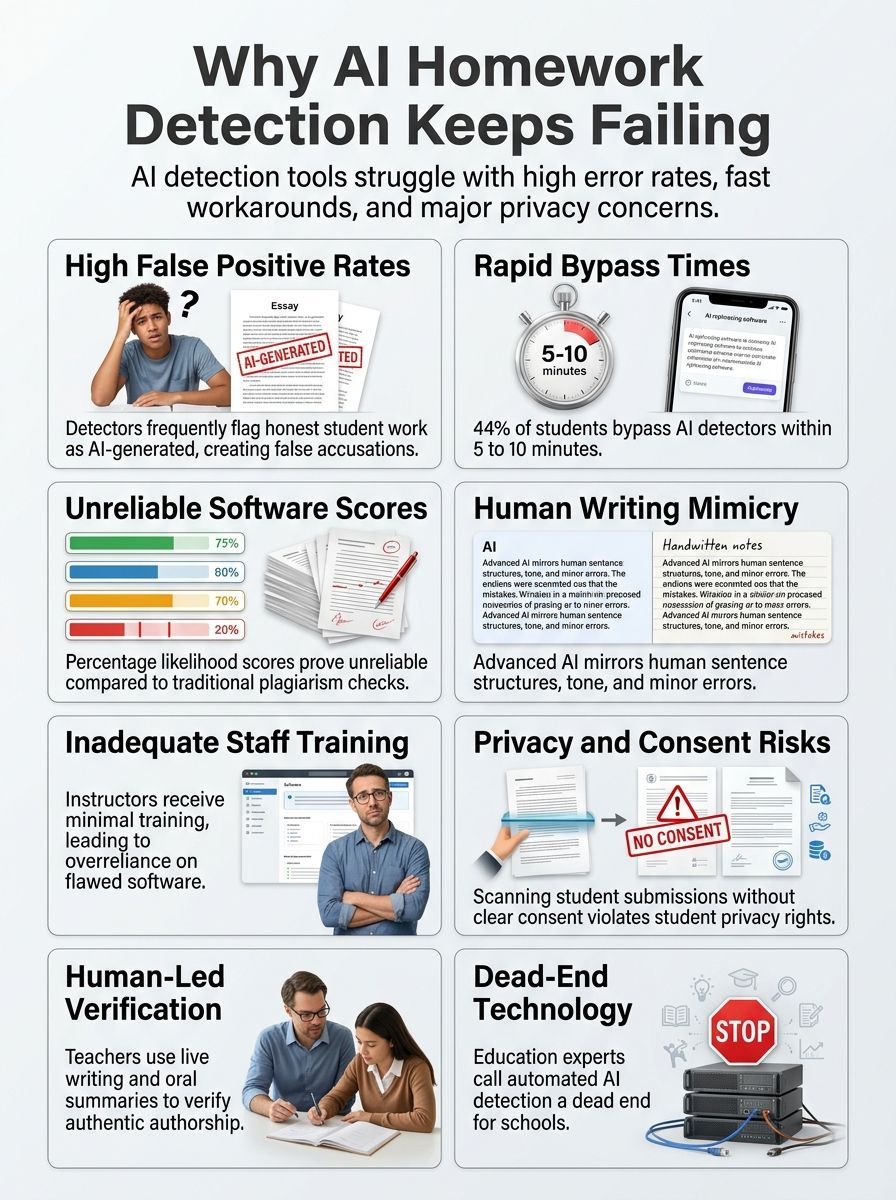
AI detection runs into trouble because human writing and machine writing overlap more than schools expected. The closer AI gets to average student prose, the harder it is for software to separate honest work from cheating.
Reliability issues with detection tools
OpenAI retired its own AI Classifier in July 2023 after reporting that it correctly identified only 26% of AI-written text while falsely labeling human text 9% of the time. If the company behind ChatGPT could not keep its text detector live, schools should be very careful about treating any detector as dependable proof.
Turnitin also states that its model can misidentify human-written, AI-generated, and AI-paraphrased text. That tells you something useful right away: the score is a lead for review, not a finding of misconduct.
A detector score can show where to look, but it cannot prove who wrote the homework.
Accuracy and data bias concerns
Bias worries are part of the problem too. A 2023 Stanford-led study found an average false positive rate of 61.3% when seven detectors judged TOEFL essays written by non-native English speakers, which is a serious warning for schools with multilingual students and very formal writers.
Vendors push back on that point. Turnitin says its own testing on nearly 2,000 English language learner samples found false positive rates of 0.014 for ELL writers and 0.013 for native writers on documents that met the 300-word requirement. For schools, the practical lesson is simple: the fairness question is still unsettled, so every flag needs human review, context, and a real appeal path.
- Do not treat one writing style as the only normal one.
- Do not assume formal or repetitive prose equals cheating.
- Do compare the paper to the student’s own baseline work.
- Do document why the case looks suspicious beyond the software score.
Lack of teacher training and awareness
Even a decent tool can be used badly. Many schools adopted AI detection before they built clear rules for disclosure, appeals, or acceptable AI assistance on assignments.
In a February 2026 memo, Washington State University said it canceled Turnitin AI detection and kept its policy against using any AI detector as the sole support in an academic misconduct case. That is the kind of staff training schools need: know the limits, gather more than one form of evidence, and separate suspicious writing from proven cheating.
- State clearly what AI use is allowed for each assignment.
- Train teachers to read detector results as one signal among several.
- Require process evidence before filing a misconduct claim.
- Give students a documented way to explain or appeal a flag.
Why AI Detection Often Fails
Why AI detection often fails comes down to one big issue: schools are trying to infer intent from finished text. Students revise, paste, paraphrase, and mix their own thinking with machine help, while the software only sees the final writing.
Overreliance on technology
Schools get into trouble when they confuse automation with proof. Turnitin’s own guidance says its AI model should not be the sole basis for adverse action against a student, yet many disputes still begin with a percentage score on a screen.
The better approach is to use automated tools as triage. A teacher can start with the report, then move to drafts, version history, a short meeting, and a quick in-class writing check before deciding whether misconduct actually happened.
- Start with the software report.
- Pull the draft trail and timestamps.
- Ask the student to explain the paper’s sources and argument.
- Use a live writing sample if the gap still looks real.
AI-generated content mimicking human writing patterns
Modern AI is good at sounding like a careful student. Add a little editing, a few personal examples, and cleaned-up citations, and the writing can become much harder to separate from genuine work.
That same 2026 higher education study tested 160 papers and found that several detectors underestimated fully AI-generated papers created with a newer model, while edited AI text slipped by even more easily. In plain English, the software has the hardest time with the kind of mixed authorship students are most likely to submit.
- Replace one-shot take-home essays with staged drafts.
- Ask for brief reflections on how sources were chosen and used.
- Grade the process, not just the final polish.
- Use more prompts that require class-specific examples or personal reasoning.
Ethical and privacy concerns in implementation
There is also a data issue. When schools upload student writing to outside services, they are handling education records, and that creates privacy and record-keeping duties.
The U.S. Department of Education’s student privacy guidance says schools should safeguard student data, and written agreements are required in some cases when vendors receive personally identifiable information from education records. Washington State University also warned in 2026 that sending student work to third-party detectors can raise FERPA, intellectual property, and even HIPAA concerns in some settings.
Some states are moving in the same direction. A 2026 Washington law says an automated decision system cannot be the sole or determinative basis for a student discipline-related decision, which is a strong sign that blind reliance on AI detection is becoming harder to defend.
- Review what student data the vendor stores and for how long.
- Limit uploads to the minimum material needed for the check.
- Tell students what tools are being used on their writing.
- Keep a human decision-maker in every academic integrity case.
Final Thoughts
If you are asking how schools detect AI-written homework, the short answer is that they use software, draft evidence, comparison writing, and teacher judgment.
The hard part is that AI detection still fails in the cases schools care about most, mixed-authorship writing, edited machine text, and honest student work that simply sounds polished.
The fairest path is simple: use detectors as clues, keep proof of the writing process, and leave room for conversation before anyone calls it misconduct.
FAQs about How Schools Detect AI-Written Homework
1. What methods do schools use to detect AI written homework?
They run text through AI detectors and plagiarism tools, watch for big shifts in writing style, and check drafts and timestamps. Teachers also ask students to explain their work, in class or one on one.
2. Why do detection tools keep failing?
Large language models keep getting better, and students can mask AI text with editing or adversarial paraphrasing, which fools detectors. Tools also make false positives, they sometimes flag real student work as AI. So schools end up chasing smoke, and trust erodes.
3. Can schools rely on AI detectors alone?
No, AI detectors help, but human judgment, teacher interviews, and attention to student behavior and writing style must guide decisions.
4. What can schools do that is fair to honest students?
Require drafts, in class writing, oral checks, and staged projects, to raise the cost of cheating. Teach students how to use AI tools responsibly, and set clear rules about help and sources. Use detectors as one signal, always follow up with human review.