
The monthly accumulation of software subscription fees can quickly burden a creator’s operating budget. With standard commercial plans hovering around twenty dollars a month, users often assume that premium price tags guarantee superior text, code, or image output. However, the current landscape of no-cost AI software proves that premium pricing is no longer a requirement for high-end processing.
In many production scenarios, specific free AI tools beat paid versions by removing artificial feature limits or providing direct system integrations for zero cost. True efficiency in your daily workflow relies on identifying platforms that offer genuine utility rather than surface-level feature trials.
Why Tech Giants Are Giving Away Elite Tools for Zero Cost
It feels counter-intuitive that massive software ecosystems would offer high-performance tools without charging a monthly fee. This dynamic occurs because enterprise companies operate on completely different monetization timelines than small startups.
Major cloud providers and search companies use free access tiers as a strategic method to capture early market share and secure developer loyalty. By providing open sandboxes and high daily compute limits, they encourage creators to build their primary workflows within their specific infrastructure. Once a developer or creator scales their operational usage past the generous free thresholds, they naturally transition into paying corporate cloud customers, making the initial zero-cost tier a highly effective customer acquisition strategy.
The Hidden Catch to Watch Out for in Free Frameworks
While finding instances where free AI tools beat paid options is increasingly common, relying entirely on zero-cost tiers introduces specific infrastructure risks. Software companies frequently alter their access rules overnight to push users toward premium upgrades.
-
Rate limits can change without notice, suddenly cutting off access during a critical project timeline.
-
Data privacy terms are occasionally less strict on non-paid tiers, meaning your input data might be utilized to train future models.
-
Export formats may be limited, making it difficult to move your assets out of the platform if you decide to switch software later.
To mitigate these risks, always keep a secondary backup tool operational in your stack and review the service terms before processing highly sensitive or proprietary client data.
How to Safely Migrate From Paid Subscriptions to a Free Tool Stack
Canceling your premium software accounts cold turkey often disrupts active production pipelines. A structured migration strategy prevents data loss and minimizes downtime as you transition your workflows.
First, run a side-by-side performance test for at least one week. Process identical tasks through both your current premium setup and your targeted free AI alternatives to ensure the processing quality meets your baseline standards. Second, export and archive all historical project files, templates, and asset libraries from your paid dashboards, saving them to a local drive. Once your data is securely stored and your new free setup is fully verified, you can cancel the recurring billing cycles with confidence.
The Best 7 Free AI Tools That Beat Paid Ones
The following collection highlights platforms that match or outclass their commercial counterparts in active production environments.
1. Google AI Studio
For developers and copywriters who want direct access to large language models without intermediate interface filtering, this tool outclasses paid developer wrappers. It offers an open developer sandbox where users can test prompts, adjust temperature variables, and interface with flagship models for zero dollars. The free daily allocation is highly generous, allowing for extensive testing that would quickly run up heavy API invoices on commercial billing systems.
2. NotebookLM
Traditional document analysis software often requires a premium subscription to parse massive PDF archives or generate logical study guides. This platform handles complex source-grounded research entirely within a clean, free interface. Users upload up to fifty separate documents, including long corporate handbooks, academic transcripts, or full audio files. The system processes the materials and provides direct, cited answers based strictly on the uploaded data, eliminating the classic hallucination issues found in paid alternative chat systems.
3. Storyflow Free Tier
Managing multi-step creative projects usually requires purchasing expensive visual canvas tools or team collaboration boards. This workspace alternative provides a highly functional canvas setup at zero cost. The tier allows for unlimited visual boards, unlimited digital cards for mapping notes, and unrestricted teammate collaboration. It provides a clean visual layout for structuring production pipelines without the sudden payment screens common in alternative mapping apps.
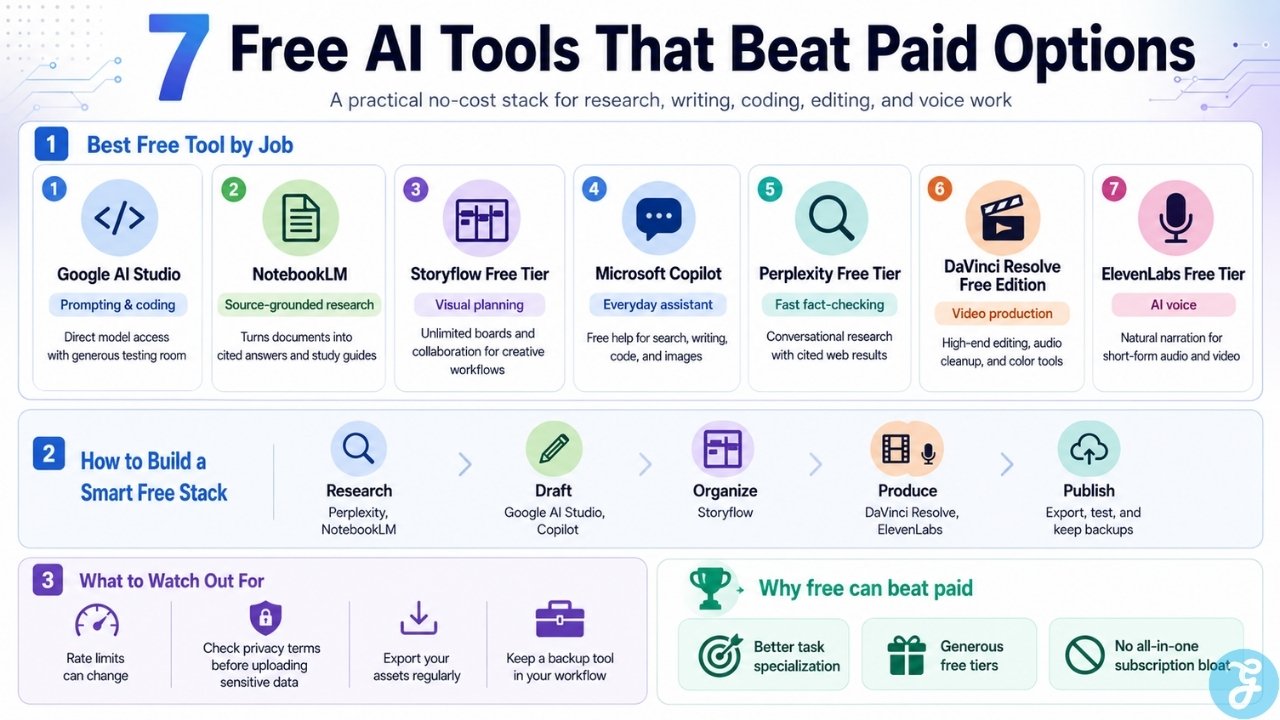
4. Microsoft Copilot
Paying twenty dollars every month for basic access to premium text models and image generators is an unnecessary expense for casual users. By using this built-in engine on Edge or Windows, creators get direct access to advanced intelligence and image generation platforms without a credit card. It handles active web search summaries, writes clean functional code, and builds visual layouts for zero cost, matching the primary workflows of premium alternatives.
5. Perplexity Free Tier
Standard search engines return pages cluttered with ad placement blocks and sponsored text links. This research tool functions as a conversational directory that processes search queries and returns direct summaries with embedded reference citations. The free plan provides unlimited basic research searches, making it a highly effective asset for fact-checking workflows that previously required paid best free AI tools.
6. DaVinci Resolve Free Edition
Premium video editing platforms have increasingly locked their best automated adjustments behind expensive subscription models. The non-paid layer of this editing package includes high-end automation features that process raw video effortlessly. Users can access deep audio cleanup tools, automatic voice tracking, and smart color balancing systems that often require costly add-on plug-ins or monthly fees in competing corporate editing packages.
7. ElevenLabs Free Tier
Voice generation platforms frequently restrict clear, natural-sounding synthetic speech to paid customer tiers, leaving free users with robotic, synthetic voices. This platform provides ten thousand characters of high-fidelity voice generation every month for zero dollars. It gives independent creators clean access to identical vocal profiles, tone stability adjustments, and style controls utilized on commercial accounts, making it a reliable solution for short video narration or ad production.
Comparing Value Across the Free Stack
| Tool Category | Free Alternative | Premium Feature Matched |
| Research Hub | Perplexity Free | Live cited web indexing |
| Voice Generation | ElevenLabs Free | High-fidelity voice profiles |
| Workspace Canvas | Storyflow Free | Unlimited board collaboration |
Building Your Production Stack Without Costs
Maximizing your output requires changing how you select your tech stack. Instead of searching for a single all-in-one commercial platform that charges heavy recurring monthly rates, piece together targeted tools for specific tasks. Combine direct API environments for drafting, localized desktop engines for video processing, and source-grounded hubs for research. This approach guarantees that these free AI tools beat paid platforms by allowing you to custom-build your workflow around verified utilities instead of marketing promises.
Frequently Asked Questions (FAQs) About Free AI Tools
Are inputs secure when using these free AI tools?
Security protocols vary heavily by platform. Developer sandboxes like Google AI Studio may use non-paying tier inputs for model training, whereas NotebookLM keeps your uploaded source documents isolated. Always verify the individual privacy terms before handling sensitive client data.
Why do tech ecosystems offer elite features for zero cost?
Major software giants use zero-cost tiers as a strategic method to capture early market share and secure customer loyalty. By providing high daily compute limits, they encourage creators to build core workflows inside their ecosystems. Users naturally transition into paying cloud customers once their infrastructure needs scale up.
What is the best way to bypass unexpected rate limits?
The fastest fix is integrating an exponential backoff routine into your processing scripts to space out automated requests. For manual workflows, caching your primary prompt structures locally or switching between distinct model architectures keeps you below tracking thresholds. This strategy prevents sudden production downtime.
Can the outputs of these free tools be used commercially?
The majority of massive software ecosystems do not claim copyright ownership over text, code, or media files generated within their free infrastructures. The primary exceptions are creative media tools that stamp visible watermarks onto your final assets. The output is legally yours to deploy as long as your raw inputs are original.