

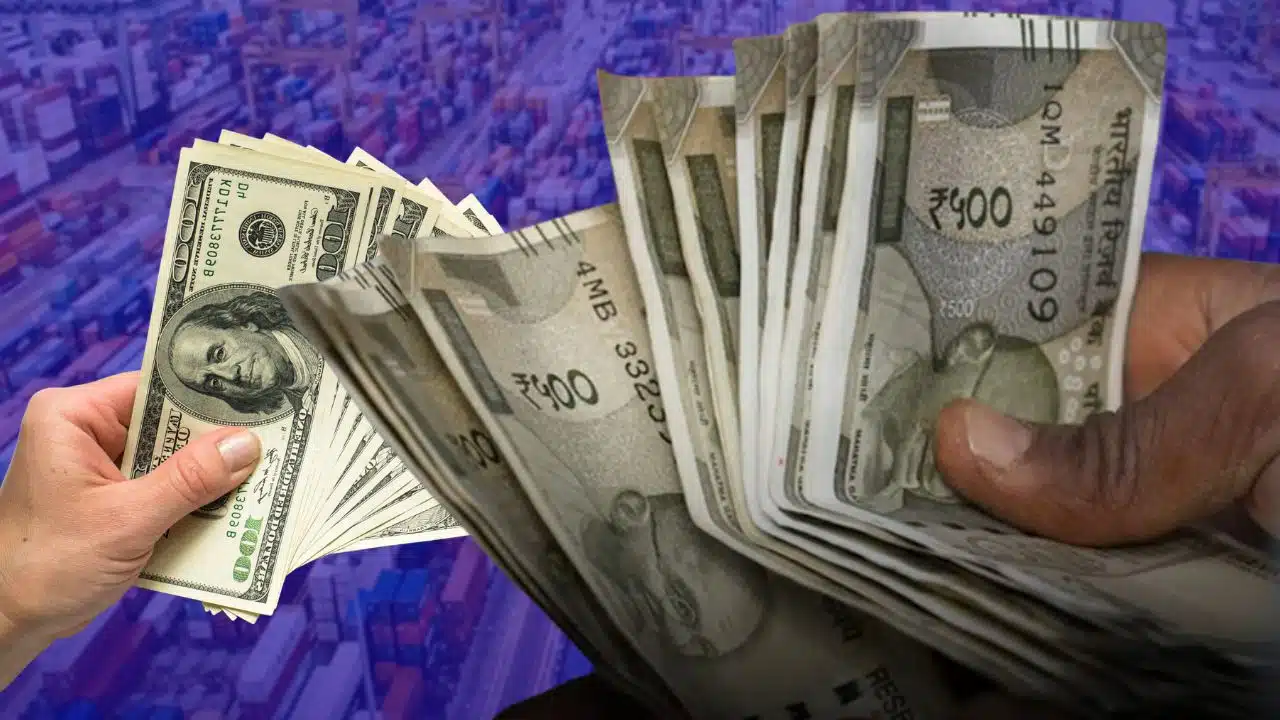
The Indian rupee ended Friday’s trading session at a record low of ₹88.1950 per U.S. dollar, after briefly touching an all-time intraday level of ₹88.3075. This was the first time in history that the rupee had crossed the ₹88 mark against the greenback, signaling deep stress in India’s currency markets.
The rupee dropped 0.65% in a single day, its sharpest fall in nearly three months. In August alone, the currency slipped 0.68%, extending its losing streak for the fourth straight month.
Analysts attribute this decline to a combination of external shocks and domestic vulnerabilities, with the U.S. decision to sharply increase tariffs on Indian goods acting as the immediate trigger
U.S. Tariffs Doubled to 50%
Earlier this week, Washington imposed an additional 25% duty on Indian exports, raising the total tariff burden to 50%. This move is expected to significantly dent India’s trade competitiveness in its largest export market.
The affected sectors include textiles, jewellery, engineering goods, seafood, and leather products, many of which are labour-intensive and employ millions of workers. According to India’s Commerce Ministry data, exports to the United States account for around 2.2% of India’s GDP.
Economists warn that if these tariffs remain in place for a full year, India could lose 60 to 80 basis points of GDP growth, further straining an economy that is already slowing down from post-pandemic recovery highs.
Rising Balance of Payment Pressures
The tariffs come at a time when India is already battling capital outflows and a widening trade deficit.
- Foreign portfolio investors (FPIs) have sold more than $9.7 billion worth of Indian debt and equities in 2025 so far.
- Following the U.S. tariff announcement, FPIs pulled out over $1 billion from equities in just two trading sessions, triggering one of the steepest stock market declines since March.
- India’s trade deficit is widening due to high imports of crude oil, electronics, and gold, and weaker portfolio inflows are aggravating the balance of payments gap.
Currency strategist Dhiraj Nim of ANZ Bank noted that the tariffs are likely to “prolong India’s balance-of-payment stress, keep financial flows weak, and widen the trade deficit.”
RBI Intervention and Policy Dilemma
The Reserve Bank of India (RBI) was forced to step in on Friday, selling dollars to prevent the rupee from breaching deeper lows. While its intervention helped the currency recover slightly from its day’s trough, traders observed that the RBI has been less aggressive than usual in its support measures.
Market watchers suggest that the central bank may be deliberately allowing a gradual depreciation of the rupee to boost export competitiveness, while avoiding sharp volatility.
The RBI’s cautious approach reflects a policy dilemma: intervening too heavily could deplete foreign exchange reserves, while allowing too much depreciation risks inflationary pressures due to more expensive imports—especially crude oil, which India relies on heavily.
Impact on Growth and Jobs
India’s GDP growth forecast for FY2025-26 currently stands at 6.5%, but economists are revising projections downward.
- Exports risk: Textiles, gems and jewellery, and other labour-intensive industries could see sharp slowdowns.
- Employment concerns: Sectors hit hardest by tariffs employ millions of semi-skilled workers. Job losses could amplify social and economic challenges.
- Investment climate: Weaker financial inflows, coupled with heightened global risk aversion, could make India less attractive to investors in the near term.
Comparative Currency Trends
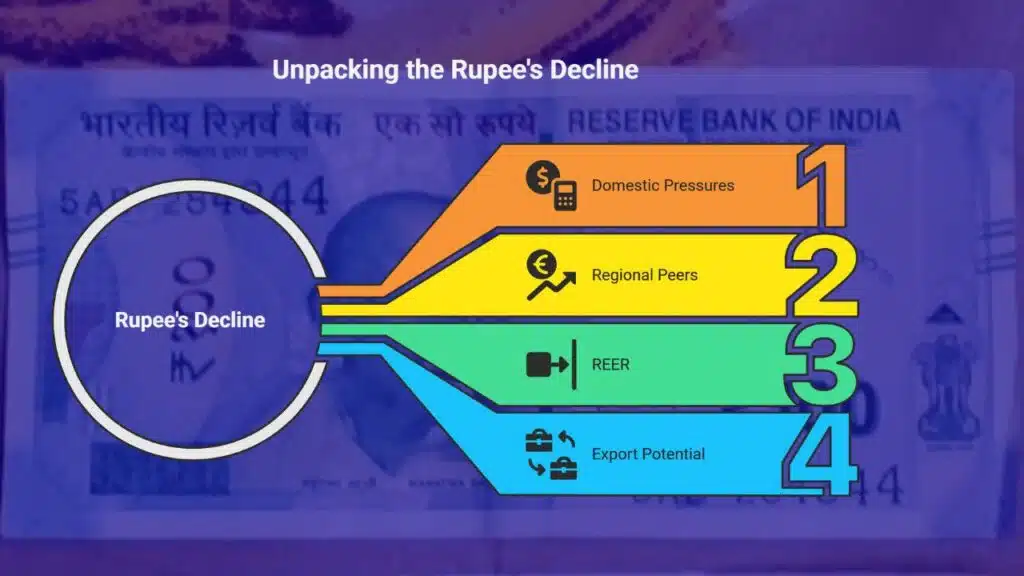
Interestingly, the rupee’s fall has occurred despite a generally weaker U.S. dollar in global markets. The Indian currency has also touched new lows against the Chinese yuan, reflecting the extent of domestic pressures relative to regional peers.
Analysts at J.P. Morgan highlighted that India’s real effective exchange rate (REER)—a measure of competitiveness—has now fallen to its lowest level in two years. While painful in the short term, this could eventually help Indian exports gain market share in global trade.
Equity Market Reaction
Indian equities mirrored the rupee’s pain, with benchmark indices posting their steepest weekly decline since March. Investors remain cautious, fearing prolonged trade tensions with the U.S. and weak earnings growth if tariffs persist.
Sectors such as IT, textiles, and consumer goods—which depend heavily on U.S. demand—led the decline.
Broader Geopolitical Context
The sharp escalation in tariffs is seen as part of Washington’s broader strategy to address trade imbalances and exert pressure on emerging markets. India, which has become a key economic partner in the Indo-Pacific region, faces the challenge of balancing strategic ties with the U.S. while protecting its economic interests.
Trade experts believe the next few months will be critical: negotiations between New Delhi and Washington could determine whether tariff levels remain punitive or are rolled back through diplomatic compromise.
Outlook for the Rupee
The outlook remains bearish:
- Short-term projections suggest the rupee could slip further toward the ₹89/$ mark if U.S. tariffs remain in place and foreign outflows continue.
- Medium-term relief may come from improved export competitiveness due to a weaker rupee and potential central bank actions.
- Risks to watch include global oil prices, Federal Reserve rate moves, and the strength of India’s domestic consumption.
The rupee’s plunge to record lows underscores the fragility of India’s external position in the face of geopolitical trade shocks. While the RBI’s interventions may stabilize short-term volatility, structural challenges remain—from persistent capital outflows to sector-wide export risks under U.S. tariffs.
India now faces a dual challenge: protecting growth and employment at home, while negotiating with Washington to soften the tariff blow. Until then, market participants expect continued pressure on the rupee, making the coming months a crucial test for India’s policymakers and economic resilience.
The Information is collected from Yahoo Finance and MSN.





















