

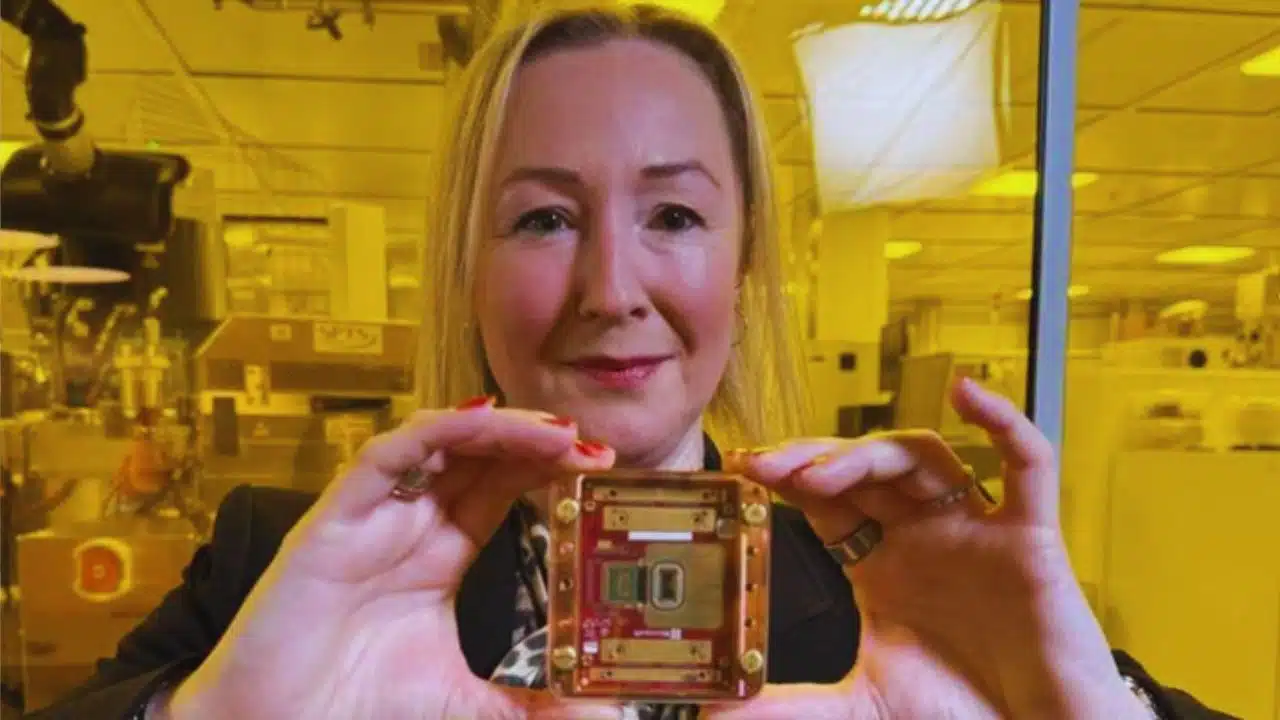
There’s a long-standing adage among tech journalists: you can try to explain quantum mechanics accurately, or you can explain it so that people understand it. But doing both at once is nearly impossible.
Why? Because quantum mechanics is deeply counter-intuitive — the realm of tiny particles behaving in ways that defy everyday logic. When you dive into superposition, entanglement, virtually simultaneous multiple states… you quickly end up in a place that most people’s brains aren’t built to intuitively grasp.
And yet, for all that complexity, quantum technology is quietly gaining real momentum. Its strange behaviour has opened up the potential for a whole new class of scientific and technological capability — one that might reshape industries in ways we’ve barely begun to imagine.
Still, despite this promise, quantum occupies a lower profile than tech’s current rock-star: artificial intelligence (AI).
Why quantum is less visible than AI
Several factors help explain the gap in prominence:
- Different manifestation: AI is primarily software-based and highly visible to everyday users (chatbots, image generation, enterprise automation). Quantum tends toward hardware (quantum chips, sensors, lab machines) and remains hidden from most end-users.
- Maturity and adoption: AI has already moved into broad commercial use. Quantum is still largely R&D, pilot projects and early labs.
- Complexity and accessibility: The “weirdness” of quantum (extreme cold, error rates, decoherence) means it’s harder to frame in simple, compelling stories for general audiences — unlike many “AI breakthroughs” which are easy to visualise.
- Hype vs delivery: Both fields carry hype. But quantum often requires more patience — many of the “big promises” still await major hardware and algorithm advances.
As Brian Hopkins, VP and principal analyst in emerging tech at Forrester, observes: “The potential is there, but the jury is still out.” Initial experiments are promising, but they all indicate that we need much more powerful quantum computers and further innovative research to apply quantum effects effectively to AI.
The Technology: What We Mean by “Quantum” & How it Differs from AI
AI in a nutshell
AI — especially in its current wave (machine-learning, deep learning, generative models) — is about algorithms that learn patterns from data, make predictions, optimise decisions, and increasingly generate creative content. The hardware needed is conventional (GPUs, TPUs, data centres) and the growth gate is largely software, data, compute scale.
Quantum, defined
Quantum technology — broadly speaking — covers several strands. Not all “quantum” is about computing in the narrow sense. The main pillars are:
- Quantum computing: Machines that use quantum bits (“qubits”) which can exist in multiple states simultaneously (superposition), plus quantum entanglement and interference, to perform calculations that classical computers find extremely hard or impossible (for certain problems).
- Quantum communication: Using quantum mechanics (e.g., quantum key distribution, quantum entanglement) for secure transmission of information, immune to many classical hacking methods.
- Quantum sensing: Very precise measurement devices (gravity, magnetic fields, time, motion) leveraging quantum phenomena, enabling new applications (navigation in GPS-denied areas, medical imaging, etc.).
According to McKinsey & Company, by 2035 the global market sizes might look like: quantum computing US$28-72 billion, quantum communication US$11-15 billion, quantum sensing US$7-10 billion. That totals up to ~US$97 billion across those areas.
Key technological hurdles
Quantum computing remains in what’s called the NISQ (noisy intermediate-scale quantum) era: systems with tens to low hundreds of qubits, prone to error, requiring extreme conditions (cryogenics, vibration isolation) and not yet fault-tolerant.)
Even though companies like Google have announced chips (e.g., the “Willow” processor) that solve benchmark tasks in minutes which classical supercomputers would take lifetimes to match. The bottom line: quantum has potential advantage, but many structural, hardware and algorithmic obstacles remain.
Market Size and Growth: Quantum vs AI
Quantum’s current and projected market
- The Fortune Business Insights report estimates global quantum computing market value about US$1.16 billion in 2024, projected to ~US$12.62 billion by 2032 (CAGR ~34.8%).
- The Quantum Insider projects a cumulative value creation of US$1 trillion by 2035 (end-user benefits) and about US$50 billion in vendor revenue in that period.
- McKinsey’s analysis aligns: ~US$97 billion market by 2035, with the possibility of ~US$198 billion by 2040.
AI’s current and projected scale
- AI is already in the hundreds of billions market size. Some forecasts put global AI spending (hardware + software + services) at US$1.5 trillion in 2025.
- Other projections place global AI market across trillions of dollars in the 2030s.
Comparative takeaway
- Today, AI is much larger than quantum in commercial scale, adoption, ecosystem.
- In the medium-term, quantum is growing fast but remains orders of magnitude smaller than AI.
- In the long term, quantum could challenge or complement the structural impact of AI—depending on how the technology develops and is adopted.
Use-Cases & Real-World Impact: Why Quantum Matters
1. Drug discovery, materials science & chemicals
Quantum computing’s ability to simulate molecular interactions at scale could transform sectors such as pharma (tailor-made drugs), agriculture (efficient fertilisers), and materials (novel alloys, batteries). For example, quantum computers could explore molecular combinations far beyond what classical computers can handle within realistic timeframes.
“Things that could take the age of the universe to calculate, even on the most powerful supercomputer, could be performed probably in seconds,” says Prof Sir Peter Knight.
— Reflecting this, quantum’s potential in chemicals and life-sciences is emphasised in multiple reports.
2. Navigation, sensing, and infrastructure
Quantum sensors are already being piloted for non-GPS navigation (e.g., underground, under seas), ultra-precise clocks (for finance, telecoms), medical scanning in challenging conditions (e.g., moving children). For instance, a “quantum compass” trial in the UK used quantum sensors in a subway network where GPS fails.
These capabilities promise huge leverage in defence, infrastructure resilience, environment monitoring.
3. Cryptography & cyber-security
One of the most discussed quantum implications: the possibility of quantum computers eventually breaking current public-key encryption systems (RSA, ECC) via algorithms like Shor’s. Many governments and agencies are already prepping “post-quantum” encryption.
The term “Q-day” is used to refer to the moment when practical quantum decryption becomes feasible. Quantum thus is as much a risk management and national-security mantle as it is a commercial-tech frontier.
4. AI + Quantum synergy
Importantly: quantum and AI are not rivals— they may have a symbiotic relationship. Quantum computing could accelerate AI (for example, optimisation, hyper-parameter tuning, large-model training). At the same time, AI can help quantum (for hardware calibration, error mitigation, control systems).
Reports show this convergence is becoming a “frontier of innovation”.
But: there are caveats. Some researchers flag that quantum computing may not easily advance all AI workloads (for instance, large-scale deep-learning on huge datasets) because of quantum’s current limitations.
Timing & Adoption: Why “Bigger” Doesn’t Mean Immediate
On the timeline
While quantum offers architecture-shifting potential, the timeline remains uncertain. For example:
- Google has stated that some commercial quantum applications may arrive within about five years.
- Others (including industry voices like Nvidia’s CEO) argue that broadly useful, fault-tolerant quantum computing is 15–20 years away.
- Because quantum technology must overcome significant hurdles (error correction, scale, cost, ecosystem), the path to mass adoption will be long.
On the adoption curve
- AI has already crossed a technology adoption inflection: enterprise budgets, feasibility, business models are now well understood.
- Quantum is still largely in the “innovation & early adopters” phase: pilot projects, research labs, defence/finance verticals, quantum-prime geography (US, China, UK, EU).
- The broader ecosystem (software stacks, algorithms, workforce, business models) is still building. For example, workforce studies show a gap in trained quantum engineers and programmers.
On the business/industry readiness
- Many industries will benefit from quantum sooner than others. McKinsey identifies electromaterials, pharmaceuticals, chemicals, manufacturing and logistics as early-impact sectors.
- On the flip side, some applications of quantum remain speculative, and actual business cases where quantum provides clear commercial ROI today are limited.
- AI’s business case is now mature: models, frameworks and practices exist, deployment is real, ROI is documented.
Strategic Business & Geopolitical Implications
Strategic business mindset
Here are strategic implications:
- Position quantum as the next frontier, not the immediate competitor to AI. Content should frame quantum as long-term, high-leverage, and complementary to the ongoing AI story rather than replacing it.
- Focus on use-cases where quantum can realistically generate value in the near- to mid-term: e.g., finance optimisation, advanced materials, cybersecurity defences, sensing, not just “quantum will solve everything in 5 minutes”.
- Highlight the geostrategic dimension: quantum technology is increasingly part of national-tech strategy (as is AI), and many of the big moves will be global (US vs China vs EU vs India). That ties directly into your interest in BRICS, UN, NATO, ASEAN etc.
- Content opportunity: you can build articles, infographics and explainer assets that cover: “What quantum is, what quantum isn’t, timelines, industry sectors, national-strategy implications, quantum+AI synergy”.
- Risk and governance angle: because quantum affects cyber-security, cryptography, privacy, defence — you can build content around the “down-side” as much as the upside. Balanced expert commentary strengthens credibility.
Geopolitical and macro-technology terrain
- Countries are racing to secure leadership in quantum as part of broader tech sovereignty. The ability to build quantum hardware, software, workforce and supply chains is seen as strategic.
- Quantum computing’s impact on encryption means that national security, intelligence, defence spending are in play — it’s not just a commercial story but a geopolitical one.
- Given your focus on global organisations (BRICS, ASEAN, UN etc.), quantum is another axis of “technology diplomacy” — who controls, who exports, who regulates, who sets standards.
So… Will Quantum Be Bigger Than AI? Here’s How I’d Frame It
Based on first-principles reasoning, the answer is nuanced:
If by “bigger” you mean in the near-term commercial market size, adoption scale, visible business impact → no, quantum will not outpace AI in that dimension for the foreseeable future. AI already holds that territory.
If by “bigger” you mean long-term foundational impact on the computing paradigm, scientific discovery, global infrastructure, geo-tech influence → yes, quantum could equal or exceed AI’s structural significance — but only under the condition that major technological and ecosystem breakthroughs occur.
The more strategic lens: quantum and AI are likely co-evolving, not strictly in competition. The real “big bet” is on their intersection and hybridisation (quantum-accelerated AI, AI-aided quantum hardware, quantum-secure AI systems).
For your strategic content and business positioning: emphasise quantum potential, uncertainty, time-horizon, and complementary value to AI, rather than hyperbole of “quantum will replace AI tomorrow”.
The Information is Collected from BBC and AOL.






















