

Proper software project management gives a team a dependable way to make decisions while the work is still changing. People know why the software is being built, what belongs in the current scope, who can make which decisions, what could delay delivery, and what must be true before release.
That sounds basic. In practice, many projects create the appearance of control without the substance. Tickets move, meetings happen, and status reports stay green. Meanwhile, priorities shift through side conversations, testing gets pushed back, and the delivery date becomes something everyone repeats but few people trust.
I do not judge a project by how closely it follows one methodology. I judge it by whether the process helps the team see problems early, make clear tradeoffs, and deliver software that is useful and supportable.
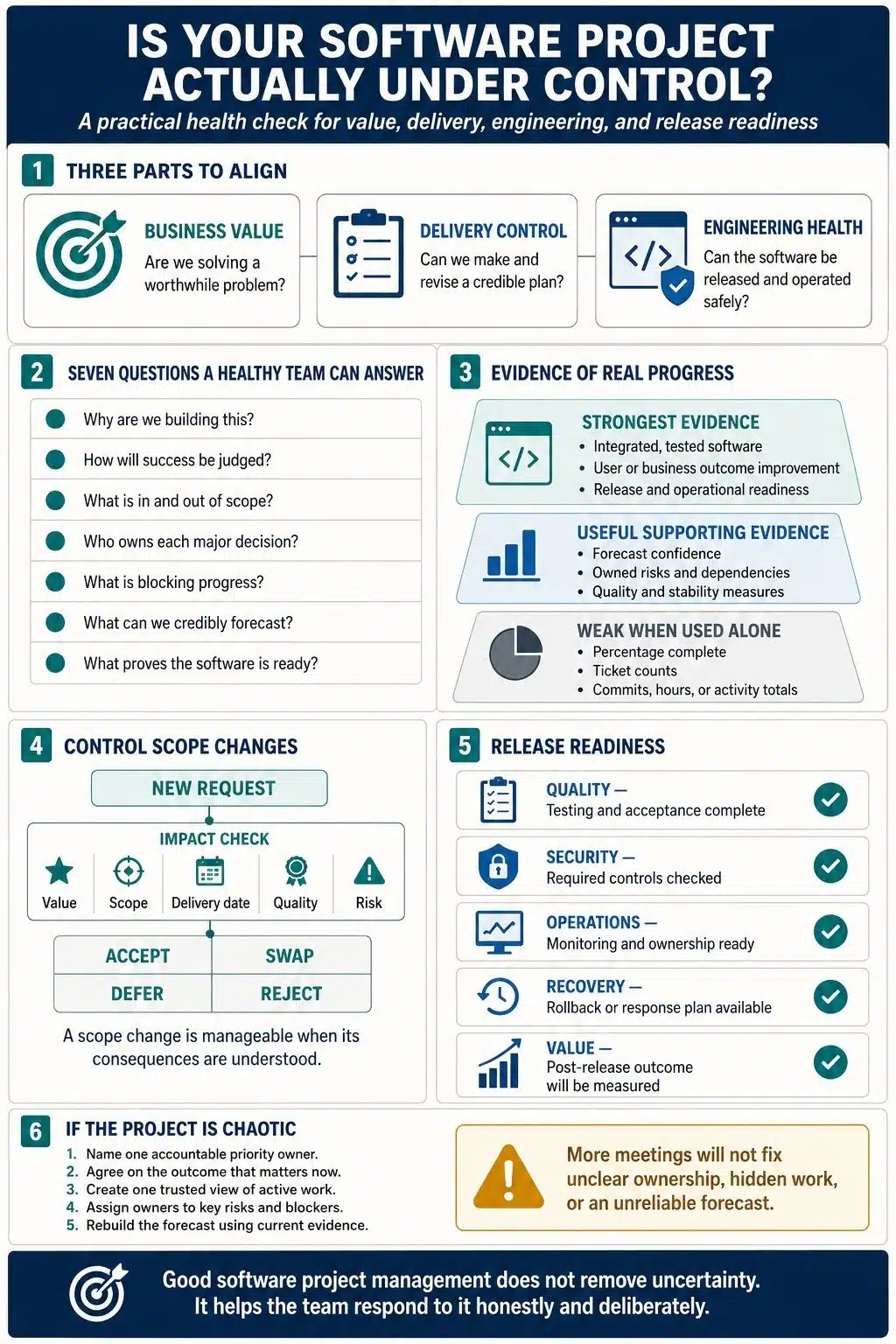
What Proper Software Project Management Has to Do
Software projects contain uncertainty that cannot be planned away. Users may respond differently than expected. A technical dependency may prove harder to change. A small feature request may touch permissions, data, reporting, and several connected systems.
A useful plan gives the team direction while leaving room to learn. It controls commitments, scope, cost, risk, and quality, but it also creates regular chances to test assumptions and revise the forecast. That balance matters more than whether the team calls its process Agile, Waterfall, Scrum, or hybrid.
PMI’s current PMBOK guidance reflects this broader view by emphasizing value, adaptability, accountability, quality, and practices suited to the situation. The method is there to serve the project. It should never become the project.
Keep Value, Delivery, and Engineering Aligned
Three parts of a software project need attention at the same time:
| Area | The question it answers | Evidence of healthy management |
| Business value | Are we solving a worthwhile problem? | Defined users, a clear need, intended outcomes, success measures, and active sponsor decisions |
| Delivery control | Can we make and revise a credible plan? | Ordered work, visible dependencies, realistic forecasts, controlled changes, and owned risks |
| Engineering health | Can we change, release, and operate the software safely? | Testable requirements, appropriate security, deployability, monitoring, and support ownership |
Delivery control is often the most visible of the three. It produces boards, schedules, reports, and meetings. But tidy tickets cannot rescue a product that solves the wrong problem. A strong idea is no better if the software is unstable or too risky to release.
The tradeoffs between these areas should be open. If a date requires a smaller scope, say so. If a security requirement adds time, explain the consequence. Quietly weakening quality to protect a schedule only moves the cost to a less convenient moment.
Begin With a Brief the Team Can Use
Before the backlog becomes crowded, the team needs a short project brief. It should identify:
- The user or business problem
- The intended outcome and how it will be judged
- Important constraints, assumptions, and dependencies
- What the current effort includes
- What is deliberately out of scope
- Who owns the outcome and major decisions
This is a starting position, not a promise that nothing will change. Its purpose is to give the team something specific to test.
“Build a better customer portal” leaves almost every important choice open. “Reduce avoidable support contacts by helping existing customers find invoices and update billing details” is more useful. It connects the work to a real problem and gives the team a way to question features that do not support it.
Give Important Decisions Clear Owners
Collaboration becomes slow when every decision requires consensus. A healthy project identifies who owns product priorities, technical choices, budget and schedule tradeoffs, acceptance, security decisions, and escalation.
Without that clarity, the latest senior opinion can reset the work. The team revisits settled questions because a discussion took place, but nobody knows whether a decision was actually made.
I prefer ownership to be visible close to the work. The owner should consult the right people and record choices that will matter later. That does not give one person permission to ignore expertise. It gives the team a clear path from discussion to action.
Turn Scope Into Ordered, Testable Work
A feature list is not yet a delivery plan. Work has to be broken into pieces the team can understand, build, test, and demonstrate. Each item needs a reason for its priority and a shared view of what acceptable completion looks like.
For most teams, one trusted source of ordered work is enough. It should show what matters now, what is likely to come next, and what is blocked or not ready. A complex tool is of little value if people continue to make commitments in chat messages, private documents, and hallway conversations.
Acceptance criteria should describe observable behavior rather than restate a ticket title. Relevant requirements for accessibility, performance, privacy, reliability, or auditability also belong with the work. Adding them immediately before release is usually expensive because earlier design and technical choices may already limit the options.
Scope will change, and sometimes it should. The management failure is allowing a request to enter without examining what it does to cost, timing, risk, quality, or another commitment. A new request can be accepted, exchanged for something else, deferred, or rejected. What matters is that the consequence is understood.
Treat Dates as Forecasts, Not Facts
An early software estimate is a forecast based on incomplete knowledge. It should be useful, but it should not pretend to be certain.
A credible forecast considers the remaining work, team capacity, dependencies, previous delivery performance, technical uncertainty, and the effort required for integration and release. It also states the assumptions behind the date. “We expect to finish in late October if the payment provider completes certification by September” tells a stakeholder more than a confident deadline that hides the dependency.
Developers need to participate because they understand much of the technical effort and risk. Management may set a genuine business constraint, such as a regulatory date or a fixed market event. That constraint still does not become a credible delivery estimate merely because someone senior announced it.
Forecasts should become more accurate as evidence improves. If the facts change, the forecast may need to change too. The real failure is learning that the plan is no longer credible and continuing to report it unchanged.
Use Working Software as the Main Evidence of Progress
Integrated, testable software tells us more than a percentage-complete report. It exposes misunderstood requirements, awkward user flows, weak assumptions, and technical problems that remain invisible in a document.
Smaller increments reduce the cost of being wrong. Stakeholders can respond to something concrete, integration happens earlier, and the team can assess whether the proposed solution is useful before the full budget has been spent.
This does not mean every change must go straight to customers. It means the product should remain close enough to a releasable state that the team is not postponing the hardest questions until the end.
Plan for Quality, Security, and Technical Debt
Quality is built through the work. A suitable definition of done may include code review, testing, security checks, documentation, monitoring, and deployment readiness. The exact requirements should reflect the product’s risk.
A marketing microsite and a healthcare platform do not need identical controls. The second carries greater consequences for privacy, reliability, access, and traceability. Applying the same lightweight process to both would not be efficient; it would be careless.
NIST’s Secure Software Development Framework makes the same practical point about security: secure practices belong throughout development, not only at a final approval gate.
Technical debt also needs judgment. An imperfect implementation may be an acceptable short-term choice. It becomes a management concern when it slows future changes, increases defects or security exposure, leaves critical knowledge with one person, or makes delivery less predictable. At that stage, ignoring the debt is a business decision, even if the problem is recorded in an engineering ticket.
Do Not Mix Risks, Issues, Changes, and Decisions
A risk is something uncertain that could affect the project. An issue has already happened. A change alters an agreed part of the plan, while a decision settles a meaningful choice. Keeping these records separate makes the required response clearer.
Each important item needs an owner and a next action. Risks need a planned response. Issues may need immediate action or escalation. Changes need impact analysis. Consequential decisions should retain enough context that the team does not reopen the same debate a month later.
These records should stay short and current. Five live risks with accountable owners are more useful than a register containing fifty forgotten entries. Documentation earns its place when it supports delivery, operation, traceability, or the recovery of important context.
Report What Stakeholders Can Act On
A useful status update helps someone decide. It shows what working software was completed, what matters next, how credible the current forecast is, which risks need attention, and where a scope or quality tradeoff requires approval.
“The project is 80% complete” rarely provides that clarity. The unfinished portion may contain migration, integration, security approval, performance work, or operational preparation. Those are often the areas where the most serious problems appear.
Metrics need similar restraint. Delivery measures can reveal throughput and stability. Product measures can show whether user or business outcomes improved. Quality and operational measures expose defecsofts, reliability, and recovery performance. DORA’s delivery metrics are useful because they consider both speed and instability, but they do not measure the full value of a project.
No single number represents developer productivity. Ticket counts, commits, lines of code, story points, and logged hours are especially risky as individual targets. People learn to improve the score, which may have little connection to better software. I would use metrics to investigate the delivery system, not to rank the people working inside it.
A Release Still Needs Management
Deployment is a milestone, not the end of responsibility. Before release, the team may need to confirm data migration, security, monitoring, rollback, documentation, support, and operational ownership. The list will vary, but it should not be discovered during an incident.
After release, the team needs to check whether the intended outcome actually improved. Usage, support demand, reliability, customer behavior, or another agreed measure may show that the software worked technically but failed to solve the original problem.
This final review closes the gap between shipping features and creating value. It also gives the next round of planning better evidence than opinion alone.
If the Project Is Chaotic, Repair the Basics First
Adding a complete framework to a troubled project can produce more forms and meetings without resolving the confusion. I would start by naming one accountable priority owner and agreeing on the outcome that matters now.
Then create one ordered view of active work and stop accepting requests through side channels. Identify the few blockers, dependencies, risks, and unresolved decisions that could materially change delivery, and give each an owner. Redefine done so that quality and release work are included. Only then should the team rebuild its forecast from current evidence and explain what changed.
The point is not to achieve methodological purity. It is to restore enough shared understanding for dependable decisions.
Final Thought
Proper software project management does not guarantee that the original plan will survive contact with the work. It gives the team a disciplined way to respond when it does not.
For me, the clearest signs of good management are straightforward: the purpose is understood, decisions have owners, working software provides evidence, risks are discussed early, quality is planned, and tradeoffs are honest. Tools and ceremonies can support those habits, but they cannot substitute for them.
Frequently Asked Questions on Software Project Management
1. What Is Software Project Management in Simple Terms?
Software project management is the work of guiding a software initiative from an identified need to a useful, supportable result. It coordinates outcomes, people, scope, time, cost, risk, quality, technical delivery, stakeholder decisions, release, and follow-up.
2. Does Proper Software Project Management Require Agile or Scrum?
No. A team may use iterative, predictive, or hybrid practices. The method is suitable when it helps the team test assumptions, manage commitments and risks, maintain quality, and adapt without losing control of the outcome.
3. What Is the Difference Between a Software Project Manager and a Product Manager?
A project manager usually focuses on delivery coordination, dependencies, resources, risks, communication, and commitments. A product manager typically owns product direction, user needs, outcomes, and priorities. The boundaries vary, but the decisions still need clear owners.
4. How Should Software Project Progress Be Measured?
Use several forms of evidence: working software, forecast confidence, progress toward the intended outcome, quality, operational stability, material risks, and unresolved decisions. Percentage complete and individual activity measures are too easy to misread or game.
5. Can a Non-Technical Project Manager Manage a Software Project?
Yes, provided the person has enough technical literacy to understand dependencies, uncertainty, quality concerns, and the consequences of tradeoffs. They do not need to be the strongest programmers. They do need to ask informed questions and respect the judgment of the people doing the technical work.