

The strongest product page elements do more than decorate an online store. They help search engines understand the offer and give shoppers enough information to buy without returning to the search results.
Organic traffic alone does not create revenue. A product page must confirm that the item matches the search, answer practical questions, reduce risk, and make the next action obvious. No single element guarantees rankings or sales, but these eight work together to turn qualified visits into purchases.
1. A Precise and Descriptive Product Title
A strong product title tells shoppers exactly what they are viewing. Generic titles such as “Running Shoes” or “Wireless Headphones” leave out the details people use to compare products.
Combine the product type with the most relevant identifying information. Depending on the item, this could include the brand, model, material, capacity, color, size, or intended user.
Keep the title tag, visible page heading, structured product name, and product-feed title consistent. They do not have to be identical, but they should clearly describe the same item.
Avoid repeating keyword variations or promotional phrases. A concise, natural title is more useful than one written to satisfy a keyword counter.
The meta description can summarize the product’s main benefit and distinguishing features. However, search engines may generate a different snippet from the page, so the visible content must communicate the same value.

2. A Product Gallery That Answers Visual Questions
Online shoppers cannot touch or inspect a product. The image gallery must provide the missing physical context.
Start with an accurate primary image. Add the angles, close-ups, and contextual views needed to understand the product. Show its scale beside a familiar object or in a realistic setting. Products designed to be worn should normally appear on a model so shoppers can judge their size and fit.
Every selectable color, pattern, or design should have corresponding images. A short video can also help when movement, assembly, texture, or operation is difficult to explain through photographs.
There is no ideal number of images. Include enough to answer genuine visual questions without filling the gallery with repetitive shots.
Images should be high-resolution, crawlable, and efficiently compressed. Write descriptive alt text that explains the product, angle, and relevant variation. Do not turn alt text into a keyword list. The gallery should improve visual search visibility without making the page slow or unstable.
3. An Original, Decision-Focused Product Description
A product description should help someone decide, not simply fill space beneath the images.
Open with a plain explanation of what the product is, who it is for, and why its main feature matters. Translate features into practical benefits, but support those benefits with accurate facts.
The rest of the description should address information relevant to that product category. This may include materials, ingredients, measurements, care instructions, package contents, compatibility, warranty coverage, or realistic use cases. Mention important limitations when they could affect the purchase.
Manufacturer copy can provide basic facts, but using it unchanged rarely distinguishes the page from competing retailers. Add original explanations based on verified product information and recurring customer questions.
There is no required description length for SEO. A simple product may need only a few short paragraphs. A costly or technical item will usually require more detail. Stop when the buyer has enough information to make an informed choice.
4. Scannable Specifications, Fit, and Compatibility Details
Descriptions explain value. Specifications allow shoppers to verify suitability.
Organize technical information in a table or clearly labelled sections. Group related details such as dimensions, materials, performance, connectivity, compatibility, care, certifications, and package contents.
Use consistent labels and measurement units across comparable products. For apparel, provide an understandable size guide. For accessories, replacement parts, and electronics, make compatibility information easy to find. Briefly explain technical terms that an ordinary buyer may not recognize.
Keep essential information in readable page content. Do not place critical measurements or compatibility requirements only inside an image, manual, or downloadable PDF.
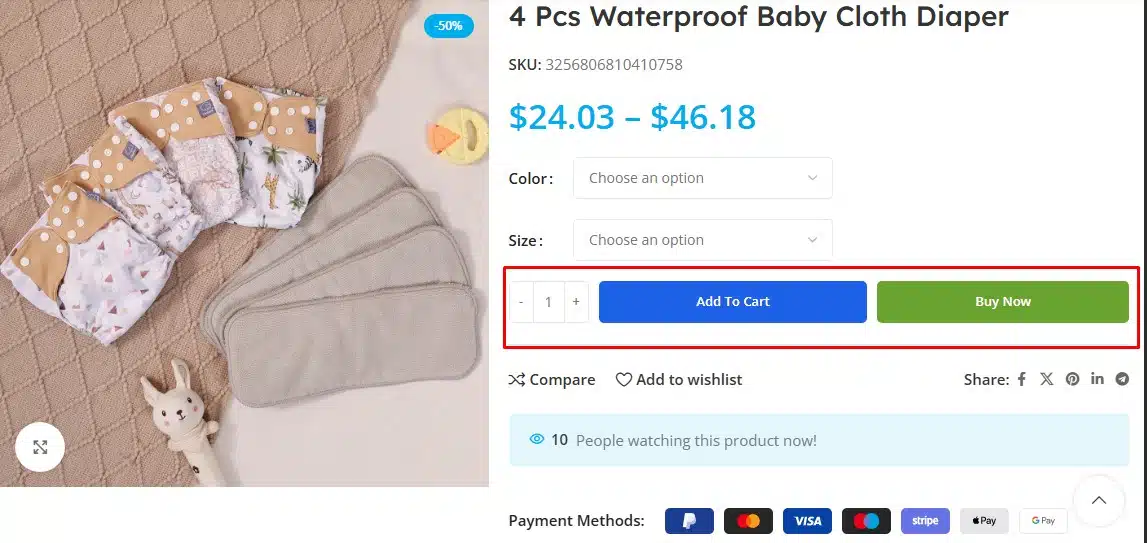
5. A Complete Buy Box With a Clear Action
The buy box is where product evaluation becomes action. It should contain everything needed to choose and add the correct item.
Display the current price, currency, stock status, quantity selector, product variations, and a clear “Add to Cart” or equivalent button. Show unit pricing when customers are comparing different quantities or package sizes.
Available and unavailable options should be visible before someone tries to order. If a size is out of stock, mark it clearly instead of hiding that information inside a menu.
When a shopper changes the color, size, or configuration, the image, price, availability, SKU, and purchasing option should update together. Conflicting information creates uncertainty and can also cause problems when product data is submitted to search and shopping platforms.
Avoid vague buttons, artificial stock warnings, and countdown timers that continually reset. A clear offer builds more lasting confidence than manufactured urgency.
6. Shipping, Delivery, Total Cost, and Return Information
The displayed product price may not be the final amount a customer pays. Shipping charges, duties, taxes, and return costs can change the value of an offer.
Place the most important fulfilment details near the buy box. Show the estimated shipping cost, free-shipping conditions, expected arrival date, and available pickup or delivery options.
An arrival estimate is more useful than saying the item “ships within three days.” The first helps customers plan; the second only explains when the order may leave the warehouse.
Return information should cover the return window, method, fees, refund process, and product-specific exclusions. Provide a short summary on the page with access to the complete policy.
If exact taxes or duties cannot be calculated until checkout, explain what the displayed price includes and when additional charges will appear. Customers should not have to begin checkout to discover the true conditions of the purchase.
7. Authentic Reviews and Product-Specific Q&A
Product descriptions present the seller’s view. Reviews show how the item performs for actual customers.
A useful review section includes the average score, number of reviews, and rating distribution. Let shoppers read both positive and negative experiences, identify the variation purchased, and filter reviews by rating or relevance.
Verified-purchase labels and customer photographs can add valuable context. For apparel, cosmetics, furniture, and home products, customer images often reveal fit, scale, color, or texture more realistically than studio photography.
Do not automatically hide criticism. A calm, clearly labelled response from the retailer can show prospective buyers how problems are handled.
Product-specific FAQs and moderated Q&A sections can answer unusual questions without making the main description excessively long. Staff should respond to unanswered questions and use recurring concerns to improve the permanent product content.
Never fabricate reviews or offer rewards that depend on a positive rating. Any incentive should be disclosed, and review information used in structured data must match genuine content visible on the page.
8. Accurate Product Structured Data
Structured data works behind the visible design. It helps search engines interpret the product and its offer more accurately.
Product and Offer markup can identify the name, description, images, brand, product identifiers, price, currency, availability, condition, shipping details, return information, and genuine ratings. Products with several sizes, colors, or configurations may also need variant information to show how those options relate.
Correct markup can make a product eligible for enhanced search appearances containing information such as price, availability, ratings, or shipping. It can also support product visibility across image search, free listings, and other shopping experiences.
Structured data does not guarantee higher rankings or enhanced results. Accuracy matters more than the amount of markup added.
The visible product page, structured data, product feed, and checkout must show matching prices, stock information, and variations. Validate the implementation and monitor errors whenever the catalogue or website template changes.
The Best Product Page Finishes the Search
A shopper should not need to return to Google to discover a product’s size, compatibility, delivery cost, or return conditions. Every unanswered question creates another opportunity to lose the sale.
Start with accurate information. Then improve clarity, visual evidence, trust, and purchasing ease. Measure organic impressions, clicks, add-to-cart activity, conversion rate, and revenue by landing page. The best product page is not the one with the most elements, it is the one that makes a confident decision easiest.
Frequently Asked Questions on Product Page Elements
1. Which product page element should be fixed first?
Fix inaccurate price, availability, variation, and purchasing information first because these errors can block a sale. Next, improve the title, product content, images, and technical data that affect discovery and evaluation.
2. Can manufacturer descriptions hurt product page SEO?
Using manufacturer text does not automatically cause a penalty. However, the same copy may appear on many competing sites and may not answer your customers’ questions. Enrich it with verified details, clearer explanations, measurements, and useful buying guidance.
3. Can customer reviews improve product page SEO?
Authentic reviews can add useful product-specific language and may support rating enhancements when marked up correctly. Their main value, however, is helping shoppers evaluate quality, fit, durability, and real-world performance.
4. Does product structured data guarantee rich results?
No. Valid structured data makes a page eligible for supported search features, but search engines decide when those features appear. Incorrect or outdated markup can remove that eligibility.
5. Should an out-of-stock product page remain online?
Keep the page live when the product is expected to return. Show its status clearly and offer restock notifications or relevant alternatives. For a permanently discontinued product, retain the page if it remains useful, redirect it only to a genuinely close replacement, or return an appropriate unavailable status when no useful alternative exists.