

A title tag looks small. In reality, it often does the first hard job in SEO. Before someone reads your introduction, sees your images, checks your examples, or trusts your advice, they usually see the title. In search results, that title becomes the first signal. It tells the searcher what the page is about, whether the page matches their intent, and whether the result is worth opening.
That is why title tag optimization still matters in 2026. Search has changed. People now find answers through classic Google results, AI Overviews, featured snippets, video results, image packs, social search, and AI-powered search tools. But even in this new search environment, the title still carries weight. It helps search engines understand the page, and it helps people decide whether the page deserves their click.
The problem is that many title tags are still written like SEO chores. Some are stuffed with keywords. Some are too vague. Some are too long. Some promise more than the article delivers. Some are copied across dozens of similar pages. Some are written for search engines but sound awkward to actual readers.
That is not optimization. That is noise. A strong SEO title tag should do three things at once. It should describe the page clearly, include the main search idea naturally, and give the reader a reason to choose your result over the others. It does not need to be clever every time. It needs to be useful, accurate, and click-worthy without being desperate.
What Is a Title Tag in SEO?
A title tag is an HTML element that defines the title of a web page. It usually appears in browser tabs, bookmarks, and search result title links. In simple terms, it is the page title that search engines read from your HTML.
For example:
<title>Title Tag Optimization Best Practices for SEO in 2026</title>
Most modern CMS platforms, including WordPress, let you edit the title tag through the page title field or an SEO plugin. You do not usually need to touch code unless you are working on a custom website. Still, editors and writers should understand the difference between a few title-related elements.
Your title tag is the HTML title that search engines may use in search results. Your H1 is the main visible heading on the page. Your social title or Open Graph title may appear when the page is shared on platforms like Facebook, LinkedIn, or messaging apps. Sometimes these can be the same. Sometimes they should be slightly different.
For SEO, the title tag matters because it gives both users and search systems a quick summary of the page. But it is not a private instruction to Google. Google may use it, shorten it, adjust it, or choose another visible page element if the title tag does not represent the page well.
That is why title tag writing needs more care than simply placing a keyword before a separator.
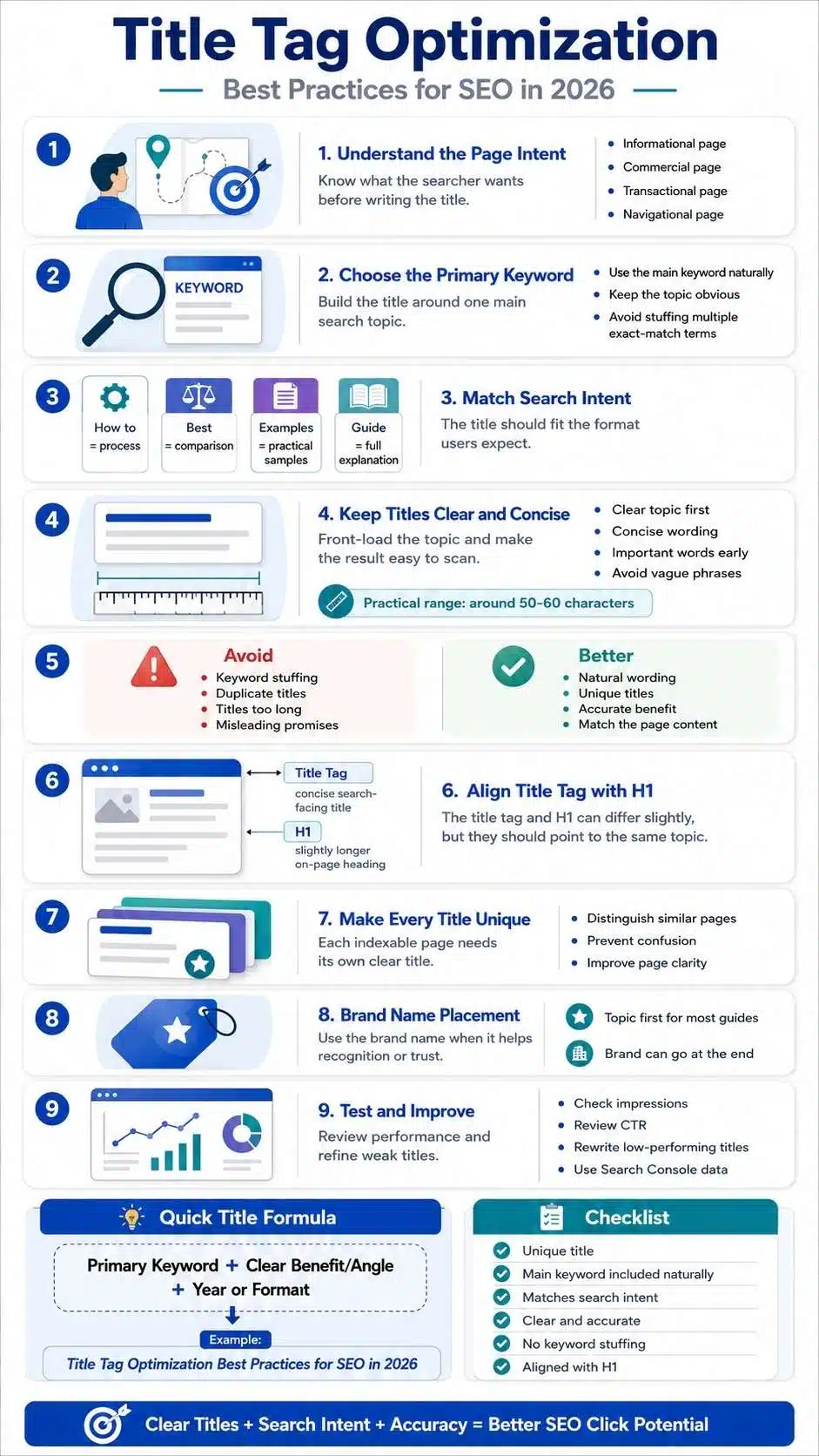
Why SEO Title Tags Still Matter in 2026
SEO has become more complex, but the title tag remains one of the most visible on-page SEO elements. A page can be well-written and still get ignored if the title is weak. A title can improve click-through rate when it clearly matches the searcher’s need. It can also help search engines understand the main topic of the page when it aligns with the H1, URL, headings, and body content.
This is especially important now because search results are crowded.
Your page may compete with:
- AI Overviews
- Featured snippets
- Video results
- Image packs
- Reddit or forum threads
- Product listings
- Local results
- Strong brand pages
- News results
- Competitor guides
In that environment, a lazy title tag loses quickly. A title like “SEO Tips” does not say enough. It could mean anything. A title like “Title Tag Optimization Best Practices for Better SEO Clicks” is clearer because it tells the reader the exact topic and benefit.
That does not mean every title needs to sound like a marketing slogan. In many cases, plain and specific works better than clever and vague.
The best title tags usually feel obvious after you read them. They match the search, set the right expectation, and make the page easy to understand before the click.
Title Tag vs H1: They Should Work Together
A common beginner mistake is treating the title tag and H1 as the same thing all the time. They can be similar, but they do different jobs. The title tag has to work in search results, browser tabs, and bookmarks. It should be concise and designed for quick recognition.
The H1 works on the page itself. It can be slightly longer, more editorial, or more natural because the reader has already arrived.
Here is a simple example:
Title Tag: Title Tag Optimization Best Practices for SEO in 2026
H1: Title Tag Optimization Best Practices: How to Write SEO Titles That Still Get Clicks in 2026
Both are aligned. Both describe the same topic. But the H1 has more room to set the article angle. Problems start when the title tag and H1 say different things. If the title tag says “SEO Title Tags Guide” but the H1 says “How to Improve Blog Traffic,” search engines and users may receive mixed signals. The page may still work, but it is less clean.
My practical rule is simple: the title tag and H1 should not be identical every time, but they should feel like they belong to the same page.
How Google Generates Title Links
The title link is the clickable headline people see in Google Search results. The title tag is an important source for that title link, but it is not the only source.
Google may also look at the main visual title, H1, other headings, Open Graph title, prominent page text, internal anchor text, external anchor text, and other signals. This matters because some site owners panic when Google shows a different title in search.
A rewritten title does not always mean something is wrong. Sometimes Google adjusts the title to better match the query. But frequent or strange rewrites can be a sign that your title tag is not clear, accurate, or aligned with the page.
Common reasons title links get changed include:
- The title tag is too long.
- The title tag is stuffed with keywords.
- The title tag is outdated.
- The page has multiple large headings.
- The title is missing or half-empty.
- The same title is repeated across many pages.
- The visible H1 says something more accurate.
- The title does not match the page content.
- The language of the title does not match the page language.
This is not a small issue. If Google rewrites your title into something less attractive, you may lose clicks even if the page ranks well.
So the goal is not to “force” Google to use your title. You cannot fully force it. The goal is to make your title tag the best, clearest, and most accurate option.
The Core Rules of Title Tag Optimization
Good title tag writing is not complicated, but it requires discipline.
A strong title tag should be:
- Unique to the page
- Clear to the reader
- Accurate to the content
- Natural with the primary keyword
- Specific enough to show value
- Concise enough to display well
- Matched with search intent
- Different from competitor titles when possible
- Free from keyword stuffing
- Updated when the page changes
That sounds simple. In practice, many titles fail one of these tests. A page title can include the keyword and still be weak. It can be short and still be vague. It can be catchy and still mislead the reader. The best titles balance SEO, clarity, and editorial judgment.
For this article, the primary keyword is title tag optimization. It fits naturally in the title because the page is directly about that topic. The secondary keywords, such as SEO title tags, page title SEO, and title tag examples, can appear naturally in the body, subheadings, and examples. What you should avoid is forcing every keyword into the title.
Bad title: Title Tag Optimization SEO Title Tags Page Title SEO Examples
Better title: Title Tag Optimization Best Practices for SEO in 2026
The second title is cleaner. It still carries the main keyword, but it sounds like something a human would actually click.
How Long Should a Title Tag Be?
There is no perfect character count that works in every search result. Google does not rank a title because it fits a magic number. Search result display depends on pixels, device width, wording, and how Google chooses to show the title link. A short title can still be bad. A longer title can still work if the important part appears early and the title remains readable.
That said, most SEO teams still use a practical range because it helps avoid messy truncation. A title around 50 to 60 characters often displays cleanly in many desktop results, but you should not write mechanically for that number.
The better question is this:
Can a searcher understand the page before the title gets cut?
If the answer is yes, you are safer. Put the most important words early. Do not bury the topic behind branding, slogans, or filler.
Weak:
The Ultimate Helpful Complete Beginner-Friendly 2026 Guide to Better SEO Titles for Websites
Stronger:
SEO Title Tags: Best Practices and Examples for 2026
The stronger version gets to the point faster. If your brand name matters, you can add it at the end. But if the title is already long, do not sacrifice clarity just to include the brand on every page.
Where to Place the Main Keyword
For most SEO title tags, place the primary keyword near the beginning if it sounds natural. That does not mean every title must begin with the exact keyword. It means the topic should be obvious quickly.
Examples:
Good: Title Tag Optimization Best Practices for SEO in 2026
Good: SEO Title Tags: How to Write Better Page Titles
Good: Page Title SEO: Examples, Mistakes, and Best Practices
Weak: A Complete Guide to Better Search Clicks Using Smart Titles
The weak title is not terrible for readers, but it does not clearly show the target topic. If someone searches “title tag optimization,” they may not immediately recognize it as the best result. Use the keyword where it helps recognition. Do not make the sentence awkward. A title tag is not a storage box for keywords. It is a search pitch.
Match the Title Tag With Search Intent
Search intent should shape the title. A “what is” keyword needs a clear explanatory title. A “best” keyword needs a comparison or selection angle. A “how-to” keyword needs a process. A “examples” keyword needs examples. A “template” keyword should offer templates or a framework.
For title tag optimization, the likely intent is educational and practical. The searcher wants to understand how to write better title tags and probably wants examples. So the title should promise practical guidance, not just a definition.
Better options include:
- Title Tag Optimization Best Practices for SEO in 2026
- SEO Title Tags: Best Practices, Examples, and Common Mistakes
- Page Title SEO Guide: How to Write Better Title Tags
- Title Tag Examples That Improve SEO Clarity and Clicks
Each one signals a practical article.
A poor match would be:
- What Is HTML?
- Complete SEO Guide
- Digital Marketing Strategy for Beginners
Those may touch related topics, but they do not satisfy the title tag optimization intent. A title tag should not trick the searcher into clicking. It should help the right searcher choose the right page.
Use a Clear Benefit, Not Clickbait
A good title gives the reader a reason to click. But there is a line between benefit and clickbait.
Good benefit:
- Learn how to write clearer SEO title tags.
- See practical title tag examples.
- Avoid common page title SEO mistakes.
- Improve search clarity and click-through potential.
Clickbait:
- This One Title Trick Will Explode Your Traffic
- Google Hates These Titles
- You Won’t Believe What Happens When You Change Your Title Tag
Those may get attention for a second, but they damage trust. In SEO content, especially expert or educational content, trust is more important than cheap curiosity. A strong title should feel confident, not desperate.
For example:
Good: Title Tag Optimization Best Practices for Better SEO Clicks
Better for this cluster: Title Tag Optimization Best Practices for SEO in 2026
The second version is cleaner and fits the educational search intent better. It also connects naturally with your broader modern SEO pillar.
Make Every Title Tag Unique
Every indexable page should have a unique title tag. Duplicate title tags confuse users and search engines. If five pages have the same title, nobody can easily tell which page is about what. Search engines may also struggle to choose the best result when pages look too similar.
This happens often on e-commerce sites, media sites, WordPress blogs, and programmatic pages.
Examples of weak duplicate titles:
- Blog – Site Name
- Product – Site Name
- SEO Guide – Site Name
- Category – Site Name
Better titles add page-specific detail:
- Technical SEO Guide for Beginners – Site Name
- Keyword Research Fundamentals for 2026 – Site Name
- Title Tag Optimization Best Practices – Site Name
- Meta Description Writing Guide – Site Name
For large sites, title templates are useful, but they must be built carefully. A template should create meaningful differences, not repeat boilerplate.
For example:
[Product Name] – [Category] – [Brand]
Can work for e-commerce.
But:
Buy Best Cheap Products Online – [Brand]
Across thousands of product pages is weak because it says almost nothing specific. Unique titles are not just an SEO requirement. They are basic user experience.
When to Add the Brand Name
Brand names can help when the brand is known, trusted, or important to the searcher. For a homepage, the brand name usually belongs in the title. For service pages, product pages, and high-trust editorial sites, branding can also help.
Examples:
- Editorialge Media LLC – Digital Venture Studio
- Title Tag Optimization Best Practices – Editorialge
- Modern SEO Fundamentals for 2026 – Editorialge
But do not let branding overpower the actual topic.
Weak:
Editorialge Media LLC – Editorialge SEO Editorial Strategy Content Marketing Title Tag Optimization Best Practices
Better:
Title Tag Optimization Best Practices – Editorialge
The title should first help users understand the page. Branding supports that. It should not bury the topic. For smaller or newer sites, the topic often matters more than the brand in search results. Put the keyword and value first, then add the brand if space allows.
Title Tag Examples by Page Type
Different pages need different title styles. A blog post title is not the same as a product page title. A local service page is not the same as a category page. A news article title is not the same as an evergreen guide.
Here are practical title tag examples by page type.
| Page Type | Weak Title | Better Title |
| Blog guide | SEO Titles | SEO Title Tags: Best Practices and Examples |
| Cluster article | Title Tag Guide | Title Tag Optimization Best Practices for SEO in 2026 |
| Product page | Running Shoes | Nike Pegasus 41 Running Shoes – Men’s Road Trainers |
| Category page | Laptops | Best Gaming Laptops Under $1,500 |
| Local service page | Dentist | Emergency Dentist in Austin – Same-Day Appointments |
| SaaS landing page | Project Tool | Project Management Software for Remote Teams |
| News article | Google Update | Google Confirms Search Ranking Update in March 2026 |
| Comparison page | Ahrefs vs Semrush | Ahrefs vs Semrush: SEO Tool Comparison for 2026 |
The better titles are more specific. They give the user more context before the click. Do not copy these blindly. Use the pattern. Specific topic + clear value + useful qualifier.
Title Tag Formulas That Actually Work
Formulas help when you are stuck, but they should not make every title sound the same.
Here are reliable structures:
- Keyword + Best Practices + Year:
Title Tag Optimization Best Practices for SEO in 2026 - Keyword + Guide + Benefit:
SEO Title Tags Guide: How to Improve Search Clicks - Keyword + Examples + Mistakes:
Title Tag Examples: What Works and What to Avoid - How to + Action + Outcome:
How to Write SEO Title Tags That Match Search Intent - Topic + Checklist:
Page Title SEO Checklist for Better Search Visibility - Problem + Solution:
Why Google Rewrites Title Tags and How to Fix Them - Beginner Angle:
SEO Title Tags Explained for Beginners
A formula gives you a starting point. The final title still needs human editing. If the title sounds like every competitor title, sharpen the angle. If it sounds too clever, simplify it. If it promises too much, make it more honest.
Common Title Tag Mistakes
Some title tag mistakes are small. Others can quietly reduce clicks across hundreds of pages.
Keyword Stuffing
Keyword stuffing makes a title look spammy.
Bad: Title Tag Optimization, SEO Title Tags, Page Title SEO, Title Tag Examples
Better: Title Tag Optimization Best Practices and Examples
The better version still covers the topic but reads naturally.
Vague Titles
Vague titles waste visibility.
Bad: Helpful Tips for Your Website
Better: Page Title SEO Tips for Better Search Visibility
The second title tells the reader what kind of tips they will get.
Overly Long Titles
Long titles are not automatically bad, but they often hide the most important words.
Bad: A Complete and Detailed Beginner-Friendly Guide to Everything You Need to Know About Optimizing Page Titles for Search Engines in 2026
Better: Page Title SEO: Best Practices for 2026
Duplicate Titles
Duplicate titles make pages hard to distinguish.
Bad:
SEO Guide – Site Name
SEO Guide – Site Name
SEO Guide – Site Name
Better:
Keyword Research Fundamentals – Site Name
Title Tag Optimization Best Practices – Site Name
Meta Description Writing Guide – Site Name
Misleading Titles
A title should not promise something the page does not deliver. If your title says “Examples,” include examples. If it says “Checklist,” include a checklist. If it says “2026,” make sure the content reflects current search behavior.
Ignoring the Visible H1
If the title tag and H1 are badly mismatched, Google may choose the H1 or another page element instead. Keep them aligned.
Why Google Rewrites Title Tags
Google may rewrite title links when it believes another title better represents the result. This often happens when the title tag is weak, missing, stuffed, outdated, repeated, too long, or inconsistent with the page.
For example, if your title tag says:
2024 SEO Title Guide
But the page H1 says:
SEO Title Tags Guide for 2026
Google may choose the visible heading because it appears more current.
If your title tag is Home, Google may use other page text or anchor text because “Home” tells users almost nothing. If several pages share the same title, Google may insert extra details from the page to make each result clearer.
You cannot completely stop title rewrites. But you can reduce unnecessary rewrites by making your title tag accurate, unique, concise, and aligned with the visible page.
When you see a rewrite, do not panic. Ask whether Google’s version is actually clearer. Sometimes it is. If it is worse, review your title tag, H1, headings, internal anchors, and page content.
How to Optimize Title Tags for AI Search Behavior
AI search does not make title tags useless. AI-powered search experiences still need to understand pages, identify useful sources, and show links when relevant. Clear title tags help because they explain the page’s purpose quickly. But there is a trap here. Some people are now writing titles only for AI systems. That often leads to robotic phrasing.
A better approach is simple:
- Use natural language.
- Make the topic obvious.
- Match the page intent.
- Avoid vague branding.
- Avoid over-optimized keyword chains.
- Keep the title useful for human scanning.
AI search often handles longer, more specific user questions. That means your title should clearly identify what the page solves. A generic title like “SEO Guide” is less helpful than “Title Tag Optimization Best Practices for SEO in 2026.” The same rule works for humans and machines: clarity wins.

A Practical Page Title SEO Workflow
Good title tags should not be written after everything else as a rushed final step. Use a simple workflow.
- Confirm the page’s primary intent. Is it a beginner guide, comparison, checklist, tutorial, product page, or service page?
- Choose the primary keyword. For this article, that keyword is title tag optimization.
- Check the live search results. Look at what title formats competitors use. Are they using “guide,” “best practices,” “examples,” “checklist,” or “how to”?
- Write three to five title options. Do not settle for the first one.
- Test clarity. Would a searcher understand the topic in two seconds?
- Check accuracy. Does the title match the page content?
- Check uniqueness. Does another page on your site already use a similar title?
- Review the title after the page is live. Search Console data may show whether impressions are deep, but clicks are weak.
A title is not permanent. If the page gets visibility but poor CTR, title testing may be one of the first things to review.
How to Test and Improve Existing SEO Title Tags
Old pages often have title problems. A page may have been published years ago with a weak title. Search intent may have changed. Competitors may have improved. The article may have been updated, but the title still looks outdated. Start with Google Search Console.
Look for pages with:
- High impressions and low CTR
- Declining clicks
- Rankings between positions 3 and 10
- Old titles with outdated years
- Duplicate or generic titles
- Strong content but weak search appearance
Then review the query data. A page may be showing for a slightly different search intent than expected. That can help you rewrite the title.
Example:
Old title: SEO Metadata Guide
Search Console queries show: title tag optimization, SEO title tags, page title SEO
Better revised title: Title Tag Optimization: SEO Title Tags and Examples
This is how real title optimization works. You do not just guess. You use search data, intent, and editorial judgment. After updating a title, give Google time to recrawl and reprocess the page. Do not change titles every two days. That creates noise and makes performance harder to measure.
Title Tag Optimization Checklist
Use this checklist before publishing.
- Does every indexable page have a title tag?
- Is the title unique?
- Is the primary keyword included naturally?
- Is the topic clear within the first few words?
- Does the title match search intent?
- Does the title accurately describe the page?
- Is it concise enough to scan quickly?
- Does it avoid keyword stuffing?
- Does it avoid repeated boilerplate?
- Is the H1 aligned with the title tag?
- Is the brand name used only when helpful?
- Does the title reflect the current year or updated content if needed?
- Would a real person click it?
- Does the page actually deliver what the title promises?
That last question is the most important. A title can win the click once. The content has to earn trust after that.
Practical Title Tag Examples for This Cluster
Because this article is part of a broader SEO cluster, the title needs to fit the site structure.
Here are possible title options for the current article:
| Option | Title Tag | Best Use |
| 1 | Title Tag Optimization Best Practices for SEO in 2026 | Strong all-around title |
| 2 | SEO Title Tags: Best Practices and Examples | Cleaner and shorter |
| 3 | Page Title SEO Guide: How to Write Better Title Tags | Good beginner-friendly option |
| 4 | Title Tag Examples and Optimization Tips for 2026 | Best if examples are the main angle |
| 5 | How to Write SEO Title Tags That Get More Clicks | More click-focused |
| 6 | Title Tag Optimization: Examples, Mistakes, and Checklist | Practical and editorial |
My pick for this article would be:
Title Tag Optimization Best Practices for SEO in 2026
It includes the focus keyword, sets the time context, and clearly matches the educational intent.
The H1 can be more editorial:
Title Tag Optimization Best Practices: How to Write SEO Titles That Still Get Clicks in 2026
That combination is clean. The title tag is concise. The H1 has more personality.
How Title Tags Support Your SEO Cluster
For example, this cluster belongs under the broader topic of modern SEO fundamentals. That matters because title tags are not isolated. They connect to keyword research, search intent, on-page SEO, metadata, internal linking, and content strategy.
A good title tag begins with proper keyword research. If the wrong keyword is chosen, the title may attract the wrong audience. If the search intent is misunderstood, the title may promise the wrong format. If the page content is weak, the best title in the world will not save it. This is why your cluster order makes sense.
First, understand how search engines crawl and index pages. Then, understand keyword research fundamentals. After that, title tag optimization becomes more practical because you already know how search engines discover pages and how users search.
In a strong SEO cluster, every article makes the next one easier to understand.
Frequently Asked Questions About Title Tag Optimization
1. What Is Title Tag Optimization?
Title tag optimization is the process of writing clear, accurate, and search-friendly page titles that help users and search engines understand a page. A good title tag includes the main topic naturally, matches the page content, and gives searchers a reason to click.
2. Are SEO Title Tags Still Important in 2026?
Yes, SEO title tags are still important. They help search engines understand the page and help users decide whether to open a result. Search has changed, but clear titles still matter across classic results, AI search experiences, snippets, and browser displays.
3. How Long Should a Title Tag Be?
There is no fixed, perfect length. In practice, many SEO teams keep title tags around 50 to 60 characters when possible because longer titles may be truncated. The more important rule is to keep the title clear, concise, and front-loaded with the main topic.
4. Should the Title Tag and H1 Be the Same?
They can be the same, but they do not have to be. The title tag should work well in search results, while the H1 can be slightly more natural or editorial on the page. They should clearly match the same topic.
5. Why Does Google Rewrite My Title Tag?
Google may rewrite a title link if the title tag is too long, stuffed with keywords, outdated, duplicated, missing, unclear, or mismatched with the page content. It may also use the H1, visible page text, anchor text, or other signals if those better describe the result.
6. Should I Put My Brand Name in Every Title Tag?
Use the brand name when it helps with recognition or trust. For many blog posts and guides, the main topic should come first, and the brand can appear at the end if there is enough space. Avoid letting the brand name bury the actual page topic.
7. What Is a Good Title Tag Example?
A good example is: “Title Tag Optimization Best Practices for SEO in 2026.” It is clear, specific, and includes the primary keyword naturally. It also tells readers what type of information they will get.
Write Titles for Humans, Then Sharpen Them for SEO
Title tags are small, but they carry a lot of responsibility. They tell search engines what the page is about. They tell users whether the result is worth opening. They shape first impressions. They can help a strong page earn more clicks, or they can make good content easy to ignore.
The best title tag optimization in 2026 is not about cramming keywords into a tiny space. It is about clarity, search intent, accuracy, and useful positioning.
A good title says: ” This page answers your question.
A weak title says: we remembered to fill in the SEO field.
That difference matters. So write the title after you understand the page. Use the focus keyword naturally. Keep the wording specific. Avoid stuffing. Match the H1. Make every title unique. Review old titles when performance drops. And always check whether the page actually delivers what the title promises.
That is how page title SEO becomes more than a technical task. It becomes part of the reader’s first reason to trust you.