OpenAI has officially fired the starting gun on the generative video economy. Just one month after the invite-only launch of its ‘Sora 2’ app, the company has introduced its first paid add-on, confirming that the days of free, unlimited AI video creation are over.
In a move announced this week, “power users” of the Sora 2 app who exhaust their daily free generation quota can now purchase a bundle of 10 extra video generations for $4.00.
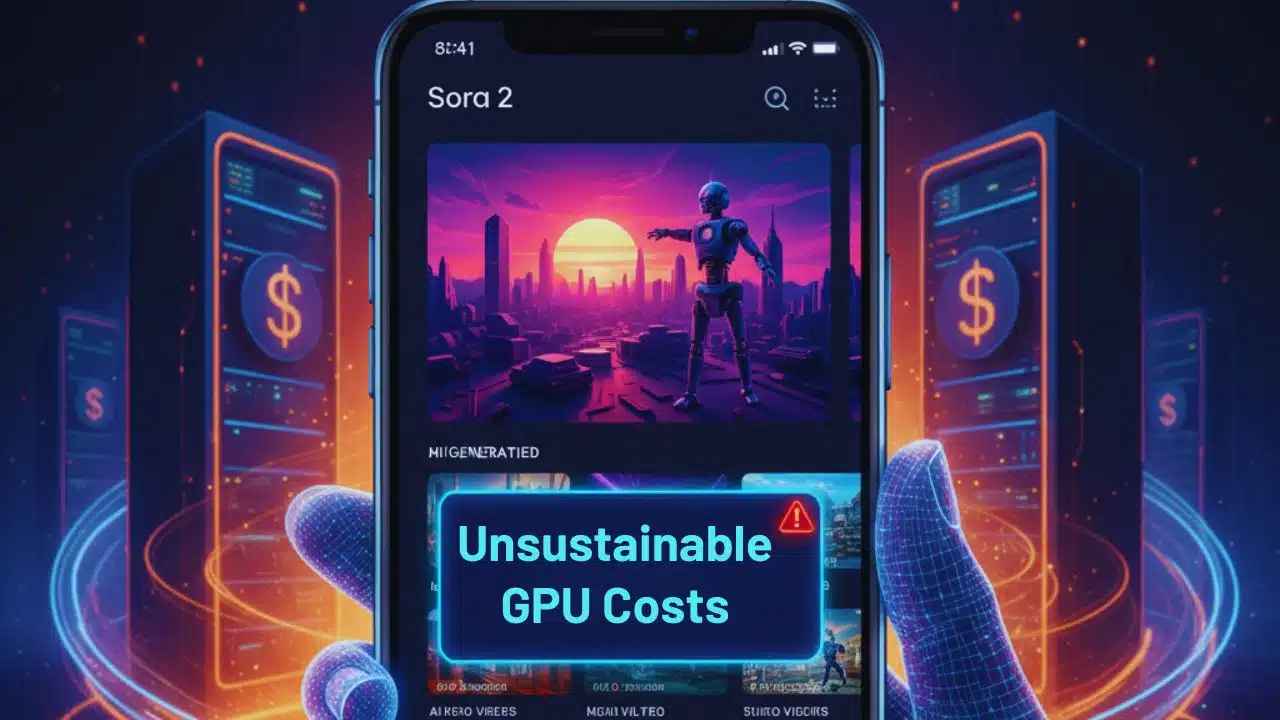
The policy change, confirmed by Sora project lead Bill Peebles, is a direct response to the “completely unsustainable” computational costs required to run the advanced text-to-video model. This move signals a new era of metered, consumption-based pricing for high-end creative AI tools.
The New Sora 2 Pricing Structure
- New Consumer Price: OpenAI has introduced a paid add-on, effective October 31, 2025. Users can buy a pack of 10 extra video generations for $4.00 after hitting their daily free limit.
- Current Free Limits: Currently, users on the Free, Plus, and Teams plans get 30 free video generations per day. Pro subscribers receive 100 per day.
- Official Rationale: Bill Peebles, Head of Sora at OpenAI, stated the change was necessary because “the economics are currently completely unsustainable” and “we won’t have enough gpus” to accommodate growth otherwise.
- Enterprise Pricing: For developers and businesses, Sora 2 is also available on Microsoft’s Azure AI Foundry at a different rate: $0.10 (10 cents) per second of generated video.
- What’s Next: OpenAI has confirmed that the free daily generation limits will be reduced in the future. The company is also planning a “creator economy” to let rightsholders and celebrities monetize their likenesses via the app’s “Cameo” feature.
A ‘Completely Unsustainable’ Model
The move to monetization, which arrived just 30 days after Sora 2’s flashy September 30th launch, was not a surprise to industry analysts, but its abruptness was. The generative video model, which can create high-fidelity, physically coherent video clips with synchronized audio from simple text prompts, is notoriously expensive to run.
In a candid post on the social platform X (formerly Twitter) on October 30, 2025, OpenAI’s Bill Peebles laid the reasoning bare.
We are launching the ability to buy extra gens in sora today,” Peebles wrote. We are doing this for two main reasons: first, we have been quite amazed by how much our power users want to use sora, and the economics are currently completely unsustainable.
Peebles also warned that this is just the first step. Eventually we will need to bring the free gens down to accommodate growth (we won’t have enough gpus to do it otherwise!),” he added, confirming that the generous free quotas of 30 daily generations will soon shrink.
The high cost of generative video has been a known challenge. In a March 2024 interview with The Wall Street Journal about the first version of Sora, OpenAI CTO Mira Murati admitted the model was “significantly more expensive” to run than their text (GPT) or image (DALL-E) models.
The new Sora 2, which adds synchronized audio, a social sharing platform, and a “Cameo” feature for inserting your likeness, is presumed to be even more computationally demanding.
What is the ‘Real’ Cost of a Sora 2 Video?
The new pricing provides the first public data points for calculating the value of a single AI-generated video, revealing a stark difference between consumer and enterprise costs.
- The Consumer App Price: $0.40 per video The new add-on pack sets a clear consumer price: $4.00 for 10 generations. This breaks down to $0.40 (40 cents) per video generated on the iOS app. Currently, the app limits generations to a maximum of 15 seconds.
- The Enterprise API Price: $0.10 per second For businesses building on OpenAI’s technology, the cost is structured differently. Microsoft, OpenAI’s primary partner, offers Sora 2 in its Azure AI Foundry. The price listed there, as of October 15, 2025, is $0.10 (10 cents) per second of generated video.
This comparison suggests the consumer app price is heavily subsidized to encourage adoption. A 15-second video—the maximum length on the app—would cost an enterprise user $1.50 to generate via the API ($0.10/second * 15 seconds).
This $1.50 enterprise cost is nearly four times higher than the $0.40 consumer add-on price. This strategy allows OpenAI to simultaneously capture high-value business clients while building a massive user base on its social app, offsetting the unsustainable costs with a low-friction microtransaction.
Beyond the Hype: What Is Sora 2?
For those who haven’t secured an invite, it’s crucial to understand that Sora 2 is not just the technology demoed in February 2024. It has been packaged as a direct competitor to TikTok and YouTube Shorts.
Launched on October 1, 2025, the Sora 2 app is an invite-only platform for iOS, currently limited to the United States and Canada. It functions as a social feed where users can generate videos, “remix” other users’ prompts, and share their creations.
Its two flagship features, beyond higher fidelity, are:
- Synchronized Audio: The model now generates dialogue, music, and sound effects that match the video content.
- Cameos: A new feature that allows users to scan their own likeness (or those of consenting creators) and insert them into generated videos.
This “Cameo” feature is the key to OpenAI’s long-term business plan.
The ‘Sora Economy’ is the Real Product
While the $4 add-on fee addresses the immediate “GPU problem,” OpenAI’s true monetization strategy lies in building a new content economy.
Bill Peebles’ X thread also teased this future, referencing a planned creator revenue-sharing mechanism.
We imagine a world where rightsholders have the option to charge extra for cameos of beloved characters and people,” Peebles wrote.
This statement outlines a revolutionary, and controversial, business model:
- A Licensing Marketplace: OpenAI plans to allow film studios, IP holders (like Disney or Warner Bros.), and celebrities to license their official “characters” or “likenesses” for use in the Sora 2 “Cameo” feature.
- A New Revenue Stream: Users will be able to pay a fee to include “Iron Man” or “Taylor Swift” in their personal video generations.
- Revenue Sharing: OpenAI would presumably take a cut, similar to an app store, while sharing the rest with the creator or rightsholder.
This “Sora Economy” transforms the tool from a simple video generator into a massive, three-sided marketplace for licensed digital content. The $4 add-on is merely the first step in training users to pay for video generation, paving the way for these more complex, high-value transactions.
The generative AI space is now watching OpenAI’s next three moves:
- The Free Quota Reduction: When, and by how much, will OpenAI reduce the 30-generation free daily limit? Peebles promised transparency, but the change is confirmed to be coming.
- The ‘Cameo’ Economy Pilot: Peebles suggested the first pilot for the creator revenue-sharing program could launch “within the year.” This will be the true test of the Sora economy.
- Geographic Expansion: The app is still limited to the US and Canada. Its expansion into Europe and Asia, where it will face different regulatory and copyright laws, will be critical.
The introduction of OpenAI Sora 2 pricing is more than a simple fee; it’s a market-defining moment. It establishes a baseline cost for high-end generative video and signals that the venture-capital-fueled era of free, limitless AI experimentation is rapidly drawing to a close.
The Information is Collected from The Verge and Times Now.