


In a significant move to combat the rising tide of unsolicited messages, WhatsApp is preparing to launch a new restriction that will limit how many messages users can send without receiving a reply. The Meta-owned platform confirmed the test will roll out in the coming weeks across multiple countries, a direct strike against spammers and automated accounts that bombard users with unwanted communication.
The upcoming feature will impose a yet-undisclosed monthly cap on the number of messages a user or business can send to contacts who have not replied. Once a recipient responds to a message, the conversation will no longer count towards the sender’s limit, effectively rewarding genuine engagement over mass broadcasting. This change is poised to significantly impact high-volume messaging, particularly from marketing and scam operations.
Key Facts & Quick Take
- New Monthly Cap: WhatsApp is introducing a monthly limit on messages sent to users who do not reply. This applies to both regular and business accounts.
- Targeting Spammers: The company stated the move is designed to curb “people and businesses that blast messages and spam people,” insisting that “average users won’t usually hit the limit.”
- Reply-Based System: Getting a reply from a recipient effectively ‘clears’ the sent messages from counting against the sender’s monthly allowance.
- Global Test Phase: The feature will be tested in various countries starting in the next few weeks, with WhatsApp experimenting with different limit thresholds.
- Part of a Broader Strategy: This follows other anti-spam measures, including a 2019 reduction in message forwarding and the recent banning of millions of accounts.
- Massive Scale of the Problem: In the first half of 2025 alone, WhatsApp banned over 6.8 million accounts linked to organised fraud operations, highlighting the immense challenge the platform faces.
The War on Unwanted Messages
The announcement marks the latest offensive in WhatsApp’s ongoing war against the spam that plagues its 2.7 billion-strong global user base. For years, the platform has been a fertile ground for everything from unsolicited marketing to sophisticated financial scams. The problem is particularly acute in major markets like India, WhatsApp’s largest with over 500 million users, where the app is deeply integrated into daily life and commerce.
This new system is designed to be a self-regulating mechanism. By linking sending privileges to recipient engagement, WhatsApp is creating a powerful disincentive for “spray and pray” messaging tactics. A spokesperson for the company confirmed the test to technology news outlet TechCrunch on October 17, 2025, emphasizing its targeted nature.
Users approaching their monthly cap will receive a warning notification, giving them a chance to moderate their sending activity before being temporarily blocked from initiating new conversations with non-contacts.
Latest Data Underscores the Challenge
The scale of the spam and scam problem is staggering. WhatsApp’s parent company, Meta, has been increasingly proactive in its enforcement.
- Account Bans: In a push to dismantle organised fraud, WhatsApp announced in August 2025 that it had banned over 6.8 million accounts in the first six months of the year. Many of these were linked to scam centres, particularly those operating out of Southeast Asia.
- Previous Restrictions: In 2019, WhatsApp famously restricted the forwarding of messages to just five chats at a time to slow the spread of misinformation. This was a direct response to viral, often harmful, content spreading rapidly on the platform.
- User Reporting: The Indian government’s “Sanchar Saathi” portal allows citizens to report suspected fraud communications, including those on WhatsApp, indicating a high level of official concern over the misuse of the platform.
Expert Analysis: A Necessary Friction
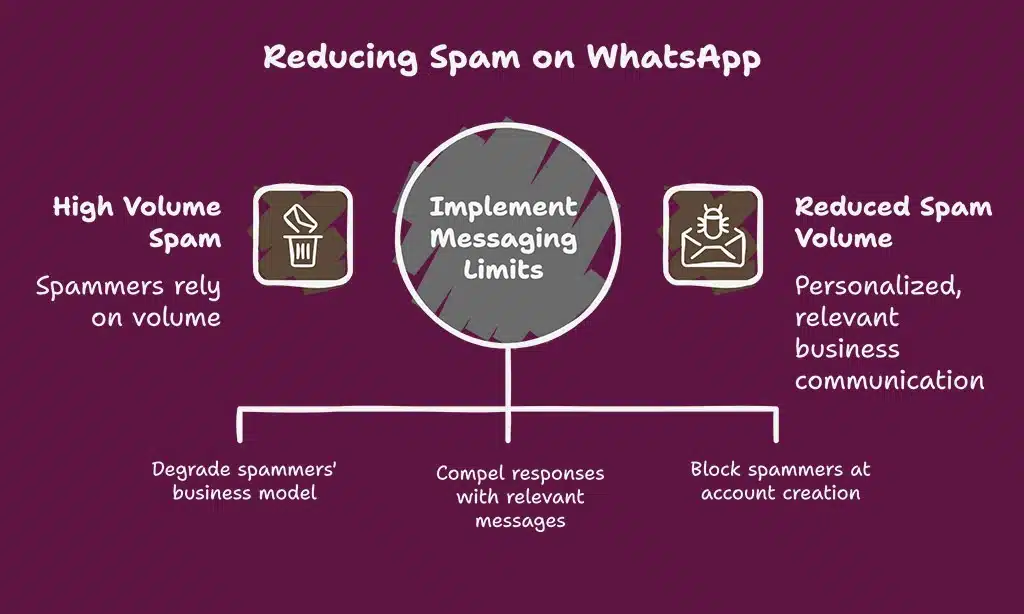
Digital communication experts see the move as a logical and necessary step to preserve the platform’s integrity. By adding friction to mass messaging, WhatsApp can degrade the business model of spammers who rely on volume.
The new policy forces a shift from quantity to quality. Businesses that use WhatsApp for legitimate customer outreach will now have to ensure their initial messages are compelling enough to elicit a response. This could lead to more personalized and relevant business communication, ultimately benefiting users.
However, some analysts express caution. One potential loophole, as noted in user comments on platforms like MacRumors, is that determined spammers could simply create and burn through multiple disposable accounts to circumvent the monthly limits. The effectiveness of the new measure will depend on how robustly WhatsApp can detect and block these serial spammers at the account creation stage.
Impact on People: A Quieter Inbox?
For the average user, the promise is a cleaner, less cluttered inbox. The frustration of receiving a daily barrage of messages from unknown businesses, loan sharks, and dubious investment schemes is a universal experience for WhatsApp users.
“If your WhatsApp inbox looks anything like mine, it’s overflowing with unread messages from unknown numbers, half of them promotional,” wrote journalist Unnati Gusain in an article for India Today, capturing a sentiment shared by millions.
By making every unsolicited message ‘cost’ the sender a piece of their monthly allowance, the update could finally force a change in behaviour that automated blocking systems have struggled to achieve on their own.
What to Watch Next
The key details to monitor in the coming weeks are the specific monthly limits WhatsApp decides to implement and the list of countries included in the initial test phase. The company’s ability to enforce these limits against sophisticated, multi-account spam operations will be the true test of this new strategy’s success. Furthermore, the reaction from the business and marketing community will be critical, as many rely on the platform for customer acquisition.
WhatsApp is drawing a clear line in the sand. The platform, built on the promise of personal and private communication, is reinforcing its core values by prioritising user experience over unchecked outreach. This new reply-dependent limit is one of the most aggressive anti-spam measures introduced by a major messaging platform to date and could set a new industry standard in the global fight against digital junk mail.
























