Welcome to another deep dive in our “On This Day” series here at Editorialge. If you pull out a calendar and point to October 17, you might think it’s just another ordinary autumn day. However, a quick glance through the archives of global history reveals a completely different story.
In this comprehensive editorial, we are traveling back in time. We will explore the defining global events, celebrate the iconic figures born on this day, and honor the legends we lost. Whether you are a history buff, a trivia enthusiast, or simply curious about the past, grab a cup of coffee and join us as we unpack the fascinating legacy of October 17.
Global Historical Events: Turning Points in Time
History is rarely made in a vacuum. The events that occurred on October 17 span across continents and centuries, affecting politics, infrastructure, and human rights. Below is a quick-reference table of the major events, followed by an in-depth analysis of their global impact.
October 17 Historical Milestones at a Glance
| Year | Event | Region | Significance |
| 1777 | Battle of Saratoga ends with British surrender | United States | The turning point of the American Revolutionary War. |
| 1860 | The First Open Championship (British Open) | United Kingdom | The birth of professional major championship golf. |
| 1874 | Opening of the First Howrah Bridge | India (Bengal) | Revolutionized trade and transport in colonial Calcutta. |
| 1905 | Tsar Nicholas II issues the October Manifesto | Russia | A precursor to the Russian constitution, granting civil rights. |
| 1931 | Al Capone convicted of tax evasion | United States | The fall of America’s most notorious organized crime boss. |
| 1933 | Albert Einstein arrives in the USA as a refugee | Global / USA | Fleeing Nazi Germany, changing the landscape of American science. |
| 1973 | OPEC initiates global oil embargo | Middle East / Global | Fundamentally altered global economics and energy policies. |
| 1979 | Mother Teresa awarded the Nobel Peace Prize | Global / India | Global recognition of her humanitarian work in Kolkata. |
| 1989 | Loma Prieta Earthquake strikes the Bay Area | United States | One of the most devastating earthquakes in modern US history. |
The Deep Dive: How These Events Shaped Our World
The Surrender at Saratoga (1777)
In the annals of American history, few days are as vital as October 17, 1777. During the American Revolutionary War, British General John Burgoyne was forced to surrender his 5,000 troops to American General Horatio Gates at the Battle of Saratoga in New York. Why does this matter today? This decisive American victory proved to the rest of the world—most notably France—that the American colonists could actually stand toe-to-toe with the mighty British Empire. This victory directly led to France officially allying with the United States, providing the naval and financial support necessary to eventually win the war.
The Rise of Colonial Infrastructure: The Howrah Bridge (1874)
Moving across the globe to the Bangalee sphere, October 17, 1874, marks a monumental day in South Asian engineering and commerce. The very first pontoon bridge over the Hooghly River was opened to traffic, permanently linking the bustling metropolis of Kolkata (then Calcutta) with Howrah. Before this, crossing the treacherous river relied entirely on boats. The bridge acted as a vital artery for the British Empire’s economic machinery, accelerating the industrialization of Bengal.
The Fall of a Mobster Kingpin (1931)
Al Capone practically owned Chicago in the 1920s. He built a ruthless organized crime empire on bootlegging, gambling, and violence. Local law enforcement could never pin his brutal crimes on him. However, on October 17, 1931, the federal government finally brought Capone down—not for murder, but for income tax evasion. His conviction proved that forensic accounting could be used as a weapon against organized crime, a tactic still heavily utilized by the FBI today.
Einstein Seeks Refuge (1933)
As the shadow of the Nazi regime darkened Europe, one of the greatest minds in human history was forced to flee his home. On this day in 1933, theoretical physicist Albert Einstein arrived in the United States. He took up a position at the Institute for Advanced Study in Princeton, New Jersey. Einstein’s relocation not only saved his life but also initiated a massive brain drain from Europe, establishing the United States as the supreme global powerhouse for scientific research during the 20th century.
The OPEC Oil Embargo (1973)
Few dates highlight the immense power of natural resources quite like October 17, 1973. In response to the United States’ support of Israel during the Yom Kippur War, the Organization of Arab Petroleum Exporting Countries (OPEC) announced an oil embargo against the U.S. and its allies. The results were immediate and chaotic: gas prices skyrocketed, long lines formed at fuel stations, and the global economy plunged into a recession. This single event forced the world to wake up to its dangerous dependency on fossil fuels, sparking the first major push toward energy conservation and smaller, fuel-efficient vehicles.
The World Series Earthquake (1989)
Sports fans and historians alike remember exactly where they were on October 17, 1989. The San Francisco Giants and the Oakland Athletics were warming up for Game 3 of the World Series at Candlestick Park. Suddenly, a 6.9 magnitude earthquake—known as the Loma Prieta earthquake—struck the Bay Area. Live television cameras broadcasted the terrifying shaking to millions. The quake caused widespread destruction, collapsing portions of the Bay Bridge and killing 63 people. It led to a massive overhaul of seismic building codes across earthquake-prone regions worldwide.
International Observances: What the World Celebrates Today
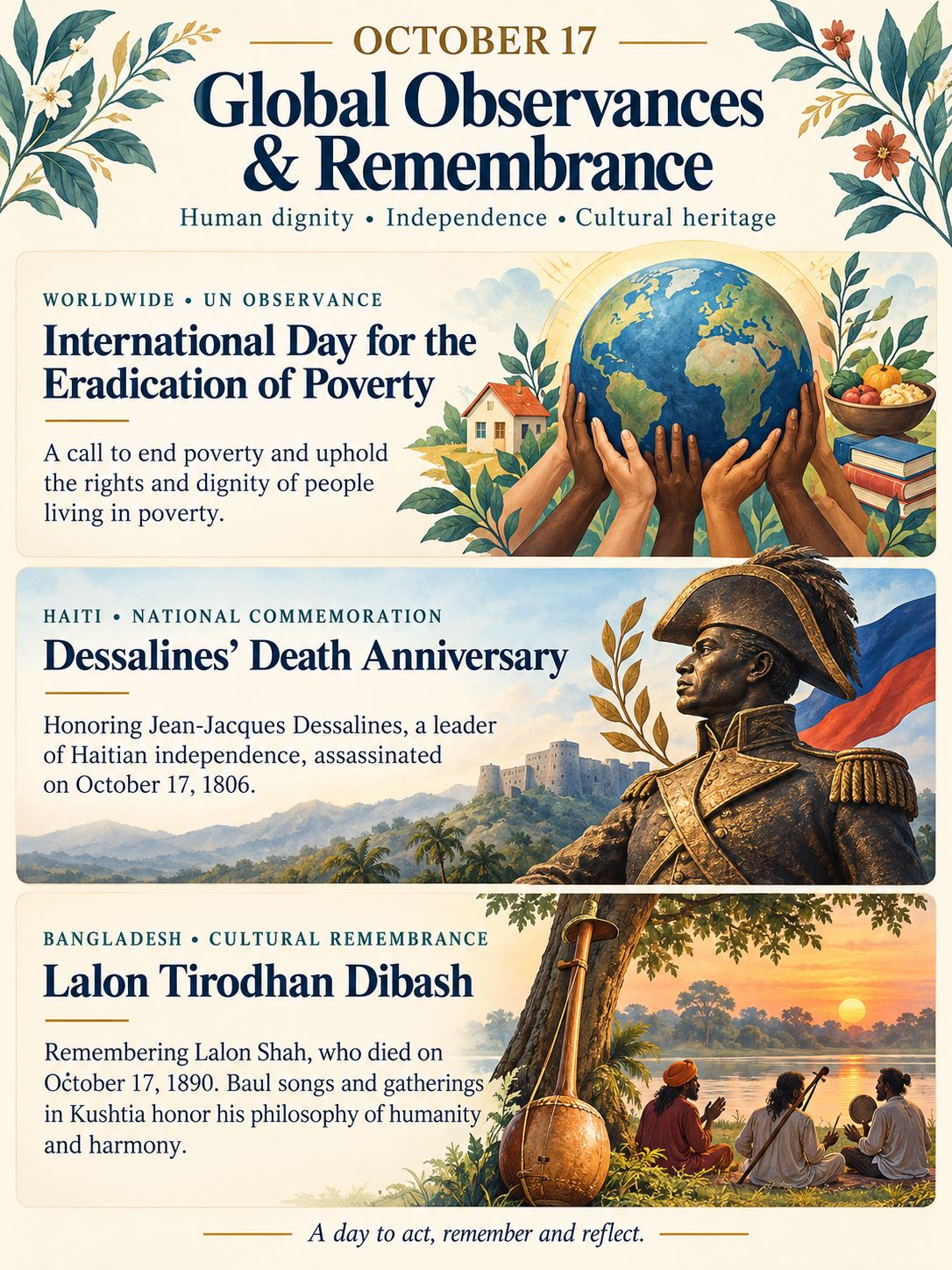
October 17 is not just about the past; it is a day of active global observance and cultural heritage.
International Day for the Eradication of Poverty
Recognized globally by the United Nations, this day is dedicated to raising awareness about the need to eradicate poverty and destitution in all countries. It promotes the idea that access to basic human needs and dignity is a fundamental human right. Across the world, NGOs and governments use October 17 to evaluate economic policies and advocate for marginalized communities.
Dessalines’ Death Anniversary (Haiti)
In Haiti, October 17 is a solemn national holiday commemorating the assassination of Jean-Jacques Dessalines in 1806. Dessalines was the heroic leader of the Haitian Revolution, famously defeating Napoleon’s forces and establishing Haiti as the first free Black republic in the world.
Lalon Tirodhan Dibash (Bangladesh)
As mentioned earlier, the death anniversary of Lalon Shah transforms into a massive cultural festival in Bangladesh. Musicians, philosophers, and travelers gather to sing Lalon’s timeless folk songs, engaging in a continuous celebration of peace and humanity that lasts for days.
Famous Birthdays: Celebrating Legends Born on October 17
The individuals born on this day span the spectrum of human achievement, from pioneering space exploration and revolutionizing literature to dominating the pop culture and music charts.
Sir Syed Ahmad Khan (Born 1817)
A towering figure in South Asian history, Sir Syed Ahmad Khan was a pragmatic social reformer, philosopher, and educator. Realizing that the Muslim community in British India was falling behind due to a lack of modern education, he dedicated his life to reform. He founded the Muhammadan Anglo-Oriental College, which eventually became the globally renowned Aligarh Muslim University. His vision laid the intellectual groundwork for generations of thinkers in the subcontinent.
Arthur Miller (Born 1915)
If you have ever studied American literature, you have likely encountered the genius of Arthur Miller. Born in Harlem, New York, Miller became one of the greatest playwrights of the 20th century. Works like Death of a Salesman and The Crucible forced society to look in the mirror, offering blistering critiques of the American Dream, capitalism, and the McCarthy-era political witch hunts.
Mae C. Jemison (Born 1956)
A true pioneer in STEM, Mae C. Jemison is a physician, engineer, and former NASA astronaut. On September 12, 1992, she shattered the ultimate glass ceiling by becoming the first Black woman to travel into space, serving as a mission specialist aboard the Space Shuttle Endeavour. Today, she remains a fierce advocate for science education and diversity in technology.
Eminem (Born 1972)
Born Marshall Bruce Mathers III, Eminem emerged from the underground battle rap scene of Detroit to become one of the best-selling music artists of all time. Known for his rapid-fire delivery, controversial subject matter, and unparalleled lyricism, Eminem broke down racial barriers in hip-hop. He has won 15 Grammy Awards and an Academy Award, cementing his legacy as a global cultural icon.
Notable Deaths: Remembering the Icons We Lost
October 17 is also a day of remembrance for some of history’s most influential figures—ranging from musical prodigies and spiritual mystics to the last remnants of ancient empires.
Frédéric Chopin (Died 1849)
The Romantic era of classical music owes much of its emotional depth to Frédéric Chopin. A Polish virtuoso pianist and composer, Chopin spent his life composing pieces that pushed the technical limits of the piano while maintaining heartbreakingly beautiful melodies. Plagued by poor health for most of his life, he died in Paris at the young age of 39, likely from tuberculosis. His nocturnes and waltzes remain essential repertoire for pianists worldwide.
Fakir Lalon Shah (Died 1890)
In the heart of Bengal, October 17 is observed with deep spiritual reverence as the death anniversary of Fakir Lalon Shah. Lalon was a Baul saint, mystic, and social reformer who rejected the rigid divisions of caste, class, and religion. His songs spoke of a universal, secular humanism. Even today, his philosophy heavily influences Bengali literature, and his shrine in Kushtia, Bangladesh, attracts thousands of followers every year on this date to celebrate his life through music.
Puyi (Died 1967)
The story of Puyi is one of the most cinematic and tragic in modern history. Crowned as the 12th Emperor of the Qing Dynasty at just two years old, he was the absolute ruler of China. However, he was swept away by the tides of the Xinhai Revolution. After a lifetime of political manipulation, serving as a puppet ruler for the Japanese, and enduring a stint as a Soviet political prisoner, Puyi died as a humble gardener and archivist under Mao Zedong’s Communist regime. His death on October 17 marked the definitive biological end to thousands of years of imperial rule in China.
Did You Know? Fascinating October 17 Trivia
To wrap up our historical journey, here are a few lesser-known, bizarre, and fascinating facts that happened on this exact date. These make perfect conversation starters!
-
The Great London Beer Flood (1814): On October 17, 1814, a massive vat containing over 135,000 gallons of fermenting beer ruptured at the Meux and Company Brewery in London. The resulting 15-foot tidal wave of dark porter destroyed two homes and tragically drowned eight people in the streets of the St. Giles neighborhood.
-
The Late-Night Cockroach Prank (1985): In a wild moment of television history, the famous magic and comedy duo Penn & Teller appeared on Late Night with David Letterman on October 17. For their grand finale, they dumped hundreds of live, swarming cockroaches directly onto Letterman’s desk. The host was legitimately furious, though it resulted in some of the most memorable late-night TV of the decade.
-
The First Commercial Radio Broadcast to a Ship (1907): Long before Spotify or satellite radio, October 17, 1907, saw the first regular transatlantic commercial wireless service established. It allowed newspapers and vital information to be transmitted instantly across the ocean, shrinking the world in an unprecedented way.
Final Thoughts
The tapestry of human history is woven tightly with the events of October 17. Looking back at this specific day highlights the duality of the human experience. On one hand, we see the destructive forces of nature in the Loma Prieta earthquake and the violence of war at Saratoga. On the other, we celebrate the heights of human creativity through the birth of Arthur Miller, the musical genius of Chopin, and the boundary-breaking scientific achievements of Mae C. Jemison.
History is a continuous cycle of learning. By understanding the geopolitical shifts—like the OPEC embargo or the fall of Al Capone—we can better comprehend the socioeconomic structures of our modern world. At Editorialge, we believe that looking back at days like October 17 isn’t just about memorizing facts; it is about recognizing the shared heritage, resilience, and ingenuity of humanity across every border.