History is not just a collection of dates and facts; it is the fascinating story of human achievement, struggle, and transformation. October 14 is a date that has repeatedly altered the course of history. From shattering the sound barrier to pivotal political shifts that redefined nations, this day holds a mirror to our collective past.
Whether you are a history enthusiast, a trivia lover, or simply curious about what makes today special, this comprehensive guide dives deep into the monumental events, celebrated births, and somber departures that occurred on October 14.
Historical Events on October 14
The world has witnessed remarkable scientific breakthroughs, devastating conflicts, and monumental political decisions on this day. Here are some of the most significant events that shaped the modern world.
The Dawn of Supersonic Flight
On October 14, 1947, U.S. Air Force test pilot Chuck Yeager achieved the impossible. Piloting the experimental Bell X-1 rocket plane over the Mojave Desert, Yeager reached Mach 1.06, officially becoming the first human to break the sound barrier. This milestone revolutionized aviation and paved the way for modern aerospace exploration. Remarkably, exactly 65 years later on October 14, 2012, Austrian skydiver Felix Baumgartner became the first person to break the sound barrier in a freefall, plunging from a helium balloon in the stratosphere.
The Cuban Missile Crisis Begins
The Cold War reached its most terrifying peak on October 14, 1962. A U.S. Air Force U-2 reconnaissance plane captured photographic evidence of Soviet-made medium-range nuclear missiles being installed in Cuba. This discovery triggered the Cuban Missile Crisis, a tense 13-day political and military standoff that brought the world dangerously close to nuclear war.
A Literary Debut: Winnie-the-Pooh
On a lighter cultural note, October 14, 1926, marks the literary debut of one of the world’s most beloved children’s characters: Winnie-the-Pooh. British author A.A. Milne published the first collection of stories about the honey-loving bear and his friends in the Hundred Acre Wood, creating a cultural legacy that has endured for nearly a century.
The Battle of Hastings
Turning the clock back to the Middle Ages, October 14, 1066, remains one of the most critical dates in European history. At the Battle of Hastings, William the Conqueror’s Norman forces decisively defeated the English army. The death of King Harold II on the battlefield marked the beginning of the Norman Conquest, which fundamentally transformed English culture, language, and governance.
| Year | Event Description | Global Impact |
| 1066 | Battle of Hastings: Normans defeat the English army. | Initiated the Norman Conquest of England, altering the English language and feudal system. |
| 1912 | Assassination attempt on Theodore Roosevelt. | The former US President survived being shot in the chest and proceeded to deliver an 84-minute speech. |
| 1947 | Chuck Yeager breaks the sound barrier. | Ushered in the era of supersonic aviation and modern spaceflight. |
| 1962 | Discovery of Soviet nuclear missiles in Cuba. | Ignited the Cuban Missile Crisis, bringing the US and USSR to the brink of nuclear war. |
| 1964 | Dr. Martin Luther King Jr. wins the Nobel Peace Prize. | Brought unprecedented global recognition to the American Civil Rights Movement. |
| 2012 | Felix Baumgartner’s stratospheric freefall. | Broke the sound barrier without a vehicle, advancing high-altitude physiological research. |
Pivotal Moments in South Asian History
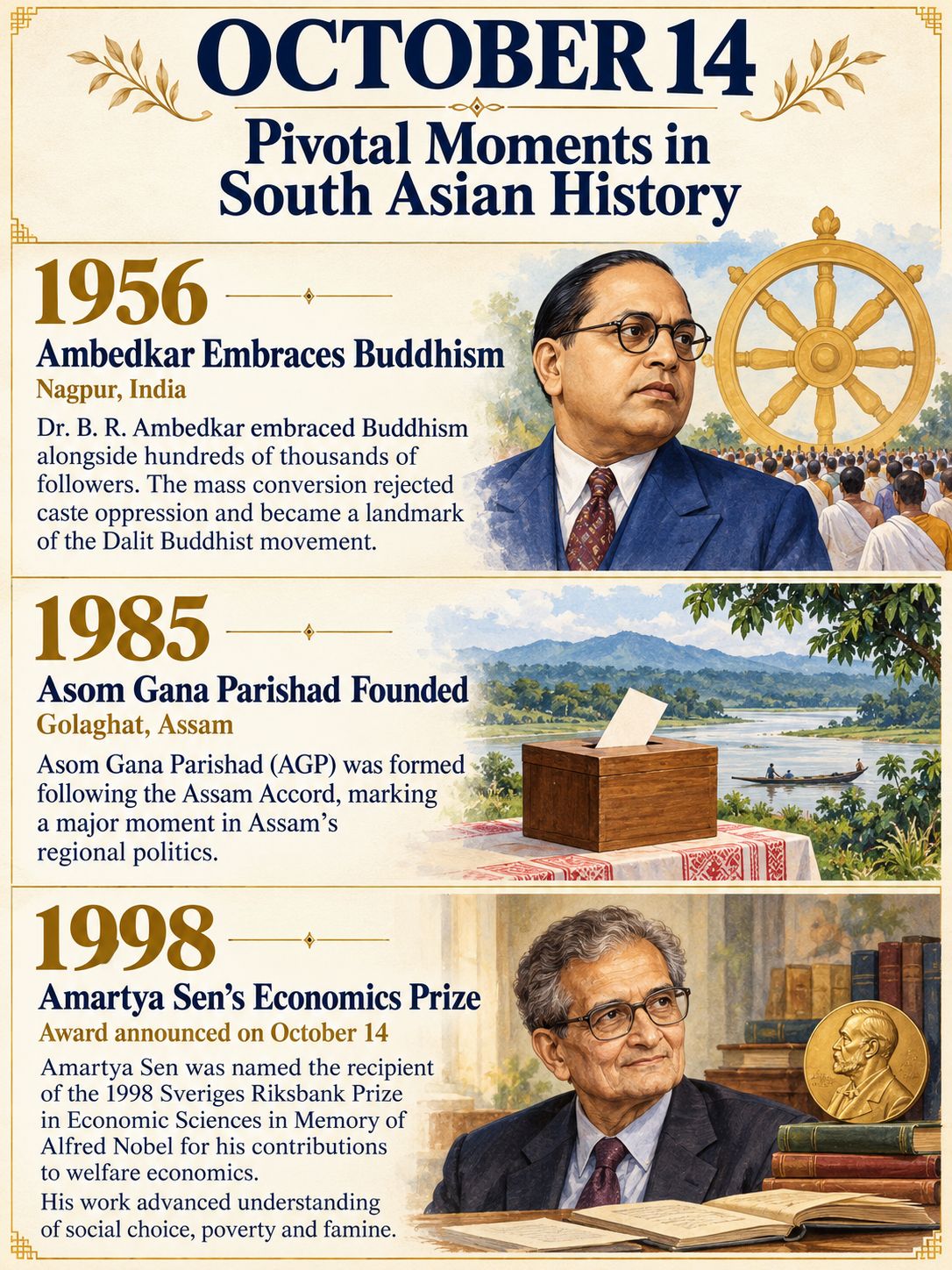
October 14 has also been a day of immense historical importance for the Indian subcontinent, encompassing political milestones and social reforms.
-
Mass Religious Conversion (1956): On this day, Dr. B.R. Ambedkar, the chief architect of the Indian Constitution, formally embraced Buddhism along with nearly 380,000 of his followers in Nagpur. This mass conversion was a profound socio-political rejection of the caste system and remains a cornerstone of the Dalit Buddhist movement.
-
Nobel Prize in Economics (1998): Prof. Amartya Sen was awarded the Nobel Prize in Economic Sciences for his outstanding contributions to welfare economics and social choice theory. His work deeply analyzed the mechanisms of poverty and famine in South Asia.
-
Formation of Assam Gana Parishad (1985): A significant political development took place in northeastern India with the formal establishment of the Assam Gana Parishad (AGP) following the historic Assam Accord.
Famous Birthdays on October 14
October 14 has welcomed a diverse array of brilliant minds, from pioneering statesmen and profound philosophers to modern pop culture icons.
| Year | Name | Nationality | Profession & Legacy |
| 1644 | William Penn | English | Founder of the Province of Pennsylvania, early champion of democracy and religious freedom. |
| 1884 | Lala Har Dayal | Indian | Nationalist revolutionary who founded the Ghadar Party in the US to fight British colonial rule. |
| 1890 | Dwight D. Eisenhower | American | 34th US President and Supreme Commander of the Allied Forces in Europe during WWII. |
| 1894 | E.E. Cummings | American | Highly influential avant-garde poet known for unorthodox syntax and typography. |
| 1906 | Hannah Arendt | German-American | Political philosopher renowned for her critical works on totalitarianism and power. |
| 1927 | Roger Moore | British | Iconic actor best known for portraying James Bond in seven feature films. |
| 1939 | Ralph Lauren | American | Billionaire fashion designer who built a global lifestyle brand. |
| 1978 | Usher | American | Multi-platinum R&B singer, songwriter, and dancer. |
| 1981 | Gautam Gambhir | Indian | Cricketer known for match-winning performances in two World Cup finals for India. |
Notable Deaths on October 14
History also remembers those who departed on this day. October 14 marks the loss of towering historical figures and beloved entertainers who left an indelible mark on society.
| Year | Name | Nationality | Legacy & Cause of Death |
| 1066 | King Harold II | English | The last crowned Anglo-Saxon king of England, killed in action at the Battle of Hastings. |
| 1944 | Erwin Rommel | German | Highly decorated WWII Field Marshal (the “Desert Fox”), forced to commit suicide by the Nazi regime. |
| 1959 | Errol Flynn | Australian-American | Legendary Hollywood actor known for his romantic swashbuckler roles. |
| 1977 | Bing Crosby | American | Iconic singer and actor, famed for “White Christmas” and his massive influence on 20th-century pop culture. |
| 1990 | Leonard Bernstein | American | Visionary composer and conductor, creator of West Side Story. |
International Observances and Holidays
Beyond historical events and individual milestones, October 14 is recognized globally for various observances that promote international cooperation, culture, and awareness.
-
World Standards Day: Celebrated globally to honor the collaborative efforts of thousands of experts who develop voluntary technical agreements. The date commemorates the day in 1946 when delegates from 25 countries gathered in London to create a unified international organization focused on standardization.
-
National Dessert Day (USA): A widely celebrated culinary holiday in the United States dedicated to enjoying sweets, pastries, and confections.
-
Mother’s Day (Belarus): While most of the world celebrates Mother’s Day in May, Belarus honors motherhood annually on October 14.
-
National Education Day (Poland): Commemorates the anniversary of the creation of the Commission of National Education in 1773, marking a day of appreciation for teachers and educators.
Final Thoughts
October 14 is a testament to the dynamic and ever-evolving nature of human history. From the muddy battlefields of Hastings in 1066 that reshaped medieval Europe to the arid skies of California where the sound barrier was shattered in 1947, this date has hosted some of humanity’s most transformative moments. The individuals born on this day—visionaries like William Penn, Hannah Arendt, and Lala Har Dayal—went on to challenge the status quo, while the tragic losses of figures like Erwin Rommel remind us of the complexities of global conflicts. Recognizing what happened on this day helps us understand the continuous chain of events that has built the world we navigate today.