

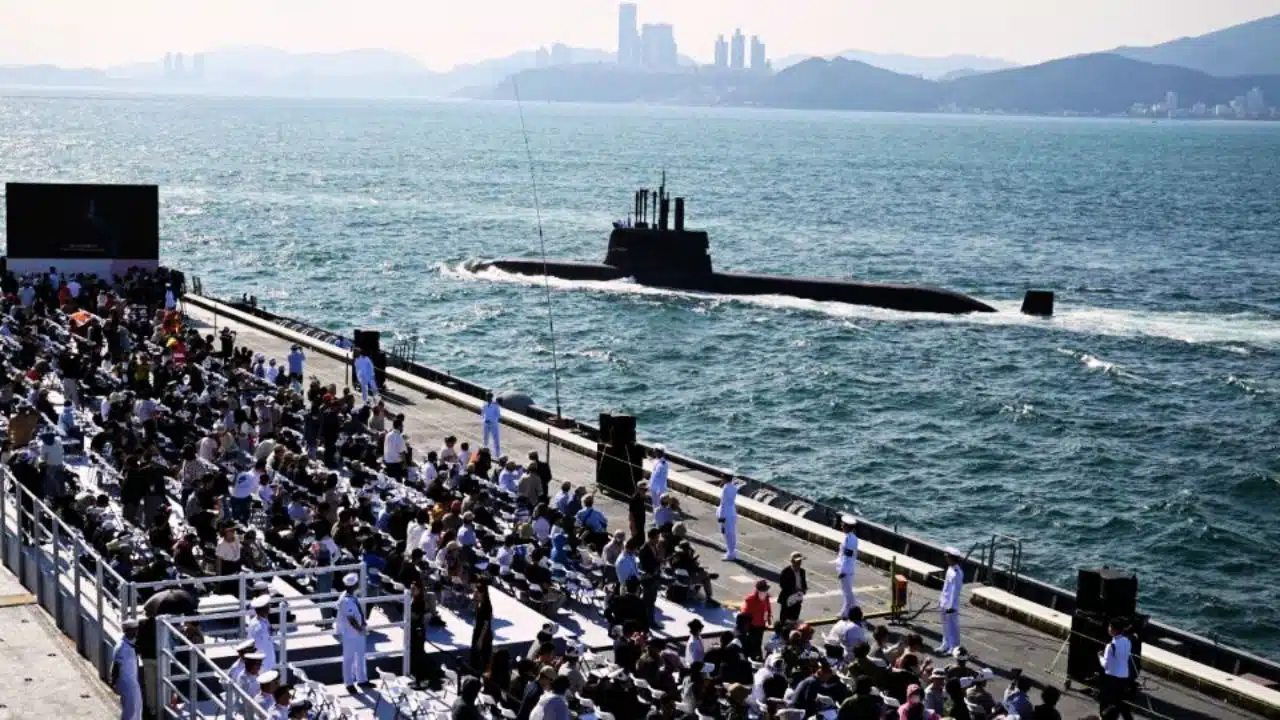
Seoul’s plan to build nuclear-powered attack submarines with US help is reshaping Asia’s security map, raising fears of an underwater arms race involving China, North Korea, Japan and India.
A New Underwater Front in Asian Security
South Korea’s decision to push ahead with nuclear-powered submarines, backed by US technology and shipbuilding cooperation, is emerging as one of the most consequential military shifts in Asia in years. Seoul argues the move is essential to counter North Korea’s growing submarine-launched nuclear threat and China’s expanding undersea fleet, but analysts warn it could ignite a broader underwater arms race across the region.
The plan follows a US policy reversal that for the first time allows South Korea access to nuclear propulsion technology, positioning the country to join the small club of states operating nuclear-powered submarines. Neighbours including China, North Korea and Japan are watching closely, with reactions ranging from quiet concern and condemnation to renewed debate about acquiring their own nuclear-powered boats.
South Korea and US Advance Nuclear Submarine Deal
In late October 2025, US President Donald Trump signalled Washington would support South Korea in developing nuclear-powered attack submarines, shifting from earlier US reluctance to share such sensitive technology. The announcement was followed in mid‑November by a broader economic and defence package in which Seoul pledged large-scale investments in US industry while receiving approval to pursue nuclear propulsion for its navy.
South Korean President Lee Jae-myung has framed the deal as both a strategic and economic partnership, linking tariff relief on Korean exports to long‑term cooperation in shipbuilding, nuclear energy and advanced defence platforms. A US fact sheet and South Korean media reports indicate Washington has relaxed restrictions on uranium enrichment and spent fuel reprocessing for propulsion use, steps that had long been blocked under past bilateral nuclear agreements.
Key elements of the US–South Korea submarine deal
| Item | Detail |
| Political trigger | US green light for South Korean nuclear submarine program announced in late October 2025. |
| Formalization | Partnership details outlined in mid‑November trade and security package between Washington and Seoul. |
| Technology transfer | US consent to share nuclear propulsion know‑how and ease limits on enrichment and fuel cycle for submarine reactors. |
| Economic component | Tens of billions of dollars in planned South Korean investment in US shipbuilding and related industries. |
| Strategic aim | Strengthen allied undersea presence to monitor North Korea and balance China’s growing naval power. |
What the Nuclear Submarine Program Involves
South Korean officials and retired naval officers say the country has already advanced basic design work for nuclear-powered submarines, despite past delays and political hesitations. According to public comments cited in local defence reporting, the government estimates it will take around a decade to deliver the first operational boat and suggests a minimum fleet of four 5,000‑tonne nuclear-powered attack submarines is required.
Defence Minister Ahn Gyu-back has described reactor assembly work as being at a significant stage, indicating that nuclear engineering and shipyard planning are moving in parallel. However, President Lee has also publicly cautioned that building such submarines remains extremely difficult, citing the financial, technical and regulatory challenges involved.
Outline of South Korea’s planned nuclear submarine capability
| Aspect | Expected Features |
| Submarine type | Nuclear-powered attack submarines (SSNs), armed with conventional weapons only. |
| Estimated displacement | About 5,000 tonnes per vessel, according to South Korean defence sources. |
| Fleet size goal | At least four SSNs seen as necessary for credible patrol and deterrence posture. |
| Timeline | Rough government estimate of around 10 years to field the first operational boat. |
| Industrial base | Use of South Korea’s major shipbuilders, already experienced in advanced conventional submarines. |
Why Seoul Says It Needs Nuclear Submarines
South Korea argues that nuclear propulsion is vital to track North Korea’s emerging nuclear-armed submarines and to follow Chinese vessels that can already operate for long periods in the East and South China Seas. Diesel-electric submarines must regularly surface or snorkel to recharge batteries, limiting how long they can shadow adversaries or remain hidden in distant waters.
North Korea has unveiled images and reports of a nuclear-powered, nuclear‑armed submarine under construction, and has tested submarine‑launched ballistic missiles (SLBMs), steps that South Korean officials say significantly raise the threat level. Seoul insists its own nuclear-powered submarines would carry only conventional weapons and that the country has no intention of developing a domestic nuclear arsenal, reiterating commitment to the Nuclear Non‑Proliferation Treaty (NPT).
Drivers behind South Korea’s nuclear submarine push
| Driver | Description |
| North Korean SLBM threat | Pyongyang developing nuclear-powered and nuclear‑armed submarine capability and SLBMs. |
| Chinese naval expansion | China’s nuclear and conventional submarines regularly operate in nearby seas and the western Pacific. |
| Need for endurance | Nuclear propulsion allows much longer submerged operations than diesel-electric boats. |
| Alliance burden-sharing | Additional South Korean undersea capability seen as easing pressure on US forces in the region. |
| Desire for autonomy | Nuclear subs seen as enhancing Seoul’s independent surveillance and deterrence options. |
Regional Reactions: From Alarm to Quiet Support
North Korea has condemned the South’s nuclear-powered submarine plan as a dangerous escalation, warning it could set off a nuclear domino in the region and deepen a global arms race. The North’s rhetoric builds on its own undersea nuclear developments, which outside analysts already view as a major driver of military competition on and under the Korean Peninsula.
China’s official response has so far been relatively muted compared with its sharp criticism of the AUKUS nuclear submarine deal for Australia, but Chinese commentators and state-linked analysts warn the move could erode non‑proliferation norms and destabilize regional security. At the same time, some Japanese security experts see South Korea’s nuclear submarines as a potential counterweight to China and as an opportunity for deeper trilateral undersea cooperation with the United States.
Snapshot of regional reactions
| Country | Public stance | Main concern or interest |
| North Korea | Strong condemnation, warning of a regional “nuclear domino” effect. | Claims South Korean SSNs justify further nuclear buildup and expanded SLBM forces. |
| China | Officially cautious, expressing concern over non‑proliferation and balance of power. | Worries about another US ally operating stealthy nuclear-powered subs near its coast. |
| Japan | Mixed but increasingly open debate about nuclear propulsion. | Some analysts welcome Seoul’s move and argue Japan may eventually need its own SSNs. |
| United States | Supportive, framing the project as strengthening deterrence and burden-sharing. | Seeks stronger allied undersea network to counter China and monitor North Korea. |
Rising Fears of an Underwater Arms Race in Asia
Analysts warn that South Korea’s entry into the nuclear-powered submarine club, alongside existing operators like China and India and Russia’s regional deployments, risks triggering a multi-sided undersea arms race in Asia. China already operates a growing fleet of nuclear-powered attack and ballistic missile submarines, while India is expanding its Arihant‑class strategic submarines and preparing to commission additional nuclear boats.
Several recent studies and commentaries argue that the combined effect of North Korea’s new atomic submarine, Chinese undersea modernization, India’s nuclear fleet expansion and South Korea’s SSN program could push other states, including Japan, further toward considering nuclear propulsion. Some security experts describe this as a shift from a primarily surface‑ and air‑based competition to a more opaque underwater contest where detection is harder and miscalculation risks are higher.
Existing and emerging nuclear-powered submarine players in Asia
| Country | Nuclear-powered submarines status | Source |
| China | Operates nuclear-powered attack and ballistic missile submarines, with fleet expected to grow. | |
| India | Runs Arihant‑class nuclear ballistic missile submarines and is commissioning additional units. | |
| North Korea | Building a nuclear-powered, nuclear‑armed submarine and testing SLBMs. | |
| South Korea | Planning nuclear-powered attack submarines with US support; no boats in service yet. | |
| Japan | No nuclear-powered submarines, but new government and expert studies openly debate the option. | |
Legal, Technical and Political Hurdles
Despite the momentum, South Korea faces serious obstacles. Building, operating and safely maintaining nuclear-powered submarines requires long-term investment in specialized reactors, fuel handling, safety regulation and crew training, areas where even experienced navies have encountered setbacks. Experts note that cost overruns and engineering delays are common in nuclear naval programs, raising questions about whether Seoul can meet its ambitious timelines.
Non‑proliferation advocates are also watching closely. While the NPT does not explicitly ban naval nuclear propulsion, transferring weapons‑usable nuclear material for submarine fuel can blur lines in the safeguards system and create precedents other countries might seek to exploit. Some analysts warn that if multiple states in Asia seek NPT‑compliant submarine fuel arrangements simultaneously, verification burdens on the International Atomic Energy Agency could grow sharply.
Key challenges facing South Korea’s nuclear submarine project
| Category | Example challenges |
| Technical | Designing compact naval reactors, ensuring safety at sea, and integrating propulsion into new hulls. |
| Financial | High upfront and lifecycle costs for construction, fuel infrastructure and long‑term maintenance. |
| Legal / non‑proliferation | Managing NPT obligations and IAEA safeguards while using nuclear material for propulsion. |
| Domestic politics | Balancing strategic ambitions with public concerns about nuclear safety and potential escalation. |
| Regional diplomacy | Reassuring neighbours that the program will not undermine stability or encourage nuclear weapons spread. |
What Comes Next for the Region
South Korean officials stress that their pursuit of nuclear-powered submarines is not intended to fuel an arms race and that the vessels will remain conventionally armed, but neighbouring states remain wary. As design work proceeds and reactor and shipyard milestones are reached, regional diplomacy and crisis‑management mechanisms are likely to come under greater strain, particularly if more countries openly explore similar capabilities.
For now, the train is already moving, as one retired South Korean naval officer put it, with governments across Asia recalibrating their defence plans in anticipation of a more crowded and more heavily armed undersea environment. Whether this nuclear submarine gamble ultimately strengthens deterrence or accelerates an underwater arms race in Asia will depend on how quickly capabilities grow—and whether diplomacy can keep pace.





















