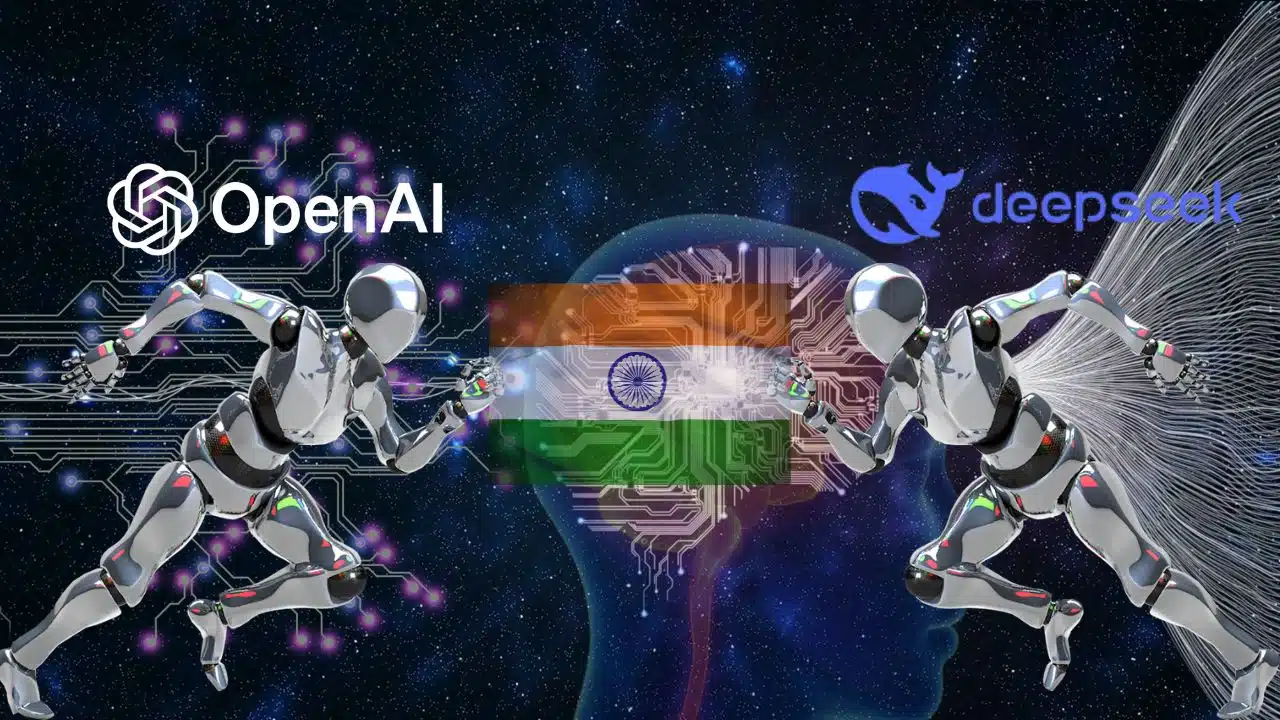
For decades, India’s IT industry has been a global leader in software services, supplying tech talent and expertise to power businesses worldwide.
However, with artificial intelligence (AI) rapidly transforming industries, India faces an urgent challenge—how to transition from an outsourcing powerhouse to an AI-driven innovator before it’s too late.
The emergence of Chinese AI start-up DeepSeek, with its cost-effective open-source AI models, has intensified the competition. The United States and China continue to lead in AI innovation, leaving India scrambling to establish its foothold. Industry experts warn that without swift action, India risks falling behind.
The Urgency of AI Adoption
AI is set to disrupt global job markets and economic structures. A recent International Monetary Fund (IMF) report predicts that nearly 40% of jobs worldwide could be affected by AI. Meanwhile, India’s dominant software services market, holding a 44% global share, is experiencing slower growth, with projections of an 11.9% annual expansion through 2028. By contrast, AI is expected to grow at an astonishing rate of 37.3% annually between 2024 and 2030.
Recognizing the stakes, the Indian government launched the IndiaAI Mission, a $1.25 billion initiative aimed at fostering AI start-ups and building necessary infrastructure. However, the latest federal budget allocated only $575,000 for AI education centers, which many experts consider inadequate given the scale of the challenge.
IT Minister Ashwini Vaishnaw has indicated that India’s first foundational AI model, customized for its diverse linguistic and cultural needs, could be ready within months. He has also praised DeepSeek’s cost-effective approach as a model for India’s AI ambitions.
India’s Strengths and Weaknesses in AI
Despite its strong IT sector, India’s software services dominance is a double-edged sword. On one hand, it provides a vast pool of skilled engineers. On the other, the outsourcing model has historically limited innovation.
“The software-services sector has a negative effect on India’s capacity to innovate as it firmly places India in the global value chain and makes it dependent on ideas and models originating elsewhere,” said Supriyo Chaudhuri, CEO of UK-based e1133, which collaborates with Indian universities on AI education.
To compete globally, India must leverage its vast and diverse datasets—spanning healthcare, agriculture, and finance—to develop proprietary AI solutions. However, success depends on more than just data. The country needs higher investments, a stronger education system, and aggressive AI adoption across industries.
The Need for Policy and Educational Reforms
Education remains a critical weak point. While India introduced coding in schools through the 2020 National Education Policy, its uneven implementation has slowed progress. Additionally, India’s research labs and higher education institutions require urgent revitalization.
“It would need to fix its higher education first as well as rejuvenate its moribund research labs, which have been neglected for so long,” said Chaudhuri. “To create innovation capacity, one needs deep and extensive preparation and a focus back on the fundamentals.”
India must also bridge the talent gap by embedding AI education at the school level and strengthening university-industry collaborations. Experts suggest creating an AI Grid—a national network of computing resources connecting universities, research labs, and start-ups—to ensure accessibility for smaller players.
Tapping into India’s Youth and Global Diaspora
India’s demographic advantage—nearly 65% of its population is under 35—could be its biggest asset. By focusing on large-scale upskilling, India can cultivate a generation of AI innovators.
“India doesn’t need to abandon its software-services strengths but must evolve towards AI-driven value creation,” said Abhijit Bhaduri, a former Microsoft executive. He emphasized the importance of hands-on AI training, industry partnerships, and leveraging India’s global diaspora for mentorship and collaboration.
The High-Stakes Future of AI in India
Raj Kapoor, founder and chairman of the India Blockchain Alliance, warned that traditional software services are already struggling to keep up with AI-driven automation and instant data analysis. Companies that fail to integrate AI risk obsolescence.
As the world moves towards an AI-driven future, India’s ability to pivot will determine its standing in the global tech landscape. With strategic investments, policy reforms, and aggressive AI adoption, India has the potential to leapfrog its competitors and shape the future of AI. But without bold action, the nation risks becoming a footnote in AI’s global rise.
The Information is Collected from MSN and SCMP.