

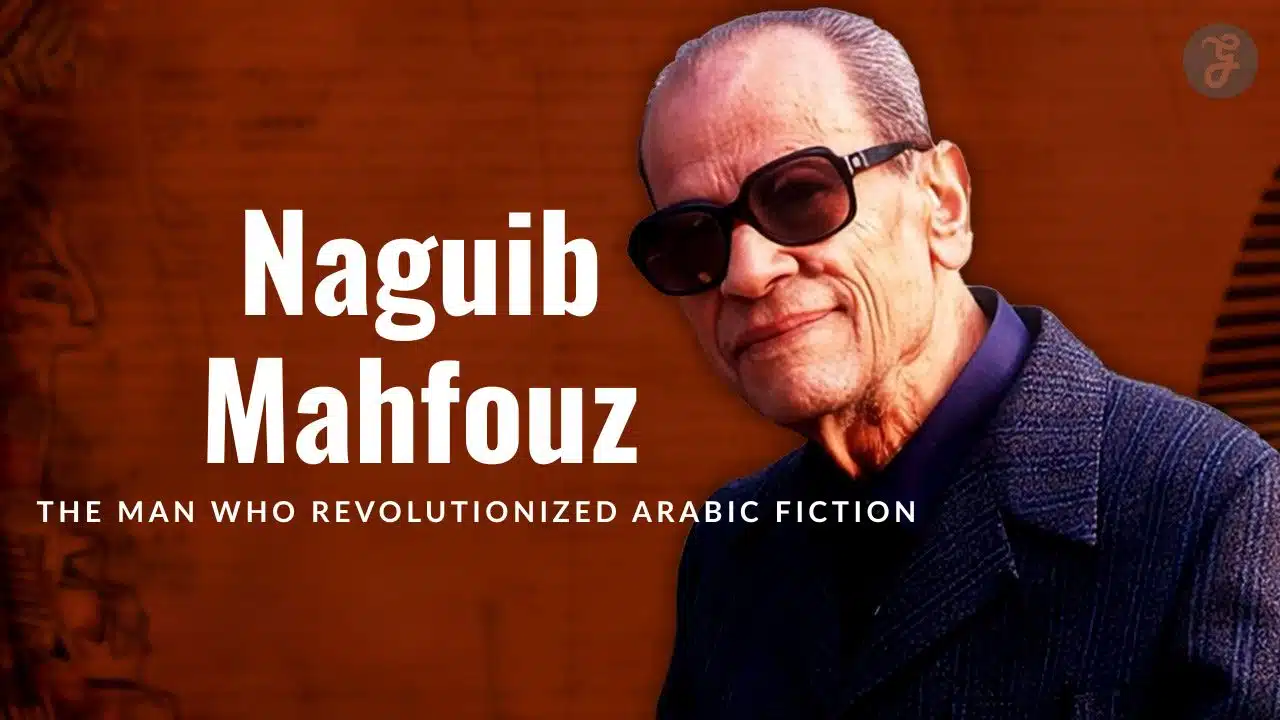
Have you ever wanted to explore Arabic literature but felt unsure where to begin? It can feel like standing at the edge of a vast ocean, not knowing which wave to catch first. You might search for “best international books,” only to find dry academic lists that don’t tell you which stories will actually grab your heart. Start with Naguib Mahfouz.
Today is his 114th birth anniversary. He wasn’t just the first Arabic writer to win the Nobel Prize for Literature in 1988; he was a master storyteller who made the streets of Cairo feel as familiar as your own neighborhood. Critics often call him the “Dickens of Cairo” because of how vividly he brings the city’s alleys and people to life.
In this guide, I’ll walk you through everything you need to know about this literary giant. We will look at his most famous books, like Palace Walk, and the fascinating real-life events that shaped them. You’ll see exactly why his work is the perfect entry point for modern Arabic fiction.
So, grab a cup of coffee (or tea, if you want to be authentic!), and let’s discover the stories that captivated the world.
Key Takeaways
- Naguib Mahfouz made history as the first Arabic writer to win the Nobel Prize for Literature in 1988.
- His masterpiece, The Cairo Trilogy, includes Palace Walk, Palace of Desire, and Sugar Street.
- These stories vividly depict Egyptian life, covering family dynamics, the 1919 revolution, and major political shifts.
- US readers often start with the American University in Cairo Press translations, which launched his global fame.
- He survived an assassination attempt in 1994 by an extremist angered by his novel Children of Gebelawi.

What Shaped Naguib Mahfouz’s Early Life and Influences
Naguib Mahfouz grew up in the Al-Jamliyyah district, a historic part of old Cairo that would later become the heartbeat of his novels. Born in 1911, he watched his father work as a civil servant, a stable career path that Mahfouz himself would follow for many years. But it was the 1919 revolution against British rule that truly shook his world.
He was only seven years old when he saw protestors marching in the streets. This early exposure to political passion gave him a lifelong awareness of the struggle for freedom. It planted seeds that would eventually grow into the rich political backdrops of his famous Cairo Trilogy.
The Books That Built the Author
As a boy, Mahfouz didn’t just play outside; he devoured books. He started with Hafiz Najib’s detective novels, tearing through 22 mysteries by the time he was ten. But his literary world expanded when he discovered Taha Hussein.
“I remember reading Taha Hussein’s autobiography, The Days (Al-Ayyam), and feeling like someone had finally written down what it meant to grow up in our part of the world.”
This bold book sparked deep thoughts about culture and identity. Later, at the Egyptian University (now Cairo University), he studied philosophy and met the editor Salama Musa. Musa was a strong advocate for science and socialism. These ideas stuck with Mahfouz, guiding him to write not just for entertainment, but to explore the big questions of modern life.
Naguib Mahfouz’s Prolific Writing Career
Mahfouz wrote with incredible discipline, balancing his job as a civil servant with his passion for storytelling. He eventually produced over 30 novels and hundreds of short stories. While he started locally, his partnership with translators like Denys Johnson-Davies and the AUC Press helped break his work to a global audience.
What were Naguib Mahfouz’s early publications?
At age seventeen, Mahfouz began crafting short stories that caught the eyes of local editors. His first novel hit the shelves in 1939, but it wasn’t the realistic style he is famous for today. His debut, Abath al-Aqdar (often translated as Khufu’s Wisdom), was a historical tale set in Ancient Egypt. He followed this with Radobis in 1943, continuing his exploration of pharaohs and dynasties.
By 1945, he shifted gears completely with Khan al-Khalili. This book abandoned ancient history to paint a picture of contemporary Cairo living under King Farouk. He realized that the drama of daily life—the gossip, the tea shops, the family feuds—was just as epic as any historical legend.
How did Naguib Mahfouz achieve global acclaim?
For decades, Mahfouz was a hero in the Arab world but unknown in the West. That changed in the late 1980s and early 1990s. The American publication of The Cairo Trilogy in 1990 by Anchor Books was a major turning point. Suddenly, US readers could walk the streets of Cairo through his pages.
The Trilogy Phenomenon
This three-part series—Palace Walk, Palace of Desire, and Sugar Street—follows the Abd al-Jawad family through three generations. It captures everything from the 1919 revolution to the end of World War II. Readers fell in love with the characters, especially the stern father who lives a double life.
Winning the Nobel Prize for Literature in 1988 cemented his status. The committee praised him for forming “an Arabian narrative art that applies to all mankind.” This award didn’t just honor him; it put modern Arabic literature on the map for readers everywhere.
What are the Core Themes in Naguib Mahfouz’s Literature
Mahfouz used his novels to explore the tension between tradition and modernity. His stories are often set in the specific alleys of Cairo, but the problems his characters face are universal. Whether it’s a father losing control of his family or a young man questioning his faith, you will likely see a piece of yourself in his work.
How does Mahfouz depict Egyptian society?
If you read Midaq Alley, you will meet a cast of characters that represents the soul of Egypt. You have the corrupt politician, the ambitious young girl, and the street vendor all living side-by-side. Mahfouz was a master at showing how major political events, like the 1952 coup or the policies of Gamal Abdel Nasser, trickled down to affect ordinary people.
In The Thief and the Dogs, he explores the bitterness of post-revolutionary Egypt. The protagonist, a thief named Said Mahran, comes out of prison to find that the world—and his former revolutionary friends—has left him behind. It is a powerful look at betrayal and the loss of hope.

How does Mahfouz explore existentialism?
Mahfouz didn’t just write social dramas; he loved philosophy. He was part of a group called the “Harafish,” a circle of writers and intellectuals who met weekly at places like the Casino Qasr el-Nil to debate life’s big questions. You can see this influence in his characters who struggle with the meaning of existence.
In novels like The Beggar (1965), his heroes often face a spiritual crisis. They look for answers that science and politics cannot provide. He weaves these heavy themes into the story naturally. A conversation in a café might start about the price of bread but end with a debate on the existence of God. This blend of gritty realism and deep philosophy is what makes his work unique.
Naguib Mahfouz’s Political Impact and Controversial Moments
Mahfouz believed that a writer must be a witness to his time. This honesty often landed him in hot water. His words could stir up a hornet’s nest, sparking debates from Cairo cafés to university lecture halls. He supported the Wafd Party in his youth but remained critical of all power structures throughout his life.
How did Mahfouz influence political discourse?
His novel Children of Gebelawi (also known as Children of the Alley) was his most daring work. Published serially in 1959, it used the setting of a Cairo alley to retell the stories of religious figures like Adam, Moses, Jesus, and Muhammad. Conservative critics were furious, seeing it as an insult to faith.
The book was banned in Egypt for decades, though people still smuggled in copies from Lebanon. It forced a national conversation about the limits of free speech and the role of religion in society. Mahfouz never backed down, insisting that the book was a plea for social justice, not an attack on religion.
What happened during the assassination attempt?
The controversy around Children of Gebelawi took a tragic turn years later. On October 14, 1994, an 82-year-old Mahfouz was sitting in a car near his home when a young man approached him. The attacker, Mohammad Naji, stabbed the author in the neck.
The Aftermath
Naji was a member of the extremist group Al-Gama’a al-Islamiyya. He admitted later that he had never even read Mahfouz’s books but was acting on a fatwa issued by Omar Abdel-Rahman (the “Blind Sheikh”). Mahfouz survived the attack but suffered permanent nerve damage in his right hand. For a writer who lived to hold a pen, this was a devastating blow. Yet, he learned to dictate his stories, refusing to be silenced until his death in 2006.
What is the Enduring Legacy of Naguib Mahfouz

Today, Mahfouz is more than just a name on a book spine; he is a cultural icon. His Nobel Prize opened the floodgates for translations of Arabic fiction. Before him, very few Arabic novels reached Western bookstores. Now, you can find shelves dedicated to the genre in major bookstores across the US.
The Naguib Mahfouz Medal for Literature
To honor his impact, the American University in Cairo Press established the Naguib Mahfouz Medal for Literature. This annual award discovers and translates the best new voices in Arabic writing. It ensures that Mahfouz’s legacy continues to build bridges between cultures.
In 2024, the medal was awarded to the Lebanese novelist Mohammed Tarazi for his book Muted Microphone. Winners like Tarazi get their works translated into English, giving them the same global chance that Mahfouz fought for.
How did Mahfouz shape modern Arabic literature?
Mahfouz proved that the novel could be a truly Arab art form. He moved away from copying European styles and created a voice that was distinctly Egyptian. Younger writers looked at his characters—shopkeepers, civil servants, students—and realized their own lives were worthy of literature.
His influence is everywhere. Authors like Alaa Al Aswany (The Yacoubian Building) follow in his footsteps, using the multi-character structure to dissect modern society. Mahfouz turned the local stories of Cairo into universal tales of the human condition.
Celebrated Works by Naguib Mahfouz
If you are ready to start reading, here is a quick guide to his most essential books. I’ve organized them to help you choose the right one for your taste.

| Book Title | Best For… | Why Read It? |
|---|---|---|
| Palace Walk (Cairo Trilogy #1) | Readers who love family sagas | It has a 4.2/5 rating on Goodreads. It introduces the unforgettable Al-Sayyid Ahmad, a strict father with a secret nightlife. |
| Midaq Alley | Fans of character studies | It’s shorter than the trilogy but packed with action. It captures the hustle of a single Cairo street in the 1940s. |
| The Thief and the Dogs | Thriller and noir fans | A fast-paced psychological drama about a man seeking revenge. It’s short, intense, and deeply philosophical. |
| Children of Gebelawi | Readers who like allegory | This is the controversial book that sparked the assassination attempt. It’s a fascinating retelling of religious history. |
The Enduring Impact of The Cairo Trilogy
The Cairo Trilogy remains his crowning achievement. Published in Arabic between 1956 and 1957, it is often compared to Thomas Mann’s Buddenbrooks. It chronicles the physical and moral changes of a nation through the eyes of one family. By the time you finish Sugar Street, you feel like you have lived a lifetime in Cairo.
Mahfouz’s work is a testament to the power of storytelling. He took the details of his corner of the world and made them matter to everyone. Whether you start with a short novel like The Thief and the Dogs or commit to the trilogy, you are in for a master class in fiction.
So, which book will you pick up first? I recommend starting with Palace Walk—it’s a journey you won’t regret.
FAQs on Naguib Mahfouz
1. Who was Naguib Mahfouz and why is he important in Arabic literature?
Naguib Mahfouz was the first Egyptian novelist to win the Nobel Prize for Literature, widely credited with bringing Arabic narratives to a global audience. He drew inspiration from his childhood in the historic Gamaliya district to create realistic, nuanced portraits of Cairo’s changing society.
2. What are some famous books by Naguib Mahfouz?
Readers usually start with The Cairo Trilogy, which consists of Palace Walk, Palace of Desire, and Sugar Street. You should also check out the classic Midaq Alley or the controversial Children of Gebelawi to truly understand his range.
3. Did Naguib Mahfouz win any big awards?
He made history in 1988 as the first writer in Arabic to win the Nobel Prize for Literature.
4. How did his writing reflect changes in Egypt’s society?
His historical novels often critique political shifts, moving from the 1919 Revolution to the social disillusionment under Gamal Abdel Nasser. Through stories like The Thief and the Dogs, he explored the tension between traditional values and the harsh realities of modern Cairo.
5. Was religion a theme in his work?
Faith is a central theme in his books, particularly in Children of Gebelawi, which uses allegories of Abrahamic faiths to explore the conflict between science and religion. This specific exploration of Islamic extremism and spiritual history even led to an assassination attempt against him in 1994.
6. What else did he do besides write novels?
He spent decades working in the Egyptian civil service, including a role as the Director of Censorship, while maintaining a strict writing schedule after hours. He famously wrote his drafts in local cafes like Ali Baba or Café Riche once his government shift ended.





















