

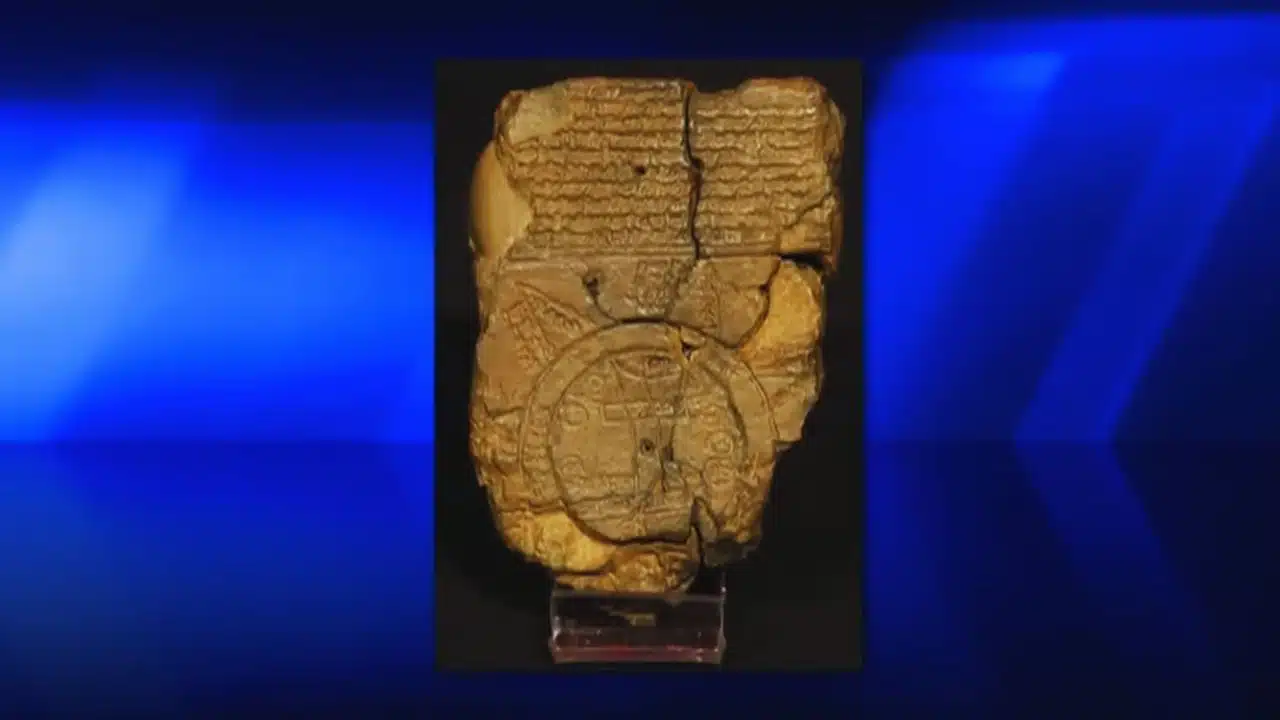
British Museum researchers have recently deciphered what is believed to be the world’s oldest map, etched onto a 3,000-year-old clay tablet known as the Imago Mundi. Historians have long puzzled over this Babylonian artifact, discovered in Iraq in 1882, because of its unique circular diagram and cuneiform script, an ancient writing system with wedge-shaped symbols.
Scholars now say the tablet may contain references to Noah’s Ark and its landing site, revealing new insights into ancient beliefs and geography.
The Map’s Design and Historical Significance
The Imago Mundi’s circular design represents what Babylonians believed was the known world, centered around Mesopotamia. Encircling Mesopotamia is a ring labeled as a “bitter river,” which ancient Babylonians thought surrounded the earth.
At the bottom of this diagram are triangles that likely represent mountains, with symbols pointing travelers toward what they might find on their journey. Despite the tablet’s damage, researchers have successfully deciphered these sections, unveiling a captivating view of the ancient world.
A Journey to ‘Urartu’ and Possible Connections to the Ark
On the back of the Imago Mundi, researchers found detailed instructions for a journey, mentioning a mysterious “parsiktu,” a term often associated with boat sizes in Babylonian texts.
One passage instructs travelers to “travel seven leagues” to reach something described as “thick as a parsiktu vessel.” According to Dr. Irving Finkel, a curator at the British Museum, this reference could indicate a large boat structure, possibly akin to the ark described in Biblical and Babylonian flood stories.
By following these instructions, researchers have pinpointed a path leading to Urartu, an area that ancient Mesopotamian poems associate with a legendary ark. The Biblical account of Noah’s Ark landing on the “mountains of Ararat” after a great flood aligns with Urartu, known in Assyrian as the equivalent of “Ararat.”
Biblical and Babylonian Flood Stories: A Historical Intersection
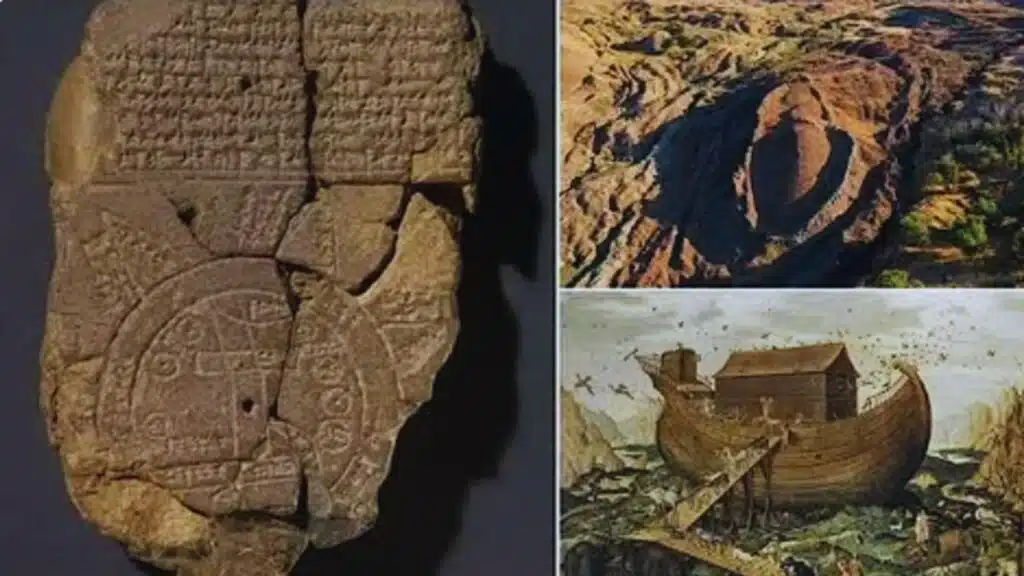
The Imago Mundi tablet contributes to a long-standing dialogue between ancient flood narratives. The Epic of Gilgamesh, which contains the Babylonian version, describes a flood that the god Ea sends to purify humanity. In this account, Utnapishtim, the Babylonian equivalent of Noah, builds an ark and fills it with animals to preserve life. Scholars find similarities in these stories and suggest centuries of influence.
Dr. Finkel clarifies, “The narrative on the tablet aligns with the Biblical account.” It’s not only a retelling but also a validation that, from a Babylonian perspective, this ark journey was seen as historical.”
Mount Ararat: Ongoing Archaeological Controversies
Mount Ararat, located in modern-day Turkey, has drawn significant attention for potentially housing remnants of the ark. Teams of archaeologists, including one from Istanbul Technical University, have excavated Ararat and discovered marine clay and antiquated artifacts, possibly indicating human presence on the mountain between 3,000 and 5,000 years ago. The team’s 2023 findings included marine materials and traces of seafood, hinting at ancient maritime activity in this high-altitude region.
However, some scholars challenge these claims. Dr. Andrew Snelling, a geologist and young Earth creationist, argues that Mount Ararat formed after the flood, casting doubt on it as the ark’s landing place. Many scholars further argue that the Biblical ark story serves as a cultural myth rather than literal history.
The Legacy of the Imago Mundi and Ancient Beliefs
With its unique mapping and symbolic content, the Imago Mundi tablet provides a rare glimpse into Babylonian beliefs about world structure and early attempts to map the known world. The discovery of references that could correspond to Noah’s Ark strengthens the tablet’s importance as a historical artifact that bridges mythology and archaeology, connecting ancient Mesopotamian beliefs with enduring Biblical narratives.
While the origins of Noah’s Ark remain shrouded in mystery, this ancient tablet reveals the depth of flood narratives across cultures, offering modern readers a pathway into the thoughts and worldviews of one of the earliest civilizations.
The Information is Collected from MSN and Daily Mail.
























