
It can feel hard to pick the best crypto startups to follow. Ripple now has over 500 staff and pushes cross-border payments with its blockchain technology. This guide will break down ten top names, from defi tools to developer tools, so you know where to focus.
Read on.
Key Takeaways
- Ripple leads cross-border payments in 50+ countries. It employs 501–1,000 people, holds a $1 billion+ valuation, and settles payments in seconds with XRP. Glassdoor rates its work at 4.6/5 and leadership at 4.4/5, and 66 roles remain open.
- Polygon Labs speeds up Ethereum with zero-knowledge rollups. It offers SDKs and APIs for DeFi and NFT projects, delivers fast finality and low fees, and its zkEVM testnet drives mass adoption.
- Aptos Labs and Zora power next-gen blockchain tools. Aptos runs a layer-1 chain handling thousands of transactions per second, has 11–50 staff, a $1 billion+ valuation, and struck 2025 partnerships. Zora, with 11–50 employees in LA, Berlin, and Brooklyn, lets creators mint NFTs and tap DeFi rails via simple APIs.
- TaxBit, Fireblocks, Chainalysis, and Sardine secure crypto compliance and assets. TaxBit (51–200 staff, $1 billion+ valuation) generates tax reports. Fireblocks uses MPC to guard keys. Chainalysis supports FBI, Europol, and ICE with real-time KYT and Reactor tools. Sardine (51–200 staff, $500 million+ valuation) stops fraud with smart contracts and ID checks.
- StarkWare Industries and Worldcoin drive scaling and identity. StarkWare uses zero-knowledge proofs and its Cairo language on StarkNet for low-fee, high-throughput tx. Exchanges list StarkNet tokens and run parallel execution. Worldcoin, backed by Sam Altman, maps iris scans in an Orb, stores only cryptographic proofs on-chain, and issues WLD tokens to new users.
Ripple: Revolutionizing Cross-Border Payments

Ripple operates in over 50 countries. Its network spans hundreds of banks and fintech companies. RippleNet uses a distributed ledger to settle cross-border payments in seconds. Using XRP, it moves digital assets at low fees.
Ripple employs between 501 and 1000 people. Founded in 2012, the company has a valuation above $1 billion. Employees rate work at 4.6 out of 5 on Glassdoor, and leadership gets 4.4 out of 5.
Teams build smart contracts and dapps on the XRP ledger. Developers also add APIs for banks and exchanges. Sixty six roles remain open now.
Polygon Labs: Scaling Ethereum for Mass Adoption
Polygon Labs accelerates Ethereum transactions with zero-knowledge rollups. It bundles thousands of operations off-chain and posts proofs on the main ledger. Developers praise its fast finality and low fees.
They say it feels like a fast lane on a busy highway. The network hosts smart contracts and digital assets for decentralized finance projects. This method trims costs, compared with proof-of-work chains.
Many decentralized applications see faster growth on this layered setup.
The team offers robust developer tools, like SDKs and APIs for decentralized applications. Teams can deploy non-fungible tokens and payment rails without heavy gas bills. Users praise speedy swaps on its chain connected to Coinbase Wallet.
Industry voices call its zkEVM testnet a key milestone for blockchain infrastructure. Scaling Ethereum might look simple now, thanks to its zero-knowledge design. It drives mass adoption across global finance apps.
Aptos Labs: Enhancing Blockchain Efficiency
Aptos Labs runs a high-performance layer-1 blockchain that can handle thousands of transactions a second. It has between 11 and 50 staff members. Investors value the startup at over one billion dollars.
The team builds core blockchain infrastructure with smart contract frameworks and parallel execution tools to power digital assets. It signed partnerships with a top software company and a major cloud platform in 2025.
Some developers compare the coding flow to snapping Lego pieces together. The Move language runs contracts fast, cuts fees, and spurs token development. One coder joked the network feels like a digital high-speed train with no red lights.
Builders lean on open-source developer tools to ship dapps in days, not months.
Zora: Empowering Creators Through Web3 Tools
Zora runs an Ethereum-based cryptomedia hub for creators. It has offices in Los Angeles, Berlin, and Brooklyn. Staff size runs from 11 to 50 employees. The platform offers developer tools and APIs like Infura and Alchemy.
Creators can mint NFTs, launch smart contracts, or start token sales with ease.
Artists tap these tools to store art on distributed storage, claim digital assets, and build marketplaces. They link smart contracts to self-sovereign IDs and crypto wallets. They even tap decentralized finance rails for royalties and revenue share.
Zora makes the tech feel as easy as a click.
TaxBit: Simplifying Crypto Tax Compliance
TaxBit helps users track digital asset taxes. It integrates with major networks like Ethereum, Binance Smart Chain and Hyperledger Fabric. The software flags taxable events in wallets, exchanges, or smart contract interactions.
The guide simplifies crypto tax compliance for both retail traders and institutional clients. The team has 51 to 200 staff across Seattle and Salt Lake City, and it holds a valuation over $1 billion.
Users find detailed reports on taxable events by syncing crypto wallets. It pulls data from exchanges, smart contracts and DeFi platforms. The platform supports CPA workflows in supply chain management for enterprise blockchain solutions.
Clients see clear forms ready for audit and anti-money laundering checks. The firm lists 7 open roles now, hiring across engineering, product, and support.
Fireblocks: Ensuring Secure Digital Asset Transactions
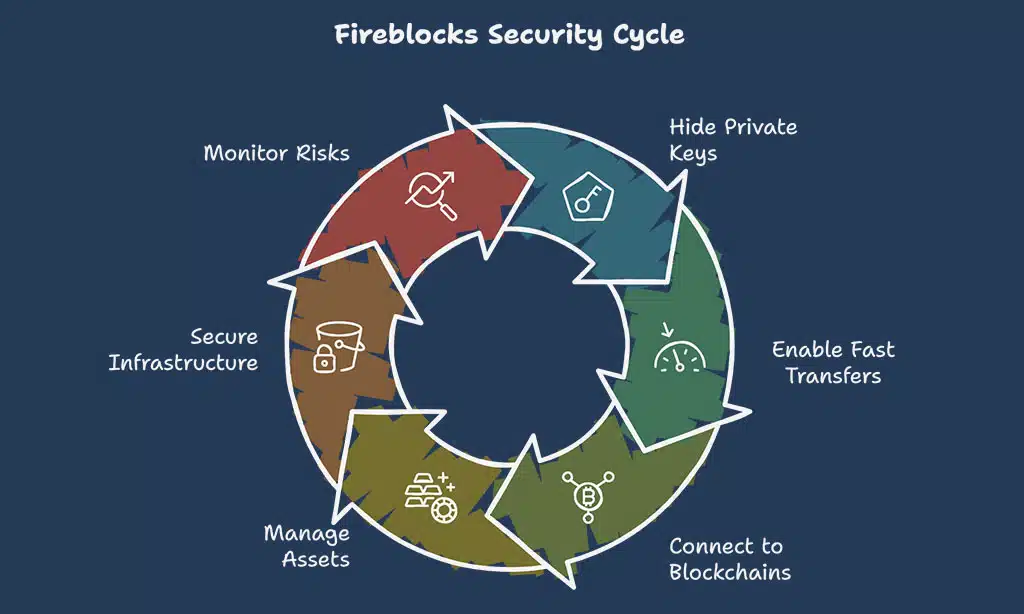
It hides private keys behind multi-party computation, cutting hack risk to near zero. Transfers happen in seconds across exchanges, crypto wallets, and defi apps. The tool connects via API to every blockchain network, from layer 1 protocols to smart contract chains.
Teams launch token minting, set up cold storage vaults, then track every move in one dashboard.
Enterprise groups like banks and fintechs lock down blockchain infrastructure, securing digital assets and logging every event. Developers plug in secure rails to roll out dapps, while compliance officers monitor risks.
Even high-frequency traders rest easy, knowing a digital vault stands guard around their crypto tokens.
Chainalysis: Advancing Blockchain Analytics and Security
Chainalysis acts like a digital bloodhound, sniffing out bad funds on bitcoin and ether chains. Its KYT tool flags odd transfers in real time, while Reactor maps wallet links, smart contracts, and stolen NFTs on dapps.
Crypto exchanges and DeFi platforms tap its APIs to meet anti–money–laundering rules, and firms monitor millions of transactions each day for hacks or fraud.
Agencies such as the FBI, Europol, and ICE rely on Chainalysis data to freeze tainted assets fast. Training workshops teach agents to chase illicit flows across public ledgers, boosting security for digital assets.
This blockchain company drives adoption at startups and banks, making decentralized finance safer and more transparent.
StarkWare Industries: Innovating Layer 2 Scaling Solutions
StarkWare Industries builds fast layer two solutions on blockchain technology for ethereum scalability. The team uses zero knowledge proofs to shrink data on blockchain networks. Developers tap into Cairo to write smart contracts with ease.
Granular parallel execution boosts transaction speed. Dapps face low fees and high throughput on StarkNet.
Major exchanges list tokens on StarkNet to cut costs. They run parallel execution that speeds up blockchain infrastructure for defi. A web3 wallet on StarkNet feels like riding a bullet train.
Enterprise blockchain solutions, such as cryptocurrency wallet in banking, plug in easily. Users move digital assets fast, and developers love low fee smart contracts.
Worldcoin: Redefining Digital Identity and Payments
Worldcoin uses iris based scans to prove your digital identity. You step into an Orb, a sphere with a camera. It maps 256 points on each eye and turns them into cryptographic proofs.
OpenAI CEO Sam Altman backs the project. The system keeps no image, only a code on blockchain infrastructure. This setup guards privacy and blocks fake accounts.
People use that code to open a digital wallet and trade digital assets. Worldcoin gives WLD tokens for each registration. Traders move them on many cryptocurrency exchanges. Developers build decentralized finance (defi) apps that accept WLD for payments.
This move sparks new ways to link identity and online money.
Sardine: Combating Fraud in Crypto Transactions
Crypto firms tap Sardine to fight fraud in real time. The firm uses smart contracts and ID checks to scan each transaction. The team spans Austin, New York City, San Francisco, and Toronto.
They guard digital assets with instant, global, risk-free payments.
Sardine counts 51 to 200 staff and hires 20 experts now. Investors value the startup at over $500 million. The platform stops stolen funds, blocks fake accounts, and cuts scams for decentralized finance (defi) groups.
Clients rely on the tech to power secure blockchain applications.
Takeaways
Bold teams like payment ledger provider Ripple and sidechain builder Polygon Labs push cross-border payments and Ethereum scaling. Aptos Labs and rollup engine StarkWare rev up layer 1 blockchain, and rollups.
NFT platform Zora and identity network Worldcoin help creators claim new IDs in Web3. Custodial fortress Fireblocks and block explorer Chainalysis guard assets by tracking transactions.
Tax engine TaxBit and fraud shield Sardine smooth tax rules and payment rails for developers. These names light up the horizon for decentralized finance, smart contracts, and blockchain infrastructure.
Watch for more growth as they refine NFTs, digital identity, and dapps. Keep your eyes peeled, 2025 might bring a crypto gold rush.
FAQs
1. What makes a crypto startup stand out in 2025?
It uses smart contracts on a strong layer 1 blockchain, adds parallel execution for fast trades, and brings new token development.
2. How do layer 1 blockchain projects tackle ethereum scalability?
They add parallel execution to clear backlogs, use new ways to speed up, boost ethereum scalability, and cut gas fees.
3. Can startups help with cross-border payments and financial inclusion?
Yes, they use blockchain infrastructure to move digital assets across borders, cut costs, and help more people get banking services via defi tools.
4. How do dapps and developer tools drive blockchain adoption?
Dapps show how decentralized applications work, developer tools help coders build on blockchain tech, and this drives more use online.
5. What role do NFTs play in the digital economy?
Non-fungible tokens let artists sell digital art or gift cards, they open new markets for digital assets, and power our digital economy.
6. How do startups guard token development against hacking and data breaches?
They use secure code, run audits on testnet, and add decentralized identity checks to stop hacks and data breaches in web 3.0.