

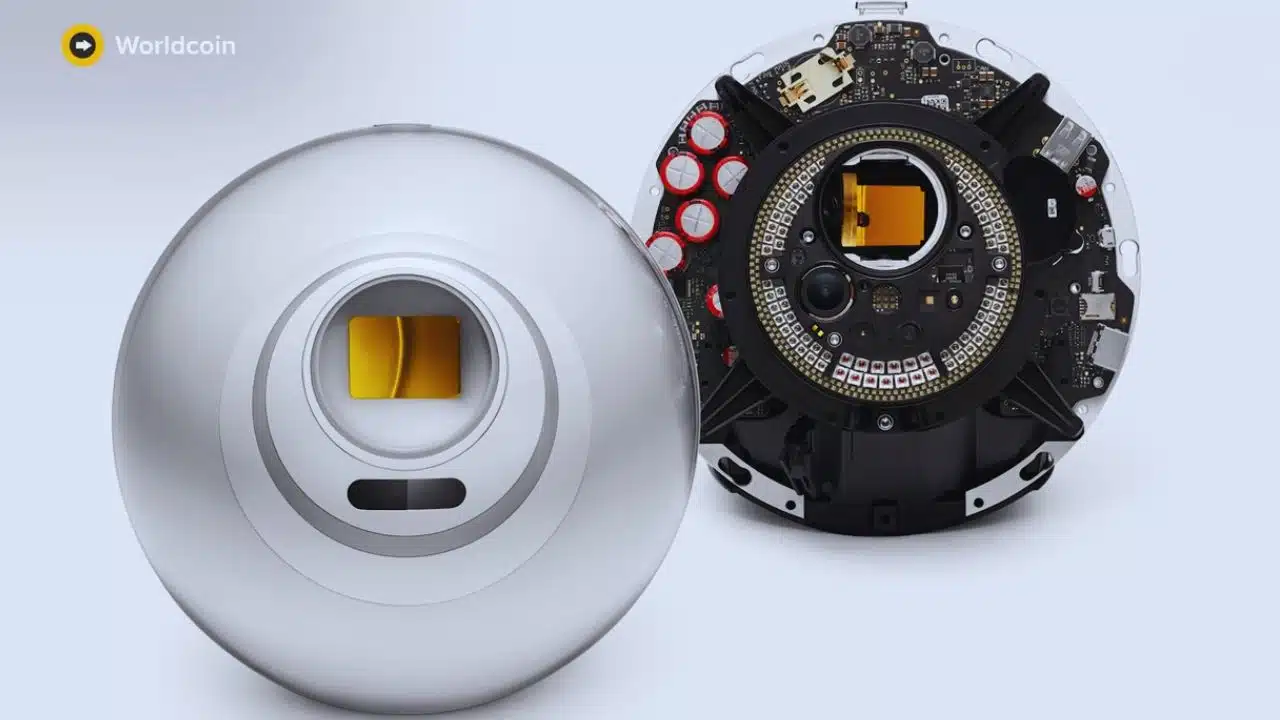
Sam Altman, the co-founder of OpenAI, has officially launched his controversial cryptocurrency and identity verification project, Worldcoin, in the United States. The project, which has sparked global debate since its inception, involves scanning people’s irises through a device known as the Worldcoin Orb to create a “World ID”—a biometric digital identity intended to verify that users are human in an age of advancing AI.
Beginning this week, Worldcoin’s native token WLD became available for trading on major U.S. crypto exchanges such as Coinbase, Kraken, and others—though New York State is excluded due to local regulations.
This is the first time Worldcoin is officially operating in most of the U.S. The rollout is being marked by a national campaign, including installations of Worldcoin Orbs in select locations across cities like Atlanta, Austin, Los Angeles, Miami, Nashville, and San Francisco. Users can visit these stations—called World Spaces—or participating Razer gaming stores to undergo the eye scan process.
How It Works: Get Paid to Prove You’re Human
Once a user agrees to have their iris scanned by the Orb—a gleaming metallic device that resembles a polished bowling ball—the system generates a unique, encrypted World ID tied to their biometric data. New participants in the U.S. who complete the iris scan are rewarded with 16 WLD tokens.
In addition, those who previously downloaded and registered with the World App (Worldcoin’s mobile wallet) before the U.S. launch are now receiving a “pioneer grant” of 150 WLD tokens, dropped directly into their digital wallets.
The World App functions as both a crypto wallet and a social chat interface, allowing users to send and receive WLD or other supported digital assets. It also provides access to a growing ecosystem of over 150 mini-apps, including games, prediction markets, and social tools—one recent addition being from prediction market platform Kalshi.
Mission and Philosophy: A Digital Identity for the AI Age
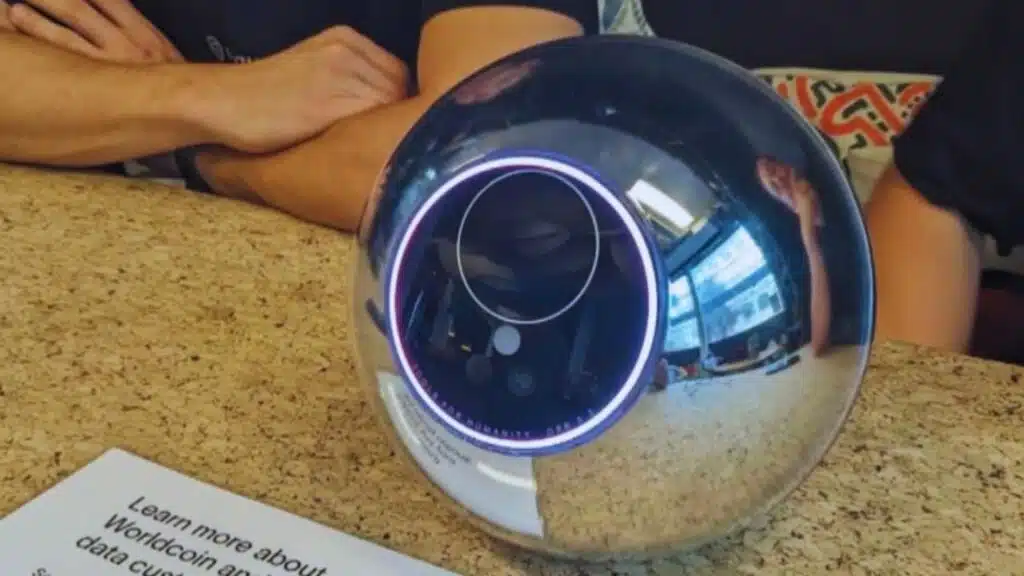
Founded in 2019 by Sam Altman, Alex Blania, and Max Novendstern, the company behind the project—Tools for Humanity—was built on the premise that humanity would soon need a secure, decentralized system for verifying human identity online.
The founders argue that with the rapid rise of artificial intelligence tools capable of mimicking human behavior, it will become increasingly difficult to tell whether online interactions are with real people or AI-generated agents.
Altman believes that World ID can help preserve trust and integrity online, allowing platforms to filter bots and ensuring authenticity in voting, transactions, and digital interactions. Additionally, he envisions Worldcoin serving as a form of universal basic income (UBI) in the future—especially for people whose jobs are displaced by AI.
“As AI systems become more powerful, distinguishing humans from machines becomes critical,” Altman said during a press conference in San Francisco, dubbed “At Last.”
Worldcoin’s Economic Ecosystem and Visa Partnership
In a move that could accelerate real-world adoption, Tools for Humanity is collaborating with Visa to roll out a Worldcoin debit card later this year. This card will allow users to convert WLD tokens to fiat currency during regular checkout transactions.
This development could make Worldcoin more than just a speculative digital token—it could function as a spendable currency in the broader economy. According to the company, users will soon be able to link the card to their World App wallets, making it easier to transact globally.
Corporate Integrations: World ID Comes to Stripe, Tinder, and Razer
Worldcoin is also pushing to make World ID widely usable. It has announced early-stage integrations with major companies such as:
- Stripe (for identity verification during payments)
- Match Group, the parent company of Tinder (for verifying real people on dating apps)
- Razer, the gaming brand (for identity-based rewards and authentication in online gaming platforms)
These integrations highlight how World ID could evolve into a universal login or digital passport across online services, gaming, fintech, and social platforms.
Design Evolution: Introducing the ‘Orb Mini’
The original Worldcoin Orb—often described as a futuristic silver sphere—is now getting a new, more compact sibling. At the San Francisco launch event, Tools for Humanity teased the “Orb Mini,” a smaller version that resembles a smartphone, aiming to make iris-scanning technology more portable and accessible.
The new design addresses early criticism that the original orbs were bulky, hard to deploy, and intimidating. The Orb Mini could pave the way for mass adoption by simplifying the biometric verification process in smaller or mobile environments.
Global Pushback Over Biometric Privacy Concerns
Despite its rapid growth, Worldcoin has faced strong criticism from data privacy regulators around the globe. Countries like France, Germany, Kenya, and South Korea have either opened investigations or halted the project over concerns related to the collection and storage of biometric data.
Worldcoin insists it does not store raw iris images. Instead, it converts the biometric data into unique cryptographic hashes (called IrisCodes) that are irreversible and cannot be reverse-engineered to recreate the original image. The company says it adheres to GDPR and other global privacy standards.
Still, critics argue that any system relying on biometric verification inherently carries ethical and surveillance risks. Several watchdogs have warned about the potential misuse of biometric identities—particularly in less regulated regions.
12 Million Identities and Counting: A Global Network Takes Shape
Despite the scrutiny, Worldcoin’s growth has been staggering. The startup reports that over 12 million people across 100+ countries have already verified their humanity through a Worldcoin Orb. Most of these users are from Latin America, Asia, and parts of Africa, where the project initially gained traction through monetary incentives and promotional campaigns.
The World ID database is powered by the Ethereum-based World Chain, a custom Layer-2 blockchain that supports the Worldcoin ecosystem.
Why Now? Political Landscape and Reduced Scrutiny
Under the leadership of former SEC Chair Gary Gensler, the U.S. Securities and Exchange Commission had taken a hardline stance on crypto projects, often labeling token launches as unregistered securities offerings.
However, with the Trump administration returning to power, crypto regulations have become less aggressive, according to legal analysts. This shift in regulatory tone has emboldened Tools for Humanity to roll out Worldcoin in the U.S., after operating internationally for years.
Still, the token remains unavailable in New York State, which enforces stricter financial regulations and licensing requirements.
Price Volatility: WLD Token Still Struggles to Find Stability
Since its launch in mid-2023, the WLD token has experienced sharp price swings. Initially debuting above $2, it has since dropped below its launch price and was trading near $1.04 at the time of the U.S. debut. Analysts cite uncertainty about long-term utility, regulatory pressures, and speculative trading as reasons for its volatility.
Some industry observers remain skeptical of Worldcoin’s sustainability, suggesting that the project’s long-term value depends on real-world adoption and the success of the World ID standard.
Brave New World or Privacy Nightmare?
Worldcoin’s expansion into the U.S. signals a bold new chapter for biometric-based identity systems and blockchain innovation. With a mission to verify humanity online and offer an economic safety net in an AI-driven world, the project touches on deep questions of privacy, trust, and the future of work.
Supporters see Worldcoin as a visionary tool for identity and equality in the digital era. Critics, meanwhile, warn of the Orwellian risks posed by tying cryptocurrency and online access to biometric surveillance.
Whether Worldcoin becomes the foundation of a fairer, AI-proof internet—or another controversial crypto experiment—remains to be seen.
The Information is Collected from The Verge and CNBC.























