Mark Zuckerberg, CEO of Meta Platforms Inc., has unveiled one of the most ambitious infrastructure projects in the history of technology: a series of hyper-scale data centers designed to support Meta’s new wave of advanced artificial intelligence (AI) systems. The first of these futuristic facilities, named Prometheus, is scheduled to become operational in 2026 and will be located in Ohio.
The announcement was made directly by Zuckerberg in a post on Threads, Meta’s social media platform, where he described these new data centers as “titan clusters” — multi-gigawatt facilities that dwarf traditional data centers in both scale and capability. These facilities are being purpose-built to power next-generation AI models and support Meta’s long-term plan to develop “superintelligence”, an advanced form of AI that could exceed human-level performance across various domains.
Prometheus: A Giant Among Giants in Data Infrastructure
Named after the mythical figure who gave fire to humanity, Prometheus symbolizes the enormous leap Meta is taking toward becoming a global leader in AI. The scale of the facility is unprecedented. While many standard data centers around the world operate at around 100 to 300 megawatts, Zuckerberg’s Prometheus facility is expected to exceed 1 gigawatt of power capacity.
That’s the equivalent of powering approximately 900,000 U.S. homes annually, based on data from the U.S. Department of Energy. In comparison, Meta’s current largest facility under construction — located in Richland Parish, Louisiana — is already described as nearly the size of Manhattan. But Prometheus will be even bigger, both in physical size and in computing power.
Why Meta Is Building Titan Clusters
According to Zuckerberg, these new “titan clusters” are necessary to meet the increasingly massive computational demands of AI systems. As AI models like LLaMA (Meta’s large language model) and other generative models evolve, they require millions of GPU cores and high-bandwidth networking systems — something traditional data centers can’t efficiently support.
These titan clusters are designed to host custom-built AI training supercomputers, high-performance networking infrastructure, and proprietary software to orchestrate trillions of operations per second. Meta’s AI roadmap envisions training multi-modal, open-source superintelligent models capable of reasoning, planning, and decision-making on a scale never seen before.
The company expects to spend “hundreds of billions of dollars” over the next decade on AI infrastructure, model development, and expert talent — a clear signal that AI is now central to Meta’s future.
The AI Arms Race: Meta, Microsoft, OpenAI, and Oracle
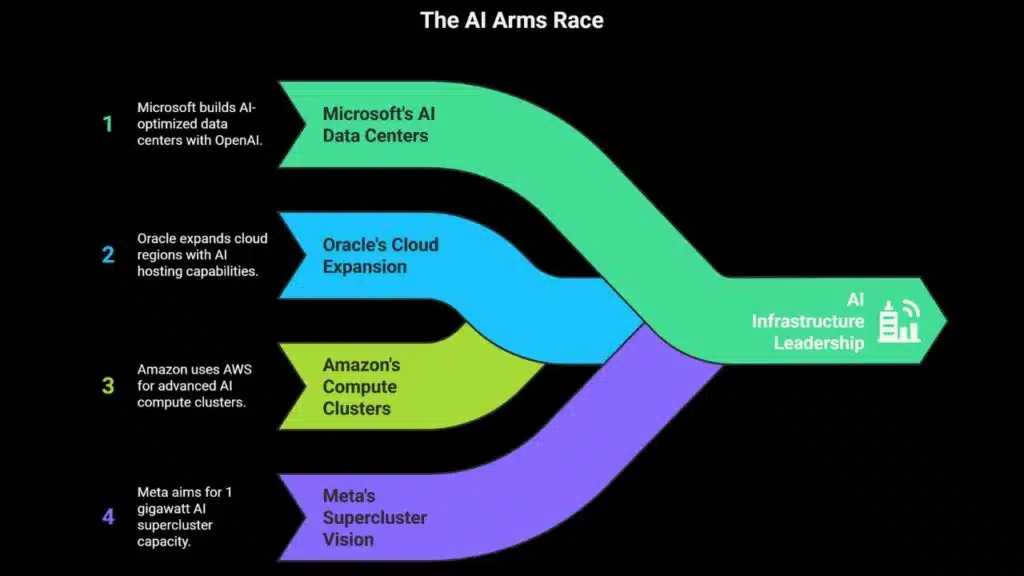
Meta’s push into AI infrastructure comes at a time when rival tech giants like Microsoft, OpenAI, Amazon Web Services (AWS), and Oracle are all pouring billions into data centers to support their own generative AI initiatives.
- Microsoft has committed to building hundreds of AI-optimized data centers, largely in partnership with OpenAI, the creator of ChatGPT.
- Oracle recently announced plans to open 100 new cloud regions around the world with specialized AI hosting capabilities.
- Amazon is using AWS to roll out advanced compute clusters that will support training and deployment of Anthropic’s Claude and other foundation models.
Industry analysts at SemiAnalysis predict that Meta may become the first company to build a “supercluster” that exceeds 1 gigawatt in computing capacity, setting a new benchmark for AI infrastructure.
Zuckerberg’s Personal Involvement and Frustration with Meta’s Past AI Strategy
Meta’s aggressive shift toward AI isn’t just a business decision — it reflects a personal mission for Mark Zuckerberg. According to internal reports from Meta, Zuckerberg had grown increasingly dissatisfied with the company’s progress in AI, especially when compared to OpenAI’s rapid advances with GPT models and Google’s breakthroughs through DeepMind and Gemini.
Rather than outsource solutions or license AI tech from competitors, Zuckerberg has taken a hands-on role in building an elite in-house AI team. Over the past year, he has personally led efforts to hire the top minds in AI research and infrastructure development.
Key Talent Recruited from OpenAI, Google, and Apple
One of the most headline-grabbing moves was Meta’s acquisition of a 49% stake in Scale AI — a leading AI data labeling and infrastructure company — for $14.3 billion. As part of the deal, Alexandr Wang, Scale AI’s co-founder and a rising star in the AI world, has been appointed as Meta’s Chief AI Officer.
Other high-profile hires include:
- Nat Friedman, former CEO of GitHub, known for his work in open-source software and developer tools.
- Daniel Gross, former Apple and YC partner, an AI visionary and investor behind several unicorn startups.
- Ruoming Pang, a former engineer at Apple, reportedly joined Meta with a compensation package exceeding $200 million, one of the highest ever offered to a technical hire.
These moves underscore Meta’s commitment to building an AI dream team — one capable of developing systems rivaling or even surpassing those of OpenAI and Google DeepMind.
AI Investment Funded by Meta’s Advertising Business
What gives Meta the ability to fund such extraordinary infrastructure and talent is its robust core business. Despite investing tens of billions into the metaverse, Reality Labs, and now AI, Meta continues to post strong revenue growth — thanks to the continued profitability of its advertising empire across Facebook, Instagram, WhatsApp, and Messenger.
In Q1 2025, Meta reported over $35 billion in revenue, driven largely by ad sales on its core platforms. The company’s advertising network reaches over 3.5 billion users, providing the scale and capital needed to fuel its AI transformation without external financing.
Environmental and Energy Considerations
With plans for multi-gigawatt-scale data centers, energy consumption is a significant concern. According to industry sources, Meta is working with utility partners and governments in Ohio, Louisiana, and Virginia to ensure that clean and renewable energy — such as solar, wind, and hydro — will power these massive facilities.
Meta has already pledged to become carbon neutral across its operations and to reach net-zero emissions throughout its supply chain by 2030. The company is also investing in advanced cooling systems, liquid immersion cooling, and AI-optimized power management to reduce environmental impact.
What Prometheus Means for the Future of AI
If Prometheus and the titan clusters deliver on Zuckerberg’s vision, Meta could position itself at the forefront of AI innovation for the next decade. These facilities will not only train large language models but also support real-time inference for billions of users interacting with Meta’s platforms.
Potential applications include:
- Hyper-personalized recommendations across Meta’s platforms.
- Multi-modal chat assistants integrated into Messenger, WhatsApp, and Instagram.
- AI-powered content moderation, translation, and even real-time video generation.
- AI agents that assist with learning, productivity, and healthcare support.
The implications stretch far beyond social media. Meta’s infrastructure could power AI tools for developers, enterprise applications, and public sector use, redefining what’s possible in digital interaction, automation, and human-AI collaboration.
A Monumental AI Bet with Global Implications
Mark Zuckerberg’s Prometheus project marks a turning point not only for Meta but for the entire tech industry. By committing to multi-billion-dollar investments in AI superclusters, Meta is building the infrastructure backbone for the future of artificial intelligence.
With the first Prometheus center scheduled for 2026, and more titan clusters to follow, Meta’s vision of AI superintelligence is no longer science fiction — it’s becoming reality. The race for AI dominance is on, and Meta has just taken a massive leap forward.
The Information is Collected from Live Mint and CNBC.