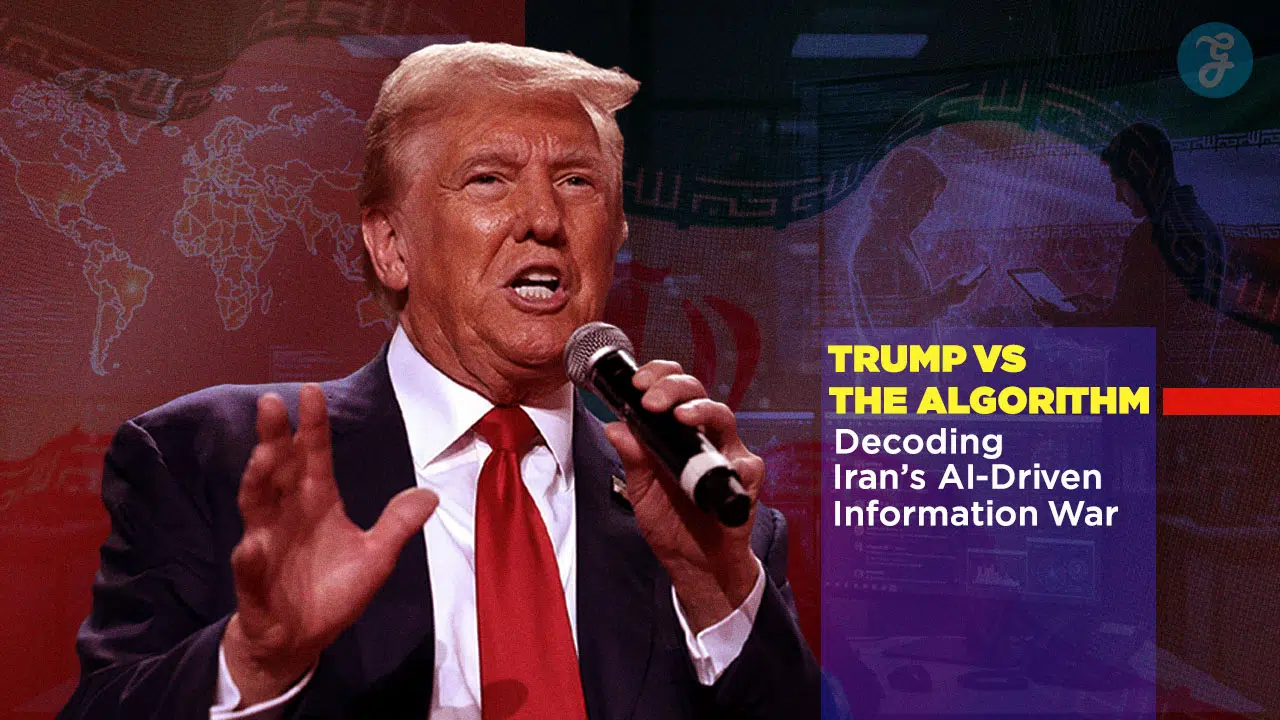
The death of a child is a physical finality. Yet, in the digital age, it has been reduced to a mere data point for an algorithm. When the Iranian Embassy in The Hague shared a Disney-styled animation mocking Donald Trump, they were not just posting a parody. They were weaponising the memeification of warfare. This video, bright with the bouncy aesthetics of a Pixar film, represents a terrifying transition from the “Post-Truth” age to a “Synthetic-Truth” era.
Here, the visceral tragedy of a school strike in Minab is cynically blended with the dark scandals of the Epstein files. We are now witnessing the moment where state-sponsored memes have become strategic munitions, designed to bypass our critical thinking and reshape reality in real time.
The visual dissonance is profound. You see vibrant colours and big-eyed characters that belong in a nursery, yet the narrative they deliver is a biting piece of state propaganda. This is a strategic tool built to exploit political fractures in the West. By using familiar pop culture motifs, Tehran has found a way to slip past the mental filters of a younger, digitally native audience. They have turned a horrific war crime into a digestible piece of digital entertainment, proving that information warfare is no longer a sideshow. It is the primary front line where the gravity of war is being dissolved by flickering pixels.
The tragedy at the Shajareh Tayyebeh girls’ school in Minab was real and devastating. Reports from international sources and satellite data confirm that over 160 children died in a strike that involved a triple-tap manoeuvre. While the physical world mourns mass graves, the digital world is being flooded with AI-generated satire that mocks both the victims and the victors. This episode is a final warning. If we allow generative AI to simultaneously dictate military targeting and the cultural narratives that follow, we lose our capacity for empathy. We are trading the sanctity of human life for the viral speed of a meme.
The Kinetic Catalyst: The Shajareh Tayyebeh Tragedy
The blood on the dusty floor of the Shajareh Tayyebeh school was real long before the internet turned it into a talking point. On February 28, 2026, the quiet town of Minab became the unintended epicentre of Operation Epic Fury. While military briefings in Washington spoke of surgical precision, the ground reality was a scene of catastrophic loss. This girls’ elementary school took a direct hit during the opening hours of the campaign.
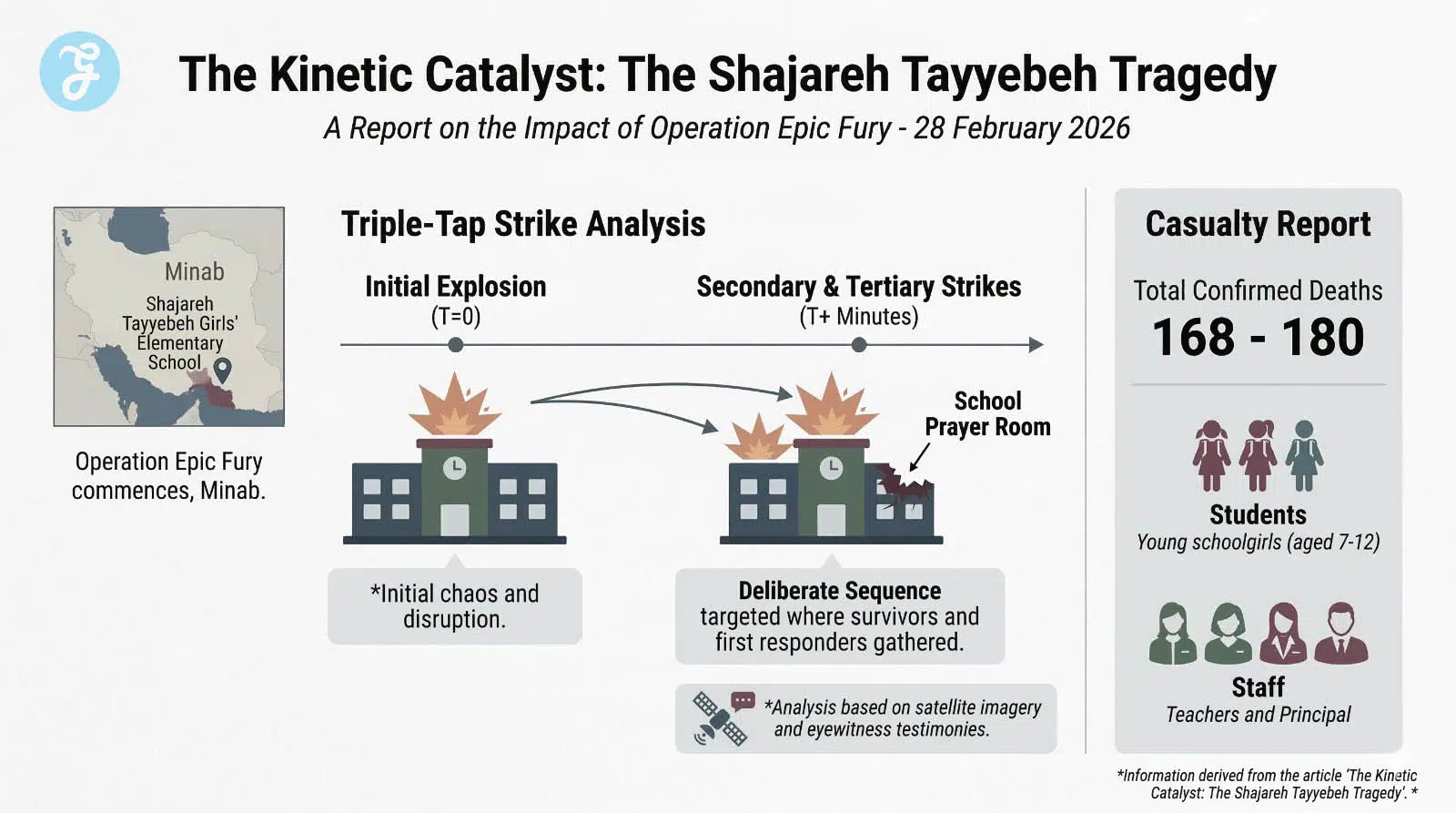 The numbers are haunting. Reports from international sources and local medical teams confirm between 168 and 180 people died. Most of these victims were young schoolgirls aged between 7 and 12, struck in the middle of their morning routine. Teachers and the school principal died alongside them. There was no time to run.
The nature of the attack suggests something far more sinister than a single stray missile. Satellite analysis and testimony given to the Middle East Eye describe a tactical nightmare: a triple-tap strike. The first explosion created the initial chaos. The secondary and tertiary strikes hit minutes later, explicitly targeting the school prayer room where survivors and first responders had rushed to find safety. This specific sequence is a hallmark of deliberate targeting.
The Intelligence Void: How Erased Reality Drives the Memeification of Warfare
How did a house of learning become a military target? Independent investigations have uncovered a massive intelligence gap, revealing a catastrophic disconnect between physical reality and military data. The school sat on land that was partitioned from an IRGC naval base a decade ago, in 2016. While the physical walls and colorful murals were clearly marked, the digital maps used to guide the strike were dangerously obsolete.
The U.S. military increasingly relies on sophisticated AI targeting software, such as Palantir’s Maven Smart System to speed up the decision-making process and shorten the strike sequence. These tools process thermal patterns and movement faster than any human could. But in Minab, the algorithms failed to account for years of civilian urban development. The system flagged the site based on its historical association with military activity rather than its current use as a primary school. It prioritised automated speed over human verification, misidentifying a civilian structure as a high-value military asset. A house of learning was erased because a database failed to update.
This is the cold logic of modern war. A line of code failed to recognise a playground. A drone operator followed an algorithmic prompt. The result was an immense and immediate loss of life in southern Iran. This physical tragedy provided the vacuum that the memeification of warfare would soon fill. While families buried their children, the digital gears in Tehran were already turning to transform this grief into a Pixar-styled weapon.
Memeifying War: “Inside Out” as a Weapon
The Iranian Embassy in The Hague did not choose the “Inside Out” aesthetic by accident. They turned to the memeification of warfare to ensure their message reached deep into Western social feeds. By using the soft and rounded visual language of a Pixar film, they created a digital Trojan Horse. This family-friendly format is designed to bypass the natural defences of a younger, highly sceptical audience through several tactical advantages.
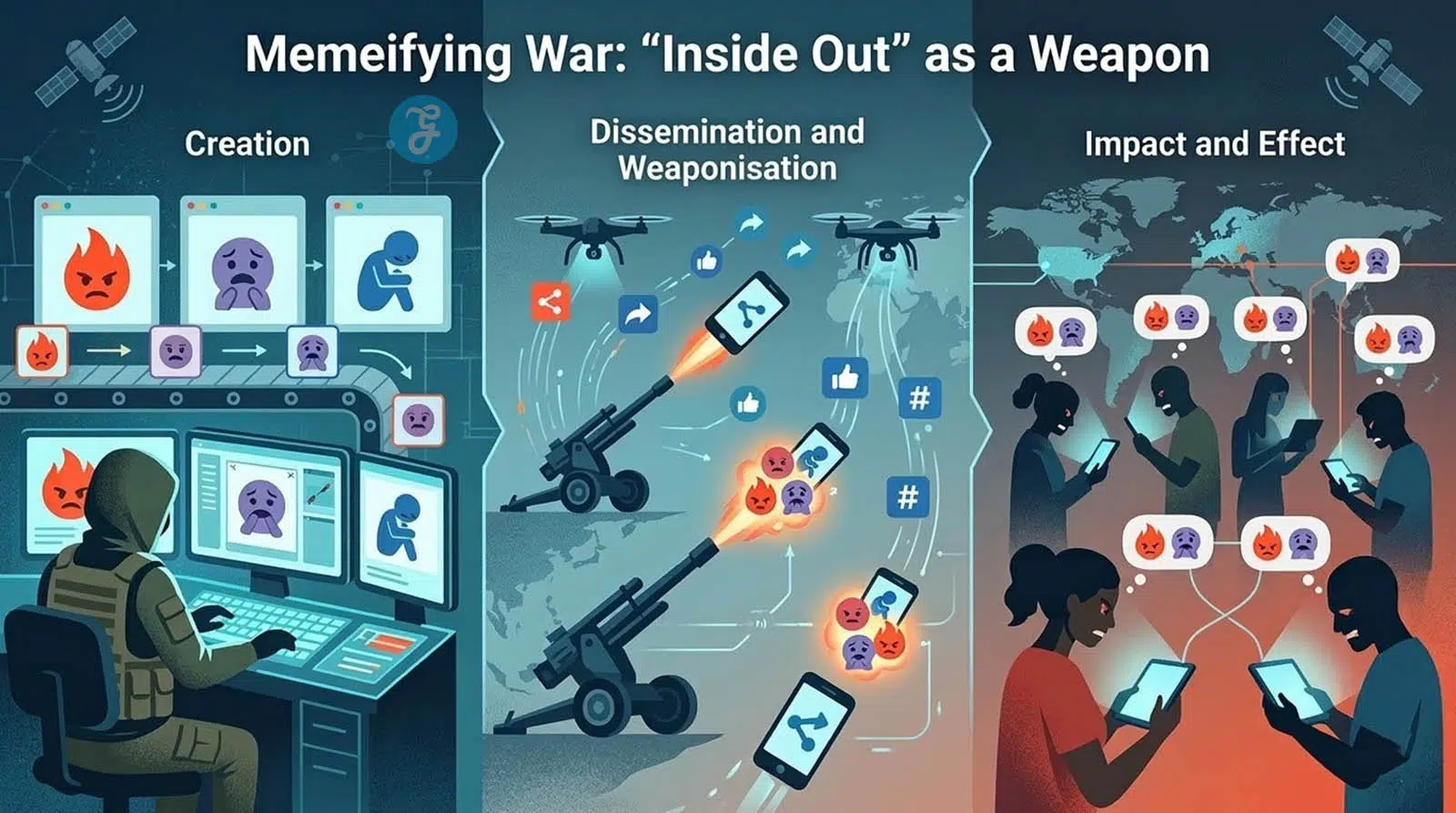 First, it prioritises engagement over authority. Gen Z users are trained to ignore traditional state broadcasts and grainy footage of official spokespeople, but they readily engage with high-quality animation that mirrors the media they already consume. Second, these bright colours and familiar character designs provide a layer of algorithmic invisibility. Most content-moderation systems are tuned to flag gore and hate speech but often struggle to categorise satirical, Disney-fied state propaganda. Finally, this approach allows for the gamification of grief, turning a horrific war crime into a digestible piece of digital entertainment and lowering the barrier for entry into complex geopolitical conflicts.
The psychological operation goes deeper than just visuals; it performs a clever narrative fusion. By linking the tragedy in Minab with the muddy waters of the Jeffrey Epstein files, Tehran is poking at the open wounds of American political division. This is asymmetric warfare at its most cynical. They are not just mourning dead children; they are actively eroding trust in Western domestic institutions. The message is clear: if the American system is corrupt at home, it must be ruthless abroad.
This propaganda found fertile ground because of a massive “denial vacuum.” In the wake of the strike, President Trump took to his social platforms to dismiss any U.S. responsibility, claiming, without evidence, that the explosion resulted from “inaccurate” Iranian munitions. He even suggested Iran might have used a Tomahawk missile, a weapon the country does not possess. This official denialism, countered by verified satellite imagery of U.S. strikes, created a space where the truth felt “up for grabs.”
When a government refuses to acknowledge a catastrophic mistake, it leaves the door wide open for state-sponsored fiction. The viral AI video rushed into that empty space, providing a vivid, emotional story while the official Western response felt cold and evasive. Synthetic media does not need to be true to be effective; it only needs to be faster and more engaging than the silence of the accused. In the end, the tragedy of Minab was silenced by the white noise of a political campaign, replaced by a cartoon that turned global grief into a mocking punchline.
The American Narrative Machine: Operation Epic Fury
While Iran leaned into the surreal, the American narrative machine focused on the sublime power of the state. The messaging surrounding Operation Epic Fury was built on a foundation of hyper-militaristic strength. Defense Secretary Pete Hegseth spoke of a “laser-focused” response, while Press Secretary Karoline Leavitt used decisive rhetoric to frame the strikes as a necessary act of global hygiene. Every statement was designed to project an image of a superpower that does not hesitate and does not miss.
The visual strategy was equally calculated. The Department of Defence began a systematic distribution of highly produced footage that invited the viewer to marvel at the machinery of war while entirely obscuring the human cost on the ground. This sanitised imagery serves a specific, “Call of Duty” aesthetic purpose:
- You see the graceful silhouettes of B-2 stealth bombers against a twilight sky, but never the aftermath in the classroom.
- You watch the glowing arcs of Tomahawk missiles leaving their canisters, but never the impact on the prayer room.
- You see the high-resolution heat signature of a “target,” but never the face of a seven-year-old schoolgirl.
This approach creates a dangerous form of algorithmic polarisation. The U.S. strategy targets a domestic, patriotic base that craves a narrative of tactical superiority… clean, heroic, and final. Meanwhile, the Iranian meme warfare targets a cynical and digitally native global audience. One side uses the language of power. The other uses the language of irony. Both sides are guilty of the same sin: they treat a kinetic conflict as a content stream.
The U.S. government’s refusal to show the reality in Minab is its own form of information warfare. By focusing only on the technical success of the mission, they allow the American public to remain detached from the tragedy. This detachment is what allows the memeification of warfare to flourish elsewhere. When a superpower sanitises its actions, it loses the moral high ground and leaves the door open for adversaries to fill that gap with their own twisted versions of the truth. In the end, we are left with two competing fictions: one is a glossy military recruitment video and the other is a Pixar-styled nightmare. Neither has room for the 180 lives lost in the dust of a classroom.
The Hague: Where Justice Meets the Digital Circus
The choice of location for this digital assault was a calculated act of symbolic defiance. The Iranian Embassy in The Hague sits at the very heart of international law, a city that hosts the International Criminal Court (ICC) and the International Court of Justice (ICJ). By launching a satirical AI video from this specific ground, Tehran is doing more than just trolling a political rival. It is staging a direct mockery of the Western rules-based order. The message is clear: If the institutions of the West cannot protect schoolgirls in Minab, then the laws they uphold are nothing more than a fiction.
Take a look at the Trump viral video shared by the Iranian Embassy in The Hague:
In memory of the 168 innocent schoolchildren of #Minab whose lives were cruelly taken by the most evil people on earth.
Their names may fade from the headlines, but they must never fade from our conscience.#StandWithIran#WarCrime#مدرسه_میناب pic.twitter.com/sCG2kpfM71— ☫ Iran Embassy in The Hague, The Netherlands (@IRAN_in_NL) March 12, 2026
This act signals a permanent shift in how nations retaliate. We have entered a period where every kinetic military strike will be met with an immediate, synthetic counter-attack. The memeification of warfare has ensured that the battlefield is no longer confined to geography; it exists in the pockets and palms of every citizen with a smartphone. This new era is defined by several unsettling shifts:
- The Death of the Diplomatic Protest: In the past, a nation might wait days to craft a formal protest. Now, the response is instant, automated, and designed to go viral before the dust has even settled on the ground.
- Visual Subversion: Modern propaganda uses the visual language of the enemy, in this case, American pop-culture aesthetics to undermine the enemy from within.
- The Accountability Gap: This norm of retaliation prioritises emotional engagement over factual accountability. When a Disney-style animation becomes the primary source of news for millions, the slow, methodical process of international justice feels increasingly irrelevant.
- The Erosion of Institutional Gravity: The Hague was meant to be the place where the world finds the truth. Today, it is being utilised as a mere backdrop for a global digital circus.
Information warfare is no longer a secondary concern for backroom analysts; it has become the primary front line of modern conflict. When a government’s defence of its actions relies on sanitised “Call of Duty” launch footage and its adversary responds with “Inside Out” satire, the victims are erased twice. Once by the missile, and again by the algorithm.
Reclaiming the Human Narrative
The risk of allowing machines to dictate both the targeting sequence and the cultural story is a total loss of our shared humanity. When AI manages military targeting and then scripts the propaganda that follows, war loses its gravity. The victims are reduced to data points in an algorithm or punchlines in a cartoon. This erasure of the human soul is the most dangerous consequence of the memeification of warfare.
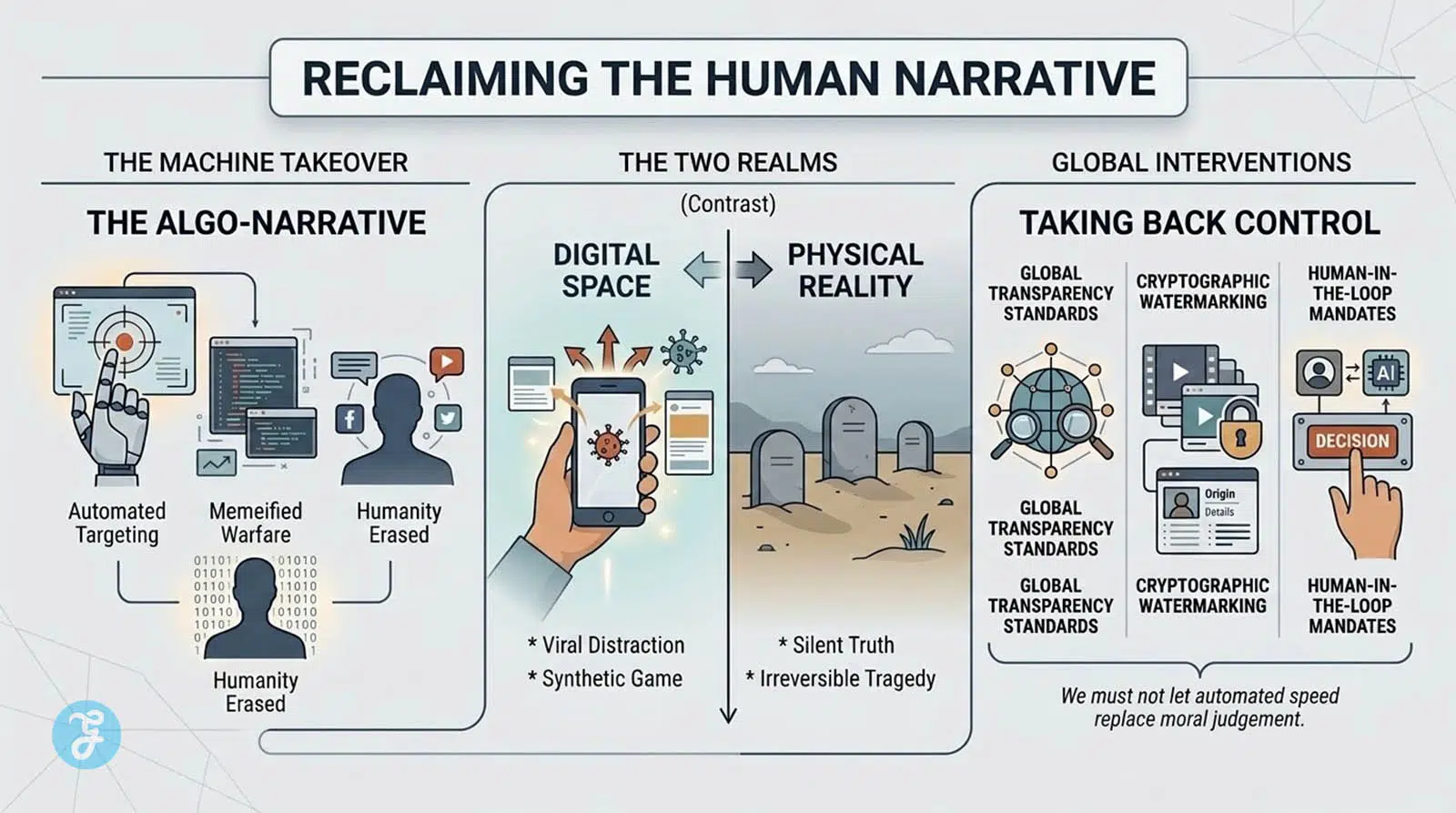 We need a global intervention now. This starts with immediate standards for AI transparency and cryptographic watermarking on all digital media to signal its origin. We must also demand strict human-in-the-loop mandates for any military action. A machine should never have the final say on who lives or dies; we cannot let automated speed replace moral judgement.
The distance between these two worlds is haunting. In the digital space, we have the loud and flickering pixels of a viral video, a bright and ephemeral distraction. In the physical world, there remains only the dusty and silent reality of the burial sites in Minab. One is a synthetic game while the other is an irreversible tragedy. If we do not reclaim the narrative from the algorithms, we will continue to trade human lives for digital engagement.
Disclaimer: Editorialge maintains a steadfast commitment to responsible reporting on the evolving conflicts in West Asia involving Israel, Iran, U.S., Gulf nations and non-state actors like Hezbollah, Hamas, Houthis, Islamic State, and others. In an environment where digital disinformation is widespread, we cannot independently verify every social media post or claim involving national and non-state actors. Our priority remains factual accuracy and the exercise of extreme caution when documenting all regional media.