

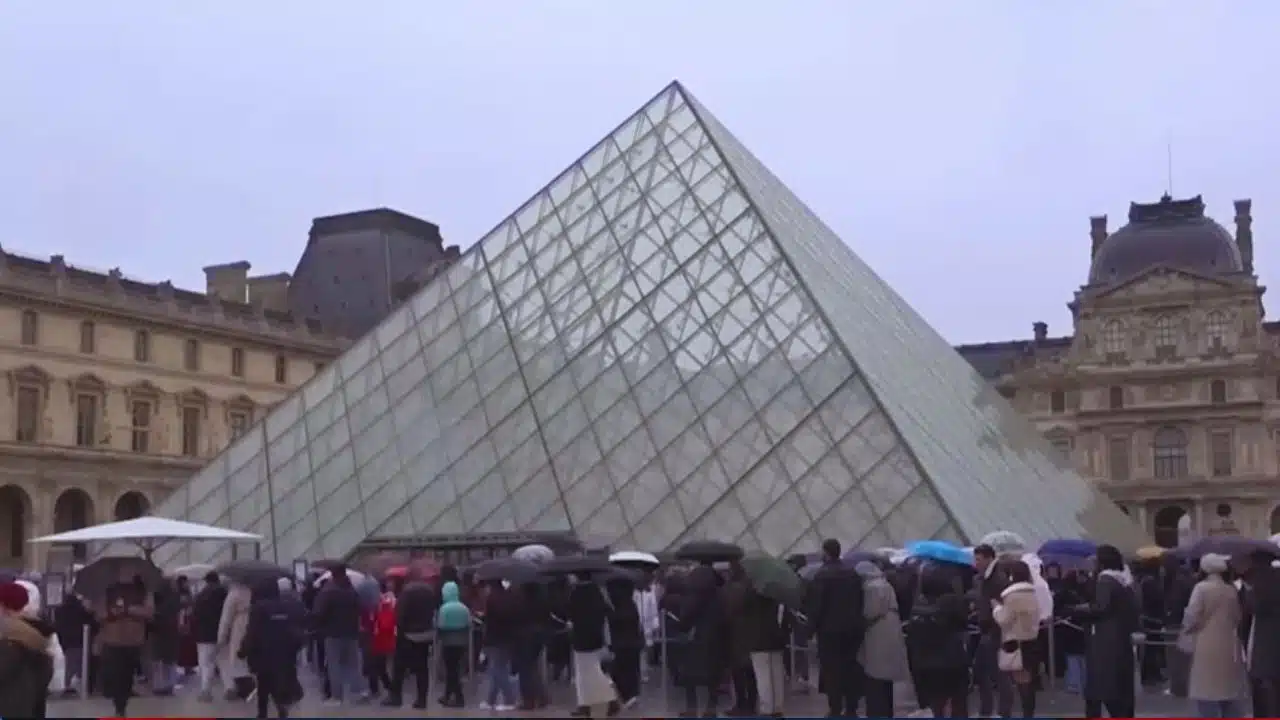
Paris prosecutors have formally charged two men in connection with the audacious October 19 Louvre heist, following their “partial admission” to investigators. However, officials confirmed Wednesday the eight priceless pieces of French Crown Jewels, valued at €88 million, have not been recovered.
The Louvre Robbery
- What Happened: Two suspects were charged Wednesday (Oct 29) with organized theft and criminal conspiracy for the October 19, 2025, daylight robbery at the Louvre Museum.
- The Suspects: Two men, aged 34 and 39, were arrested on October 25. One was detained at Charles de Gaulle airport attempting to fly to Algeria. Both are known to police and were linked by DNA evidence.
- The Loot: Eight pieces of the French Crown Jewels, including items belonging to Napoleon I and Empress Eugénie, are missing. The estimated value is €88 million ($102 million).
- Current Status: The jewels remain missing. At least two other accomplices are at large. The suspects have “partially admitted” their involvement.
- The Fallout: The heist has exposed “major gaps” and “aging systems” in the Louvre’s security, according to Paris’s police chief, sparking a national inquiry.
- Official Warning: Paris Prosecutor Laure Beccuau has publicly warned the “unsellable” jewels are too famous to be fenced, appealing for their return.
A ‘Partial Admission’ as €88M Jewels Vanish
PARIS — In a dramatic development to a case that has both scandalized France and captivated the world, the Paris prosecutor’s office announced Wednesday that two key suspects in the brazen daylight Louvre heist have been charged after offering a “partial admission” of their involvement.
The two men, aged 34 and 39, were brought before magistrates and face preliminary charges of “theft committed by an organized gang,” which carries a 15-year prison sentence, and “criminal conspiracy,” punishable by 10 years.
Speaking at a packed press conference, Paris Prosecutor Laure Beccuau provided the first official details of the breakthrough that occurred on Saturday, October 25, nearly one week after the robbery.
The 34-year-old suspect, an Algerian national residing in France, was apprehended at Charles de Gaulle airport as he attempted to board a one-way flight to Algeria. His DNA was reportedly found on one of the two motor scooters used as getaway vehicles.
The second suspect, 39, was arrested at his home in the Paris suburb of Aubervilliers. He was known to police for previous thefts, and his DNA was crucially found on one of the smashed display cases inside the Louvre’s Apollo Gallery and on tools left at the scene.
While the arrests mark a significant victory for the 100-strong investigative team, Ms. Beccuau delivered the grim news the nation had feared: “The jewels have not been recovered.
She issued a direct warning and a faint appeal to the thieves and any potential handlers, stating:
“These jewels are now, of course, unsellable… Anyone who buys them would be guilty of concealment of stolen goods. There’s still time to give them back.” — Laure Beccuau, Paris Prosecutor.
Anatomy of a 7-Minute Heist
The robbery on Sunday, October 19, was stunning in its audacity and simplicity, targeting the heart of France’s cultural heritage just 30 minutes after the museum opened its doors to the public.
At approximately 9:30 AM local time, the gang, believed to involve at least four members, executed a plan that seemed drawn from a Hollywood script.
- The Approach: The team arrived in a stolen furniture removal truck, which they parked on the Quai François Mitterrand, the quay running alongside the Seine. The truck was equipped with a cherry picker, or freight lift.
- The Entry: Two men, disguised in high-visibility vests to resemble maintenance workers, used the lift to ascend to a first-floor window of the famed Galerie d’Apollon (Apollo Gallery). This gallery, renowned for its painted ceilings, is the historical home of what remains of the French Crown Jewels. They smashed a window that officials later admitted was “unsecured”.
- The Theft: Once inside, the pair used power tools, including disc cutters, to slice open two reinforced glass display cases. The entire operation inside the gallery lasted just 3 minutes and 58 seconds.
- The Loot: The thieves grabbed nine priceless items. They fled back to the cherry picker and descended to the street, where they jumped onto two motor scooters driven by their accomplices and sped away. The entire heist was completed in under eight minutes.
In their haste, the robbers dropped one item—the gold, diamond, and emerald Crown of Empress Eugénie—which was recovered at the scene, though officials say it was badly damaged.
The eight missing pieces, however, represent an “immeasurable heritage value.” They include:
- An emerald and diamond necklace given by Napoleon I to his second wife, Empress Marie-Louise.
- A stunning diadem belonging to Empress Eugénie, wife of Napoleon III, set with 212 pearls and nearly 2,000 diamonds.
- A sapphire tiara, necklace, and earring set once belonging to Queen Marie-Amélie.
- A large diamond corsage brooch and a reliquary brooch, also from Empress Eugénie’s collection.
The total estimated value of the missing items is €88 million (£76 million / $102 million).
‘A Technological Step Not Taken’: Systemic Security Failures Exposed
The heist has triggered a painful national reckoning over the security of France’s most treasured institutions. In a stunning hearing before the French Senate on Wednesday, Paris Police Chief Patrice Faure admitted to “major gaps” in the Louvre’s defenses.
Mr. Faure told lawmakers that “a technological step has not been taken” at the world’s most-visited museum.
Key failures and admissions cited in the hearing include:
- Aging Systems: Parts of the Louvre’s massive video surveillance network are still analog, producing low-quality images that are slow to share in real-time.
- Delayed Upgrades: A long-promised €80-€93 million security overhaul, requiring 60 kilometers of new cabling, is not expected to be complete until 2029 or 2030.
- Expired Permit: In a baffling bureaucratic lapse, the Louvre’s authorization to even operate its security cameras had reportedly expired in July 2025 and had not been renewed.
- The First Alert: The first call to police did not come from the museum’s sophisticated internal alarms. It came from a cyclist on the quayside who saw the men on the freight lift and dialed the emergency line.
The museum’s director, Laurence des Cars, had previously acknowledged security blind spots, noting that a key external camera near the Apollo Gallery was pointing in the wrong direction to cover the window the thieves used.
This confirms warnings from staff unions, which have long complained of security risks. On the day of the heist, the Union syndicale Solidaires issued a statement blaming “the destruction of security jobs” for undermining safety at the museum.
A tour guide who was in a nearby room described the chaos as the alarms finally blared. “I was just trying to figure out what’s happening,” guide Ryan el Mandari told, “…when I saw the museum staff…they started running and saying ‘get out, get out, get out, get out, evacuate!'”.
The ‘Unsellable’ Treasure: A Race Against Time
With the jewels now in the wind for 11 days, fears are mounting that they will be lost forever. INTERPOL has officially added all eight items to its global Stolen Works of Art database, alerting police forces and auction houses in 196 member countries.
But experts, including France’s Interior Minister Laurent Nuñez, have expressed grave concern that the thieves are not looking to sell the items whole. The jewels are too famous, their provenance too absolute, to ever be sold on the legitimate—or even high-end illicit—market.
The far greater risk is that the gang will break the items apart. The historic gold and platinum settings, themselves works of art, would be melted down for their raw value. The thousands of diamonds, emeralds, and sapphires would be recut and sold off individually, forever destroying their lineage.
This concern is amplified by another shocking revelation: the jewels, as items of national heritage, were not privately insured. The loss, if permanent, is a total cultural and financial write-off for the state.
In response to the crisis, French officials have taken the extraordinary step of secretly transferring the Louvre’s remaining crown jewels. Prized items, including the 140-carat “Regent” diamond and the 55-carat “Sancy” diamond, were moved under heavy police escort last week to the ultra-secure underground vault of the Banque de France, known as “la Souterraine,” where they will be stored alongside the national gold reserves.
The investigation is far from over. With two suspects in custody, the focus for the BRB (France’s elite anti-gang unit) now shifts to two critical objectives: locating the two or more accomplices still at large and, most importantly, finding the jewels before they can be destroyed.
For the two men charged, the “partial admission” is a major step, but the legal road is long. They are being held in provisional detention as the magistrate-led investigation continues.
For the Louvre and the French government, the hard work of restoring public trust and physically securing its treasures has just begun. The Senate inquiry will continue, and pressure is mounting on the Culture Ministry to fast-track the security upgrades that were ignored for too long.
The October 19 heist has been a “terrible failure,” in the words of the museum’s own director. The arrests on Wednesday are a partial victory, but the clock is ticking, and the fate of Napoleon‘s emeralds and Eugénie’s diamonds hangs precariously in the balance.
The Information is Collected from BBC and CNN.
























