You use natural language processing when a search engine understands a loosely worded question, an email service catches spam, a phone transcribes speech, or an AI assistant summarizes a document.
Most of the time, the technology works quietly. People tend to notice it only when something goes wrong: a translation sounds strange, a voice assistant misunderstands a name, or a chatbot produces a confident answer that is not true.
What is Natural Language Processing?
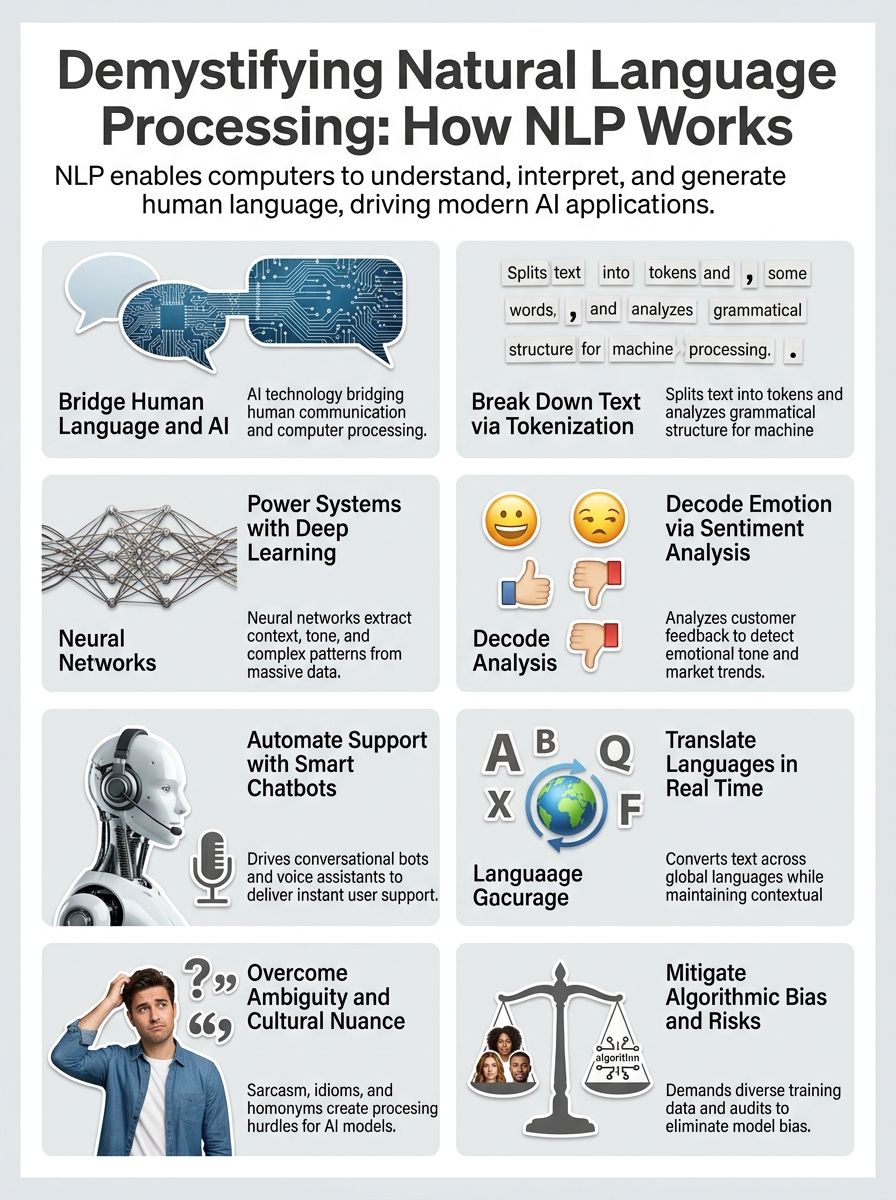
Natural language processing, or NLP, is a field of artificial intelligence that helps computers analyze, interpret, transform, and generate human language. It allows software to work with text and speech for tasks such as search, translation, classification, summarization, information extraction, transcription, and question answering.
That is the direct definition. The harder part is understanding what the word language asks a computer to handle. Human communication is incomplete, ambiguous, emotional, cultural, and full of shortcuts. We change meanings through tone. We leave information unstated. We use the same word in several ways, switch languages mid-sentence, misspell names, and expect other people to understand what we meant.
Natural language processing tries to make that untidy communication usable by software without stripping away the meaning that made it useful in the first place. Stanford’s current Speech and Language Processing manuscript treats tokens, embeddings, language models, transformers, translation, information extraction, speech recognition, retrieval, and conversation as connected parts of this wider field.
What Does “Natural Language” Mean?
Natural language is language people use to communicate with one another. English, Bangla, Arabic, Spanish, Japanese, and thousands of other human languages are natural languages. They developed through human use rather than being deliberately designed as instruction systems for machines.
Programming languages work differently. Python, Java, and SQL follow formal rules. A missing symbol or incorrect command can stop a program from running.
People are far more forgiving. Someone can write: “Send me last month’s sales numbers.” The request does not identify the database, table, date format, region, currency, or preferred layout. A colleague may still understand it because they know the surrounding situation. A computer needs that context to be supplied, inferred, or retrieved.
NLP systems may process:
- Search queries
- Emails and messages
- Reports and contracts
- Product reviews
- Customer-support tickets
- Social media posts
- Medical notes
- Meeting transcripts
- Spoken commands
- Questions submitted to a chatbot
Speech applications usually involve several technologies. A speech-recognition system may first convert sound into text. NLP methods can then identify the meaning, extract details, classify the request, or generate a response.
Why Is Human Language So Difficult for Computers?
Human language rarely offers one perfectly correct interpretation. People normally resolve uncertainty through context, shared knowledge, tone, body language, and experience. A computer sees a sequence of inputs and has to calculate which interpretation is most likely or useful.
One Word Can Carry Several Meanings
Consider the word bank. It may refer to:
- A financial institution
- The side of a river
- A reserve or collection
- Tilting an aircraft
- Depending on something, as in “bank on it”
The sentence usually narrows the meaning: “She deposited the cheque at the bank.” “They sat on the river bank.” A language model needs to use the surrounding words to represent the two instances differently.
Grammar Does Not Reveal Everything
Consider this sentence: “Alex told Jordan that the report was wrong.” The grammar may be clear, but several questions remain:
- Who wrote the report?
- Who first believed it was wrong?
- Was the report actually incorrect?
- What was discussed before this sentence?
A system may parse the sentence correctly and still lack the background needed to interpret it fully.
Tone Can Reverse the Literal Meaning
A customer writes: “Fantastic. The app crashed again.” The word “fantastic” usually looks positive. Here, it expresses frustration.
A basic sentiment system that relies heavily on individual keywords may misclassify the comment. A stronger system needs to recognize the contrast between the positive word and the negative event.
Real Language Is Rarely Clean
People use:
- Misspellings
- Slang
- Abbreviations
- Emojis
- Missing punctuation
- Regional expressions
- Voice-transcription errors
- Mixed languages
- Incomplete sentences
A support message might say: “pkg still not here pls check asap” A useful system has to connect “pkg” with “package,” detect urgency, and infer that the customer wants delivery assistance.
Meaning Can Depend on Earlier Sentences
Look at this exchange: “Did Maria approve the budget?” “She said the revised version looked fine.” Understanding she and the revised version requires information from the previous question and perhaps from earlier messages.
This is one reason long documents and conversations are harder to process reliably than isolated sentences.
How Does Natural Language Processing Work?
There is no single workflow used by every NLP application. A spam filter, translation engine, contract extractor, voice assistant, and generative chatbot solve different problems. They may use different data, models, rules, and evaluation methods.
Still, most systems perform some version of five broad steps.
1. The System Receives Language
The input may come from:
- Typed text
- A webpage
- A digital document
- A database field
- A scanned form
- A recorded call
- A live microphone
- A chat conversation
A scanned document may first pass through optical character recognition. Speech may first be converted into text. The output from those systems then becomes input for language processing.
Input quality matters. A clean digital document is easier to analyze than a blurry scan containing handwriting, damaged text, and complex tables.
2. The Language Is Divided Into Tokens
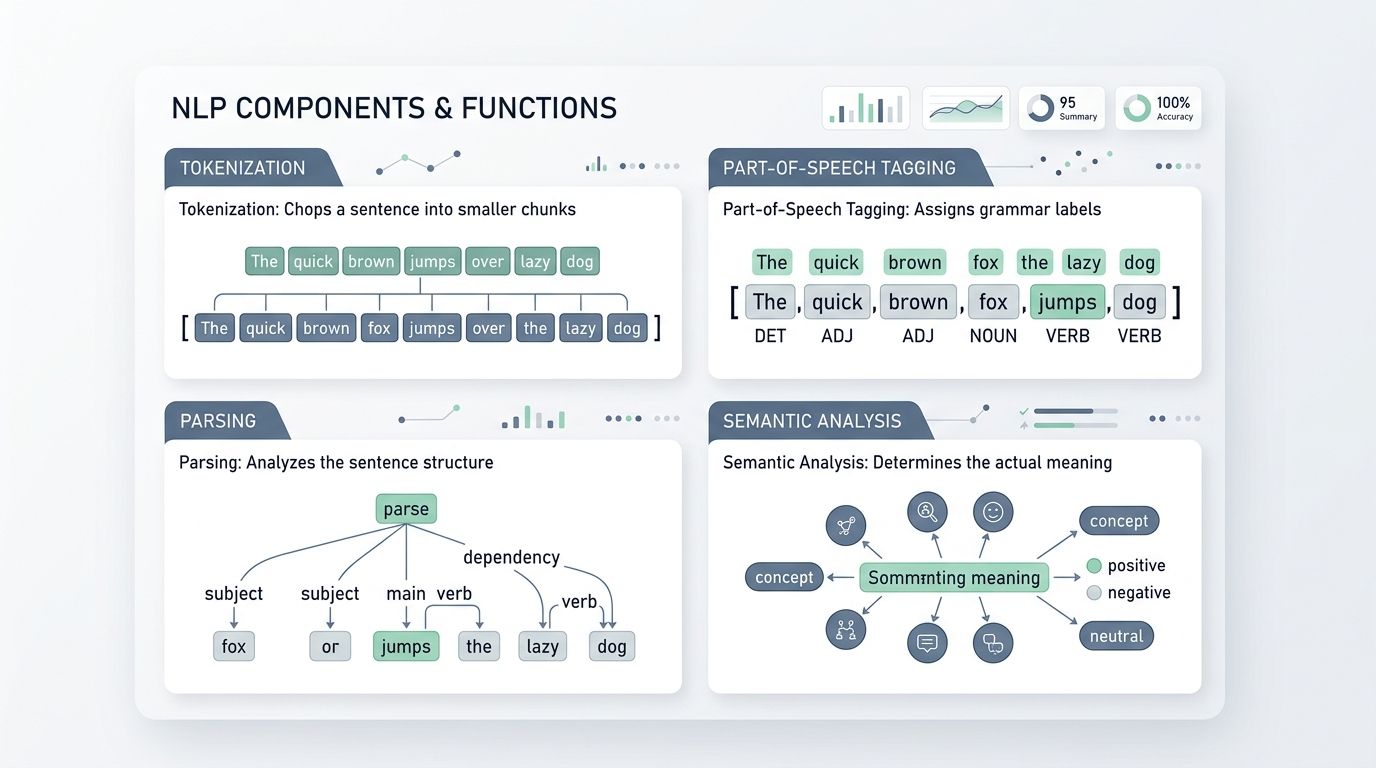
A model does not usually process a paragraph as one indivisible object. It divides the language into smaller units called tokens. A token may be a word, part of a word, punctuation mark, number, or special symbol.
For example: “The delivery was unbelievable.” might be divided into whole words. Another tokenizer may split “unbelievable” into smaller subword pieces.
Subword tokenization helps models handle rare words, unfamiliar names, spelling variations, and related word forms without storing every possible word as a separate item. Modern transformer systems and large language models generally perform their processing on tokens or subword tokens.
3. Tokens Are Converted Into Numerical Representations
Computers do not interpret words directly as people do. Tokens are converted into numbers that a model can process. Modern systems often use embeddings, which represent words, sentences, or documents as points in a mathematical space.
Terms appearing in similar contexts may receive related representations. This can help a model recognize that “doctor” and “physician” are connected even though they are different strings.
Contextual models can represent the same word differently depending on its surroundings. The representation of “bank” in “bank account” should differ from its representation in “river bank.”
4. A Model Performs a Language Task
Once the input has been represented numerically, a model applies patterns learned from rules, statistics, labelled examples, or large training datasets.
It might:
- Assign a category
- Identify a person or organization
- Detect sentiment
- Find grammatical relationships
- Retrieve a relevant document
- Translate a sentence
- Predict the next token
- Generate a response
Some systems do only one narrowly defined job. A spam classifier may produce little more than “spam” or “not spam.” Large language models can attempt many tasks through instructions, examples, fine-tuning, retrieval, and external tools.
5. The System Produces an Output
The output depends on the task.
It could be:
- A classification label
- A translated sentence
- A list of extracted dates
- A summary
- A transcript
- A search result
- A recommended action
- A generated answer
The output then needs to be evaluated. That evaluation may compare it with human labels, expected answers, business rules, expert reviews, or task-specific benchmarks. A response that sounds fluent is not necessarily a correct response.
A Simple NLP Example From Input to Output
Imagine that an online retailer receives this review: “The headphones sound good, but the left side stopped working after two days.”
One NLP system could:
- Receive the review as text.
- Divide it into tokens.
- Convert those tokens into numerical representations.
- Identify the product as headphones.
- Detect positive sentiment about sound quality.
- Detect negative sentiment about reliability.
- Extract the defect: the left side stopped working.
- Classify the complaint as a product-quality issue.
- Route it to a support or quality-control team.
A basic system may only label the review as negative. A more capable one can recognize that the review contains mixed sentiment, isolate the defective component, summarize the issue, and suggest a support response.
The difference matters. NLP is not one ability. It is a collection of methods used to perform different language tasks.
What Are the Main Approaches to NLP?
NLP did not begin with large language models, and older methods did not suddenly become useless when transformers appeared. Rule-based, statistical, machine-learning, and neural approaches still coexist. Many dependable production systems combine them.
Rule-Based NLP
Rule-based systems rely on patterns, dictionaries, grammatical instructions, and manually written conditions.
A rule might look for:
- A known product name
- An invoice number with a predictable format
- A date written in a particular pattern
- Words associated with cancellation
- A legally required phrase
These systems can be transparent and reliable in narrow situations. If an account number must follow one exact format, a clear rule may be safer and cheaper than asking a large model to identify it.
The weakness is variation. A rule designed to catch “cancel my subscription” may miss:
- “Stop charging me”
- “I don’t want to renew”
- “Close my account”
- “End the plan after this month”
Maintaining enough rules to cover natural language quickly becomes difficult.
Statistical NLP
Statistical NLP learns patterns and probabilities from language data. A statistical model might estimate:
- Which word is likely to appear next
- Which label best matches a document
- Which translation is more probable
- Which sequence of grammatical labels makes sense
Earlier language models often relied on n-grams, or short sequences of words. These models were limited by how little context they could consider, but they played important roles in spelling correction, predictive text, speech recognition, and machine translation.
Machine Learning and Deep Learning
Machine-learning models learn from examples rather than depending entirely on manually written language rules. A sentiment classifier might be trained on thousands of reviews labelled positive, negative, or neutral. It learns which combinations of words and patterns tend to correspond with each category.
Deep neural networks made it possible to learn more complex language representations and capture longer relationships.
These methods produced major improvements in:
- Translation
- Speech recognition
- Search
- Text classification
- Question answering
- Information extraction
Smaller specialist models still make sense when the task is narrow, repetitive, inexpensive to evaluate, or sensitive to speed and cost.
Transformers and Large Language Models
Transformers changed modern NLP by helping models weigh relationships among tokens across longer passages. The architecture uses attention mechanisms to model which parts of the input matter to one another. Transformers are now the standard architecture behind most large language models.
Large language models are trained on enormous collections of language data, usually by learning to predict tokens. They can later be prompted, fine-tuned, or connected to tools to perform tasks such as:
- Summarization
- Translation
- Classification
- Extraction
- Question answering
- Text generation
I would not treat this as proof that LLMs have replaced NLP. The wider field still includes speech recognition, parsing, search, information retrieval, text classification, named entity recognition, rule systems, and smaller specialist models. Stanford’s 2026 textbook places LLMs and transformers alongside those subjects rather than presenting them as the whole discipline.
Hybrid NLP Systems
A practical business system may combine:
- Rules for fixed formats
- A classifier for user intent
- Entity recognition for names and dates
- Search for verified documents
- An LLM for generating a readable answer
- Validation before the answer is released
This is often more dependable than asking one generative model to perform every step. A financial assistant, for example, might use a language model to interpret a question but rely on a verified database query for the account balance and fixed rules for compliance.
What Are the Benefits of Natural Language Processing?
Language contains enormous amounts of useful information that does not fit neatly into database columns. NLP helps make that information searchable, measurable, and easier to act on.
It Can Process Large Volumes of Language
A company may receive thousands of reviews, support tickets, messages, and calls every day. NLP can organize that volume and help employees identify the items requiring attention.
It Converts Unstructured Text Into Structured Data
A spreadsheet cannot easily analyze an entire contract.
An NLP system may extract:
- Party names
- Dates
- Payment terms
- Renewal clauses
- Locations
- Obligations
Those details can then be searched, compared, counted, or reviewed.
It Improves Search
NLP helps search systems find relevant information even when the document and query use different wording. This is especially useful in large knowledge bases, product catalogues, research libraries, and company archives.
It Automates Repetitive Language Tasks
NLP can assist with:
- Routing emails
- Categorizing support tickets
- Summarizing reports
- Extracting form data
- Transcribing calls
- Drafting routine responses
The strongest implementations automate repetitive steps while preserving human review for decisions involving judgment or risk.
It Supports Multilingual Access
Translation and cross-language search can make information available to more people. That benefit is not distributed equally. Systems typically perform better in languages with abundant digital data, tools, and research support.
It Makes Software Easier to Use
Natural-language interfaces allow users to ask for information without learning a rigid command structure. A manager may ask, “Which products had the most returns last quarter?” instead of writing a database query.
Language Is the Interface, Not the Guarantee
Natural language processing matters because language contains decisions, complaints, knowledge, agreements, questions, and records. Much of that information was historically difficult for computers to use because it did not fit neatly into tables and fixed fields.
NLP provides a bridge between human communication and computational systems. It allows software to search, classify, extract, translate, summarize, transcribe, and generate language at a scale that manual work cannot match.
Its weaknesses come from the same source as its value. Human language is contextual, cultural, ambiguous, and constantly changing. A system can recognize remarkable patterns without possessing human judgment. It can produce fluent text without knowing whether every claim is true.
Understanding natural language processing is therefore requires holding two ideas at once: NLP can make language far more useful and accessible. It still needs careful evaluation, reliable data, appropriate safeguards, and human judgment wherever errors matter.
Frequently Asked Questions on Natural Language Processing
1. What Is NLP in Simple Words?
NLP is technology that helps computers work with human language. It allows software to read, search, classify, translate, summarize, transcribe, and generate text or speech.
2. What Is an Example of Natural Language Processing?
A spam filter is a simple example. It analyzes an email and classifies it as spam or legitimate. Search engines, translation tools, chatbots, voice assistants, and sentiment-analysis systems are also NLP applications.
3. What Is the Difference Between NLP and an LLM?
NLP is a field of technology and research. An LLM is one type of model used to perform NLP tasks. NLP also includes rules, statistical methods, speech systems, search tools, classifiers, and smaller specialist models.
4. Does NLP Work With Speech or Only Text?
NLP works with both. Speech systems may convert audio into text before applying language analysis, although modern multimodal models can also process audio and language within a connected system.
5. What Programming Languages Are Used for NLP?
Python is widely used because of its machine-learning and NLP libraries. Java, C++, JavaScript, R, and other languages are also used depending on the application, infrastructure, and performance requirements.