

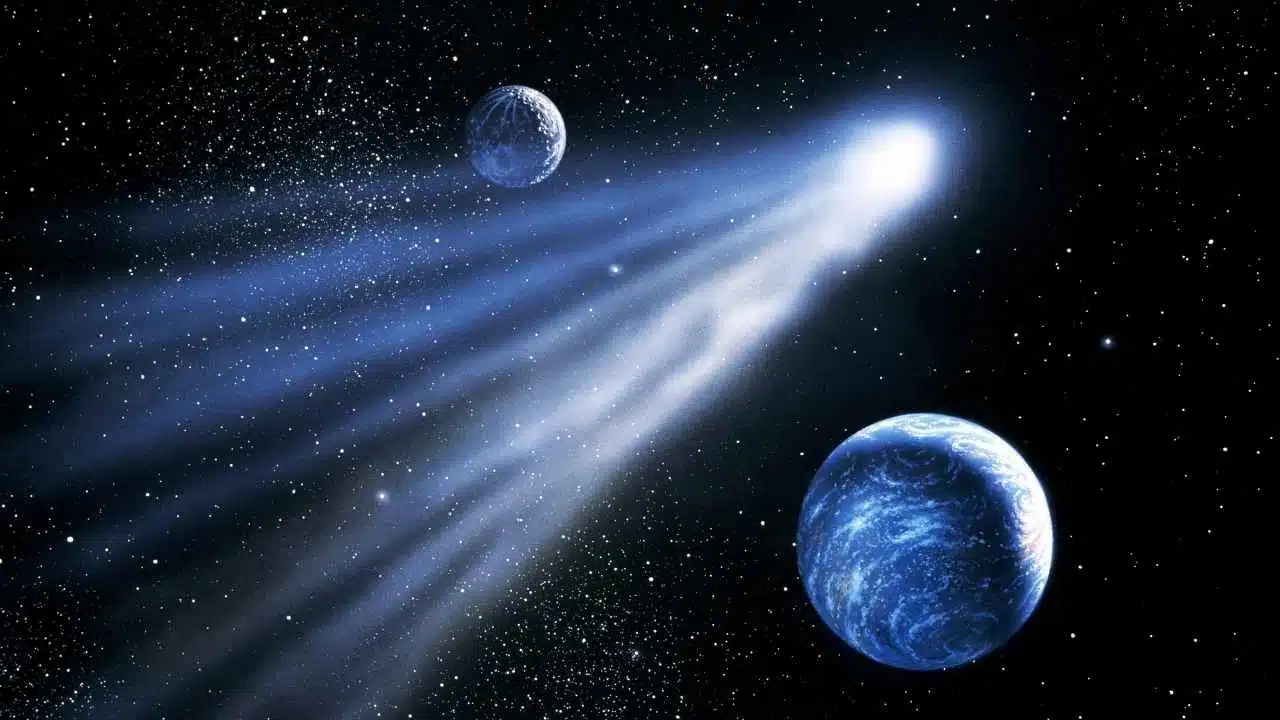
Interstellar comet 3I ATLAS made its closest approach to Earth on December 19, 2025, passing safely about 1.8 AU (around 270 million km) away. Astronomers used a tight observing window—plus help from spacecraft—to measure its speed, orbit, activity, and likely size before it heads back into interstellar space.
Closest approach: what happened, how close, and why it mattered?
On December 19, 2025, interstellar comet 3I/ATLAS reached its closest point to Earth—still very far away by space standards. NASA’s published figures put the minimum distance at about 1.8 astronomical units (AU), which equals roughly 270 million kilometers (about 170 million miles). That is nearly twice the average Earth–Sun distance, so the flyby was never a risk event.
The scientific value came from timing, not proximity. Interstellar objects move quickly and fade as they recede, so researchers aim to gather as much data as possible while the target remains bright enough for telescopes. For 3I/ATLAS, the days around closest approach offered improved viewing geometry after the comet had been difficult to observe during parts of its path near the Sun’s glare earlier in the year.
Even so, this was not a “look up and see it” moment for most people. The comet’s distance and brightness meant that meaningful viewing required telescopes and, in many cases, long-exposure imaging. For professionals, those conditions were enough: the goal was to capture spectra (light “fingerprints”) and images that reveal how much gas and dust the comet releases and how that activity changes as it travels outward.
Key numbers from the flyby window
| Measurement | Best-reported figure |
| Closest approach to Earth | Dec. 19, 2025 |
| Closest distance to Earth | ~1.8 AU (~270 million km / ~170 million miles) |
| Perihelion (closest to the Sun) | Late Oct. 2025 |
| Perihelion distance | ~1.36–1.4 AU (just outside Mars’ orbit) |
| Safety risk to Earth | None |
How 3I/ATLAS was discovered and confirmed as interstellar?
3I/ATLAS was reported on July 1, 2025, after detection by a NASA-supported ATLAS survey telescope in Rio Hurtado, Chile. ATLAS (Asteroid Terrestrial-impact Last Alert System) is part of a broader sky-monitoring effort that repeatedly scans wide areas to spot moving objects.
Within days, astronomers around the world began follow-up tracking. Early orbital solutions quickly pointed to something unusual: the comet’s path was not a closed ellipse like most comets and asteroids in our solar system. Instead, it followed a hyperbolic trajectory—meaning it is moving too fast to be gravitationally bound to the Sun. In practical terms, it is a one-time visitor that will pass through and never return.
NASA also highlighted the comet’s extreme speed. At discovery it was already moving around 221,000 km/h, later accelerating under the Sun’s gravity to about 246,000 km/h near perihelion. Those values fit what scientists expect when an object falls inward from interstellar space, swings past the Sun, and then climbs back out.
NASA also stated that the comet approached from the general direction of Sagittarius, toward the central region of the Milky Way—an arrival direction that supports an origin outside the solar system without identifying a specific parent star.
Orbit snapshot (why its path matters)
The International Astronomical Union’s Minor Planet Center lists a set of orbital elements that underline how extreme this trajectory is—especially its high eccentricity and near-retrograde inclination.
| Orbital parameter | Reported value (rounded) |
| Official designation | 3I/ATLAS = C/2025 N1 (ATLAS) |
| Perihelion date | 2025-10-29.483 (UT scale in MPC listing) |
| Perihelion distance (q) | ~1.356 AU |
| Eccentricity (e) | ~6.139 |
| Inclination (i) | ~175.113° (nearly retrograde) |
A near-180° inclination indicates a retrograde orbit—moving opposite the direction most planets travel around the Sun. Retrograde paths are not proof of interstellar origin by themselves, but combined with a clearly hyperbolic orbit, they strengthen the case that this object did not originate in the solar system.
What scientists observed: size, activity, and “two tails” seen from space/
Once 3I/ATLAS was confirmed as an interstellar comet, researchers prioritized four questions: How big is it? What is it releasing? How does it behave near the Sun? And how does it compare with earlier interstellar visitors?
Hubble’s size constraints and visible activity
NASA and ESA-associated Hubble reporting emphasized a key limitation: the comet’s solid nucleus cannot be directly seen clearly because it is surrounded by a bright coma of dust and gas. Still, by modeling the coma and brightness, astronomers can estimate a plausible nucleus size range.
NASA’s “Facts and FAQs” page cites Hubble observations from August 20, 2025 and estimates the nucleus is not smaller than ~440 meters and not larger than ~5.6 kilometers in diameter. ESA/Hubble’s photo release similarly reports an upper limit of 5.6 km and notes the nucleus could be as small as ~320 meters. Put simply: scientists can confidently say it is not tiny, but they cannot yet pin down a single diameter.
Hubble also captured signs of ongoing activity, including a dust plume from the Sun-warmed side and indications of a dust tail. Those observations supported a second point: 3I/ATLAS behaves in broadly comet-like ways when heated, even though it formed elsewhere.
JUICE: a spacecraft view that caught a clear coma and hints of two tails
One of the most striking updates came from ESA’s Jupiter Icy Moons Explorer (JUICE). In November 2025, JUICE used five science instruments to observe 3I/ATLAS and also snapped it with its navigation camera (NavCam)—a camera primarily meant for spacecraft operations, not detailed comet science.
ESA reported that a NavCam image taken on November 2, 2025 clearly showed the comet surrounded by a glowing coma and hinted at two tails:
- a plasma tail (electrically charged gas shaped by the solar wind), and
- a dust tail (tiny solid particles pushed by sunlight).
JUICE’s closest approach occurred on November 4, 2025, at about 66 million kilometers—still far, but close enough for a useful spacecraft viewpoint. ESA also said the full instrument data set will arrive later, with downlinks expected in February 2026. That means some of the most valuable chemistry and behavior results from JUICE may still be in the pipeline.
Europa Clipper’s ultraviolet spectrograph: a unique angle when Earth-based viewing struggled
A separate spacecraft contribution came from NASA’s Europa Clipper mission, which observed the comet with an ultraviolet spectrograph during a period when geometry and the Sun’s position made Earth-based tracking difficult. A Southwest Research Institute (SwRI) release described how the ultraviolet instrument could detect signatures tied to fundamental comet gases and dust-related features. The same update also explained why the viewing angle mattered: from that spacecraft perspective, the instrument could view the comet and its tails from a direction that ground-based observatories could not match.
Together, these observations strengthen a central conclusion: 3I/ATLAS is an active comet, with gas and dust release driven by solar heating, and its behavior is consistent with known comet physics rather than requiring exotic explanations.
What we know so far (observations summary)?
| Topic | What has been reported so far |
| Object type | Active interstellar comet with nucleus + coma |
| Nucleus size | Constrained range (hundreds of meters to a few kilometers) |
| Activity | Dust and gas outgassing increases near the Sun |
| Tail structure | Evidence for plasma + dust tails from spacecraft imaging |
| Speed profile | Extremely fast; accelerated near perihelion as expected |
| Earth risk | None (closest approach ~1.8 AU) |
Why this interstellar comet is important, and how it compares with earlier visitors?
Interstellar objects are rare in confirmed form, but they are scientifically valuable because they may preserve material formed around other stars—a kind of natural sample delivered to our neighborhood.
The big scientific promise is comparison: if researchers can measure the kinds of gases (like water vapor, carbon-bearing molecules, or other volatiles) and the dust characteristics released by 3I/ATLAS, they can compare those properties to comets from our own solar system and to the prior interstellar discoveries.
The “three confirmed visitors” context
3I/ATLAS follows two earlier confirmed interstellar objects:
- 1I/‘Oumuamua (2017), which appeared asteroid-like and sparked debate because it showed unusual non-gravitational acceleration and no obvious coma at the time.
- 2I/Borisov (2019), a clearly active comet whose behavior looked more familiar, though its chemistry and dust properties drew intense study.
3I/ATLAS is important because it is:
- another data point for how common interstellar comets may be,
- another test of survey capability (how early we can detect and characterize them), and
- another chance to study comet activity in a body that formed beyond the Sun’s influence.
Comparison table: 1I vs 2I vs 3I
| Object | Year confirmed | Type | What stood out |
| 1I/‘Oumuamua | 2017 | Asteroid-like (no clear coma) | Unusual acceleration; intense debate over nature |
| 2I/Borisov | 2019 | Active comet | Clear coma/tail; chemistry compared with solar comets |
| 3I/ATLAS | 2025 | Active comet | Very fast hyperbolic orbit; spacecraft observations added new angles |
Beyond pure astronomy, there is also a practical angle: modern survey networks designed partly for planetary defense can also become powerful tools for basic science. The faster an unusual object is discovered, the more time scientists have to coordinate telescope time, spacecraft opportunities, and laboratory-style modeling before the object fades.
What happens next: outbound path, upcoming data releases, and what to watch in 2026?
By late December 2025, 3I/ATLAS was already heading outward. NASA has emphasized that as it leaves the solar system, it will continue on a hyperbolic path and eventually return to interstellar space, with its outbound speed trending toward the same “at-infinity” speed it had on the way in.
The next phase is less about dramatic close passes and more about analysis and delayed data:
- JUICE instrument data from November 2025 is expected to be returned and assessed in February 2026, which could sharpen understanding of the comet’s composition and activity.
- Continued Earth-based observing campaigns are expected through spring 2026, as long as the comet remains observable and bright enough.
- NASA has also noted the comet’s path takes it outward through the region of the giant planets; by March 2026, it will be passing deeper into the outer solar system, where it will likely become progressively fainter.
The main milestones
| Date | Milestone |
| July 1, 2025 | Discovery report from ATLAS (Chile) |
| Aug. 20, 2025 | Hubble observations used for nucleus size constraints |
| Late Oct. 2025 | Perihelion (closest to the Sun) |
| Nov. 2, 2025 | JUICE NavCam captures clear coma; hints of two tails |
| Nov. 4, 2025 | JUICE closest approach (~66 million km) |
| Dec. 19, 2025 | Closest approach to Earth (~1.8 AU) |
| Feb. 2026 (expected) | JUICE science instrument data downlinked |
| Spring 2026 | Continued outbound observing window (fading target) |
Interstellar comet 3I/ATLAS did not bring a close-call or a bright spectacle, but it delivered something more valuable to science: a short, well-timed chance to measure the behavior of a comet formed around another star. With Hubble-based size limits, spacecraft views showing active outgassing and tail structure, and more instrument data expected in early 2026, 3I/ATLAS is likely to remain a reference point for how astronomers study the next interstellar visitor—whenever it arrives.





















