
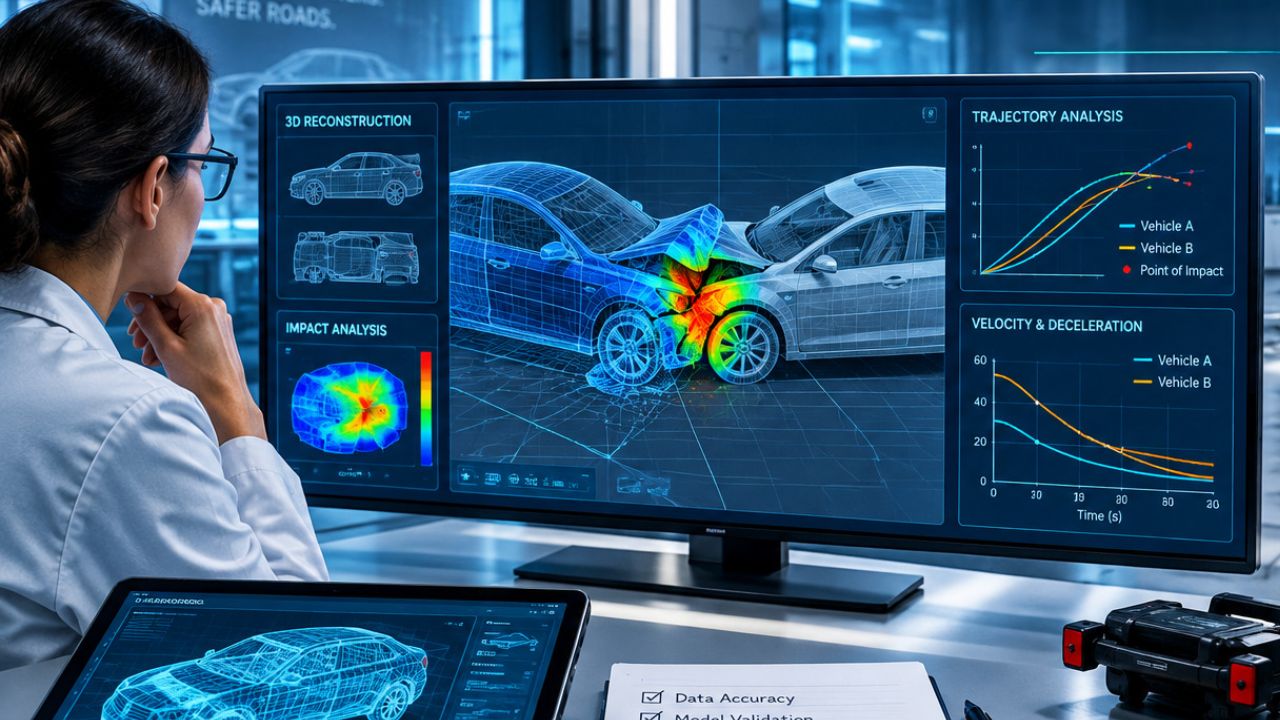
Evaluating accident reconstruction technology is essential for understanding how an accident occurred and determining the factors that contributed to it. From 3D simulation software and digital scene mapping to vehicle dynamics analysis and event data recorders, modern tools help investigators build a clearer picture of what happened.
However, not every solution offers the same level of accuracy, reliability, or usability. Knowing how to evaluate accident reconstruction technology can help forensic investigators, law enforcement professionals, insurance adjusters, and attorneys choose tools that deliver credible evidence, support data-driven decisions, and stand up to legal scrutiny.
What Exactly Does Accident Reconstruction Technology Do
Accident reconstruction technology recreates how a crash happened using physics calculations, scene measurements, and vehicle data. It turns raw evidence into visual diagrams, 3D models, and simulations that explain speed, impact angles, and sequence of events.
These tools generally fall into a few categories:
- Scene mapping software that converts total station, drone, or lidar scans into scaled diagrams.
- Physics-based simulators that calculate speed, momentum, and crush deformation.
- Event Data Recorder (EDR) readers that pull black-box data from vehicles.
- Animation and visualization platforms that turn calculations into courtroom-ready video.
Some platforms, like those built around photogrammetry or lidar point clouds, focus purely on capturing the scene accurately. Others focus on the math: calculating pre-impact speed from crush damage or skid marks. A complete reconstruction workflow usually stitches together two or three different tools rather than relying on one all-in-one package.
How Accurate Is Accident Reconstruction Software Really
Accuracy varies significantly by tool and by how well the input data matches real-world conditions. Reconstruction software is only as accurate as the data fed into it; even top-tier platforms can produce speed estimates with margins of error of 5 to 15 percent when scene data is incomplete.
Independent validation studies, where available, are the only real way to judge this. Look for:
- Published comparison tests against known controlled crash tests (such as those conducted by research institutions or vehicle safety labs).
- Documented uncertainty ranges for drone photogrammetry measurements, which commonly fall between 1 and 5 centimeters depending on flight altitude and camera resolution.
- Peer-reviewed papers, not just vendor white papers, describing the underlying physics model.
What Features Should I Look for When Evaluating Reconstruction Tools
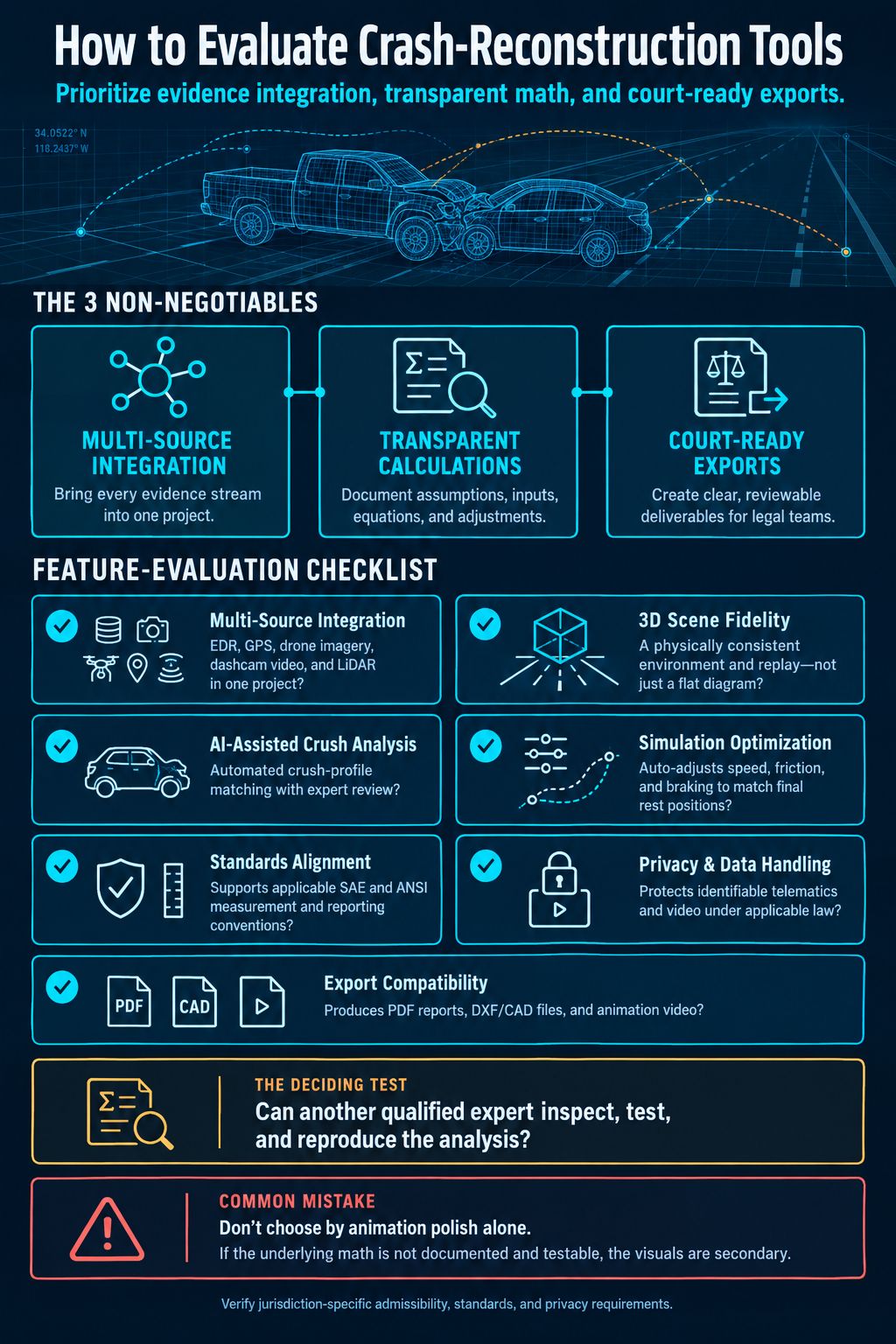
The most important features are multi-source data integration, transparent calculation methods, and court-ready export formats. Everything else is secondary.
Checklist for feature evaluation:
- Multi-source data integration, Can it pull in EDR data, GPS logs, drone imagery, dashcam video, and lidar scans in one project file?
- 3D scene recording and replay, Does it produce a physically consistent 3D environment, not just a flat diagram?
- AI-assisted crush analysis, For multi-vehicle collisions, does the software automate crush profile matching, or does it require manual measurement entry?
- Simulation optimization tools, Can the physics engine auto-adjust variables (speed, friction, braking) to match observed final rest positions, rather than requiring trial-and-error guessing?
- Standards compliance, Does it follow SAE or ANSI measurement and reporting conventions?
- Privacy and data handling, Does it comply with state and federal data privacy rules when handling telematics or dashcam footage containing identifiable information?
- Export compatibility, Can it generate deliverables attorneys and courts actually accept (PDF reports, DXF/CAD files, animation video)?
A common mistake is picking software based on how polished the 3D animation looks, while ignoring whether the underlying math is documented and testable.
How Much Does Accident Reconstruction Technology Cost
Costs range from a few hundred dollars for basic diagramming software to tens of thousands of dollars annually for full enterprise reconstruction suites with drone and lidar integration. Mid-tier professional packages for independent reconstructionists typically run $2,000 to $8,000 per year including support and updates.
| Tier | Typical Annual Cost | Best For |
|---|---|---|
| Basic diagramming tools | $300,$1,500 | Solo investigators, simple property-damage cases |
| Mid-tier reconstruction suites | $2,000,$8,000 | Independent reconstructionists, small firms |
| Enterprise platforms with drone/lidar | $10,000,$50,000+ | Large firms, insurance SIU teams, police departments |
| Hardware (drones, total stations, lidar scanners) | $3,000,$40,000 one-time | Any firm doing in-house scene capture |
Hidden costs often include training time, annual data subscription fees for mapping libraries, and cloud storage for large point-cloud files. Budget for these before signing a contract.
Can Accident Reconstruction Be Used as Evidence in Court
Yes, accident reconstruction evidence is regularly admitted in court, but only when the methodology meets the Daubert or Frye standard applicable in that jurisdiction. Judges look at whether the technique is tested, peer-reviewed, has a known error rate, and is generally accepted in the field.
This means the software itself is rarely the deciding factor, the expert’s methodology is. A reconstructionist who can explain assumptions, data sources, and known limitations will survive a Daubert challenge far more often than one who simply says “the software calculated it.”
What’s the Difference Between 2D and 3D Accident Reconstruction
2D reconstruction produces flat, scaled diagrams showing vehicle positions and paths, while 3D reconstruction creates a spatial model that accounts for elevation, road grade, and vehicle geometry. 3D models generally hold up better in court because they more closely represent the actual scene.
- Choose 2D if: the case involves simple intersection collisions on flat terrain with minimal dispute over elevation or sightlines.
- Choose 3D if: the case involves hills, curves, obstructed sightlines, rollover dynamics, or any scenario where a jury needs to visualize depth and perspective.
3D tools that use drone photogrammetry or lidar scanning capture the real scene geometry rather than relying on measurements alone, which reduces reconstruction error and makes the exhibit harder to challenge.
Do I Need Special Training to Use Accident Reconstruction Software
Yes, most professional-grade reconstruction software requires formal training in physics, vehicle dynamics, and often a certification from a recognized reconstruction program. Software that lets an untrained user generate a “reconstruction” in minutes should be treated with suspicion for any contested case.
Training typically covers:
- Crash dynamics and momentum-energy methods
- Evidence collection standards (skid marks, crush measurements, scene photography)
- Proper use of EDR data and its known limitations
- Courtroom testimony and report writing
What Are the Main Limitations of Reconstruction Technology
The biggest limitation is garbage-in, garbage-out: software cannot fix incomplete or poor-quality scene data. Other limitations include difficulty handling highly complex multi-vehicle chains, inconsistent EDR data across vehicle makes, and AI-based tools that sometimes struggle with scenarios outside their training data.
Known limitation categories:
- Data gaps, missing skid mark measurements or incomplete scene photos lower accuracy significantly.
- EDR inconsistency, not all vehicles record the same data points, and some EDRs lock after airbag deployment in ways that limit retrievable data.
- Weather and surface variables, friction coefficients for wet, icy, or gravel surfaces are often estimated, not measured, introducing error.
- AI text-to-simulation compilers, newer tools that convert plain-language crash descriptions into simulations are improving but can still misinterpret ambiguous witness statements, so outputs need expert review before relying on them.
Is Hiring a Professional Reconstructionist Better Than Using Software
For any case involving disputed liability, serious injury, or multi-vehicle complexity, hiring a trained reconstructionist is better than relying on software alone. Software is a tool the reconstructionist uses; it is not a replacement for professional judgment.
| Factor | Software Only | Professional Reconstructionist |
|---|---|---|
| Cost | Lower upfront | Higher (hourly or flat fee) |
| Court credibility | Limited without expert testimony | Strong, especially with certification |
| Handles ambiguous evidence | Weak | Strong |
| Speed for simple cases | Fast | Slower but thorough |
| Best use case | Low-value claims, internal triage | Litigation, injury, fatality cases |
What Common Mistakes Do People Make with Reconstruction Tools
The most common mistake is trusting software output without validating the input data or understanding the margin of error. A close second is using a single data source (like only GPS or only EDR) when the case calls for cross-referencing multiple sources.
Other frequent mistakes:
- Skipping scene calibration steps during drone photogrammetry capture, which inflates measurement error.
- Failing to document chain of custody for dashcam or telematics footage.
- Assuming AI-generated crush analysis is final rather than a starting point for expert review.
- Not checking software version/update history, since physics engines get corrected over time.
How Do Insurance Companies Use Accident Reconstruction Technology
Insurance companies primarily use accident reconstruction technology for fast liability triage, fraud detection, and settlement negotiation support. Special Investigation Units (SIU) often rely on software-based crush analysis and telematics data to flag inconsistencies between a claimant’s story and physical evidence.
Typical insurer workflow:
- Pull available telematics, dashcam, or EDR data shortly after the claim is filed.
- Run a quick software-based reconstruction to estimate speed and impact severity.
- Compare the output against the claimant’s and witnesses’ statements.
- Escalate to a hired independent reconstructionist only if the claim is high-value or contested.
This approach keeps costs down for routine claims but means insurers sometimes rely on lower-fidelity reconstructions that a plaintiff’s expert can challenge later in litigation.
Can This Tech Work for Complicated Multi-Vehicle or Hit-and-Run Cases
Yes, but multi-vehicle and hit-and-run cases require more advanced tools and significantly more manual expert oversight than single-vehicle crashes. AI-powered multi-vehicle collision modules can help sequence impacts, but they need clean data from every involved vehicle to work well.
For hit-and-run cases specifically, reconstruction often depends on:
- Surveillance or dashcam footage recovered from nearby vehicles or businesses
- Paint transfer and debris field analysis matched against potential suspect vehicles
- Fleet telematics data if a commercial vehicle is suspected
What Happens When Reconstruction Software Gives Conflicting Results
Conflicting results between two tools almost always trace back to differences in input data, assumed friction coefficients, or measurement methods, not a flaw in the physics itself. The fix is to audit the inputs before assuming either output is wrong.
Steps to resolve conflicts:
- Compare the raw input data each tool used (scene measurements, EDR values, friction assumptions).
- Check whether one tool used a more conservative or outdated friction coefficient model.
- Re-run both simulations with identical input values to isolate whether the difference is data-driven or model-driven.
- If results still diverge significantly, bring in a third-party reconstructionist to arbitrate the methodology.
Which Accident Reconstruction Platforms Work Best for Small vs Large Firms
Small firms and solo investigators generally do best with mid-tier, single-license software that covers diagramming and basic simulation, while large firms need enterprise platforms with multi-user licensing, cloud collaboration, and drone/lidar integration.
- Choose a lean, mid-tier platform if: you handle fewer than 50 cases a year, mostly single-vehicle or two-vehicle collisions, and don’t need in-house drone capture.
- Choose an enterprise suite if: you run multiple offices, handle high-value litigation regularly, and need standardized reporting across a team of investigators.
Firms scaling up should also budget for training costs, since enterprise tools usually require certified operators to produce defensible reports.
Final Thoughts
Evaluating accident reconstruction technology comes down to three things: validated accuracy, honest handling of multi-source data, and a track record that holds up in court. Don’t judge a platform by its animation quality alone. Ask vendors for validation studies, test how the tool handles incomplete data, and confirm it exports reports that a judge and jury can actually follow.
Next steps: request a trial license and run it against a case you’ve already solved manually, compare the output against your known results, and only commit to a long-term contract once the software’s error margin matches what the vendor claims.
Frequently Asked Questions
What exactly does accident reconstruction technology do?
It converts physical evidence like skid marks, vehicle damage, and scene measurements into calculations and visual models that explain how a crash occurred, including speed, sequence, and impact angles.
How accurate is accident reconstruction software really?
Accuracy depends heavily on data quality; even strong platforms can show 5 to 15 percent margins of error when scene data is incomplete, so always ask for validation studies before trusting the output.
What features should I look for when evaluating reconstruction tools?
Prioritize multi-source data integration (EDR, GPS, drone, lidar), transparent physics calculations, court-ready export formats, and compliance with recognized measurement standards.
How much does accident reconstruction technology cost?
Costs range from a few hundred dollars for basic diagramming tools to over $50,000 annually for enterprise platforms with drone and lidar integration.
Can accident reconstruction be used as evidence in court?
Yes, but it must meet Daubert or Frye admissibility standards, meaning the methodology needs to be tested, peer-reviewed, and generally accepted, not just software-generated.