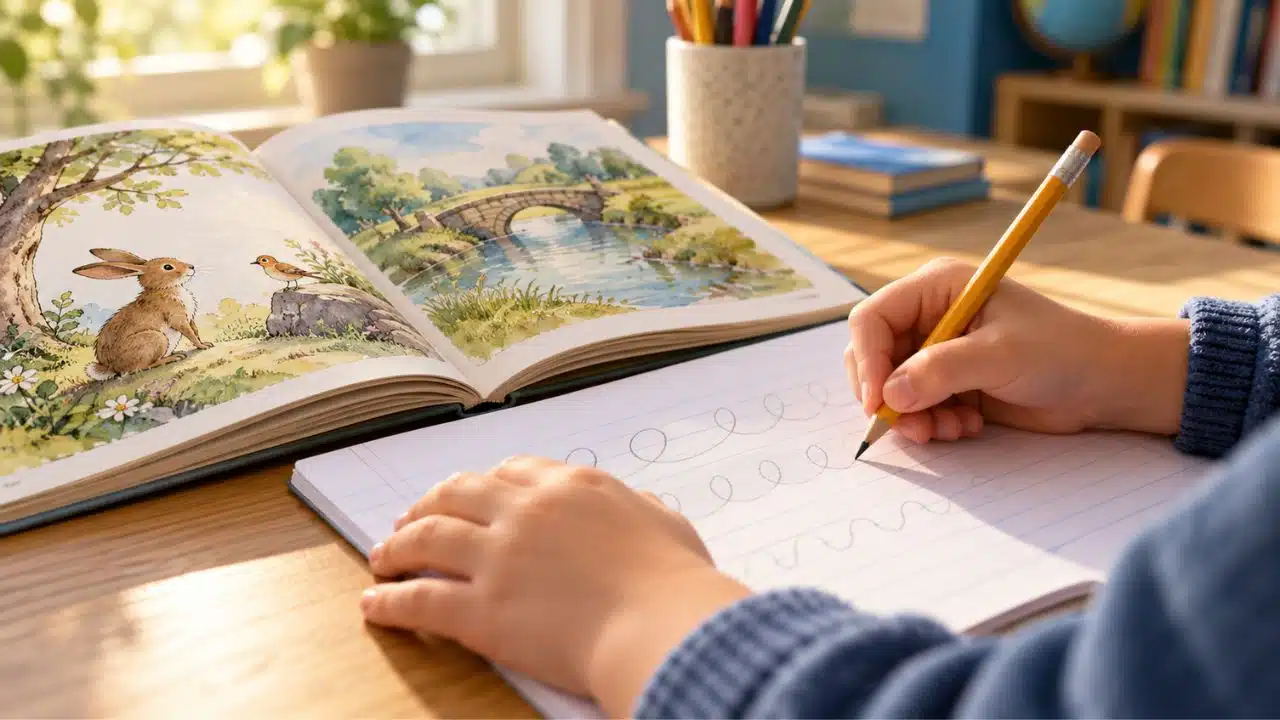
Learning to read fluently takes more than recognizing letters and sounding out words. Children also need to develop strong connections between what they see, hear, and write. This is where handwriting practice can make a surprising difference. Writing letters and words by hand helps children pay closer attention to letter shapes, sounds, spelling patterns, and word structure, which can support stronger reading skills over time.
In this article, we’ll explore how handwriting practice boosts reading fluency and why simple writing activities can be a valuable part of a child’s literacy development.
The Connection: How Handwriting Practice Boosts Reading Fluency
Handwriting and reading fluency work together like two sides of the same coin. Reading fluency means reading smoothly, at a good pace, with few mistakes.
So why are the two linked? Handwriting instruction teaches kids to organize letters and follow them with their eyes, top to bottom. That’s the same pattern their eyes use when they read.
What the Research Shows
Handwriting has solid research behind it. According to Santangelo and Graham’s 2016 meta-analysis in Educational Psychology Review, covering 31 studies and 2,030 K-6 students, handwriting instruction led to clearly better legibility and writing fluency. It beat both no instruction and other kinds of teaching. (A meta-analysis pools the results of many studies into one big picture.)
So what does that mean for reading? An earlier 2011 meta-analysis by Graham and Herbert in the Harvard Educational Review found that teaching writing improves reading comprehension, reading fluency, and word reading. The writing skills kids build carry over into how well they read.
Early handwriting skills help young readers in several ways:
- Letter recognition: Kids learn letter shapes by making them.
- Visuospatial skills: They learn how shapes sit on a page, which helps literacy grow.
- Spelling: Writing words by hand helps kids spell new words.
- Fine motor coordination: Better hand control supports the work of decoding words.
A Classroom Pilot Shows the Effect
A small classroom pilot shows this clearly. Forty first graders were split into two groups for eight weeks. The twenty kids in the handwriting group practiced letter formation and sentence copying for fifteen minutes a day.
| Group | Students | Daily Practice | Gain in Words Correct Per Minute |
|---|---|---|---|
| Handwriting | 20 | 15 minutes of letter formation and sentence copying | 18 percent |
| Digital-only | 20 | Digital practice only | 6 percent |
That’s triple the reading speed gains in just eight weeks. It shows the real payoff of putting pen to paper.
An Honest Look at the Limits
I want to be straight with you, because good advice should be honest. A four-week preschool training study of 23 children, published in 2015 in Frontiers in Psychology, looked at kids aged about 4 years 10 months to 6 years 3 months. They did 16 sessions of about 25 minutes each.
The handwriting group wrote words with about 74% accuracy. The typing group reached about 53%. Word reading only leaned slightly toward handwriting, and the gap was too small to count as a clear result. Letter recognition came out about the same in both groups.
How Handwriting Strengthens Cognitive Processes
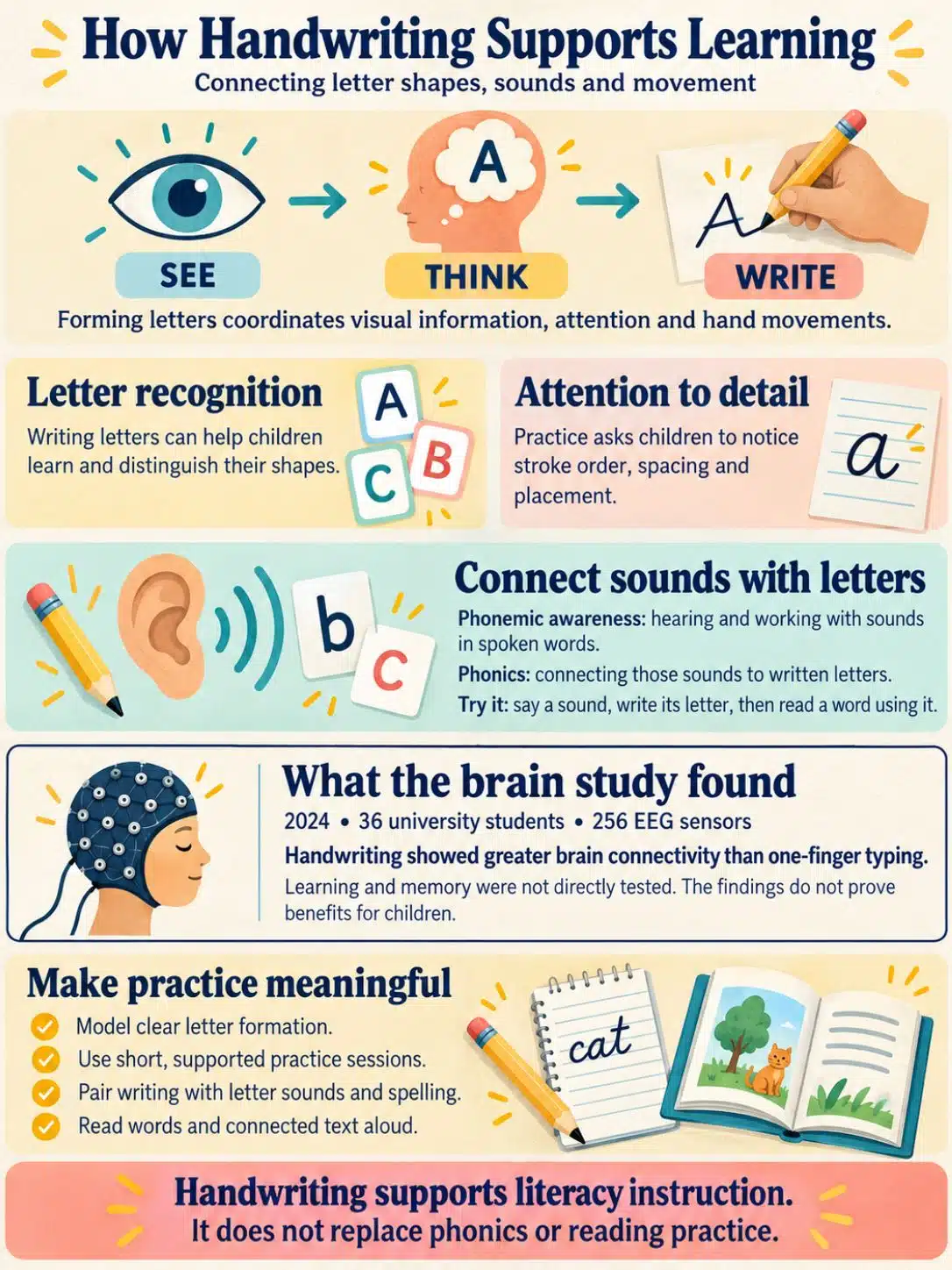
When your child picks up a pencil, a lot happens in their brain at once. Handwriting links what kids see, what they think, and what their hands do.
Enhances Memory and Focus
Brain activity during handwriting looks different from brain activity during typing. A 2024 high-density EEG study from the Norwegian University of Science and Technology, with 36 students, found that handwriting produced widespread connections across central and parietal brain regions. Typing did not. The researchers, Van der Weel and Van der Meer, used a cap with 256 sensors to track this.
There’s a catch, though. The students were in college, not grade school. A 2025 commentary by Pinet and Longcamp pointed out that the study didn’t test learning or memory directly. It also noted that the typists used an unusual one-finger method. So it’s a hopeful clue about the brain, not proof for kids.
Focus is easier to see in action. Your child can’t daydream while carefully forming cursive letters. Handwriting asks them to pay attention to several things at the same time:
- The shape of each letter
- The spacing between letters and words
- The flow from one stroke to the next
- Staying on the line, top to bottom and left to right
This steady effort trains the brain to stay on one task. Visual perception improves too, as kids track letters the same way their eyes move when they read.
Supports Phonemic Awareness and Phonics
Phonemic awareness is the ability to hear the single sounds inside words. Think of hearing the “c,” “a,” and “t” in “cat.” Phonics is the next step: matching those sounds to letters.
Handwriting supports both. As your child forms a letter, they can say its sound. That pairs a hand movement with a sound, which gives the brain two ways to remember it. Writing also makes kids think about how letters join together to build words.
Each time they trace, copy, and write an “A” or a “B,” that shape sticks a little better. Phonics lessons get easier when kids have already written the letters they’re learning.
A Common Pitfall to Avoid
Not all handwriting practice works equally well. A review of twelve tutoring notes found a common problem. When sessions skipped top-to-bottom tracing and line-tracking activities, nine of the twelve students barely improved at left-to-right tracking. They kept losing their place when reading.
They had practiced letter shapes, but those gains didn’t carry over into smoother reading. Good handwriting instruction should include:
- Top-to-bottom tracing of letters
- Left-to-right line-tracking activities
- Sequencing practice, like copying words in order
- Letter formation drills, as one part of the mix, not the whole thing
The Role of Handwriting in Literacy Development
Handwriting gives kids a hands-on way to learn the letters and words they’ll meet in books. Over time, reading can start to feel less like work and more like second nature.
Boosts Letter Recognition and Decoding Skills
When kids form letters by hand, they connect what they see with what they make. That’s a great way to practice letter recognition. To be fair, the preschool study found that typing helped letter recognition about as much, so handwriting is one good tool, not the only one.
Where handwriting really shines is decoding, which means sounding out words on the page. As kids write, they slow down and notice each letter in order. Their fingers guide their eyes, and their eyes guide their understanding.
Soon they spot familiar letter shapes everywhere, from street signs to cereal boxes. These motor skills do more than build strong hands. They help build strong readers.
Improves Spelling and Reading Comprehension
Spelling is where the evidence is strongest. Forming letters by hand creates lasting memories of how words look. That makes it easier to recall and spell words later.
Reading comprehension means understanding what you read. Here the link is less direct. Handwriting alone won’t raise comprehension scores. But the writing-to-read research from Graham and Herbert shows that teaching writing helps kids understand what they read.
| Skill | How Handwriting Helps |
|---|---|
| Spelling | Hand movements help lock in word patterns |
| Word writing | Kids write words more accurately than with typing alone |
| Reading comprehension | Supported through broader writing instruction |
As kids get more confident writers, they often become more confident readers too.
Benefits of Handwriting Practice for Early Learners
For young kids, handwriting builds both body and brain skills. It’s a big part of early childhood education for good reason.
Develops Fine Motor Coordination
Fine motor skills are the small muscle movements in fingers, hands, and wrists. Each letter your child writes makes these muscles a little stronger and more controlled.
Regular practice helps your child with:
- Gripping a pencil the right way
- Forming letters with care
- Controlling how hard they press on the paper
- Keeping letters on the line
These skills do more than tidy up handwriting. They free up your child’s attention. When writing letters becomes automatic, kids have more brainpower left for sounds, words, and meaning.
Encourages Deeper Engagement With Texts
Writing by hand makes kids slow down and pay attention. Their hands make shapes, their eyes follow those shapes, and their minds work out the meaning.
That teamwork makes words stick better than just skimming a page. Kids who write by hand spend more time on each word’s shape, sound, and meaning.
In my experience, that extra thinking time is what makes reading feel like a conversation, not a chore. When their hands are moving, their minds stay alert and ready to learn.
Tips for Effective Handwriting Practice
Handwriting practice works best when it’s part of your daily routine, not a dreaded extra. Mixing in different senses, like tracing letters in sand, helps the brain lock in what the hand is doing.
Integrating Handwriting Into Daily Learning Routines
Short, steady practice beats long, rare sessions. Start with these daily habits:
- Set aside fifteen minutes each morning for letter formation. Let your child trace and copy letters with focus.
- Pair writing with reading. Have your child write the words they just read aloud.
- Start a handwriting journal for a few short sentences each day.
- Switch between print and cursive during the week to build visuospatial skills.
- Try different surfaces and writing tools to keep things fresh.
Then weave writing into schoolwork and real life:
- Practice new spelling words by hand instead of typing them.
- Ask for handwritten answers to reading comprehension questions.
- Add cursive practice, which keeps letters flowing in a steady line.
- Write shopping lists, thank-you notes, or recipe cards together.
One reading specialist uses a short fifteen-minute morning routine. It mixes touch, sight, and sound during handwriting practice:
| Step | Time | What Happens |
|---|---|---|
| Warmup | 2 minutes | Trace textured letters |
| Guided formation | 6 minutes | Form letters while saying their sounds |
| Sentence copying | 5 minutes | Copy short decodable sentences |
| Self-reading | 2 minutes | Read back the sentences they just wrote |
After two weeks, classroom observations showed smoother tracking and fewer skipped words. This loop gets eyes, ears, and hands working together quickly, which makes following a line of text easier.
Using Multisensory Approaches for Better Results
Multisensory learning means using more than one sense at a time. When kids see, hear, and feel letters together, the learning tends to stick better.
Try these touch-based ideas:
- Trace letters on sandpaper, velvet, or bumpy surfaces.
- Write letters in sand, shaving cream, or flour on a table.
- Close eyes and feel raised letter shapes with fingertips.
Then add sound, color, and movement:
- Say each letter’s sound aloud while writing it.
- Use colored pencils or markers for words and sentences.
- Practice to music or a steady beat.
- Write big letters on a whiteboard while standing.
A tip I always share: pick just two or three of these at a time. Too many changes at once can distract your child from the letters themselves.
Final Thoughts
Handwriting practice is much more than a way to improve neatness. When children regularly write letters, words, and sentences by hand, they reinforce the connections between sounds, letters, and language. These connections can make word recognition easier and help reading become more accurate, natural, and fluent. The best part is that handwriting practice doesn’t have to feel like extra schoolwork. Short, enjoyable activities such as writing stories, copying favorite words, keeping a journal, or practicing spelling can give children valuable reading and writing practice at the same time. With consistent practice and encouragement, handwriting can become a simple but effective tool for building stronger readers.
FAQs about How Handwriting Practice Boosts Reading Fluency
1. Does handwriting practice really help kids read better?
Yes, it does. Research from Indiana University found that children who practiced handwriting showed stronger letter recognition than keyboard-only learners, because writing by hand strengthens the brain’s memory of letter shapes through motor learning.
2. Why is writing by hand better than typing for reading skills?
Typing is just a tap on a key, so every letter feels the same. Handwriting activates more areas of the brain because tracing each curve and line creates what neuroscientists call motor memory, making those letter shapes stick better for reading.
3. How much handwriting practice does my child need each day?
Ten to fifteen minutes a day is plenty, and most reading specialists recommend keeping sessions short to maintain focus and enthusiasm.
4. What handwriting activities build reading fluency best?
Have your child copy short sentences, then read them out loud. Spelling lists, grocery notes, and even silly letters to Grandma all count too. Reading researchers at Vanderbilt University found that copying text and immediately reading it aloud produces the strongest connection between writing motions and letter recognition.