Choosing Arabic-and-English AI Providers for UAE Business Applications starts with the job you need done: answering customers, translating documents, analyzing conversations, or building a private knowledge assistant. Core42, Arabic.ai, Saal.ai, Unifonic, Infobip, Yellow.ai, Kore.ai, Microsoft, Google Cloud, and IBM offer different routes. The useful comparison is how each handles your languages, business systems, and deployment requirements.
A polished Arabic reply is only one part of a working service. A UAE customer may mix English product names with Gulf Arabic, send a voice note, quote an order number, and then ask for a person. An internal assistant may need to find an English policy and explain it accurately in Arabic without revealing restricted documents.
This guide separates those needs so a buyer can build a practical shortlist. It includes UAE-based businesses and international providers with documented UAE operations, infrastructure, or customer relationships. It does not describe all ten as Emirati companies or imply that every service processes data inside the country.
How These Providers Were Selected
Research checked on November 12, 2026, covered official product documentation, language-support tables, deployment information, commercial pages, and UAE office or customer evidence. Inclusion required a documented Arabic-and-English capability, a business application, and a specific UAE connection. Fit recommendations are editorial judgments; the entries are not ranked by performance.
This is a research-led comparison, not a hands-on benchmark. Public documentation can establish that a feature is offered but cannot establish its accuracy on your recordings, documents, or customer conversations. Product families also differ: a language model, an enterprise assistant, and a communications platform are not interchangeable purchases. Tarjama and Arabic.ai are treated as one related ecosystem rather than separate entries.
Arabic-and-English AI Providers for UAE Business Applications: Quick Comparison
Use this table to identify the type of supplier you need before comparing proposals. The UAE connection supports inclusion; it is not a promise of local hosting or an approval for a regulated workload.
| Provider | Useful starting point | Documented UAE connection | Decision-changing detail |
|---|---|---|---|
| Core42 | Bilingual assistants and AI infrastructure | UAE-focused sovereign cloud offering | Compass documentation identifies Jais; confirm the model and deployment in the proposal |
| Arabic.ai | Arabic-first document and translation workflows | Dubai office listed | Separate document, agent, and speech requirements when scoping the project |
| Saal.ai | Custom bilingual language analytics | Based in Abu Dhabi | Implementation is tailored to the organization |
| Unifonic | Customer journeys across messaging and voice | Dubai operations documented | Its AI chatbot offering appears in the custom-priced Intelligence plan |
| Infobip | Messaging support with human handoff | Published Edenred UAE customer case | Arabic and English do not have identical entity-extraction support |
| Yellow.ai | Multilingual customer-service agents | Abu Dhabi office listed | Documents Arabic RTL chat display; widget speech is a paid enterprise feature |
| Kore.ai | Enterprise assistants with multilingual flows | Dubai office listed | Native language models and translation-based approaches have different implications |
| Microsoft Azure | Custom speech and AI applications | UAE North speech endpoint documented | Language support and regional feature availability need separate checks |
| Google Cloud | Gemini-based business applications | Dubai Land Department collaboration | A UAE project does not establish UAE processing for every Gemini endpoint |
| IBM | Structured bilingual service assistants | Dubai operations and AI partnership | watsonx Assistant language is fixed after creation |
1. Core42: Bilingual Assistants With a UAE Infrastructure Focus
Core42 belongs on the shortlist when the application and its hosting environment need to be discussed together. Its current portfolio emphasizes sovereign AI infrastructure, including a public-cloud offering with UAE-focused controls. Its Compass documentation separately describes Jais as an Arabic-and-English language model.
The documented Compass Chat Enterprise experience includes Arabic and English interface switching, retrieval-augmented generation, and model selection. Retrieval-augmented generation, usually shortened to RAG, means supplying relevant source material to the model when it answers. That is a useful starting point for an employee assistant working with company policies rather than answering from general knowledge alone.
Core42’s API FAQ requires an active subscription and API key; the documented private-endpoint route also requires an active Azure subscription. Procurement should identify the actual model version, endpoint, supporting search services, and hosting arrangement. The presence of Jais documentation does not mean every Core42 infrastructure package includes a ready-to-use bilingual assistant. A small team needing only website FAQs may find a packaged service platform easier to operate.
2. Arabic.ai: Arabic-First Documents, Translation, and Enterprise Workflows
Arabic.ai is a useful candidate when Arabic document work is central to the business rather than an occasional translation task. The company describes its evolution from Tarjama and lists Dubai among its offices. Its current offering includes Atelier for employee-facing work, Sadu for agents and workflows, and separate language, vision, and speech models.
The documented workspace brings together document drafting, translation, summarization, and knowledge tasks. Its demonstrations include Arabic-and-English documents and translation between the two languages. For a procurement team preparing bilingual supplier material, the practical question is whether terminology, tables, and approvals can remain consistent across the whole process.
This is an enterprise scoping conversation, not simply a choice of chatbot subscription. Ask for a pilot using your document layouts and approved terminology, with a reviewer checking numbers and obligations in both languages. Arabic-focused speech capability should also be evaluated separately from document capability. A convincing written translation does not prove that the same deployment can understand an Emirati caller or manage a live phone conversation.
3. Saal.ai: Custom Arabic-and-English Language Analytics
Abu Dhabi-based Saal.ai offers applied AI services for organizations that need a tailored system. Its official solutions material describes an Arabic-and-English natural-language-processing framework covering sentiment, topic classification, summarization, intent recognition, and named-entity recognition. It also documents speech recognition in both languages.
That makes Saal.ai relevant to an organization with a large collection of service messages, internal reports, or recorded interactions. An illustrative project could classify maintenance complaints, identify recurring equipment issues, and route exceptions to the appropriate team. The value would come from fitting the analysis into an existing operational process.
Saal.ai says it customizes solutions, handles hosting, and trains employees; its broader portfolio describes on-premises, cloud, and hybrid options. These are vendor-described delivery capabilities, not proof of a particular deployment’s performance. Define the output fields, integration responsibilities, maintenance arrangements, and acceptance criteria in the project scope. Buyers seeking a self-service tool they can configure in an afternoon should compare that requirement carefully with a custom implementation.
4. Unifonic: Customer Conversations Connected to Business Actions
Unifonic combines communications channels with customer-engagement automation. Its platform documents WhatsApp, SMS, voice, and other channels, while its AI positioning emphasizes regional Arabic dialects alongside English capability. Its published company materials also establish Dubai operations.
The fit is strongest when a conversation needs to lead somewhere: an onboarding step, a support case, a delivery update, or a transfer to an employee. A retailer evaluating it should demonstrate the complete sequence from a bilingual request to the correct order record and final customer confirmation. Fluent conversation alone will not fix an unreliable stock or delivery integration.
The commercial distinction matters. Unifonic’s pricing page places AI chatbot sessions and an advanced agent console in its custom-priced Intelligence plan. A basic communications plan should not be treated as the price of the finished AI service. Request a proposal covering the chosen channels, AI sessions, staff access, implementation, and support. For UAE use, establish the exact processing locations and the escalation team; broad GCC coverage does not settle either question.
5. Infobip: Messaging Support With a Documented UAE Use Case
Infobip’s Answers platform documents both Arabic and English, and its Edenred UAE case study describes a multilingual WhatsApp support deployment using Answers with the Conversations contact-center product. The case shows a local business application; its reported outcomes should not be treated as forecasts for another company.
A useful feature of that workflow is the transfer of complex queries to an employee with conversation context. This matters when a customer has already explained an issue in Arabic and supplied details that an English-speaking colleague needs to investigate. Editorialge’s comparison of AI support platforms with human handoff records explains what to inspect at that transition.
There is a concrete language limitation to include in testing: Infobip’s documentation says the Date named-entity attribute supported in English is not supported in Arabic. Changing an existing bot’s language can therefore invalidate that attribute. A booking workflow needs an explicit alternative for capturing and confirming dates. Evaluate the configured Arabic and English flows individually rather than assuming a language switch preserves every function.
6. Yellow.ai: Multilingual Service With Attention to Arabic Display
Yellow.ai lists an office in Abu Dhabi and documents Arabic and English across its agent-building tools. Its language table names several Arabic regional groups, including Peninsular Arabic. That provides a basis for evaluation, although a supported-language listing is not an independent accuracy measurement.
One useful detail is its chat-widget documentation. Arabic message bubbles are displayed right to left, while English messages are displayed left to right. Direction is determined per message, which matters when a conversation switches languages. A buyer should still inspect mixed-script messages containing order codes, prices, links, and punctuation.
For voice-enabled experiences, the widget’s text-to-speech documentation lists Arabic UAE and several English locales. It also identifies the capability as a paid enterprise feature requiring activation. That distinction prevents a text-chat demonstration from being mistaken for an included voice service.
Yellow.ai is worth examining for teams comparing packaged multilingual customer service. Keep acceptance tests tied to the exact agent type, channel, and subscription: documentation for one component should not be generalized to every newer product in the portfolio.
7. Kore.ai: Multilingual Assistants With Configurable Language Approaches
Kore.ai has a listed Dubai office and describes Arabic and English support in its XO platform. Its documentation distinguishes multilingual models, manually curated translations, and integrations with translation services. Those approaches can produce different operating costs and different failure modes.
Consider a company that wants an employee assistant to provide approved policy answers. Curated bilingual responses can make sense for stable, consequential wording. A broader knowledge assistant may need language detection, retrieval, and generated answers. Kore.ai’s configurable approach gives an implementation team choices about how these pieces work together.
The buyer’s task is to make those choices visible. Ask which parts use native language processing, which translate through another service, and which depend on an external model. Then test a conversation that switches language after supplying an account reference or changing a request. Preserving the meaning and the business context is more valuable than merely detecting the new language. Organizations with several workflows and integration owners may benefit most; a simple FAQ deployment may not need this level of orchestration.
8. Microsoft Azure: Building Blocks for Bilingual Speech Applications
Microsoft is a practical candidate for teams building their own application around cloud AI services. Azure Speech documents Arabic UAE, identified by the locale code ar-AE, alongside multiple English locales. Microsoft also documents a UAE North text-to-speech endpoint, establishing a specific local infrastructure connection.
A possible application is a service workflow that transcribes a caller, passes the request to a business system, and reads back a confirmation. The advantage is control over the components. The tradeoff is engineering responsibility: authentication, integrations, monitoring, and the customer interface still need to be assembled and maintained.
Inspect the language and region tables separately. Support for a locale does not imply that every speech feature, model, or processing mode is offered through the same regional endpoint. Nor does an Azure resource location establish the location of every connected service.
Budget by the services actually used. Microsoft’s pricing distinguishes transcription usage, speech generation, and other features; custom training or hosting can add charges. A consumer productivity subscription should not be used as the cost estimate for this application.
9. Google Cloud: Gemini for Custom Bilingual Business Applications
Google’s current model documentation lists Arabic and English among Gemini’s supported languages. For a development team, that creates a route to applications that summarize material, answer questions, or generate structured responses within a larger business workflow.
There is a concrete UAE connection: Dubai Land Department announced a Google Cloud collaboration in October 2025 that included an investor assistant powered by Gemini. This establishes local institutional adoption, not a general endorsement or proof of every commercial use case.
Google Cloud is most relevant when a business has developers or an implementation partner who can connect AI to approved data and permissions. A hypothetical distributor might build a bilingual product assistant that retrieves its own specifications before drafting an answer.
Cloud model usage is billed separately from consumer Gemini subscriptions, with costs varying by model and input/output usage. Specify the enterprise service and endpoint in the design. Neither Arabic support nor the Dubai partnership establishes UAE-only processing, retention settings, or permission to send confidential documents to any Gemini interface.
10. IBM: Structured Arabic-and-English Service Assistants
IBM’s watsonx Assistant documentation identifies dedicated Arabic and English classifier models and describes language support for actions, dialogs, and search integration. IBM also has an established Dubai presence and announced an AI partnership with Dubai Future Foundation in 2025.
This option suits teams that want to design controlled service interactions with defined steps and answers. A bilingual assistant could direct users to the right support process while keeping important wording under editorial or operational control. That is a different requirement from giving every employee a general-purpose writing chatbot.
Plan the language architecture before building. IBM states that an assistant’s language cannot be changed after creation. Its documentation describes translation-based approaches as well, while warning that translation can lose meaning. A bilingual deployment therefore needs a deliberate design, rather than an assumption that one toggle will convert an existing assistant.
Keep the product scope precise when requesting a proposal. Arabic support in watsonx Assistant does not automatically establish identical support across every watsonx product, model, or speech component. Compare the exact configuration that your team would operate.
A UAE Buying Checklist That Goes Beyond Language Support
Evaluate Arabic-and-English AI providers for UAE business applications against three practical requirements: a named workflow owner, an approved data boundary, and a clear definition of success. The following checks make proposals easier to compare.
Specify the Arabic You Actually Need
Separate formal written Arabic from conversational Gulf Arabic, and separate text from speech. Add examples of English product names inside Arabic sentences, Arabic written in Latin characters where relevant, and common misspellings. Have a fluent reviewer judge whether the answer preserves meaning and sounds appropriate for the audience.
Right-to-left rendering is a separate requirement. Check forms, chat messages, tables, exported documents, and error messages. A correct Arabic sentence can still become confusing when a date or account reference appears in the wrong visual order. Editorialge’s guide to localizing a SaaS product for global markets covers why the whole customer journey needs attention.
Define the Data Boundary and Contracting Entity
Ask the supplier to identify where input, inference, search indexes, logs, backups, and support access are handled. A UAE sales office, a local infrastructure option, and a UAE-only contractual deployment are different things. Record retention periods, deletion procedures, use of customer data for model improvement, and any third-party processors in the proposed agreement.
The UAE government’s overview of personal-data protection identifies requirements around processing and cross-border transfers. Your review should establish the rules relevant to the entity, sector, and location involved, including any applicable free-zone framework. A supplier’s general compliance statement cannot decide that for the buyer.
For local delivery, document the contracting company, invoice currency, applicable taxes, Arabic-and-English support coverage, service hours, and escalation contact. If a project requires an emirate-specific procurement approval or regulated-sector clearance, make it an explicit purchasing condition rather than assuming a nationwide sales presence satisfies it.
Compare the Cost of an Accepted Business Outcome
Use one workload brief for every finalist. Include conversations, audio duration, document volumes, expected peaks, staff access, integrations, and the review effort that remains. Ask the quote to separate setup, recurring platform charges, model usage, channel charges, and ongoing support.
An illustrative calculation shows why this matters: if a pilot costs AED 1,200 and produces 400 correctly completed tasks, the cost is AED 3 per accepted task before staff review. Counting every attempted answer would make the service look cheaper without showing whether it solved the problem. These figures are an example, not a provider quote or a test result.
Run the Same Bilingual Pilot for Every Finalist
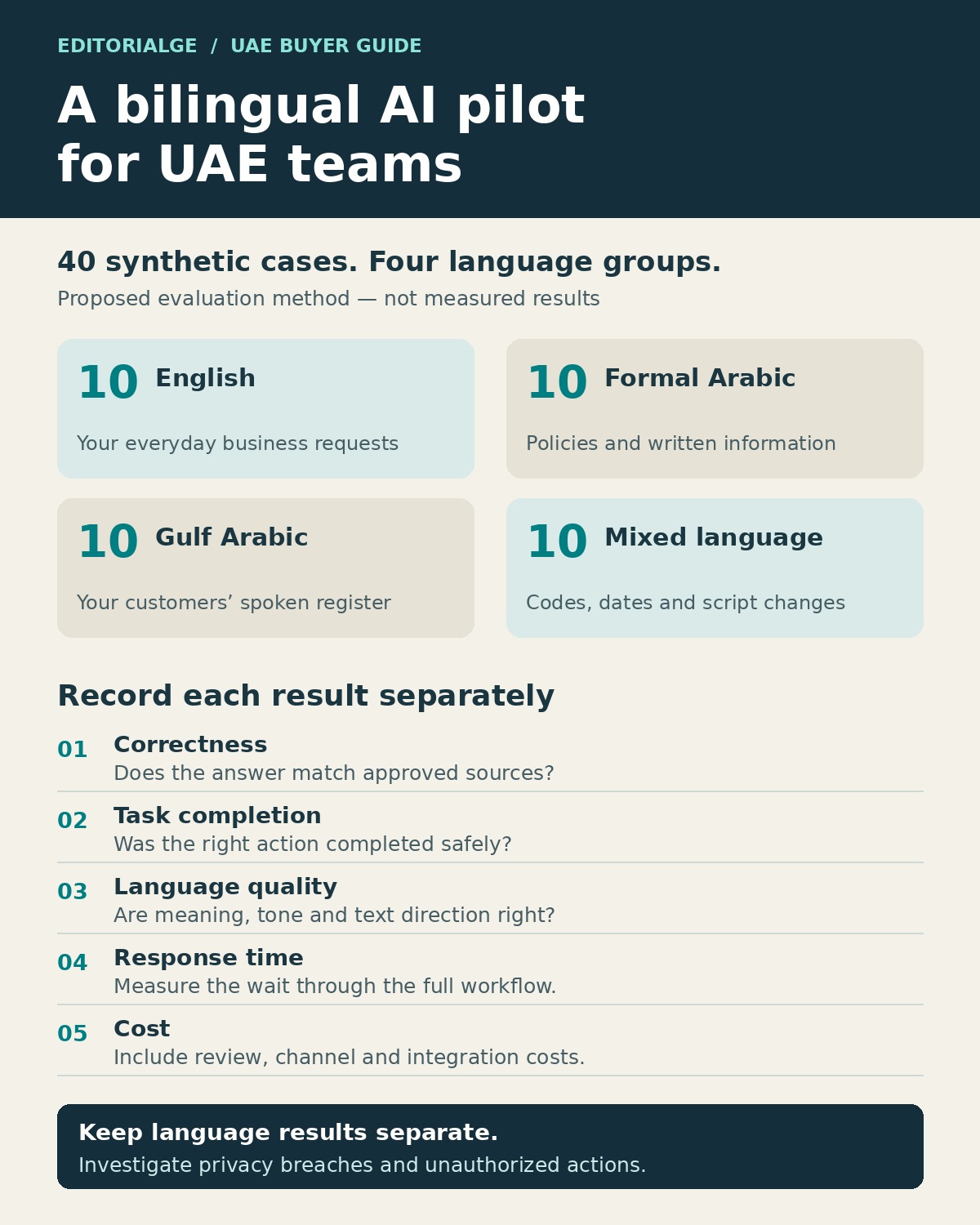
The following is a proposed evaluation method, not a benchmark performed for this article. Build 40 synthetic cases: 10 in English, 10 in formal Arabic, 10 in the Gulf Arabic your customers use, and 10 that mix languages or contain awkward formatting. Keep real customer information out of an unapproved pilot.
- Supply the same approved reference documents and expected answers. Include at least one question the documents cannot answer.
- Test meaning as well as grammar. Check names, AED amounts, dates, product codes, and a change of language halfway through a request.
- Include an unauthorized action, an unavailable integration, and a request for a human. Observe whether the system stops, explains the limitation, and preserves context.
- Record correctness, task completion, language quality, response time, and cost separately. Keep the model version and configuration with each result.
- Review failures with a bilingual evaluator and the person responsible for the business process. Choose acceptance thresholds before comparing results.
A blended success rate can hide weak Arabic performance. Keep results separate by language group, then investigate why failures occurred. A critical privacy breach or unauthorized transaction should trigger investigation even when the other answers look good.
Choose the Provider Around the Workflow
For Arabic-first documents and tailored language work, begin with Core42, Arabic.ai, and Saal.ai according to the deployment you need. For customer-facing conversations, compare Unifonic, Infobip, Yellow.ai, and Kore.ai around channels, integrations, and escalation. Microsoft, Google Cloud, and IBM provide additional routes for teams with the resources to design and operate their own applications.
The right shortlist of Arabic-and-English AI Providers for UAE Business Applications is the one that can demonstrate your actual workflow in both languages, explain its data handling, and quote the complete operating cost. Start with two or three suitable candidates, use the same bilingual pilot, and choose on verified results rather than a generic language count.