
A preschooler can trace a page of beautifully shaped letters and still have no idea what those letters say. That is why tracing deserves a more careful place in early literacy than it sometimes gets.
The benefits of tracing letters for reading are real, but indirect. Following a letter with a finger or pencil gives a child visual and movement-based experience with its shape. That can support letter learning, especially when the child is still figuring out how written forms are constructed.
Reading, however, requires much more than remembering a shape. Children also need to connect print with speech sounds, notice sounds inside spoken words, blend those sounds, and eventually recognize written words efficiently.
So tracing is useful scaffolding. It is not a reading method by itself.
What a Child Is Actually Learning While Tracing
Adults recognize familiar letters so quickly that it is easy to underestimate how complicated the task is for a beginning learner.
A young child has to notice which features make b different from d, or p different from q. Letters such as m and n share many visual features too. Until those forms become familiar, recognizing them takes real attention.
Tracing adds movement to that visual learning.
Instead of simply looking at an S, the child follows the curve. Instead of observing an M, the hand travels through the strokes that create it. Researchers often describe this part of handwriting as graphomotor experience: the coordinated hand movements involved in forming written symbols.
That additional information appears to matter.
A widely cited brain-imaging experiment with preliterate five-year-olds compared what happened after children printed, traced, or typed letters and shapes. When researchers later showed those forms to the children during an fMRI scan, freehand printing was associated with greater activity in parts of the brain involved in letter processing than tracing or typing.
The interesting part is not that tracing somehow switches on a special reading circuit. The study does not show that.
Instead, it suggests that physically generating a letter can involve learning processes that simply viewing or typing it does not engage in the same way. Freehand writing required the children to produce the form themselves, while tracing supplied the path.
That difference matters when deciding how long tracing should remain part of practice.
Why Tracing Can Help Before Independent Writing
A child who has never written a particular letter faces several problems at once. Where should the pencil begin? Which direction should it move? How long should the line be? Where does the next stroke go?
Tracing removes some of that uncertainty.
The path is already there, so the child can concentrate on following the broad structure of the letter. For a beginner, that reduction in difficulty can be useful.
Research comparing handwriting with keyboard-based learning also supports the broader value of producing written forms by hand. Studies with preschool children have found advantages for handwriting experience in later letter recognition, although effects vary with the child’s age, the task, and the type of training.
More recent experimental work has compared hand-copying, tracing, and typing while prereaders learned unfamiliar symbols and pseudowords. Children in the handwriting conditions generally learned the material more accurately than children in the typing conditions.
That does not make a case for filling entire workbooks with dotted letters. It makes a narrower and more useful case: movement can contribute to learning a written form.
The next question is what happens after the child knows the path.
Tracing Should Lead Somewhere
Tracing is most valuable when it is temporary.
There is a meaningful difference between following a dotted letter and producing one independently.
With tracing, the child follows a route someone else has supplied. With copying, the model is visible, but the child has to recreate it in another space. Writing from memory removes even that support.
That progression increases the amount of information the child has to retrieve and organize:
Trace the letter → copy it → write it from memory → use it while reading and spelling
Children do not have to move through those steps according to a fixed timetable. A preschooler may still need to trace an unfamiliar g while already writing m, s, and t without help.
What matters is noticing when the support has stopped being useful.
If a child can follow every dotted A on a worksheet without hesitation, another row of dotted As may add very little. Asking the child to produce one in a blank space creates a more informative challenge.
The result might look messier. From a learning perspective, that can be more valuable.
The Benefits of Tracing Letters for Reading Increase When Sound Is Included
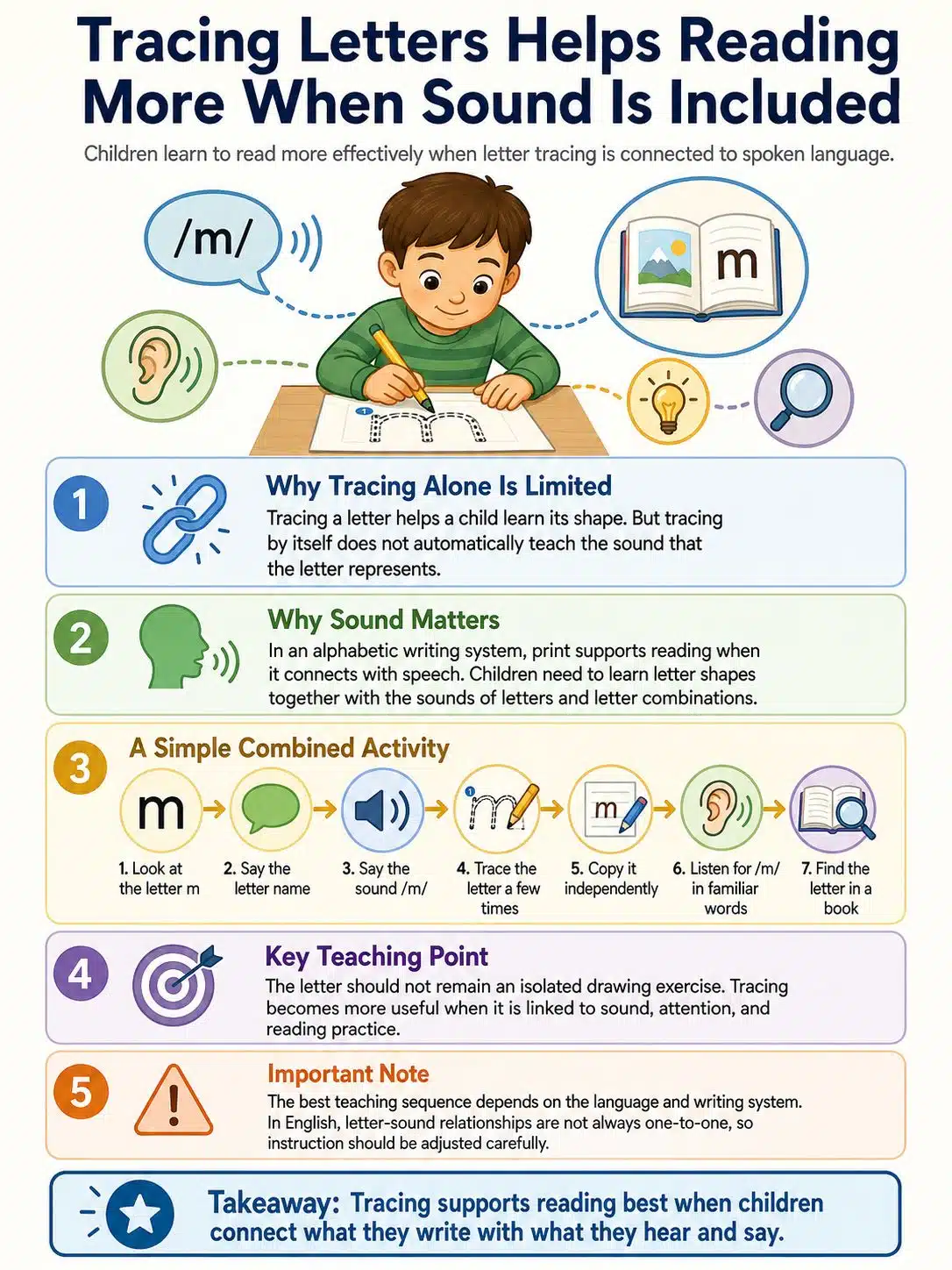
One of the weakest uses of tracing is also one of the most common: children silently copying letter forms without connecting them to spoken language.
Tracing m teaches something about the shape of m. It does not automatically teach that the letter can represent /m/.
For children learning an alphabetic writing system, print becomes useful for reading when it connects with speech. Early literacy instruction therefore needs to include the sounds represented by letters and letter combinations, not just their shapes.
A simple activity can do both.
A child learning m, for example, might look at the letter, say its name, repeat the sound being taught, trace the form a few times, and then try to copy it independently. The adult might then ask the child to listen for /m/ in familiar words or find the letter in a book.
None of those steps needs to become an elaborate lesson. The important point is that the letter should not remain an isolated drawing exercise.
The exact teaching sequence also depends on the language and writing system. English letter-sound relationships are not always one-to-one, and the same instructional routine cannot simply be transferred unchanged to every language.
Why Children’s Imperfect Letters Can Be Useful
Adults often judge handwriting practice by neatness. Early learning does not work quite that way.
Young children naturally produce variable letters. One a may be wider than another. A vertical stroke may lean. The shape may be recognizable without looking anything like a printed font.
Research on handwriting suggests that some of this variation may actually help children learn what is essential about a symbol.
In experimental work on symbol learning, children who produced forms through handwriting encountered their own slightly different versions of the same symbol. Researchers found evidence that this variability could help learners build broader symbol categories.
That is an important contrast with tracing.
A dotted worksheet gives the child almost exactly the same model every time. Independent writing creates small differences automatically. The child has to learn that all of those imperfect examples can still represent the same letter.
This is one reason neatness should not become the main measure of success.
A child who writes a slightly crooked M, recognizes it, and connects it with the sound being taught is showing more useful knowledge than a child who perfectly follows an M outline but cannot identify the letter afterward.
Legibility matters. Perfection does not.
What Tracing Cannot Teach
Tracing supports one part of early literacy. Several other parts require different kinds of practice.
Phonemic awareness
Phonemic awareness involves hearing and working with the individual sounds in spoken words.
A child may trace map perfectly while still struggling to hear that the spoken word begins with /m/. Handwriting cannot replace activities that help children notice, separate, or manipulate speech sounds.
Blending
Even knowing individual letter sounds is not the same as reading a word.
A beginning reader who sees m-a-p needs to retrieve the relevant sounds and blend them together. That ability develops through explicit teaching and reading practice, not from tracing the letters repeatedly.
Automatic word recognition
Tracing the same word over and over also should not be confused with learning it as a sight word.
Skilled readers eventually recognize many words quickly because their spellings, pronunciations, and meanings have become connected in memory. Researchers commonly describe this learning process as orthographic mapping.
Phonemic awareness and knowledge of how graphemes represent speech sounds are central to that process.
A word may look more familiar after a child has traced it repeatedly, but visual familiarity alone is not the same as secure word recognition.
That distinction matters because early literacy materials sometimes treat repeated copying as though it were equivalent to reading practice. It is not.
More Worksheets Do Not Automatically Produce More Learning
Alphabet worksheets are easy to count. A child completed three pages today and five yesterday, so it can feel as though progress is visible.
Learning is harder to measure than paper consumption.
Research on alphabet instruction shows that teaching letters can strengthen alphabet knowledge. What it does not show is that practicing alphabet forms by itself automatically produces equivalent gains in broader reading, spelling, or phonological skills.
That makes long, repetitive tracing assignments difficult to justify once the child has understood the basic form.
A shorter session can be more useful if it asks the child to do different things with the same knowledge.
Instead of tracing s twenty times, a child might:
- trace it two or three times;
- copy it without the dotted path;
- try writing it from memory;
- say or identify the sound being taught;
- find s in a familiar piece of print;
- use it while spelling or reading a word whose sound-symbol relationships have already been taught.
That sequence reveals much more about what the child actually knows.
If a child traces accurately but cannot recognize the letter later, adding another worksheet is unlikely to solve the underlying problem.
If the child immediately recognizes the letter and its sound but struggles to form it, more handwriting practice may be appropriate.
Those difficulties look similar on paper but need different responses.
When Tracing Is Worth Using
Tracing is most useful when the child still needs the support it provides.
It can make sense when a learner is encountering a new letter, is uncertain how its strokes fit together, or needs a visible path before attempting independent formation.
For some children, large letter forms can also be easier to manage than tightly packed worksheet rows. Finger tracing or drawing a large version of the letter can reduce the immediate demand of controlling a pencil.
These alternatives should be viewed as practical teaching options, not as proven substitutes with identical effects. The evidence is much stronger for handwriting and graphomotor learning in general than it is for claims about specific textures, surfaces, grips, or so-called multisensory tracing techniques.
That is worth remembering when educational products make unusually broad promises.
There is no special worksheet format that replaces good teaching.
Likewise, writing practice should not become an endurance exercise. If the child is rushing, losing attention, or becoming frustrated, extending the page rarely improves the quality of learning.
Persistent pain, marked fatigue, or substantial difficulty with everyday fine-motor tasks deserves individual attention rather than simply more handwriting practice. Parents and educators can raise continuing concerns with an appropriate education or health professional.
Get the Letter Off the Tracing Page
The clearest sign that tracing has helped is that the child can eventually use the letter somewhere else.
Take s.
A learner might first trace the shape, then copy it. Later the child writes it from memory. The letter appears in a book and the child recognizes it there too. Its sound becomes familiar. Eventually the child uses that knowledge while reading or spelling words containing correspondences already taught.
Now the learning has moved beyond handwriting.
That broader connection matters because early literacy is built from several developing skills working together. Alphabet knowledge matters. Phonological awareness matters. Early writing matters. Knowledge of sound-symbol relationships matters.
No single worksheet activity can substitute for that combination.
Final Thoughts
The benefits of tracing letters for reading are easiest to see when tracing is treated as a starting point rather than an achievement in itself.
For a child who does not yet know how to form a letter, following a visible path can remove enough difficulty to make the shape manageable. Once the movement becomes familiar, the support should begin to disappear.
Ask for a copy. Leave a blank space. Connect the letter with its sound. Find it in real print. Give the child chances to use it when spelling and decoding.
Do not worry if the independent version looks less polished than the traced one. The imperfect letter usually requires more thinking.
A good tracing activity succeeds when the dotted line eventually becomes unnecessary.