

Some calendar dates pass quietly in the margins of history books, while others seem to act like gravitational centers for human ambition, political upheaval, and scientific discovery. November 14 belongs firmly in the second category. Across more than two millennia, this single mid-autumn date has witnessed the crowning of an ancient conqueror in Egypt, the publication of one of America’s greatest novels, the birth of the scientist who conquered Type 1 diabetes, the arrival of humanity’s first orbital spacecraft around Mars, and decisive battles for national liberation in South Asia.
Whether you are a history enthusiast, a student, or simply curious about what shaped the world on this day, here is an in-depth look at the defining historical events, global observances, famous birthdays, and notable death anniversaries of November 14.
International Observances & Global Commemorations on November 14
Before diving into centuries of archival milestones, it is worth looking at how millions of people around the globe actively commemorate November 14 today. Several major international and national observances fall on this date, each rooted in a pivotal historical figure or humanitarian cause.
| Observance | Region / Scope | Origin & Historical Significance |
| World Diabetes Day | Global (United Nations Official Day) | Established in 1991 by the IDF and WHO (and made an official UN Day in 2006) to honor the birthday of insulin co-discoverer Sir Frederick Banting. |
| Children’s Day (Bal Diwas) | India | Celebrated nationwide on the birth anniversary of India’s first Prime Minister, Pandit Jawaharlal Nehru, to promote child welfare and education. |
| Colombian Women’s Day | Colombia | Commemorates the 1817 execution of revolutionary heroine Policarpa Salavarrieta (“La Pola”) during Colombia’s struggle for independence. |
| Njegoš Day | Montenegro | State cultural holiday honoring Prince-Bishop and poet Petar II Petrović-Njegoš, author of the South Slavic literary epic The Mountain Wreath. |
World Diabetes Day: A Tribute to Medical Innovation
Every year on November 14, landmarks across the world—from the Empire State Building in New York to the Tokyo Tower—are illuminated in blue to mark World Diabetes Day. Created in 1991 by the International Diabetes Federation (IDF) and the World Health Organization (WHO) in response to rising global diabetes rates, the campaign became an official United Nations observance in 2006 through UN Resolution 61/225. The date was deliberately chosen to honor Sir Frederick Banting, who was born on November 14, 1891, and whose 1921 co-discovery of insulin with Charles Best transformed Type 1 diabetes from a fatal diagnosis into a manageable chronic condition.
Children’s Day (Bal Diwas) in India
Across India, November 14 is celebrated with school festivals, cultural performances, and educational drives as Bal Diwas (Children’s Day). Prior to 1964, India observed Children’s Day on November 20 in alignment with the United Nations’ Universal Children’s Day. Following the death of Prime Minister Jawaharlal Nehru in May 1964, the Indian Parliament passed a resolution establishing his birthday, November 14, as the permanent national day dedicated to children’s rights, nutrition, and scientific curiosity.
Colombian Women’s Day (Día de la Mujer Colombiana)
In Colombia, November 14 honors Policarpa Salavarrieta, affectionately remembered as La Pola. Working as a seamstress in Bogotá during the Spanish Reconquista of New Granada, Salavarrieta operated as an indispensable intelligence gatherer for independence forces until her capture and execution by firing squad in Bogotá’s main plaza on November 14, 1817. In 1967, the Colombian Congress officially designated the anniversary of her death as Colombian Women’s Day.
The Bangalee Sphere & South Asian Milestones
Birth of Pandit Jawaharlal Nehru (1889)
Born on November 14, 1889, in Allahabad (modern-day Prayagraj), Jawaharlal Nehru emerged as one of the towering figures of 20th-century anti-colonial politics. Educated at Harrow and Trinity College, Cambridge, Nehru returned to India and became a central strategist of the Indian National Congress alongside Mahatma Gandhi. Spending more than nine years in British colonial prisons—where he penned classics like The Discovery of India and Glimpses of World History—Nehru became independent India’s first Prime Minister on August 15, 1947. Over 17 years in office, he championed parliamentary democracy, secularism, planned economic development, and the international Non-Aligned Movement.
Other Notable Bangalee & South Asian Figures on November 14
-
Vengayil Kunhiraman Nayanar (Died 1914): Writing under the pen name Kesari, this pioneering Indian journalist, essayist, and satirist from Kerala passed away on November 14, 1914. Literary historians credit his 1891 work Vasanavikriti as the first-ever short story written in the Malayalam language.
-
S.M. Abraham Lincoln (Born 1966): Born in Kurigram, Bangladesh, S.M. Abraham Lincoln is a distinguished Bangladeshi human rights lawyer, historian, and founder of the North Bengal Museum. Widely respected for providing pro-bono legal advocacy for border shooting victims—including the family of Felani Khatun—and advising on the historic 2015 Bangladesh–India enclave exchange, he received Bangladesh’s Ekushey Padak in 2022 and the Independence Award (Swadhinata Padak) in 2024.
-
A.C. Bhaktivedanta Swami Prabhupada (Died 1977): Born Abhay Charan De in Kolkata in 1896, this Bengali Gaudiya Vaishnava scholar traveled to New York at age 69 and founded the International Society for Krishna Consciousness (ISKCON) in 1966. Before his death in Vrindavan on November 14, 1977, he authored over 70 volumes of translations and commentaries on Sanskrit and Bengali devotional texts.
-
Professor Mazharul Islam (Died 2003): A towering Bangladeshi poet, academic, and folklorist, Professor Mazharul Islam served as Vice-Chancellor of the University of Rajshahi and was appointed the first Director General of Bangla Academy in June 1972 following Bangladesh’s independence.
-
Sachin Tendulkar’s Final Test Match (2013): On November 14, 2013, Indian cricket icon Sachin Tendulkar walked out onto the pitch at Mumbai’s Wankhede Stadium to begin his 200th and final Test match (against the West Indies), bringing the curtain down on an unmatched 24-year international career that captivated hundreds of millions across the subcontinent.
Major Historical Events That Changed the World on November 14
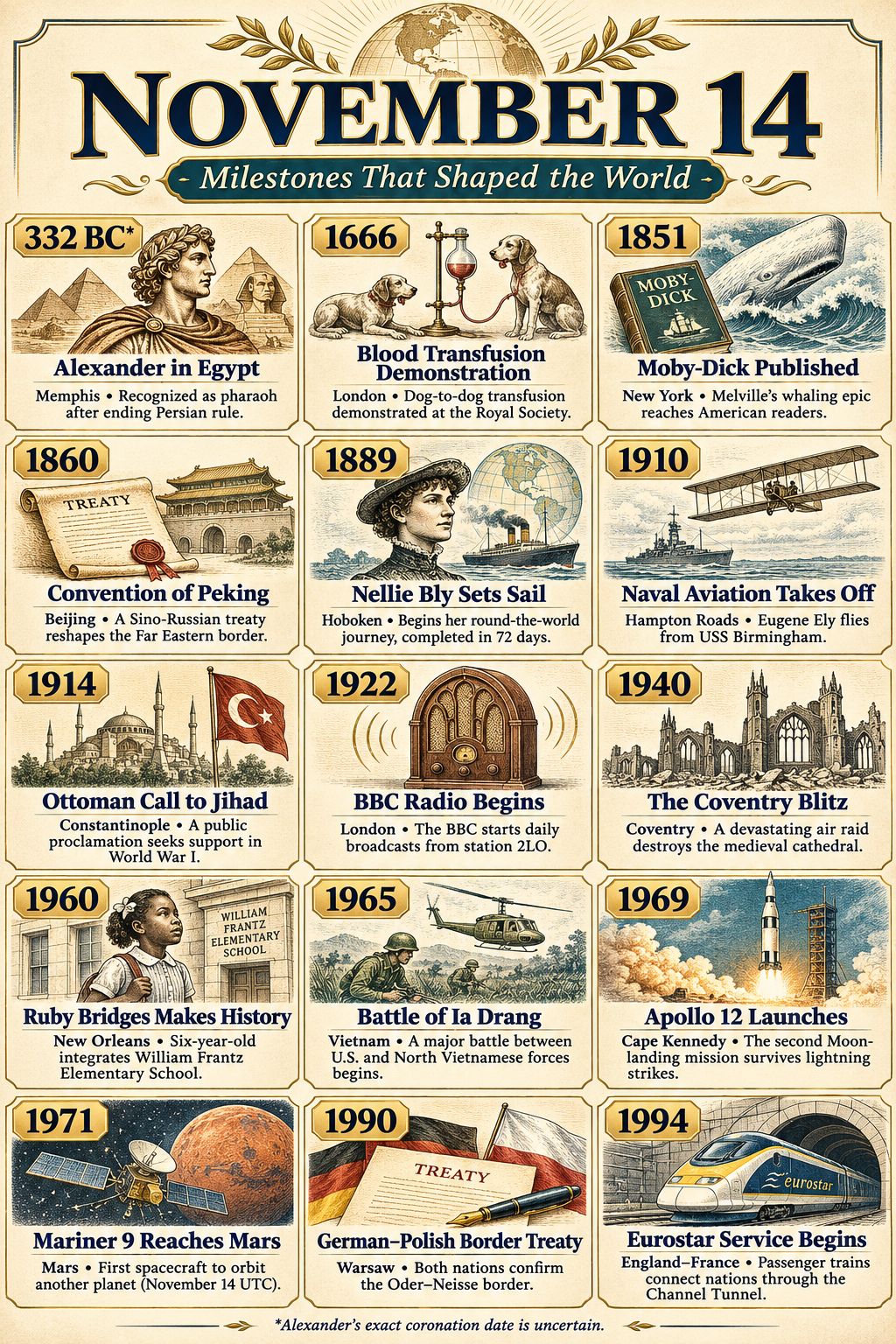
Beyond South Asia, November 14 has repeatedly served as a turning point in global diplomacy, scientific exploration, civil rights, and warfare. The table below offers a quick-scan overview of pivotal global milestones before we examine their lasting significance.
| Year | Event | Location | Historical Impact |
| 332 BC | Alexander the Great crowned Pharaoh | Memphis, Egypt | Ended Persian rule in Egypt and launched the Hellenistic era in North Africa. |
| 1666 | First documented blood transfusion | London, England | Physician Richard Lower transferred blood between two dogs at the Royal Society. |
| 1851 | U.S. publication of Moby-Dick | New York, USA | Herman Melville’s whaling epic was released in America, later hailed as a literary masterpiece. |
| 1860 | Convention of Peking signed | Beijing, China | Qing China ceded Outer Manchuria to Russia, enabling the founding of Vladivostok. |
| 1889 | Nellie Bly begins round-the-world trip | Hoboken, USA | Journalist set off to beat Phileas Fogg’s 80-day fictional record, finishing in 72 days. |
| 1910 | First airplane takeoff from a ship | Hampton Roads, USA | Eugene Ely flew a Curtiss biplane off cruiser USS Birmingham, pioneering naval aviation. |
| 1914 | Ottoman Empire proclaims Jihad | Constantinople | Sultan-Caliph Mehmed V rallied Muslim subjects against Allied powers in World War I. |
| 1922 | BBC begins daily radio broadcasts | London, England | Station 2LO transmitted the UK’s first daily public-service radio programming. |
| 1940 | The Coventry Blitz | Coventry, England | Over 500 Luftwaffe bombers devastated the city, destroying its medieval cathedral. |
| 1960 | Ruby Bridges integrates public school | New Orleans, USA | Six-year-old became the first Black child to attend an all-white school in the U.S. South. |
| 1965 | Battle of Ia Drang begins | Central Highlands, Vietnam | First major pitched battle between U.S. Army troops and North Vietnamese regulars. |
| 1969 | Launch of Apollo 12 | Cape Kennedy, USA | Second crewed Moon landing mission survived two lightning strikes just after liftoff. |
| 1971 | Mariner 9 enters Mars orbit | Mars Orbit | Became the first human-made spacecraft to orbit another planet. |
| 1990 | German–Polish Border Treaty signed | Warsaw, Poland | Reunified Germany and Poland formally confirmed the Oder–Neisse line as permanent. |
| 1994 | First Channel Tunnel passenger service | England / France | Eurostar began carrying paying passengers beneath the English Channel. |
Ancient Crowning & 19th-Century Frontiers
-
332 BC — Alexander the Great Becomes Pharaoh of Egypt: After liberating Egypt from nearly two centuries of Persian Achaemenid rule, the 24-year-old Macedonian king Alexander the Great was formally crowned Pharaoh at the ancient capital of Memphis on November 14, 332 BC. By respecting Egyptian religious traditions and founding the coastal city of Alexandria shortly afterward, Alexander anchored three centuries of Ptolemaic Hellenistic culture in the Mediterranean.
-
1851 — Moby-Dick Hits American Bookshelves: Exactly one month after its British release under the title The Whale, Herman Melville’s Moby-Dick; or, The Whale was published in the United States by Harper & Brothers on November 14, 1851. Initially met with lukewarm reviews and sluggish sales, the novel was rediscovered in the early 20th century and is now universally ranked among the foundational works of world literature.
-
1860 — The Convention of Peking Reshapes East Asia: In the aftermath of the Second Opium War, Russian envoy Count Nikolay Ignatyev secured the signing of the Convention of Peking with Qing Prince Gong on November 14, 1860. The treaty transferred roughly 350,000 square miles of territory north of the Amur River and east of the Ussuri River—known as Outer Manchuria—from China to the Russian Empire. That cession gave Russia an ice-free Pacific coastline and allowed the immediate development of the port city of Vladivostok.
-
1889 — Nellie Bly’s Race Around the Globe: Inspired by Jules Verne’s novel Around the World in Eighty Days, 25-year-old investigative reporter Nellie Bly (born Elizabeth Cochrane) boarded the steamship Augusta Victoria in Hoboken, New Jersey, on November 14, 1889, carrying a single small travel bag. Traveling solo via Britain, France, Italy, the Suez Canal, Ceylon, Singapore, Hong Kong, and Japan, she returned to New Jersey in 72 days, 6 hours, and 11 minutes—shattering the fictional record and proving that women could report from any corner of the globe.
20th-Century Media, Civil Rights, and Geopolitics
-
1922 — The Birth of Daily BBC Radio: At 6:00 PM on November 14, 1922, director of programs Arthur Burrows read the first news bulletin twice—once quickly and once slowly so listeners could take notes—from London station 2LO at Marconi House. That broadcast marked the start of daily programming by the British Broadcasting Company (later the BBC), establishing an enduring global blueprint for public-service journalism.
-
1940 — The Coventry Blitz: During World War II, the German Luftwaffe launched one of its most concentrated aerial bombardments on the English industrial city of Coventry on the night of November 14, 1940. Over 500 bombers dropped hundreds of tons of high explosives and incendiaries over 11 hours, killing more than 550 people and leaving the 14th-century St. Michael’s Cathedral in smoldering ruins. The preserved shell of the cathedral stands today as an internationally recognized shrine to peace and reconciliation.
-
1960 — Ruby Bridges Breaks the Color Barrier in New Orleans: Escorted by four U.S. Federal Marshals past jeering crowds of segregationists, six-year-old Ruby Bridges walked through the doors of William Frantz Elementary School in New Orleans on November 14, 1960. She became the first African American student to integrate a white elementary school in the American Deep South, spending her entire first-grade year being taught alone in a classroom by teacher Barbara Henry—an act of quiet courage immortalized in Norman Rockwell’s painting The Problem We All Live With.
-
1965 — Outbreak of the Battle of Ia Drang: On November 14, 1965, soldiers of the U.S. 1st Cavalry Division landed by helicopter in the Ia Drang Valley of Vietnam’s Central Highlands, triggering the first major conventional clash between the United States Army and regular forces of the People’s Army of Vietnam (PAVN). The brutal four-day battle demonstrated the tactical speed of helicopter air-mobility while foreshadowing the high-attrition warfare that would define the Vietnam War.
-
1994 — Trains Beneath the Sea: On November 14, 1994, Eurostar began regular commercial passenger service through the 31.5-mile Channel Tunnel, fulfilling a two-century-old engineering dream of connecting Great Britain and mainland Europe by rail.
Space Age Triumphs: Apollo 12 and Mariner 9
-
1969 — Apollo 12 Conquers Lightning on the Way to the Moon: On November 14, 1969, NASA launched Apollo 12 from Kennedy Space Center with astronauts Pete Conrad, Richard Gordon, and Alan Bean aboard. Just 36.5 seconds into flight, a bolt of lightning struck the Saturn V rocket—followed by a second strike at 52 seconds—knocking all three fuel cells offline and scrambling cockpit instruments. Cool-headed flight controller John Aaron instructed the crew to switch “SCE to Aux,” restoring telemetry and enabling Conrad and Bean to execute a pinpoint lunar landing in the Ocean of Storms five days later.
-
1971 — Mariner 9 Arrives at Mars: Exactly two years after Apollo 12 lifted off, NASA’s uncrewed probe Mariner 9 fired its main engine on November 14, 1971, entering orbit around Mars as the first spacecraft ever to orbit another planet. Although a massive planet-wide dust storm initially obscured the Martian surface, Mariner 9 outlasted the storm and transmitted over 7,300 images—revealing colossal canyons like Valles Marineris, towering volcanoes like Olympus Mons, and ancient dry riverbeds that proved water once flowed on Mars.
Famous Birthdays on November 14
From Impressionist painters and constitutional monarchs to Nobel-winning scientists and world leaders, November 14 boasts an extraordinary roster of birthdays.
| Year | Name | Nationality | Primary Field & Legacy |
| 1650 | William III of England | Dutch / British | Prince of Orange and King of England, Scotland, and Ireland after the 1688 Glorious Revolution. |
| 1719 | Leopold Mozart | German-Austrian | Composer, violinist, and father/mentor of Wolfgang Amadeus Mozart. |
| 1765 | Robert Fulton | American | Engineer and inventor who built the first commercially successful steamboat (Clermont). |
| 1840 | Claude Monet | French | Co-founder of Impressionism (Impression, Sunrise, Water Lilies). |
| 1889 | Jawaharlal Nehru | Indian | Anti-colonial leader, author, and first Prime Minister of independent India. |
| 1891 | Sir Frederick Banting | Canadian | Physician and co-discoverer of insulin; youngest Medicine Nobel laureate (1923). |
| 1900 | Aaron Copland | American | Pulitzer-winning composer (Appalachian Spring, Fanfare for the Common Man). |
| 1907 | Astrid Lindgren | Swedish | Children’s author and creator of Pippi Longstocking. |
| 1908 | Joseph McCarthy | American | U.S. Senator whose 1950s anti-communist investigations coined the term “McCarthyism.” |
| 1922 | Boutros Boutros-Ghali | Egyptian | Diplomat and sixth UN Secretary-General (1992–1996), the first from Africa and the Arab world. |
| 1935 | King Hussein of Jordan | Jordanian | Monarch of Jordan (1952–1999) and key architect of modern Jordanian statehood and diplomacy. |
| 1948 | King Charles III | British | King of the United Kingdom and 14 Commonwealth realms; founder of The Prince’s Trust. |
| 1954 | Condoleezza Rice | American | First African American woman to serve as U.S. National Security Advisor and Secretary of State. |
| 1954 | Yanni | Greek | Internationally acclaimed pianist, composer, and live-concert innovator. |
| 1966 | S.M. Abraham Lincoln | Bangladeshi | Human rights lawyer, historian, and Ekushey Padak & Independence Award winner. |
| 1975 | Travis Barker | American | Influential rock drummer best known for his work with Blink-182. |
- Claude Monet (1840–1926): Born in Paris, Monet rejected rigid academic studio traditions in favor of en plein air painting—capturing shifting sunlight, fog, and water reflections outdoors. His 1872 painting Impression, Sunrise inadvertently gave the Impressionist movement its name, forever changing the trajectory of modern visual art.
-
Sir Frederick Banting (1891–1941): Born on a farm near Alliston, Ontario, Banting conceived the breakthrough idea for isolating pancreatic secretions in October 1920. Working alongside medical student Charles Best at the University of Toronto in 1921, Banting successfully extracted insulin, earning the 1923 Nobel Prize in Physiology or Medicine at age 32.
-
Boutros Boutros-Ghali (1922–2016): Born into a prominent Coptic Christian family in Cairo, Boutros-Ghali led the United Nations during the turbulent post-Cold War years of the 1990s, overseeing major peacekeeping deployments and authoring the landmark An Agenda for Peace.
-
King Charles III (Born 1948): Born at Buckingham Palace on November 14, 1948, Charles became the longest-serving heir apparent in British history before acceding to the throne in September 2022. Over five decades of public life, he has been widely noted for youth philanthropy through The Prince’s Trust and early advocacy for sustainable agriculture and climate conservation.
-
Condoleezza Rice (Born 1954): Born in segregated Birmingham, Alabama, Rice rose to become Provost of Stanford University before serving as President George W. Bush’s National Security Advisor (2001–2005) and 66th U.S. Secretary of State (2005–2009).
Famous Death Anniversaries on November 14
November 14 also marks the passing of emperors, philosophers who shaped modern computing and political thought, abolitionists, and spiritual reformers.
| Year | Name | Nationality | Historical & Cultural Legacy |
| 565 | Justinian I | Byzantine | Eastern Roman Emperor who codified Roman law (Corpus Juris Civilis) and built Hagia Sophia. |
| 1263 | Alexander Nevsky | Rus’ (Russian) | Prince of Novgorod and national hero who defended Russian lands from Swedish and Teutonic invasions. |
| 1716 | Gottfried Wilhelm Leibniz | German | Polymath who co-invented calculus and formalized the binary number system. |
| 1817 | Policarpa Salavarrieta | Colombian | Independence spy and national heroine executed by Spanish royalist forces. |
| 1831 | Georg Wilhelm Friedrich Hegel | German | Philosopher and central figure of German Idealism (The Phenomenology of Spirit). |
| 1907 | Andrew Inglis Clark | Australian | Tasmanian jurist and primary drafter of the Australian Constitution. |
| 1908 | Guangxu Emperor | Chinese | Eleventh Emperor of the Qing Dynasty who championed the 1898 Hundred Days’ Reform. |
| 1914 | Vengayil Kunhiraman Nayanar | Indian | Journalist and author of the first short story in Malayalam literature. |
| 1915 | Booker T. Washington | American | Educator, author (Up from Slavery), and founder of the Tuskegee Institute. |
| 1921 | Isabel, Princess Imperial | Brazilian | Three-time regent of Brazil who signed the 1888 law abolishing slavery in Brazil. |
| 1946 | Manuel de Falla | Spanish | Leading 20th-century Spanish composer (El amor brujo). |
| 1971 | Subedar Belayet Hossain | Bangladeshi | Liberation War hero awarded Bir Uttam after falling at the Battle of Salda River. |
| 1977 | A.C. Bhaktivedanta Swami Prabhupada | Indian (Bengali) | Gaudiya Vaishnava scholar and founder of ISKCON. |
| 2003 | Prof. Mazharul Islam | Bangladeshi | Poet, folklorist, and first Director General of Bangla Academy. |
- Justinian I (c. 482–565): Ruling from Constantinople for nearly four decades, Emperor Justinian I oversaw the legal compilation known as the Corpus Juris Civilis (Justinian’s Code), which still forms the bedrock of civil law systems across Europe and Latin America, while commissioning the architectural masterpiece Hagia Sophia.
-
Gottfried Wilhelm Leibniz (1646–1716) & Georg Wilhelm Friedrich Hegel (1770–1831): In an extraordinary coincidence of intellectual history, two of Germany’s greatest thinkers died on November 14 exactly 115 years apart. Leibniz invented differential and integral calculus independently of Isaac Newton and laid the mathematical groundwork for binary code (0s and 1s), while Hegel transformed modern political philosophy and historical theory through his dialectical method.
-
Booker T. Washington (1856–1915): Born into enslavement in Virginia, Washington became the dominant voice of African American vocational education at the turn of the 20th century, building Alabama’s Tuskegee Normal and Industrial Institute from a single shanty into a major educational institution.
-
Isabel, Princess Imperial of Brazil (1846–1921): Acting as regent while her father Emperor Pedro II was abroad, Princess Isabel signed the Lei Áurea (“Golden Law”) on May 13, 1888, permanently freeing roughly 700,000 enslaved people and making Brazil the final nation in the Western Hemisphere to abolish slavery.
Fascinating “Did You Know?” Trivia About November 14
-
A single cockpit switch saved Apollo 12 from aborting: When lightning knocked out Apollo 12’s primary power systems 36 seconds after liftoff on November 14, 1969, nobody on the ground or in the capsule initially recognized the gibberish telemetry—except 26-year-old flight controller John Aaron, who remembered a nearly identical simulation glitch from a year earlier. His four-word call—”Try SCE to Aux”—saved the Moon landing.
-
The Guangxu Emperor’s death remained a mystery for exactly 100 years: When China’s reformist Guangxu Emperor died on November 14, 1908, just 22 hours before the conservative Empress Dowager Cixi, court physicians claimed he succumbed to natural organ failure. In November 2008—on the centenary of his death—Chinese forensic scientists tested locks of his hair and confirmed lethal levels of arsenic, proving he had been assassinated.
-
Two titans of German philosophy share the exact same death date: Both Gottfried Wilhelm Leibniz (1716) and Georg Wilhelm Friedrich Hegel (1831) died on November 14, neatly bookending the German Enlightenment and German Idealism on a single calendar square.
Quote of the Day
“The children of today will make the India of tomorrow. The way we bring them up will determine the future of the country.”
— Pandit Jawaharlal Nehru (born November 14, 1889)
Final Thoughts
Looking closely at November 14 reveals just how interconnected human history truly is. On a single calendar date, a Canadian surgeon’s birth sparked a medical revolution that continues to save millions of lives, a six-year-old girl in New Orleans reshaped American civil rights, freedom fighters along the Salda River defended the birth of Bangladesh, and human-made spacecraft reached both the Moon and Mars. Remembering these milestones—both the celebrated breakthroughs and the hard-won struggles—reminds us that the choices made on any ordinary autumn day can echo across generations.