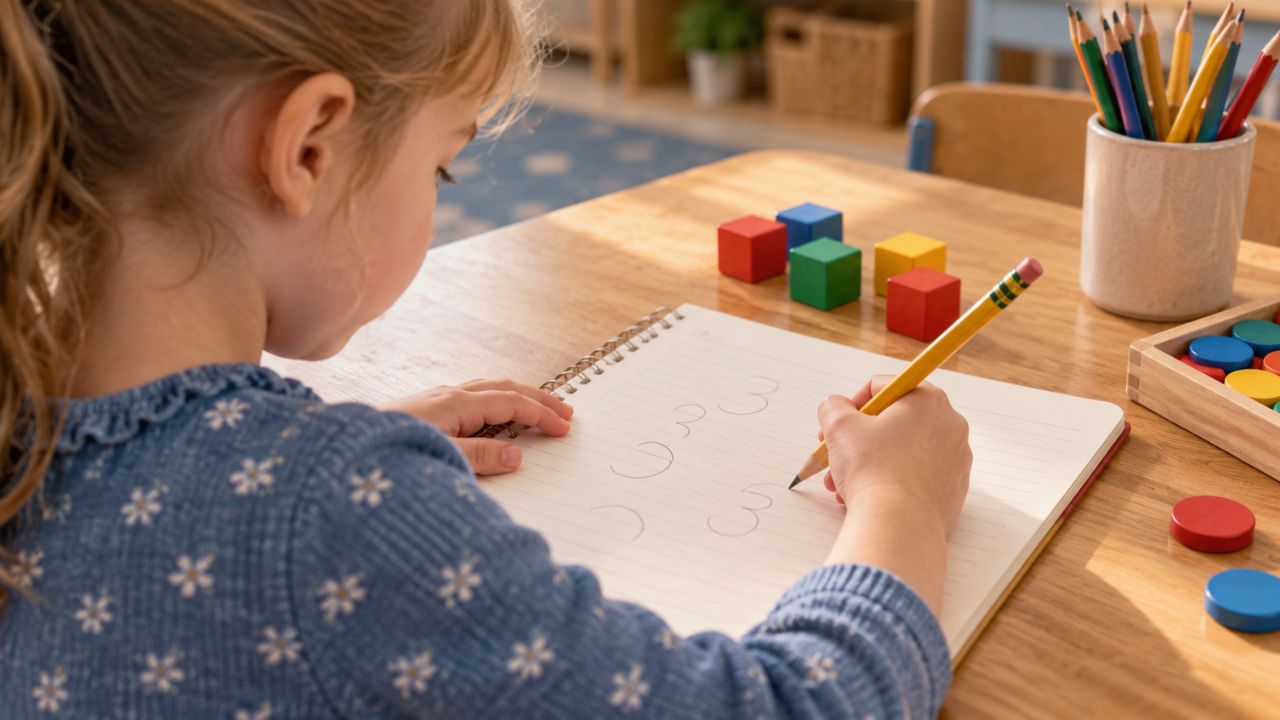
Writing numbers backwards is usually normal when young children are learning to write. You might notice a reversed 3 on a worksheet or a 5 facing the wrong way, even when your child can count the objects in front of them correctly. It is an easy mistake to worry about, especially when you are unsure whether it is part of learning or a sign that they need help.
Recognising a number, understanding its value, and remembering how to write it involve different skills. A child may know exactly what number they want to put on the page but still forget which way it faces. Number reversals alone do not tell you how well your child understands maths.
What matters is the wider picture: how your child is progressing, whether writing is becoming easier, and whether other difficulties are showing up. Understanding why these mistakes happen can help you respond calmly, make practice more useful, and know when to speak with their teacher.
Why Do Kids Write Numbers Backwards?
Kids write numbers backwards because their brains are still learning to connect visual shapes with their meaning. This is a normal part of moving from simple scribbles to real writing.
Developmental Milestones in Early Learning
Young children move through clear stages as they learn to read and write. Around ages three to five, they start to understand that marks on paper carry meaning. They draw shapes, lines, and squiggles that look nothing like letters or numbers yet.
This stage matters. It builds the foundation for everything that comes after.
Between ages five and seven, kids hit the stage where reversals show up the most. Your child’s brain is juggling visual information and spatial awareness at the same time, and that’s a lot of work for a developing mind.
Writing numbers backward or upside down is a regular phenomenon during this stage. Most kids grow out of it naturally as their thinking skills sharpen. The brain just needs more practice to lock in the right direction for each numeral, and that’s not a sign of struggle. It’s a sign that learning is right on schedule.
Transitioning from Drawing to Writing
Kids move from drawing to writing step by step, not overnight. Around age three or four, they start copying simple shapes: circles, lines, basic forms. This builds the hand strength and control they’ll need later.
Numbers and letters come next. Kids watch adults write and want to copy it, and mirror writing (that’s the term for writing letters or numbers backward or upside down) is a normal part of that copying process.
Here’s the thing to remember about this phase:
- Their visual processing and working memory are still under construction
- Most kids naturally stop reversing numbers as those skills mature
- The phase typically runs until about age five or six, though some kids show reversals until age seven
- Every reversal is your child’s brain working hard to link what they see with what their hand does
When Is Writing Numbers Backwards Considered Normal?
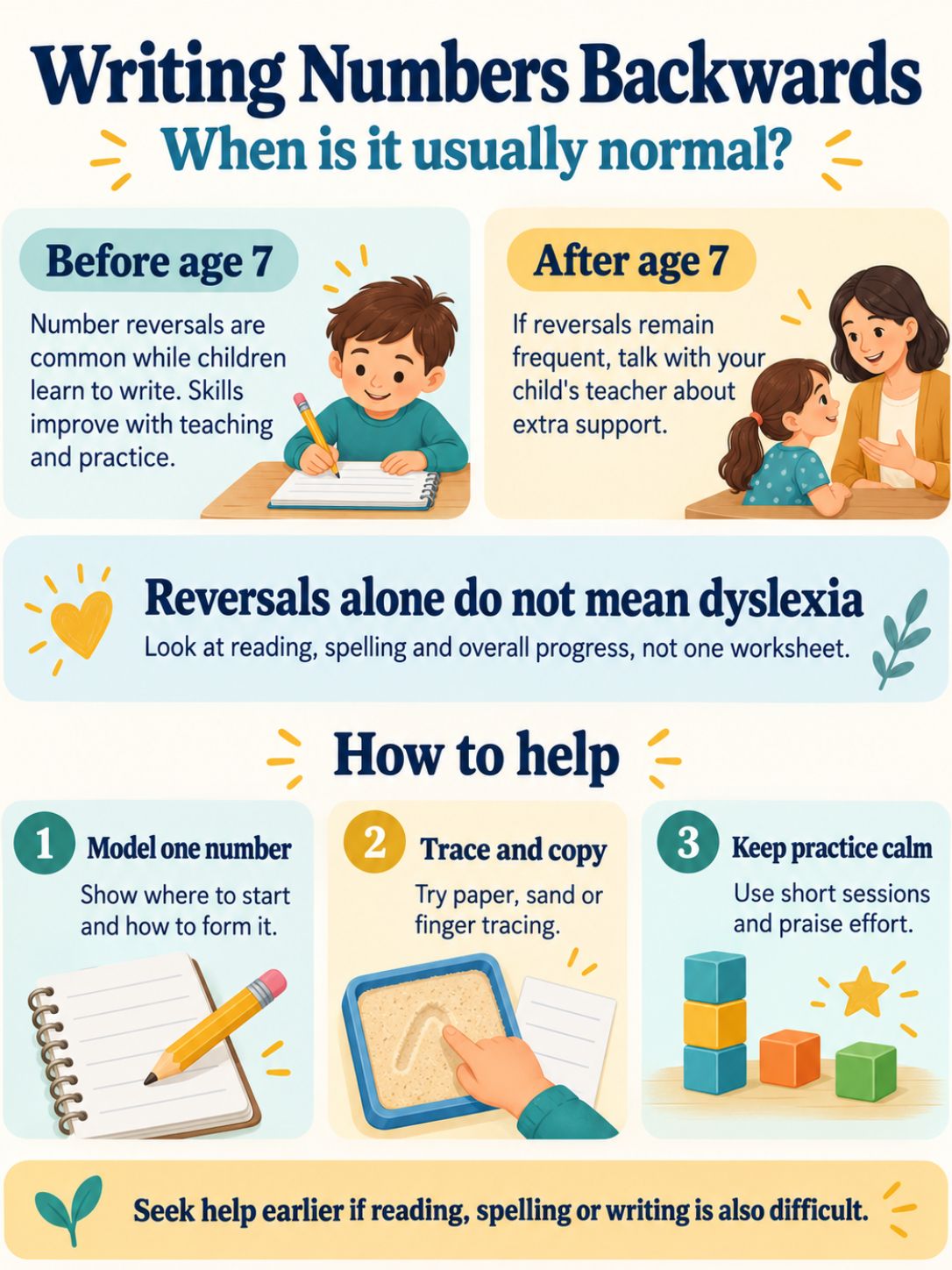
Kids typically reverse numerals between ages three and seven, which sits squarely inside normal development. Most stop by age six or seven, once their brain catches up with their hand.
Typical Age Range for Reversals
Most children write numbers backward until around five or six years old. This is expected, not exceptional.
Letter reversals can stick around through age seven for some kids. Every child’s brain develops at its own pace, so some outgrow this faster than others. Your child’s stage of development matters far more than what today’s worksheet looks like.
Common Patterns in Young Children
Kids show pretty predictable patterns when they reverse numbers and letters. Your child might flip a 3 into a backwards 3, or write a 7 upside down. These reversals happen because young brains are still learning to recognize and process visual symbols, and that skill develops gradually.
Some kids reverse letters along with numerals, since mirror writing tends to show up in the same window, up until about age seven. Left-handed children sometimes show different spatial habits when forming numbers, which can lead to more reversals for a while.
A pro-tip worth remembering: short, consistent practice tends to move kids through this phase faster than worrying about it does. Working memory and visual processing both improve with repetition, so a few minutes a day of tracing or copying numbers can make a real difference over a few weeks.
Factors That May Influence Writing Reversals
Several things shape how kids process and write numbers, from how their brains handle visual information to how they coordinate hand and eye. Memory, spatial awareness, and even which hand your child favors all play a part.
Visual Processing and Working Memory
Think of your child’s brain like a camera paired with a filing system. Visual processing helps kids see and understand what a number looks like. Working memory lets them hold that picture in their head long enough to copy it onto paper.
Young learners are still building both skills, so their brains sometimes flip what they see. This is normal during early literacy learning, not a red flag.
Kids under five or six often struggle here simply because their visual perception hasn’t fully matured. Their eyes take in a number one way, but their hand writes it differently. That gap closes naturally as they grow.
Working memory plays its own role too. A child might see the number five correctly, but their mental “workspace” doesn’t hold that image steady while their hand moves. The result: a backward or upside-down 5.
Most kids outgrow this by age seven as their thinking skills catch up to their hands. Your encouragement along the way helps speed that process up.
Left-Handedness and Spatial Awareness
Left-handed kids often process spatial information a little differently than right-handed kids do. Their brains approach the page from a different angle, which can lead to more numeral reversals for a while. That difference doesn’t mean anything is wrong. It just reflects how their brain handles visual and spatial tasks during this stage of learning.
Spatial awareness builds over time, and left-handed kids may simply take a different route to get there. A child who writes a 5 backward might just be working through spatial understanding at their own pace.
Here’s something worth knowing if you’ve heard that left-handedness is linked to dyslexia: it isn’t, at least not in the way people assume. According to a 2023 meta-analysis of more than 45,000 participants published in Neuroscience & Biobehavioral Reviews, dyslexia isn’t robustly linked to left-handedness at all. It’s linked to mixed-handedness, meaning a child who hasn’t settled on a dominant hand yet. That’s a detail worth mentioning to a teacher or pediatrician if you notice it, but on its own it’s not a cause for alarm.
Most kids naturally outgrow reversals by ages five to seven as their cognitive skills grow stronger. You can support a left-handed learner best by giving them room to develop at their own pace, offering encouragement, and using activities that build number recognition.
How to Support Children Who Write Numbers Backwards
You can help your child move through this phase with patience, practice, and the right activities. Your encouragement matters more than you might think.
Encouragement and Positive Reinforcement
Your child’s reversals are not a sign of failure. Praise them when they write a number correctly, even on days when mistakes happen too. Kids thrive on positive feedback, and celebrating small wins builds real confidence.
Try lines like, “I see you worked hard on that 5,” or “You’re getting better at writing numbers every day.” That keeps the process light instead of stressful.
Point out progress over perfection. If your child wrote three numbers correctly today and two backward, focus on those three wins.
Create a judgment-free zone at home where mistakes are just part of learning. Skip the correcting-in-front-of-others moment, and instead gently show the correct way when it feels natural. This stage calls for patience, not pressure, and your belief in your child’s ability shapes how they see themselves as a learner.
Activities to Improve Number Recognition
Your child’s brain is still learning to tell a number apart from its mirror image. These activities build that skill during the window when it matters most.
- Play number matching games where your child pairs identical numerals on cards. This builds visual processing and helps them see that 2 and a backwards 2 are different.
- Trace numbers in sand or shaving cream with a finger. The tactile feel strengthens the connection between how a number should look and how it feels to write.
- Use flashcards for short bursts each day. Quick, repeated exposure helps working memory store the correct pattern.
- Bring in large foam or wooden numbers your child can touch and move around. Physical interaction supports spatial awareness.
- Practice on a whiteboard, where mistakes wipe away easily. That takes the pressure off and lets your child experiment freely.
- Point out numbers in everyday life: on signs, clocks, and house addresses. Real-world examples reinforce the correct orientation naturally.
Two more worth trying when you want variety: hopscotch with numbers instead of plain squares gets movement and number recognition working together. Books with large, clear numerals do the same job while making story time do double duty.
Final Thoughts
Seeing your child write a number backwards can make you wonder whether you have missed something. But an occasional reversal during early learning is usually a reason to offer guidance, rather than assume something is wrong. Look beyond a single worksheet and pay attention to how your child is developing over time.
Keep support simple. Show them how to form the number, leave a clear example nearby, and give them a little time to practise without pressure. When a mistake happens, a calm reminder is more helpful than turning the whole activity into a correction exercise. Their effort and understanding deserve attention, too.
If reversals continue despite regular support, cause frustration, or appear alongside other reading or writing difficulties, bring examples to their teacher and discuss what help might be useful. Writing numbers backwards is usually normal in the early stages, but you can offer reassurance while still taking persistent difficulties seriously.
FAQs about Why Writing Numbers Backwards Is Usually Normal
1. Why do kids write numbers backwards?
Kids write numbers backwards because their brains are still learning left from right and spatial orientation. A 2018 Johns Hopkins study found that about 85% of preschoolers naturally reverse at least one number, and it typically resolves by age seven with regular writing practice.
2. At what age should backwards numbers stop?
Most kids stop reversing numbers by age seven or eight, when the brain’s left hemisphere becomes more dominant for writing tasks. If reversals continue frequently past age eight, educators recommend checking in with your child’s teacher, though occasional mix-ups through second grade are still normal.
3. Does writing numbers backwards mean my child has dyslexia?
Not usually. According to the International Dyslexia Association, number reversal alone is a typical part of learning to write and doesn’t indicate dyslexia, which involves broader reading challenges like difficulty decoding words or recognizing letter sounds.
4. How can I help my child stop reversing numbers?
Multisensory practice makes a big difference. Try having your child trace numbers on textured surfaces or use apps like Writing Wizard that provide guided tracing with instant feedback. Focus on praising their effort rather than perfection, and you’ll likely see improvement within a few weeks.