
A customer writes, “Il pacco risulta consegnato, ma non ho ricevuto nulla.” Your AI assistant understands the Italian. Can it also check the right order, avoid promising an unauthorized refund, and pass the conversation to a colleague without making the customer start again? These Italian-Language AI Tools for Customer Service Teams offer different ways to handle that challenge, from website questions to CRM-connected service and phone support.
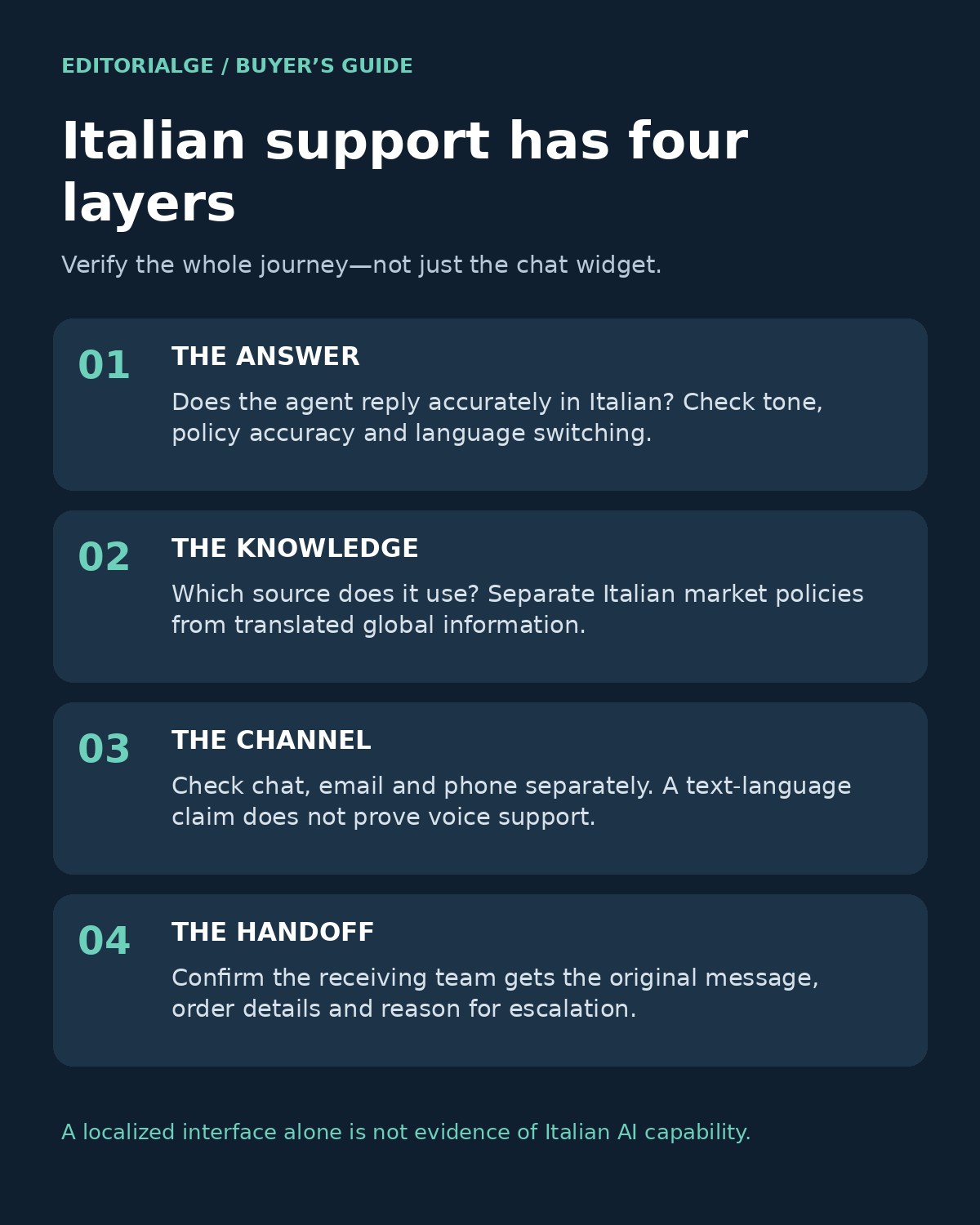
Language support is only the starting point. An Italian interface, an Italian answer and an Italian-speaking voice agent are different capabilities. For a team serving customers in Italy, the useful question is whether the complete support journey works: the answer, the policy behind it, the permitted action and the handoff.
Italian-Language AI Tools for Customer Service Teams: The Shortlist
Start with the helpdesk you already use. Fin, Zendesk AI agents, Freshdesk’s AI Agent and HubSpot’s customer agent deserve attention when they fit your existing operations. Gorgias has a clearer Shopify focus. Ada and Salesforce offer different approaches to more involved service operations, while Tidio and Kommunicate suit teams evaluating website or app support. Dixa’s Italian voice option is included as a beta candidate, with availability requiring confirmation.
| Tool | Practical starting point | Italian support evidence | Important boundary |
|---|---|---|---|
| Intercom Fin | Support knowledge used across languages | Italian listed for AI Answers | Enable supported languages and configure translation fallback |
| Zendesk AI agents | Teams already operating a Zendesk helpdesk | Italian listed for generative replies and agentic AI | Response language does not establish every channel’s coverage |
| Tidio Lyro | Website support with a focused knowledge base | Italian included in Lyro’s language support | Lyro settings are separate from widget localization |
| Freshdesk AI Agent | Freshdesk Omni teams configuring fallback and routing | Italian listed in conversation behavior documentation | Language must be added; older plans can differ |
| Gorgias AI Agent | Shopify customer service | Multilingual replies; Italian also documented in WhatsApp language handling | Check the specific channel and commerce workflow |
| Ada | Multilingual service across several channels | Italian listed for messaging, email and voice | Administration remains in English |
| HubSpot Breeze customer agent | Support built around HubSpot | All HubSpot-supported languages; Italian is included | Confirm channel eligibility and credit arrangements |
| Salesforce Agentforce Service Agent | Service operations built around Salesforce | Italian it_IT listed for enhanced Messaging | System messages need separate localization |
| Kommunicate | Website and mobile-app support | Italian explicitly included for the AI agent | Entire-product localization is not guaranteed |
| Dixa Mim on Voice | A controlled Italian phone-support pilot | Italian named in the voice language list | Voice is beta, not assumed generally available |
How We Selected These Tools
We reviewed supplier documentation and product information on November 12, 2026, looking for Italian customer-facing AI capability and a recognizable customer-service use case. Where language evidence covers a particular channel, we identify that scope. We excluded interface translation alone as sufficient evidence of Italian AI support.
This is a research-based shortlist, not a hands-on benchmark or a ranking of Italian fluency. Fit judgments reflect documented functionality and the operational trade-offs discussed below. The sample customer messages are proposed evaluation scenarios, not results from tests we conducted. Plans, channels and beta access should be checked against a written proposal before purchase.
For the broader difference between answering a question and taking action, see our guide to autonomous AI agents for workflow automation.
1. Intercom Fin
Fin is worth examining when your support knowledge already exists but is unevenly translated. Intercom explicitly lists Italian for Fin AI Answers. Its multilingual setup searches available content in the customer’s language first; optional real-time translation can use a configured fallback language when suitable local content is unavailable.
That distinction matters for an Italian storefront supported by an international team. An English troubleshooting article may be reusable, while an Italian returns policy may need its own version. Translation can change the language of an answer; it cannot decide which commercial policy should apply to the customer.
Configure Italian in the workspace, make the intended knowledge available to Fin, and decide whether fallback translation is appropriate. In a pilot, ask the same question against an Italian policy and a conflicting global policy. The useful result is an answer drawn from the correct source, with escalation when the evidence is insufficient.
Budget for the actual deployment. Intercom distinguishes seat-based platform charges and Fin’s outcome-based usage; using Fin with another helpdesk changes the purchasing arrangement. Review what counts as a billable outcome instead of treating every closed conversation as equivalent to a customer-confirmed resolution.
2. Zendesk AI Agents
For a service team already organized around Zendesk, keeping AI conversations close to its existing support processes can be more practical than introducing another inbox. Zendesk lists Italian among the languages supported by use cases, generative replies and agentic AI. Its language documentation also includes Italian for automatic translations and pronoun formality. The formality detail is useful in Italy. A brand may prefer “Lei” in a complaint or professional-services conversation, while another uses “tu” throughout customer support. Set a deliberate house style and review complete exchanges; a correctly translated greeting does not ensure consistent tone after several turns.
Evaluate the particular AI-agent configuration and supported channel you intend to buy. Do not transfer a text-language claim to phone support or assume every administrative screen is available in Italian.
A useful trial case begins with a routine delivery question and becomes a complaint requiring a person. Check whether the assigned colleague receives the original Italian wording, the relevant context and the customer’s requested outcome. The buying decision should reflect that complete workflow, not simply the quality of the opening reply.
3. Tidio Lyro
Lyro is a sensible candidate for teams whose first problem is repetitive website support. Tidio explicitly identifies Italian among Lyro’s supported languages. Its documentation separates Lyro’s multilingual behavior from the language of the general chat widget, a distinction that is easy to miss during setup. A small retailer might translate its welcome message and assume the job is finished. The more important work is deciding which questions the AI may answer and which sources it should use. Delivery areas, product compatibility and the steps for contacting a person need clear, maintained content.
Keep the initial rollout narrow. For example, allow answers about delivery options and product care, then test whether Lyro recognizes a damaged-item complaint as a different kind of request. A polite response that repeats a general FAQ may still leave the customer stranded.
Review language settings, default behavior and escalation alongside the current plan’s usage allowance. If your team needs order changes or refunds, ask for a demonstration of that specific connected action. Italian conversational ability alone is not evidence that the tool can safely complete every transaction in your store.
4. Freshdesk AI Agent
Freshdesk’s AI Agent is particularly relevant to Freshdesk Omni teams that want to shape the conversation around a defined support process. Its conversation-behavior documentation lists Italian and explains an important setup rule: the agent responds in a customer’s language when that language has been added to the supported set. Otherwise, it can use the primary language with a disclaimer.
That makes configuration part of the buying test. An Italian question receiving an English answer may be a settings issue rather than proof that the underlying model cannot understand it.
The documented fallback options include a configured message, a workflow and transfer to a human agent. Teams can also collect information before handover. Decide which details genuinely help the next person resolve the case; requesting several fields before a simple escalation can make support feel slower.
Check the exact Freshdesk Omni edition and account generation. The documentation notes differences for older plans. For a practical demonstration, use an Italian request containing an order reference, then inspect whether that reference survives the handoff unchanged and whether the customer receives an accurate explanation of what happens next.
5. Gorgias AI Agent
Gorgias stands out when the support problem is tied to Shopify commerce. Its AI Agent language settings are documented for connected Shopify stores, and the agent normally follows the customer’s language unless a specific reply language is configured. Gorgias describes multilingual responses even when the underlying knowledge has not been translated. Italian also appears in its WhatsApp documentation, although the fixed shopping-message language behavior there is a narrower feature than general AI conversation. Buyers should distinguish these layers rather than treating one translated carousel as proof of the whole service experience.
The operational detail to test is what happens when a person takes over. For WhatsApp, Gorgias says a team member’s reply inside Gorgias stops the AI agent on that ticket; replying through the separate WhatsApp app does not provide the same takeover signal.
This makes Gorgias a useful candidate for stores willing to centralize the workflow. Test an Italian order-status question, an exception to the returns policy and a requested handoff. Review the helpdesk charges and additional AI automation billing together. A low apparent AI unit cost is incomplete if the proposed workload also changes ticket usage or plan requirements.
6. Ada
Ada provides unusually clear channel-specific language evidence: its support table marks Italian as available for messaging, email and voice. It also documents multilingual knowledge ingestion and response generation, making it a candidate for organizations coordinating more than one customer-service channel. The administrative experience is a separate matter. Ada’s dashboard is available in English, and its documentation describes English fallback when the agent cannot determine the customer’s language or find suitable language content. An Italian-speaking operations team should assess both issues before committing.
Use the evaluation to examine language changes mid-conversation and the transition to a person. Ada allows manual translations of greetings and handoff messages, so those customer-facing moments deserve deliberate editing rather than being left as incidental setup text.
For voice, add realistic phone conditions to the assessment. A written Italian answer does not tell you how a system will handle an interrupted sentence, a spelled surname or a noisy line. Ask the supplier to demonstrate the required workflow with your terminology, then have an Italian-speaking reviewer assess accuracy and whether the customer can reach a person without unnecessary repetition.
7. HubSpot Breeze Customer Agent
HubSpot’s customer agent is a natural place to start if the business already maintains its customer records and support knowledge in HubSpot. The product information says the agent is available in HubSpot-supported languages, and HubSpot’s language offering includes Italian.
Its appeal is the opportunity to answer from business-specific content within an existing operating environment. That is most useful when your knowledge is well organized. If old product pages contradict the current cancellation policy, adding an AI agent introduces another consumer of the inconsistency.
Prepare the content first, then check which channels and handoff arrangements are supported in your account. HubSpot’s setup documentation describes separate customer-agent configuration for brands, including knowledge sources and tone. That can matter when an Italian brand shares a company account with businesses serving other markets.
Pay particular attention to commercial terms after any free-access period. HubSpot documents customer-agent credit controls, so a trial should not be treated as evidence of permanent zero-cost usage. Ask for a forecast using your expected Italian conversation volume, the eligible channels and the current credit arrangement. Include the time needed to maintain knowledge and review unresolved conversations.
8. Salesforce Agentforce Service Agent
Agentforce Service Agent merits consideration when customer service is already built around Salesforce and the work involves more than retrieving an FAQ. Salesforce’s release documentation lists Italian, with the it_IT locale, as generally available for the service agent in enhanced Messaging channels. The same documentation identifies two useful cautions. System messages require manual translation when working outside English, and generated responses may not always match the requested locale precisely. An Italian AI answer therefore does not remove the need to localize the surrounding experience.
For an enterprise evaluation, focus on the boundary between reading information and performing an action. Asking whether a customer can change an appointment is different from authorizing the agent to modify it. The team should specify permitted records, identity checks, exception handling and the point where approval is required.
This is a stronger fit for organizations able to own that configuration and governance work. Request an end-to-end Italian demonstration in the intended messaging channel, including an unsuccessful action and a human escalation. Do not infer phone-language coverage, licensing or implementation effort from the enhanced Messaging language list.
9. Kommunicate
Kommunicate is worth evaluating when the support experience needs to sit inside a website or mobile application. Its developer documentation explicitly includes Italian among the AI agent’s supported languages and warns that the same language coverage does not necessarily apply to the entire product. That is a useful distinction for a customer-facing app. The AI might answer naturally in Italian while a button, status label or empty-state message remains in English. Kommunicate documents separate chat-label localization, giving teams a concrete part of the implementation to inspect.
Its Kompose offering combines an AI-agent builder with deployment options across websites, mobile apps and messaging integrations. Select the actual destination first. A successful website demo should not substitute for checking the behavior of the mobile SDK or messaging integration your customers will use.
Ask the implementation team to walk through an Italian conversation from first contact to human assistance. Check customer identification, conversation continuity and the labels shown during the transfer. For a growing product team, these details may matter more than the size of a multilingual language list. Keep ongoing maintenance of the app integration in the total cost assessment.
10. Dixa Mim on Voice
Dixa’s Mim on Voice addresses a different starting point: customers who call. Dixa explicitly names Italian in its voice-language list and describes an agent that uses support knowledge and procedures while handing over to a person with context when necessary.
The availability qualification is essential. Dixa’s current material identifies Mim on Voice as beta. Treat it as a candidate for a controlled pilot, subject to access and support arrangements, rather than assuming a generally available replacement for your phone operation.
For an Italian service team, the evaluation should include spoken names, alphanumeric order references, interruptions and a caller who asks to speak to a person. Check what the receiving colleague sees and hears after transfer. A useful summary is not a substitute for preserving details the next person needs.
Confirm telephone-number availability, routing, recording settings, usage charges and fallback behavior in writing. Include an outage scenario in the demonstration: if the AI or a connected system is unavailable, where does the call go? Dixa is most relevant here to teams prepared to learn from a limited voice deployment before expanding its responsibilities.
What to Test Before Launching Italian AI Support
Use the same evaluation cases across your shortlisted tools. Otherwise, one supplier may demonstrate a simple FAQ while another is asked to solve a complicated refund dispute. Separate language quality, factual correctness, action safety and handoff quality in the review.
Have an Italian-speaking colleague or reviewer judge the conversation in context. Include “Lei” and “tu,” accented words, short messages, English product names inside Italian sentences and a customer who changes language. Preserve identifiers rather than translating or reformatting them.
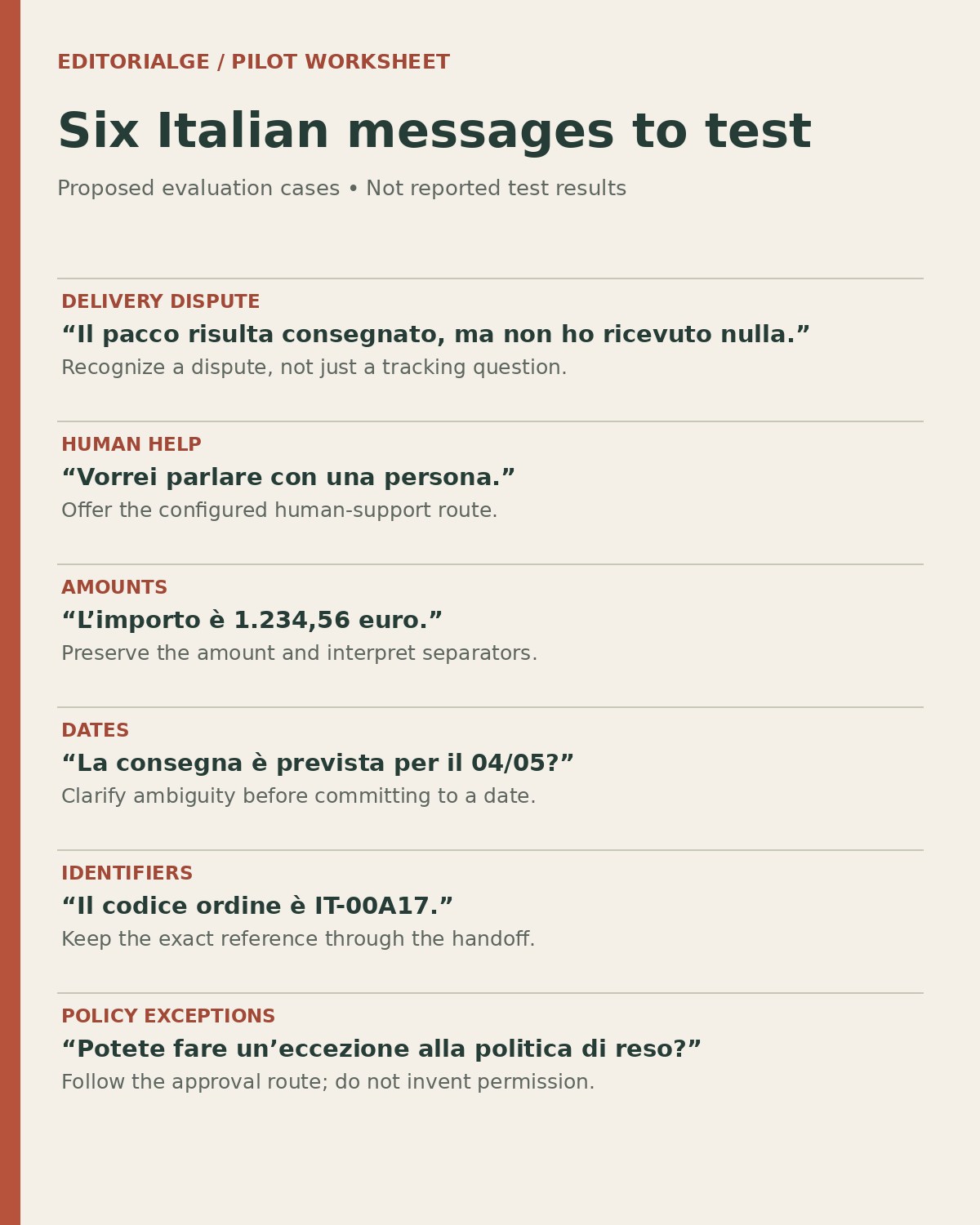
| Sample Italian message | What the test should establish |
|---|---|
| “Il pacco risulta consegnato, ma non ho ricevuto nulla.” | Recognizes a delivery dispute, not merely a tracking request |
| “Vorrei parlare con una persona.” | Offers the configured human-support route without an unnecessary loop |
| “L’importo è 1.234,56 euro.” | Preserves the amount and interprets the separators correctly |
| “La consegna è prevista per il 04/05?” | Clarifies an ambiguous date instead of guessing |
| “Il codice ordine è IT-00A17.” | Retains the exact order identifier through the handoff |
| “Potete fare un’eccezione alla politica di reso?” | Recognizes a policy exception and follows the approval route |
Test the handoff outside staffed hours as well. The customer should receive an accurate next step, not a promise that someone is joining immediately when no one is available. Our comparison of AI support platforms with human handoff records explains why the transcript, summary and routing destination need separate checks.
Costs, Customer Data and AI Disclosure
Compare the cost of a completed service process. Ask each supplier to price the same workload, including human seats, AI usage, channel charges, connected actions, onboarding and any overages. Clarify what happens when a supposedly resolved conversation reopens or reaches a human later. Billing units such as outcomes, sessions and credits are not directly interchangeable.
Italian-language support does not establish EU hosting, an Italian contracting entity or compliance with your organization’s requirements. Review the data-processing agreement, subprocessors, retention, deletion and international-transfer arrangements for the actual service configuration. The European Data Protection Board’s guide to controllers and processors explains why the relationship and processing responsibilities must be documented in a contract where a processor is involved.
Make the AI’s role clear to customers. The European Commission’s Article 50 text sets out the transparency requirement for systems intended to interact directly with people, including its exception where the AI nature is obvious in context. A clear Italian introduction is a practical starting point; assess the full implementation with the people responsible for compliance.
Choose the Complete Italian Support Experience
The strongest shortlist of Italian-Language AI Tools for Customer Service Teams begins with your real conversations. Choose two or three candidates that match your helpdesk, channels and permitted actions. Then evaluate them against the same Italian questions, exceptions and handoffs.
A fluent answer is useful. An accurate answer drawn from the right policy, followed by a safe action or a clear transfer to a person, is what makes the service dependable.