

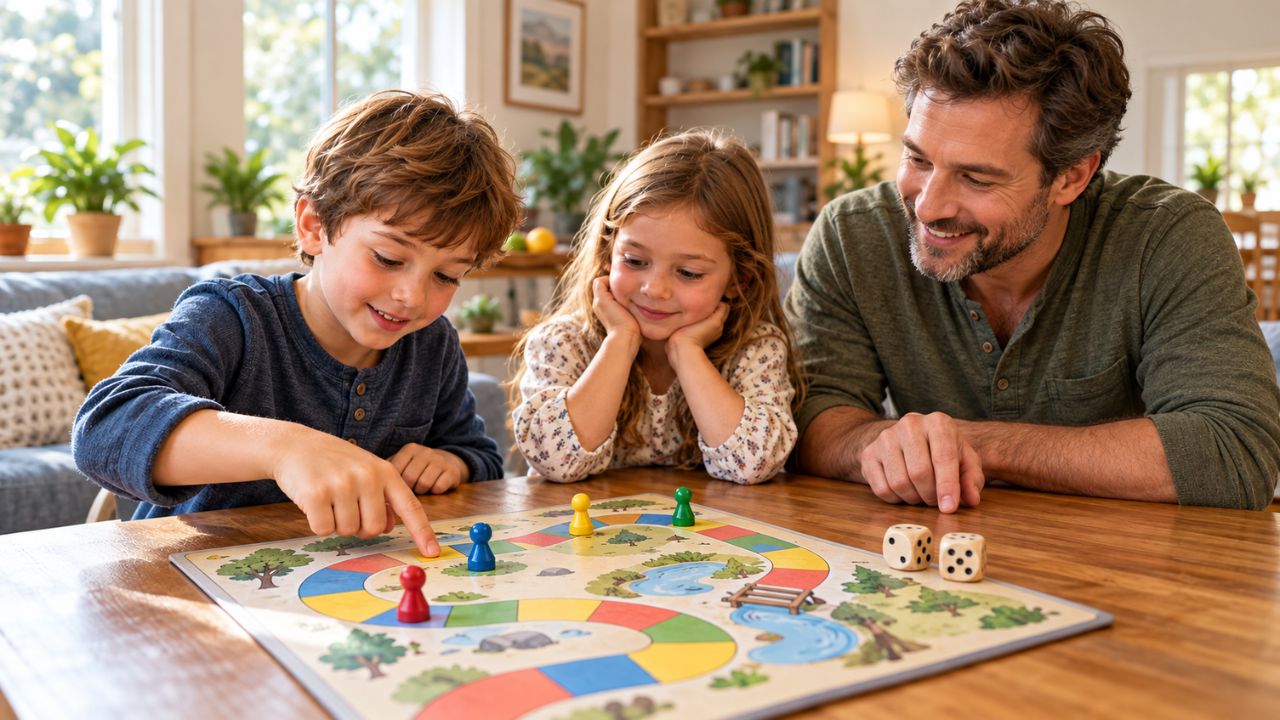
A child rolls a die, counts the dots, and moves a game piece. Then they do it again on the next turn. That simple routine shows how board games teach counting through play: children connect numbers to actions they can see and repeat.
The best part is that you don’t have to turn every move into a lesson. A game with a die and a numbered path gives children a natural reason to count, check their steps, and try again.
Exploring the Effectiveness of Board Games in Teaching Counting
Board games turn math practice into something your kid actually wants to do. When they roll dice, move pieces, and keep score, their brain works through real counting problems, but it feels like play instead of homework.
Engagement and Interaction in Learning Math
Kids stay focused way longer when they’re having fun. Rolling dice and moving a piece around a table beats staring at a worksheet every time.
Here’s a pro tip worth stealing: next time your child lands on space 14 and rolls a 3, ask them to count on to 17 instead of counting 1, 2, 3 from the very start. That small habit made the real difference in the study, and it costs you nothing to try tonight.
This back-and-forth interaction makes counting feel natural, not forced. Kids notice numbers everywhere during gameplay, whether they’re tracking scores or counting spaces.
During a typical game, your child practices things like:
- Counting spaces before moving a piece
- Tracking scores after every turn
- Saying numbers out loud without being asked
- Comparing totals to see who’s ahead
The social side matters too. Kids talk to each other, cheer on wins, and work through problems together, and that kind of interaction builds real confidence in their math skills.
Simple, number-based board games connect directly to stronger early counting skills. Cherry-O works great for young learners because every turn gives them a reason to count out loud, whether they’re moving a piece or gathering plastic cherries. Sessions don’t need to be long: even a quick 15-minute round with a preschooler turns picking and moving into a steady string of counting reps that feels like play, not a drill.
Three Sticks teaches geometry and number reasoning through gameplay that feels like a puzzle, not a lesson. Kids build a feel for where numbers sit on a line as they plan their moves.
The real growth happens quietly in the background. Kids strategize, reason, and play with a goal in mind, all while sharpening cognitive skills and building math skills that stick. They’re engaged and laughing, and they’re learning at the same time.
Playing Games as a Method of Math Concept Reinforcement
Board games work like a reinforcement tool for whatever your child already knows about numbers. They move pieces, roll dice, and track scores, and every one of those actions locks in counting skills a little more.
Games like Cherry-O give young learners a chance to practice counting without feeling like they’re sitting through a lesson. Each turn becomes a low-pressure shot at number recognition and matching numerals to quantities.
Different games reinforce different skills:
- Monopoly: mental math with real money, adding and subtracting on the fly
- Yahtzee: tracking probability and totals while scoring
- Dominoes: subitizing, or recognizing a group of dots and adding it up instantly
The social piece matters here too. Kids learn from each other, ask questions, and build confidence in how they solve problems, all while having a genuinely good time together.
Popular Board Games That Enhance Counting Skills
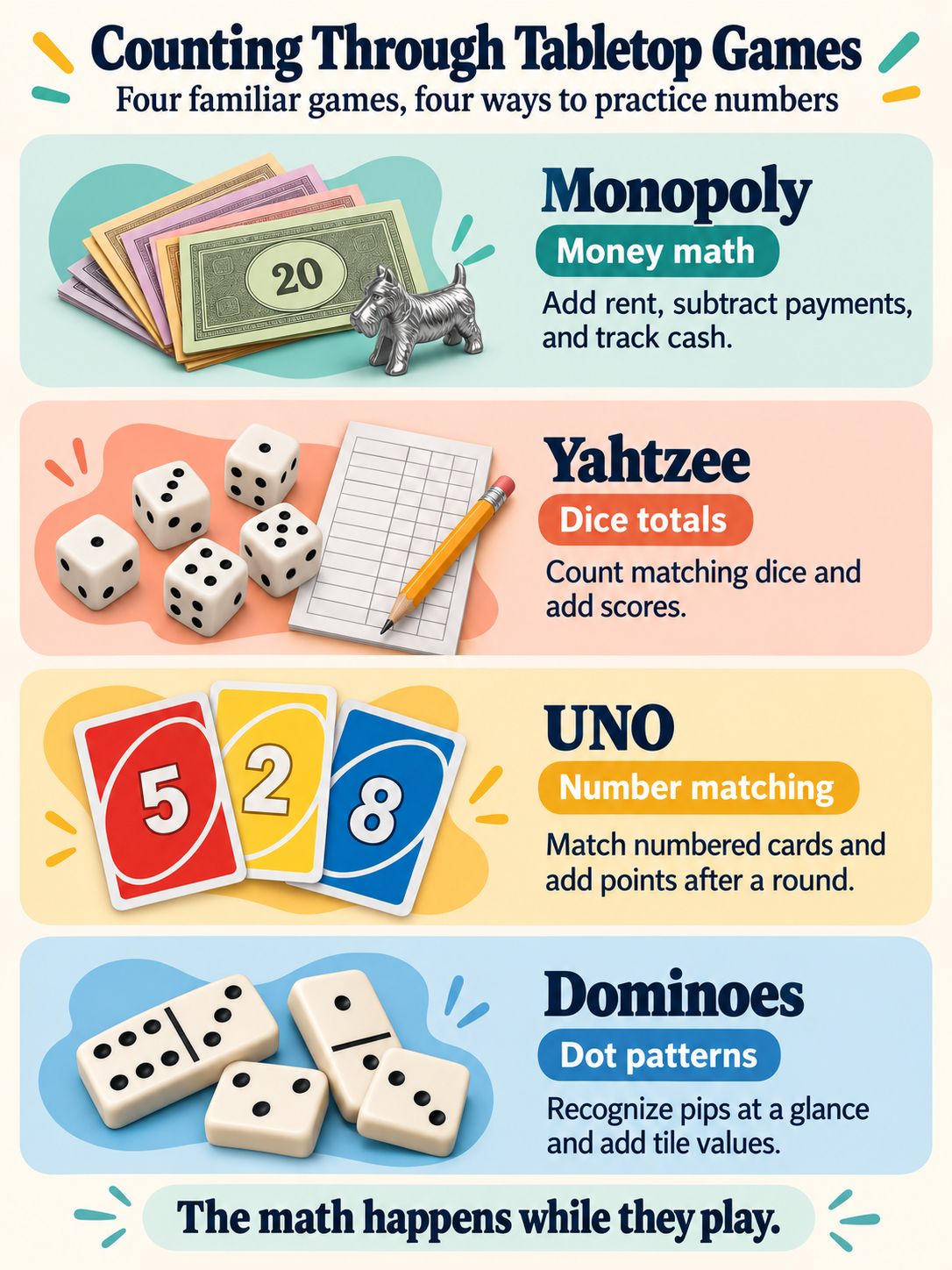
Some board games turn counting into pure fun, and kids pick up math skills without ever feeling quizzed. These games get players adding, subtracting, and tracking numbers naturally, right there at the table while everyone’s having a good time.
| Game | Core Math Skill | How It Shows Up at the Table |
|---|---|---|
| Monopoly | Mental math with money | Adding rent, subtracting payments, tracking cash |
| Yahtzee | Addition and probability | Adding dice totals, predicting subtotals |
| Uno | Addition and pattern spotting | Adding up scores, predicting likely next cards |
| Dominoes | Subitizing and quick addition | Recognizing dot patterns instantly, adding tile values |
Monopoly: Using Mental Math in Transactions
Monopoly teaches your child mental math through real money transactions. Players buy properties, pay rent, and manage their cash all game long, so they calculate change, add up expenses, and subtract payments from their bank pile without a worksheet in sight.
Rent payments force fast thinking. Say a player lands on your property and owes you $300: you either count up from what they handed you or subtract it straight from your total.
Kids practice addition, subtraction, and number recognition as the game keeps moving. Kids who play board games regularly tend to show stronger math skills, and Monopoly turns counting into an exciting back-and-forth where problem-solving happens turn after turn, not on a worksheet.
Yahtzee: Tracking Probability and Totals
Yahtzee brings math to life through dice rolling and score tracking. Players roll five dice and add up numbers to hit specific totals, which means practicing addition without ever calling it “practice.”
They calculate combinations, compare scores, and figure out which numbers work best for their strategy. Kids build counting skills and number recognition every time they mark up their scorecard, and the game teaches probability in a natural way, since kids start noticing which dice combinations show up more often just from playing round after round.
You don’t need hours of playtime to see results, either. In an early-numeracy study, Robert Siegler and Geetha Ramani tracked 124 Head Start preschoolers and found real gains in counting and number-line skills after just four short play sessions, each only 15 to 20 minutes long, spread across two weeks. That’s a good reminder that a few game nights a week can move the needle. You don’t need a daily math bootcamp.
A simple three-step routine can stretch that value even further:
- Before each roll, ask your child to guess the subtotal for their chosen category.
- After the roll, have them add the dice values out loud and write down the subtotal.
- At the end of the round, have them total three turns in a column to practice multi-step addition.
Kids who play Yahtzee regularly tend to show stronger overall math skills, mostly because they’re repeating addition without any of the stress that comes with a worksheet. The back-and-forth with other players makes it feel like fun instead of a classroom lesson, so kids stay engaged and keep playing.
Uno: Mastering Addition and Patterns
Uno teaches kids to add fast and spot patterns without ever feeling like math class. Players match cards by color or number, which builds addition skills naturally. They also add up card values in their head after each round, all while thinking through number combinations and sequences.
Pattern recognition becomes automatic with regular play. Kids start predicting what cards might come next based on what’s already been played, and spotting those patterns helps their brains work faster with numbers.
Tracking scores means kids practice addition over and over without realizing it. Every hand teaches a new lesson about numbers and strategy.
Dominoes: Practicing Subitizing and Quick Addition
Dominoes teach kids to recognize numbers fast without counting each dot one by one. Players see a domino and instantly know its value by spotting the pattern, a skill called subitizing that helps kids process numbers quickly.
Dominoes build counting skills naturally as kids match tiles and add up totals to win. The game works like a quick math workout that feels like pure fun, not a lesson.
Kids practice quick addition on every turn, which makes their math brains faster and sharper over time. That kind of repetition, wrapped in a game they actually enjoy, is exactly why dominoes deliver real learning alongside the fun.
Advantages of Using Board Games for Mathematical Learning
Board games do more than pass a rainy afternoon. On the 2024 Nation’s Report Card, only 40% of US fourth graders scored proficient or above in math, according to data from the National Assessment Governing Board, with the steepest drops showing up among kids who were already behind.
That’s exactly why low-pressure math education at home, like a weekly game night, matters so much for your child’s development.
Keep reading to see how play becomes a real tool for building confidence in math, not just a way to pass the time.
Acquiring Math Skills Through Game Play
Games like Cherry-O and Monopoly turn math practice into something fun. Kids count spaces on the board without ever realizing they’re building real counting skills.
The research backs this up, and it’s not just one old study. A January 2026 research review that looked across 18 separate studies found a 76% probability that simple, linear number-based board games, think Chutes and Ladders-style layouts, improve young children’s counting skills, according to coverage on Phys.org. That’s strong evidence, even if it’s not a guarantee for every single kid.
Simple, number-based games build early counting skills in ways worksheets just can’t match. Kids pick up numeral recognition naturally as they move pieces, read dice, and track scores.
Different games layer on different skills:
- Yahtzee builds probability sense and total calculations
- Uno strengthens addition and pattern recognition
- Dominoes trains subitizing, or recognizing quantities instantly
- Three Sticks builds number-line estimation and spatial reasoning
The back-and-forth of gameplay creates stronger learning than sitting alone with a pencil. Skills stick because kids enjoy the process, which makes math feel like an adventure instead of a chore.
Developing Problem-Solving Techniques
Board games force kids to think on their feet. Every turn brings a real choice, and they have to decide which move gets them closer to winning.
Yahtzee teaches probability and totals, so kids learn to weigh their options before they roll again. Monopoly demands mental math in every transaction. Three Sticks works a lot like Scrabble, teaching number reasoning through careful placement.
These game-driven habits show up again and again:
- Spotting patterns before making a move
- Testing an idea, then adjusting if it doesn’t work
- Treating a bad roll as information, not a dead end
- Predicting what might happen a few turns ahead
Those same skills carry over into everyday life, like figuring out how to split a snack fairly or planning out chores.
Building Social and Team Skills
Playing games with others teaches kids far more than counting. They learn to take turns, listen to teammates, and work toward a shared goal, all while practicing patience as they wait for their turn.
They celebrate wins together and handle losses with grace. These moments build friendships, teach cooperation, and push kids to explain their thinking out loud to someone else.
Kids build these social skills at the same table where they’re building math skills:
- Taking turns and waiting patiently
- Explaining their strategy to another player
- Handling a loss without giving up
- Working together toward a shared goal
That mix of interaction, strategy, and play adds up to growth that goes way beyond the numbers on the board.
Final Thoughts
Board games work quietly. Kids count spaces, add up scores, and track numbers without ever feeling like they’re studying. The research backs it up too, from the Laski and Siegler counting-on study to the 2026 review of 18 studies on number-based games. Kids who play these games regularly build stronger counting skills and better number recognition than kids who don’t.
That’s the real magic behind how board games teach counting without trying: your family game night does more than make memories. It plants the seeds for math thinking that grow for years. So roll the dice tonight, and watch your child’s confidence with counting and strategy grow, one turn at a time.
FAQs about How Board Games Teach Counting Without Trying
1. What is the best board game for teaching kids to count?
Simple games work best. Chutes and Ladders, Candy Land, and dice games like Yahtzee all get kids counting spaces or spots naturally, and research shows these linear board games are particularly effective because kids physically move along a numbered path.
2. At what age should kids start playing counting games?
Most kids can start around age three or four, when they develop one-to-one correspondence, the ability to match one number word to one object or space.
3. Do board games really help with math skills, or is that just a marketing claim?
They really help. Studies from Carnegie Mellon University found that children who played linear number board games showed greater improvements in number recognition and counting compared to other activities. Kids practice addition, subtraction, and number sense without it feeling like homework.
4. What if my child gets bored with counting games?
Switch things up by trying Sum Swamp, a game that adds simple addition to the counting fun, or let your child be the banker. Boredom usually means it’s time for a new challenge, not less counting.























