One difficult puzzle or a faster classmate can lead a child to say, “I’m not good at math.” Adults may reassure them, but “Of course you are” offers little help when the next problem is confusing.
A growth mindset in early math is the belief that mathematical ability is not fixed and can develop through instruction, useful strategies, practice, feedback, and time. It does not mean pretending every task is easy or telling children to repeat the same failed approach. It means helping them treat difficulty as information: something in the problem, strategy, or explanation may need to change.
For young children, this idea is built through ordinary interactions: what adults say after an error, which questions they ask, and whether children may revise their thinking.
What Growth Mindset Looks Like in Young Math Learners
A child with a growth-oriented response does not need to enjoy every math activity. Look at behavior instead: the child may rearrange counters, explain an answer, ask for a hint, or return after a pause.
A fixed response sounds more final: “I can’t count” or “She’s the smart one.” Children can move between both responses within one activity. Mindset is not a personality type, so avoid turning it into another label.
Math makes these beliefs especially visible because answers are often treated as simply right or wrong. Yet children also compare amounts, notice patterns, describe shapes, sort, measure, and explain spatial relationships. Their reasoning may be promising even when an answer is incomplete.
Consider a child who counts seven toy animals but skips one and says there are six. A quick correction settles the answer. A better learning exchange might begin with, “Show me how you counted them.” The child can line up the animals, touch each one once, and recount. The adult has not praised an error; they have made the thinking visible and given the child a way to improve it.
What the Evidence Supports—and What It Does Not
Growth mindset is useful, but it is sometimes sold as a cure for weak achievement. A large 2018 review found weak overall relationships with academic achievement and weak average effects from mindset interventions. Some learners or settings may benefit more, but a slogan or one-off lesson will not raise achievement by itself.
A short lesson about the brain cannot compensate for unclear teaching, unsuitable work, stress, or a learning difficulty. Children also need well-sequenced instruction, concrete materials, feedback, and accessible challenges.
Research on praise offers a useful direction, with a qualification. In a longitudinal study, parents’ process-focused praise with children ages one to three predicted more growth-oriented beliefs several years later. The study was observational, so it cannot show that praise caused those beliefs.
Experiments with older children have also found poorer responses to setbacks after intelligence praise than after effort praise. That supports caution around labels such as “smart,” but one phrase does not determine a child’s mindset.
Repeating “You worked hard” after unsuccessful effort can also sound empty when the child needs a different strategy or clearer explanation.
The stronger message is specific: ability can improve through actions the learner can adjust. That may mean organizing objects before counting, drawing a problem, checking another way, or asking someone to model the next step.
Building a Growth Mindset in Early Math Through Everyday Practice
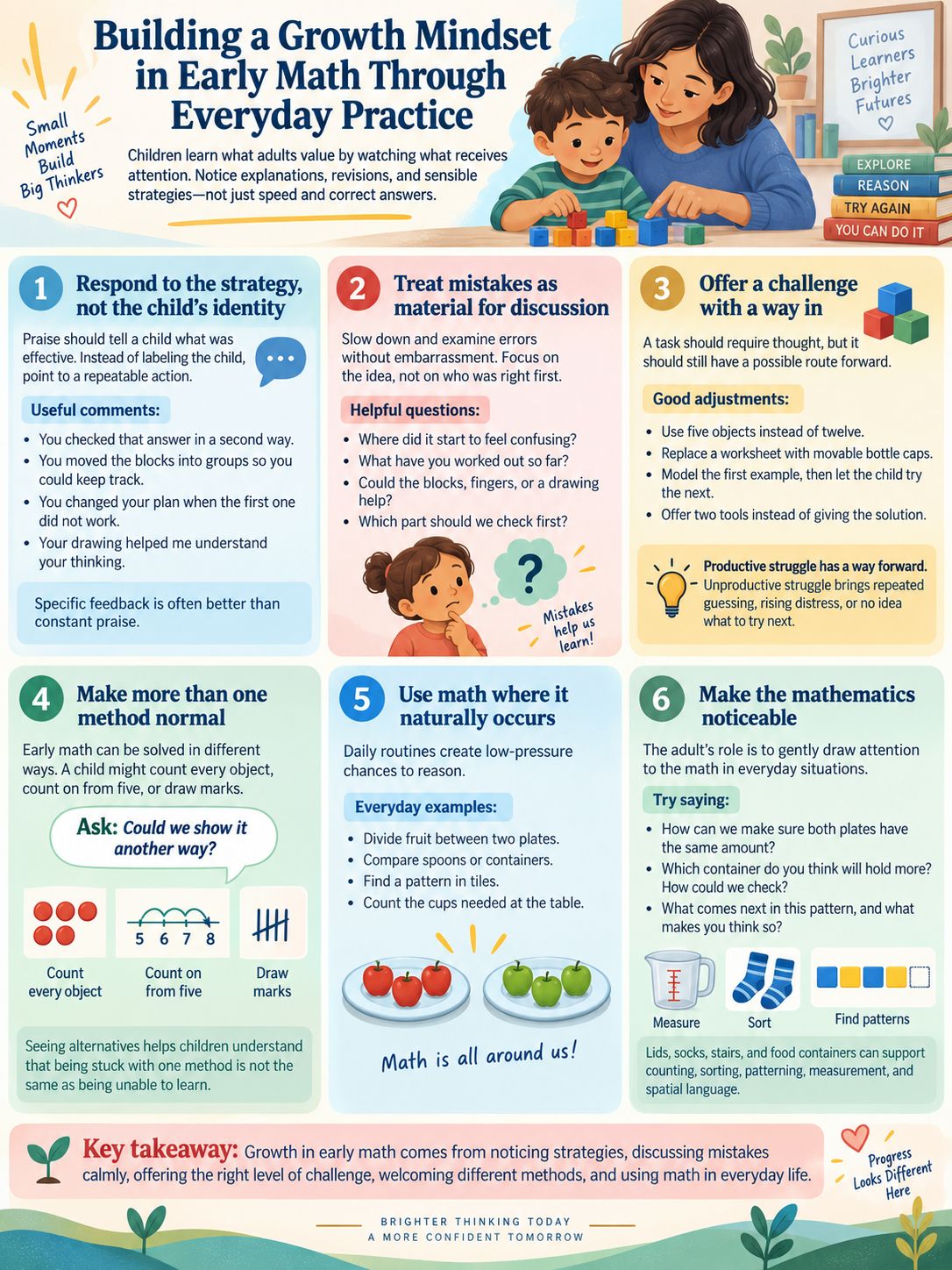
Children learn what adults value by watching what receives attention. If adults notice only speed and correct answers, quickness can look like the main sign of ability. Notice explanations, revisions, and sensible strategies too.
Respond to the strategy, not the child’s identity
Praise should tell a child what was effective. “You are a math genius” attaches success to identity. “You moved the blocks into groups so you could keep track” points to a repeatable action.
Useful comments include:
- “You checked that answer in a second way.”
- “Putting one counter in each space helped you see what was missing.”
- “You changed your plan when the first one did not work.”
- “Your drawing helped me understand your thinking.”
Specific feedback beats constant praise. Sometimes a neutral observation—“You counted each cup once”—is enough.
Treat mistakes as material for discussion
Adults do not need to celebrate every mistake. Children can tell when enthusiasm is forced. Instead, slow down and examine the error without embarrassment.
Questions such as these are useful:
- “Where did it start to feel confusing?”
- “What have you worked out so far?”
- “Could the blocks, fingers, or a drawing help?”
- “Which part should we check first?”
When discussing several possible answers in a classroom, ask children how each person may have reasoned. This keeps the conversation focused on ideas rather than who was right first. It also shows that an answer can be revised without the child losing status.
Offer a challenge with a way in
A task should require thought, not produce helplessness. If a preschooler can instantly name every quantity in an activity, there is little reason to develop a new strategy. If the task is far beyond the child’s current understanding, persistence alone will not bridge the gap.
Adjust one element at a time. Use five objects instead of twelve. Replace an abstract worksheet with movable bottle caps. Model the first example, then let the child try the next. Offer two possible tools instead of supplying the solution.
This is where adult judgment matters. Productive struggle has a possible route forward. Unproductive struggle looks like repeated guessing, rising distress, or no understanding of what to try next. A short break, a smaller step, or direct teaching may be the better response.
Make more than one method normal
Early math offers many ways to compare approaches. A child might solve five plus three by counting every object, counting on from five, or drawing marks. Seeing alternatives shows that being stuck with one method is not the same as being unable to learn.
After solving, ask, “Could we show it another way?” One thoughtful follow-up is more useful than turning the task into an oral examination.
Use math where it naturally occurs
Formal practice has a place, but routines provide lower-pressure chances to reason. A child can divide fruit between two plates, compare spoons, find a pattern in tiles, or count the cups needed at the table.
The adult’s role is to make the mathematics noticeable:
- “How can we make sure both plates have the same amount?”
- “Which container do you think will hold more? How could we check?”
- “What comes next in this pattern, and what makes you think so?”
These activities need no special kit. Lids, socks, stairs, and food containers can support counting, sorting, patterning, measurement, and spatial language. Small loose items require close supervision around children who may put objects in their mouths.
Phrases That Help More Than “You’re So Smart”
Match the response to the situation. A frustrated child may need acknowledgment; a careless guess may need a prompt to slow down; a sound method deserves precise feedback.
- Replace “You’re a natural at math” with “You noticed the pattern and used it.” This connects success to a repeatable action.
- Instead of stopping at “That’s wrong,” say, “Let’s check where the answer changed.”
- “Just try harder” gives no direction. Try, “This way is not helping yet. What else could we use?”
- Avoid “This is easy.” A child who finds it difficult may hear that as a judgment. Ask, “Where do you want to start?”
- When “Don’t give up” adds pressure, offer a practical choice: a hint, a tool, or a short break.
The word “yet” can be helpful—“You do not understand this yet”—but it should not become a reflex. Without teaching or a next step, “yet” is only optimism. Pair it with support: “You do not recognize all these shapes yet. Let’s compare two at a time and look at their sides.”
Common Mistakes Adults Make
The first is praising effort regardless of what happened. If a child repeatedly miscounts a scattered group, praising persistence while withholding guidance leaves the problem untouched.
Another mistake is removing difficulty too quickly. Giving the answer at the first pause can teach a child to wait for rescue. Allow some thinking time, then offer the smallest useful prompt.
Timed practice is not automatically harmful, and fluency matters as children progress. The problem comes when speed or public ranking becomes the main signal of ability. Accuracy, reasoning, flexible strategies, and explanation need attention too, especially while a new idea is still developing.
Adults should also watch their own comments. “I was never a math person” may sound comforting, but it frames mathematical ability as a fixed identity.
This concern is not merely theoretical. Research with first- and second-graders found that children of highly math-anxious parents learned less math and developed more math anxiety across the school year when those parents frequently helped with math homework. The study does not show that one negative comment causes anxiety, but it suggests that adult attitudes can enter the learning exchange.
A more constructive version is honest without being fatalistic: “I found this kind of math difficult at school, so let’s take it one step at a time.”
Finally, growth-mindset language should never be used to dismiss persistent difficulty. A child who continues to struggle despite clear teaching and appropriate practice may need closer observation, adapted instruction, or an evaluation through the school or a qualified professional. Encouragement and support for learning needs belong together.
A Simple Routine for Home or the Classroom
Try this routine with a puzzle, counting task, shape activity, or story problem:
- Invite a prediction. Ask the child what they think might happen or which answer seems possible.
- Ask for a first approach. Let the child choose a drawing, objects, fingers, mental reasoning, or another familiar tool.
- Pause at the difficulty. Name the specific problem: “We lost track because the objects moved after we counted them.”
- Choose one adjustment. Line up the objects, mark those already counted, use fewer items, or model one step.
- Reflect briefly. Ask what helped. Keep the answer concrete: “Moving them into a row made it easier to count each one once.”
The routine does not belong in every activity; over-questioning can drain the pleasure from play. Use it for a meaningful challenge. Over time, look for small changes: explaining an attempt, checking an error, accepting a tool, recovering from frustration, or naming a strategy.
Final Thoughts
A growth mindset in early math matters most when it changes what adults do. The next time a child stalls, resist both quick rescue and empty encouragement. Ask what they have tried, offer one useful tool or hint, and notice the strategy that moves the work forward.
Children need evidence that confusion can be examined, methods can change, and help is part of learning. That gives them a practical response when mathematics becomes difficult.
FAQs about Growth Mindset in Early Math
What Is a Growth Mindset in Early Math?
A growth mindset in early math teaches children that their math skills can improve through practice, effort, and learning from mistakes.
Why Is a Growth Mindset Important for Young Children?
It helps children build confidence, stay motivated, and approach challenging math problems with persistence rather than giving up.
How Can Parents Encourage a Growth Mindset in Math?
Parents can praise effort, ask open-ended questions, celebrate progress, and encourage children to try different ways of solving problems.
How Do Mistakes Help Children Learn Math?
Mistakes give children opportunities to understand their thinking, discover new strategies, and improve their problem-solving skills.
What Are Some Simple Activities That Build a Math Growth Mindset?
Puzzles, counting games, pattern activities, building blocks, and everyday math challenges can help children practice problem-solving while developing confidence.