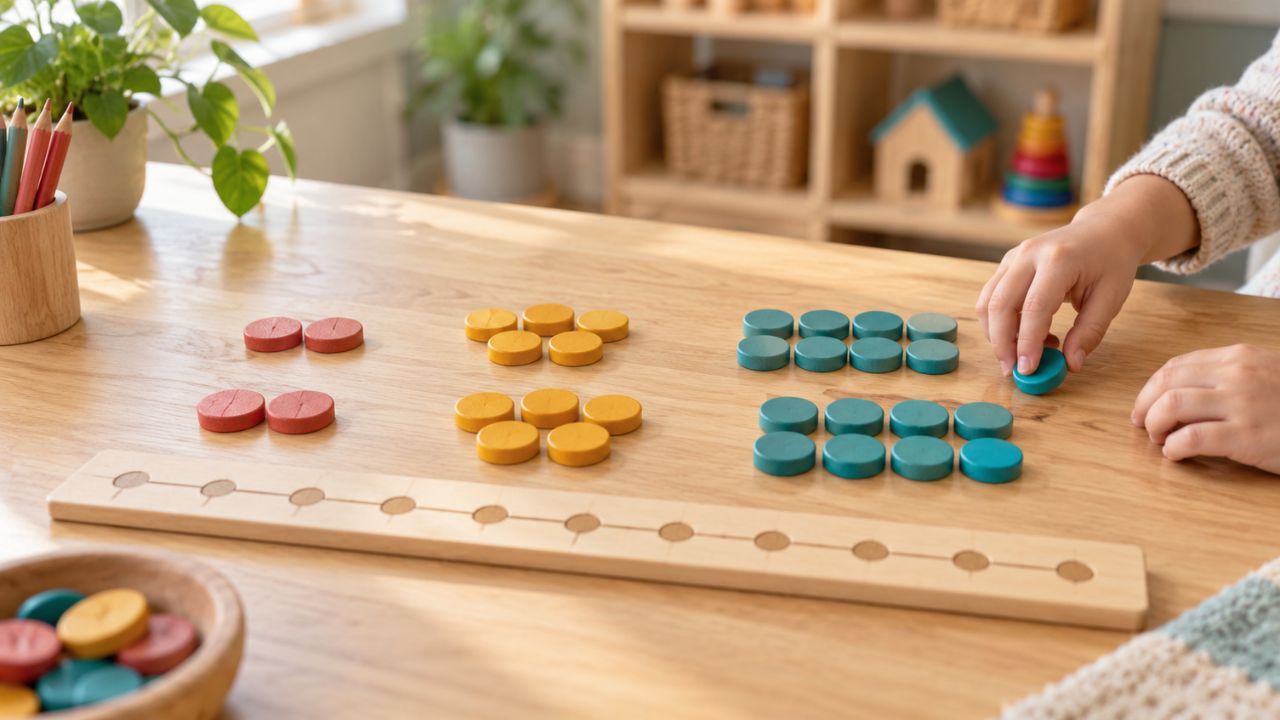
Skip counting often looks mastered before it is understood. A child may confidently chant “2, 4, 6, 8” and still be unable to use that sequence to count four pairs of objects.
That gap matters. Skip counting for kids should be more than a rhyme learned for school. It is a way to count equal groups efficiently, notice regular number patterns, and prepare for later work with multiplication, division, place value, money, and time.
Children commonly meet simple skip-counting patterns during kindergarten and the early primary years. There is no universal age at which every child should master them, however. School expectations differ between countries, and children reach the idea through different routes.
The most useful starting point is not a child’s birthday. It is whether the child can connect a spoken number sequence to real quantities.
What Skip Counting Really Means
When children count normally, they move forward one number at a time:
1, 2, 3, 4, 5, 6
When they skip count, they move by the same amount each time:
- By 2s: 2, 4, 6, 8, 10
- By 5s: 5, 10, 15, 20, 25
- By 10s: 10, 20, 30, 40, 50
The skipped numbers have not disappeared. Each number spoken represents the new total after another equal group has been included.
Picture five small plates with two crackers on each. A child can point to the plates and count:
2, 4, 6, 8, 10.
Here, 2 represents the crackers on the first plate. Four is the total on the first two plates. Ten is the amount on all five plates.
That is meaningful skip counting because the sequence is attached to quantities. If the child can only repeat the numbers when prompted by a song, the verbal pattern may be secure while the underlying idea is still developing.
Recitation is not useless. It can help children remember the order of a sequence. It simply should not be the only evidence of understanding.
When Should Children Start?
Formal expectations vary considerably.
In England, the national curriculum introduces counting in multiples of 2, 5, and 10 in Year 1. Australia’s Year 1 mathematics achievement standard includes forming equal groups and skip counting by 2s, 5s, or 10s. The US Common Core standards explicitly include skip-counting by 5s, 10s, and 100s in Grade 2.
These are curriculum benchmarks, not universal developmental deadlines. Year levels are organized differently across countries, and the Common Core standards do not apply to every American school.
A preschooler can still explore the underlying ideas through pairs, repeated movements, groups of five, and simple patterns. Formal written sequences can follow later.
A sensible progression might look like this:
- Explore pairs and equal groups with toys or household objects.
- Count the objects individually to confirm the total.
- Count the same collection group by group.
- Connect the spoken totals to numbers on a path or chart.
- Complete missing-number sequences.
- Count from less familiar starting points.
- Work backward once forward counting is secure.
Children do not move through these experiences at an identical pace. Nor will they master every step before occasionally using the next one.
Readiness Is More Than Reciting Numbers
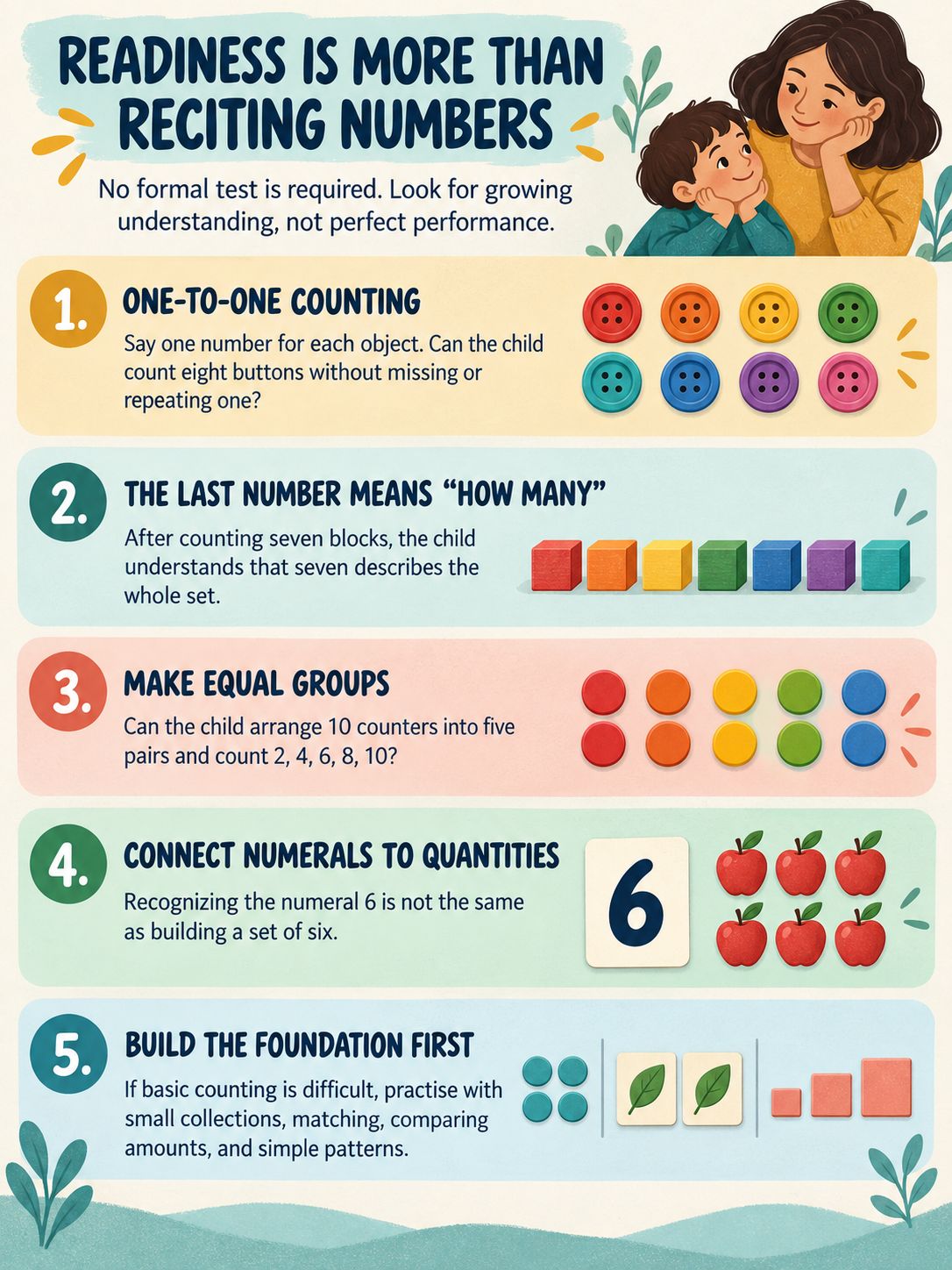
A child does not need to pass a formal readiness test before exploring skip counting. Still, several number skills make the idea much easier to understand.
The child should be developing one-to-one correspondence: one number word for each object counted. Try spreading eight buttons across a table. Can the child touch or move each one without repeatedly counting the same button?
The last number spoken should also begin to carry meaning. After counting seven blocks, the child should understand that seven describes the entire collection. If the child immediately starts again when asked, “How many are there?” that understanding may still be forming.
Equal groups are especially revealing. Give the child 10 counters and ask for groups of two. A child who can build five pairs has something concrete to connect with the sequence 2, 4, 6, 8, 10.
Recognizing written numerals also helps, but numeral recognition should not be confused with number understanding. A child may recognize the symbol 6 without being able to make a collection of six objects.
If basic counting remains difficult, pushing harder on skip-counting songs is unlikely to fix the problem. More work with small collections, matching objects, comparing amounts, and simple number patterns will usually be more useful.
Why Skip Counting for Kids Matters
The immediate benefit is efficiency. Counting 30 loose objects one by one takes time and makes it easy to lose track. Six clear groups of five can be counted as:
5, 10, 15, 20, 25, 30.
The arrangement matters. A scattered pile does not provide the same support because the groups are not visible. Before asking a beginner to skip count, make the grouping obvious.
Skip counting also provides an early bridge to multiplication. The sequence 3, 6, 9, 12 can describe one group of three, two groups of three, three groups of three, and four groups of three.
It does not follow that a child who knows the sequence understands multiplication. A child may reach 20 by counting 5, 10, 15, 20 but still be unable to explain why four groups of five equal 20. Multiplication eventually requires broader work with equal groups, arrays, equations, missing quantities, and division.
Place value becomes visible as well. Consider:
10, 20, 30, 40
Later, the child might explore:
7, 17, 27, 37.
In the second sequence, the ones digit stays the same while the tens digit changes. Base-ten blocks, bundled craft sticks, or a number chart can make that relationship easier to see.
Everyday examples include pairs of socks, wheels on bicycles, five-minute intervals on an analogue clock, bundles of ten objects, and rows of counters. Coins can also work, but adults must distinguish between the number of coins and their value. Three coins do not necessarily represent a value of three, and suitable examples will vary by currency.
Start With Objects, Not a Worksheet
For most beginners, movable objects are the clearest starting point. Bottle caps, blocks, buttons, toy animals, stones, and craft sticks all work.
To introduce counting by 2s:
- Make four or five groups containing two objects each.
- Keep a visible gap between the groups.
- Point to the first pair and say “two.”
- Include the next pair and say “four.”
- Continue until all the groups have been counted.
- Ask the child what the final number tells them.
If the child mixes up counting the groups and counting the individual objects, place each pair in a small cup, on a paper plate, or inside a drawn circle. Clear boundaries reduce unnecessary confusion.
It is also worth checking the total by counting every object individually. Children can then see that ordinary counting and skip counting reach the same answer.
Avoid racing through several intervals in one session. One well-understood pattern is more valuable than three partly memorized ones.
Add Number Paths Once the Groups Make Sense
A number path shows skip counting as equal movement.
Place a small toy at zero and move it two spaces at a time:
0, 2, 4, 6, 8.
Ask how far it moves on each turn and where the next jump will land. If the child answers incorrectly, return to the movement rather than simply supplying the number.
Floor number lines are particularly useful because children can make the jumps themselves. The physical activity makes the interval harder to overlook.
Once counting from zero feels familiar, change the starting point:
1, 3, 5, 7
or:
6, 8, 10, 12.
This is a stronger test than asking for the standard sequence again. A child who understands “add two each time” can eventually apply that rule from different starting numbers. A child relying only on memory may return automatically to 2, 4, 6, 8.
Do not introduce this variation too early. It is useful after the basic pattern has some meaning, not while the child is still trying to establish it.
Should Children Learn 2s, 5s, or 10s First?
There is no single required order.
Counting by 10s is often approachable because bundles of ten are easy to build and the written numbers form an obvious pattern. It also fits naturally with base-ten place value.
Counting by 5s connects with hands, five-frames, ten-frames, clocks, and some coin systems. The final digits alternate between 5 and 0, giving children a pattern they can see and hear.
Counting by 2s works well with familiar pairs: shoes, socks, hands, eyes, bicycle wheels, or two-block towers. The quantities are small, although the sequence has more steps than counting the same total by 5s or 10s.
Choose the interval that fits the materials and idea already being explored. Teaching all three at once may produce a quick performance, but it also makes it harder to see which pattern the child actually understands.
Songs Help, but They Can Hide Confusion
Clapping, marching, jumping, and singing make repeated practice more engaging. They can also improve recall.
The limitation appears when rhythm becomes the only cue. Some children can complete a song but cannot identify a missing number, count actual groups, or continue the sequence without starting from the beginning.
After a song, change the task:
- Build five groups of two.
- Complete 2, 4, __, 8.
- Show 20 using groups of five.
- Find the mistake in 5, 10, 15, 25.
- Explain why 3, 6, 9, 12 increases by the same amount.
The explanation does not have to sound polished. Pointing to groups, drawing jumps, or counting objects is a valid way for a young child to show reasoning.
Useful Activities Without More Worksheets
Rearrange one collection
Place 20 counters on a table. First count them individually. Then arrange them into pairs, groups of five, and groups of ten.
Ask which arrangement is quickest to count. This keeps the total constant while showing how grouping changes the method.
Build equal towers
Make several towers with two blocks in each and count the growing total. On another day, try towers of five.
Later, slip in one tower with a different height. Ask whether the original skip-counting sequence will still work. This checks whether the child understands the need for equal groups.
Hide part of the pattern
Mark every fifth number on a number chart and cover one or two marked numbers. Ask the child to work out what is hidden.
A correct answer is useful. An explanation is better. The child might count forward, work backward, inspect the final digits, or trace equal jumps.
Count backward slowly
Use visible groups and remove one at a time:
20, 15, 10, 5, 0.
Backward skip counting is usually harder than moving forward. It draws on subtraction and working memory, so children may need physical materials or a number line for longer.
Common Teaching Mistakes
The most common mistake is treating speed as mastery. Fast recitation sounds impressive, but it reveals little about whether the child can count grouped objects or explain the totals.
Another is removing counters too soon. Concrete materials are not a crutch. They give children a way to represent, check, and explain their thinking. Remove them gradually as the child becomes more flexible.
Adults can also interrupt productive thinking by correcting every pause. A child may be calculating the next total rather than forgetting the sequence. Wait a few seconds before offering help. If help is needed, point back to the groups or number line.
Harder intervals should not be introduced merely because the child can chant the easier ones. Counting by 3s, 4s, 6s, or 7s adds little if the equal-group idea is still weak.
Backward counting deserves patience too. Moving from 30 to 25 to 20 is not simply the forward sequence spoken in reverse. It places different demands on the child.
What Understanding Looks Like
Rather than relying on one recital, look for flexibility. A child who understands skip counting can usually demonstrate several of these abilities over time:
- Build equal groups and find their combined total
- Explain what the spoken numbers represent
- Continue a sequence from a different starting point
- Identify a missing or incorrect number
- Show the same pattern with objects, drawings, and numerals
- Use grouped counting in a simple practical problem
- Notice when skip counting will fail because the groups are unequal
One mistake does not show that a child lacks understanding. Young children may grasp the grouping idea and still lose their place in a long sequence.
If difficulties also appear in ordinary counting, matching number words to objects, recognizing small quantities, or comparing groups, note a few specific examples and discuss them with the child’s teacher. Skip-counting difficulty by itself is not enough to identify a learning disorder.
Final Thoughts
For skip counting for kids, the best next step is usually small and concrete: gather 10 or 20 objects, arrange them into equal groups, and count the growing total together.
There is no need to rush toward longer sequences or multiplication facts. Stay with 2s, 5s, or 10s until the child can build the groups, follow the jumps, and explain where the totals come from. A child who understands why four pairs make eight has learned something durable. Speed can develop later.
Frequently Asked Questions
Does skip counting always have to start at zero?
No. Starting at zero makes the pattern easier to introduce, but skip counting can begin with any number. For example, counting by 2s from 1 produces 1, 3, 5, 7, while starting from 6 produces 6, 8, 10, 12. Changing the starting point helps reveal whether a child understands the interval or has only memorized one sequence.
Is counting even and odd numbers the same as skip counting by 2s?
They are closely related, but not identical. Counting by 2s from zero produces even numbers, while counting by 2s from one produces odd numbers. Children should first understand the repeated jump of two before being expected to explain the wider distinction between odd and even numbers.
Does a child need to write skip-counting sequences?
Not at first. A child can demonstrate understanding by arranging objects, pointing to groups, moving along a number path, or saying the totals aloud. Requiring written answers too early may make handwriting or numeral formation the main difficulty instead of the mathematics.
How far should a child be able to skip count?
There is no universal target for every age or school system. A short sequence that a child can build and explain is more valuable than a long sequence repeated from memory. Parents and teachers should also check the expectations of the child’s local curriculum, since year-level requirements vary.