

You spend hours chasing rare skins and in-game assets, only to lose them when a server shuts down. Developers hold your digital items in a closed system. Hackers can breach game servers.
You feel like a pawn, not a player.
As of August 2024, blockchain gaming saw 4.2 million daily active users. We will share seven ways blockchain technology and smart contracts can give you true ownership. You will learn how blockchain is enhancing gaming experiences.
Read on.
Key Takeaways
- As of August 2024, blockchain games have 4.2 million daily active users who store rare swords and skins as NFTs in wallets like MetaMask.
- Smart contracts on Ethereum and Polygon record every asset trade on a public ledger, cut fraud, and lower marketplace fees to a few percent.
- Play-to-earn titles such as Axie Infinity let players earn crypto tokens and NFTs, then trade them on exchanges for real money.
- Gamers link wallets to PC, console, VR, and AR games via smart contracts, moving skins and gear across titles with no middlemen.
- Sites like OpenSea, The Sandbox, and Ronin list unique NFTs—100 dragon helmets or items from Pixels and Forgotten Runiverse—and pay creators royalties on each resale.
How can gamers truly own their digital assets?
Blockchain games grant players full ownership of in-game assets, not like old-school titles where companies keep your loot. Earning a rare sword turns it into an NFT on the Ethereum network, held in your MetaMask wallet.
Think of it as a treasure box that only you hold the key for. Smart contracts record each item on a transparent ledger to prove you own it.
No one can sneak into your treasure chest or snatch your gear. You keep that private key in your digital wallet and check it with a block explorer on the Polygon network. This system cuts fraud, locks in your rights, and puts you in control of every tokenized asset.
How Blockchain is Enhancing Gaming Experiences?
Gamers shivered after the 2019 Zynga hack hit hard. Next, blockchain technology stops that mess. A decentralized ledger locks in every coin and item transfer. It spreads data across many nodes to stop tampering.
SSL/TLS and strong encryption algorithms shield records. Digital wallets tie tokens to private keys alone. Fraud prevention shines when no one can rewrite history.
Smart contracts kick off trades of in-game assets without middlemen. Audits by third-party security firms catch hidden bugs. Multi-factor authentication blocks unauthorized access attempts quickly.
Game developers run penetration tests and apply security patches fast. Data privacy laws like GDPR guide wallet designs. Players get clear logs and enjoy secure transactions and safe in-game rewards.
Interoperability of in-game items across platforms
Smart contracts on Ethereum let you carry skins and swords across PC, console or VR through game APIs—keep reading.
What does interoperability mean for gamers?
Interoperability lets gamers carry in-game assets from one title to another. They store non-fungible tokens and loot in crypto wallets on a public blockchain. Players can use the same items across different networks, virtual reality, and augmented reality, demonstrating how blockchain is enhancing gaming experiences.
This model adds real value to digital collectibles, since skins and gear gain more use.
Game developers build smart contracts that link assets to player profiles across platforms. Players will see better accessibility options and new social features, as cross-platform multiplayer grows.
This trend may spark more collaboration and give communities shared spaces for events and trading. Gamers win when their digital assets stay with them, giving them power over their virtual possessions.
How can players use items across different games and platforms?
You link your crypto wallet to a game, then work with smart contracts to claim tokens. Wallet connections let you carry non-fungible tokens (NFTs) into other titles. Gamers treat digital wallets like keys to vaults full of in-game assets.
Sites add multi-language wallet integrations so players worldwide share items. Optimistic rollups from layer-two scaling solutions speed up transfers and cut gas fees. These faster moves help fans swap gear, tools and tokens across games.
What are play-to-earn (P2E) models and how do they benefit gamers?
Play-to-earn games let players earn cryptocurrency and NFTs while they play, trade, and compete. Axie Infinity uses blockchain gaming and smart contracts to reward users with tokens for winning battles.
Gamers store rewards in digital wallets, then trade them on cryptocurrency exchanges for real money. This model drives rapid growth and draws millions of new creators and players to the gaming industry.
Staking systems boost engagement by letting players lock tokenized assets, earn yield, and reduce token circulation. Game makers balance token supply with smart contract rules to prevent inflation and sustain the gaming economy.
Blockchain technology secures each transaction, so players trust their in-game assets stay protected. This gives gamers clear ownership and lets them profit from hours of play.
How does blockchain create transparent and decentralized gaming economies?
Public blockchains record each asset sale on a ledger, so players see every move. Smart contracts ensure secure transactions, and blockchain networks clear them in minutes. Gamers trade rare skins in decentralized marketplaces, and fees drop to a few percent.
Digital wallets link to these markets, no middlemen, no high fees. Governance tokens hand voting rights to players, who pitch ideas and vote on updates. This model turns a gaming economy into a kingdom players help build and rule.
Integration of non-fungible tokens (NFTs) for unique items
Smart contracts on the Ethereum network lock each tokenized asset in your digital wallet, so you trade digital collectibles like you swap baseball cards. Next we peel back the token standard, so you see how game devs pack real rewards into each badge.
What are NFTs and how are they used in gaming?
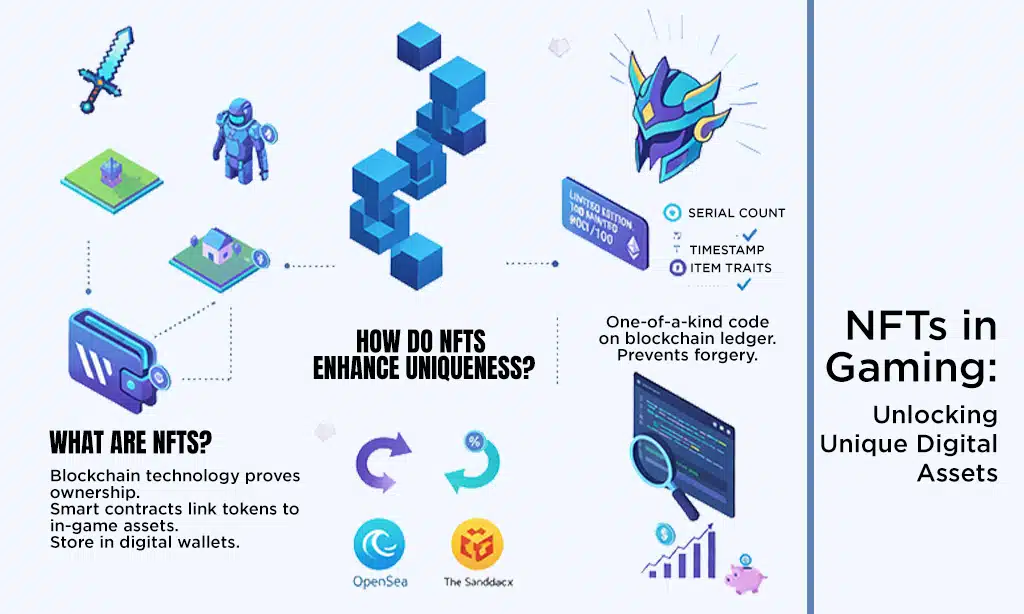
Non-fungible tokens, or NFTs, use blockchain technology to prove ownership of digital collectibles. Smart contracts link each token to a specific digital asset. Gamers store their NFTs in digital wallets, like virtual vaults.
Blockchain games offer limited edition NFTs for rare swords, character skins, or land plots. Gamers earn an NFT, and they own the in-game asset for real money trade. They boost the gaming experience by letting players trade items across virtual economies.
How do NFTs enhance the uniqueness of in-game items?
Games can offer rare skins or swords as digital collectibles with non-fungible tokens. Each token holds a one-of-a-kind code on a blockchain ledger. Smart contracts store item traits, serial counts, and timestamps.
You verify ownership with a blockchain explorer. This stops forgery or copy. Players can own a limited edition dragon helmet, only 100 minted on the Ethereum network. Gas fees may apply, but the item sits safely in a digital wallet, adding real value and bragging rights.
Developers embed special powers or stats into each token via smart contracts. Players can trade or sell assets on OpenSea or in The Sandbox. Blockchain technology logs every sale, so you see clear price history.
Creators earn a cut on each resale, thanks to coded royalty rules. This setup lifts artists and gamers, and boosts a fair gaming economy.
How do tokenized rewards improve player engagement?
Game studios use token airdrops, competitions, tournaments to reward players with NFTs or tokens. This move taps blockchain technology to add value to digital collectibles and digital assets.
Gamers store items in crypto wallets secured by smart contracts. They jump into NFT marketplaces to trade limited edition tokens that represent in-game assets.
Developers add staking tools to let players lock assets and earn yield farming returns. Analytics track player behavior on tokenized assets and guide reward tweaks. Governance tokens let fans vote on updates and shape the gaming economy.
Long-term play grows as fans feel direct impact on game development.
Takeaways
Players now own items in crypto wallets, not in a locked vault. Smart contracts record every swap. They use NFTs to mark rare swords or skins. DeFi games pay real tokens as you win.
Some players swap a sword in Pixels for a skin in Forgotten Runiverse on Ronin. This shift brings secure trades and fresh fun.
FAQs
1. What is blockchain gaming and how does blockchain technology change the gaming industry?
Blockchain gaming uses blockchain technology to run games on a shared record, it shifts control from big studios to players and sparks new ideas in the gaming industry.
2. How do non-fungible tokens transform in-game assets and digital collectibles?
Non-fungible tokens turn items into unique digital collectibles, they let you own swords, skins or cards for real, you can trade or sell them with full proof of ownership.
3. What is the play-to-earn model and how does it shape the gaming economy?
In a play-to-earn game you earn real value for your time, you collect virtual coins or tokenized assets, it ties fun to rewards and rewrites the gaming economy.
4. How do smart contracts enable secure transactions and fraud prevention?
Smart contracts act like digital rules, they hold funds until all sides do their part, they power secure transactions and cut out fraud without a middleman.
5. How do game developers use blockchain for ownership verification of digital assets in virtual worlds?
Game developers stamp each digital asset on the chain, they track who owns what, they lock records for ownership verification and protect data in virtual worlds.
6. What are gas fees and how do they affect web3 gaming and digital wallets?
Gas fees pay for each move on the chain, they can rise like tides, they hit your digital wallet and can slow down web3 gaming if you’re not ready.






















